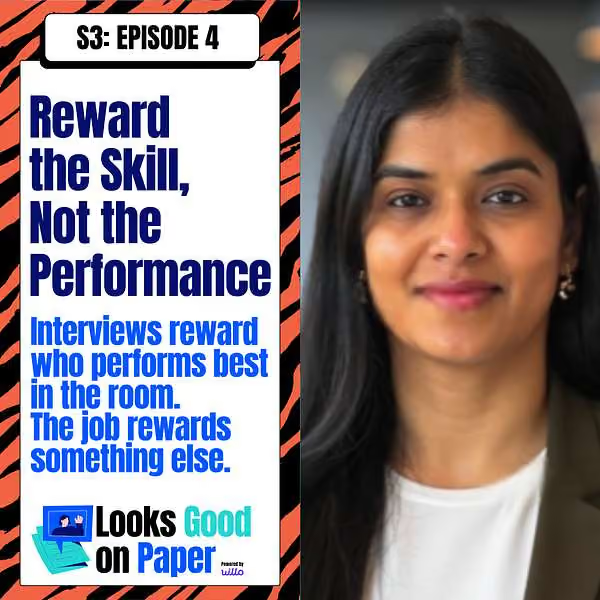
Reward the Skill, Not the Performance
Subscribe on:


Most hiring decisions get made on a feeling. A hiring manager walks out of an interview, says "I think this one is a better fit," and the team moves forward. Anu Joshi has spent 17 years inside talent functions watching that pattern play out — and she has a problem with it.
Interviews are high-pressure performance environments. The candidates who do well are often the ones who can read the room and tell you what you want to hear. The ones who freeze are not necessarily worse at the job. They're worse at the interview. Those are different things, and most teams are still confusing them.
Anu is currently Director of Talent at FutureSight, where she leads executive and leadership hiring for early-stage B2B AI companies. In this episode she walks through the biggest hiring mistakes she sees teams keep making, the bias she'd eliminate first if she could pick only one, and what hiring actually looks like when you decenter the CV.
GUEST
Anu Joshi, Director of Talent at FutureSight
https://www.linkedin.com/in/anu-joshi-sphri™-46988a12/
YOUR HOST
Anita Chauhan, Host, Looks Good on Paper
https://www.linkedin.com/in/anitachauhan/
LISTEN & FOLLOW
Apple Podcasts → https://podcasts.apple.com/us/podcast/looks-good-on-paper/id1625835562
All episodes → https://looksgoodonpaper.buzzsprout.com
POWERED BY WILLO
Hire humans, not resumes.
https://www.willo.video/looks-good-on-paper
Show Resources
- Willo: willo.video - The most cost-effective way to screen candidates at scale. Interview candidates anywhere & at any time
- CV Free Toolkit: cvfree.me/join - Break up with the CV and get everything you need to modernize your hiring approach with skills-based assessments
- Anita Chauhan: linkedin.com/in/anitachauhan - Connect with the host
Anita Chauhan (00:16)
Hi everyone and welcome to this week's edition of the Looks Good on Paper podcast powered by Willo. I'm so excited to have Anu Joshi join us today. Anu is the head of talent with a whopping 17 years of experience. She's built and scaled talent acquisition functions across venture studios, AI, B2B SaaS, fintech, prop tech, and global consulting. She's currently the Director of Talent at FutureSight where she leads executive and leadership hiring — CEOs, CTOs, founding engineers and early GTM leaders. Welcome. How did you get here?
Anu Joshi (01:09)
Thank you so much, Anita. Very excited to be on Looks Good on Paper. It's been a very interesting ride for me over the past 17 plus years. There are three distinct parts to my journey. I started in a big global consulting organization and very quickly was leading a very high performing team there as an early 20-something.
I had a great run, had an opportunity to work for a year in Europe — my first exposure to global talent. Then the startup bug bit me. I was like, okay, here's where everything is structured and I'm doing really well, but let me go find something scrappy to do. That's how I entered the startup ecosystem.
I've had the privilege of working with some very high-performing founders and co-founders. That's where I got a peek behind the scenes — thinking about business at large, budgeting, how your talent decisions are going to impact the organization. That's where my strategic approach to talent really started.
Now I'm in phase three — head of talent for a venture studio. I'm responsible for very early stage B2B AI companies, from finding the right co-founders to finding the right co-founding team to aid their growth.
Anita Chauhan (05:50)
You know the drill — three questions, rapid speed dating style. The first one: what's the biggest hiring mistake companies keep making even though it's clearly not working?
Anu Joshi (06:12)
One of the biggest mistakes I've consistently seen hiring managers make is making hiring decisions based off of gut feeling coming out of an interview. Here's my problem with that. Interviews are inherently very high pressure, high performance situations. Every candidate wants to show their best self. The ones that can really perform in an interview are telling you what they think you want to hear. And the ones that buckle under pressure — they fumble, they freeze, they're not able to present their best selves to you during that one hour you've given them.
When hiring teams come out of these interviews and tell me, I feel this is a better fit — I ask: beyond that feeling, what is the skill they showed you? What competency are you going off of? When you make hiring decisions on your feeling coming out of an interview, you're really rewarding interview performance, not the skills or abilities they bring.
So one of the key drivers in interview processes for me is: going back to basics. What is the gap you're trying to fill? What are the abilities and competencies required on your team to do this job well? Build your assessment criteria based off of that. Anita versus Anu have to be assessed against the same things, not different things, not based on feeling.
Anita Chauhan (11:14)
Jumping into question number two: what's a hidden bias companies unknowingly have even when they think that they're being progressive in their hiring?
Anu Joshi (11:29)
There are so many fighting for the number one spot. I would say: bias against less-than-typical career trajectories. When you're working with a team to support their hiring, the first step is to share potential profiles — LinkedIn, resumes. Hiring managers have a bias for: this is how the person on my team should have progressed.
But life happens. Not everybody has a perfect trajectory. There are people who've had shorter tenures. There are people who've had long breaks — because they were burnt out and needed to reset, or they had aging family members to care for. There are mothers who've taken career breaks. I've driven multiple initiatives bringing mothers back into the ecosystem — and I'm a mother myself, so I felt it.
It's really disappointing and heartbreaking when I see really good, credible candidates lose out against somebody else because this bias creeps in even without us consciously realizing it. Same skill set, same years of experience — but when they see a less-than-perfect career trajectory, there's already a bias against this candidate. And it's a hard one because you're not even realizing it's happening.
If you were to give me a mandate saying, Anu, eliminate one bias — this will be the first one I'll go after. Because this one sets the stage for many different things that happen in your organization, and for the talent you lose.
Anita Chauhan (15:22)
Moving into question number three: if you were to suddenly remove CVs from your current hiring process, what would that look like?
Anu Joshi (15:29)
Can I say this is my favorite question? To me, it's exciting — this could be transformative. A CV is a way for us to feel safe. We all want to make the right hiring decisions within the right recruiting timeline, bring in the best talent within our budget.
Going back to a structured competency and skill framework — what is the gap we're filling? And then based off of that, asking people for work samples. Show me an app you've built. This is something I very recently implemented. We were hiring a founding engineer. We gave candidates honest insight into what the opportunity would look like, so they could decide if it was in their wheelhouse. And then we told them: just send us a work sample. Send us a video talking about something you've built recently. Walk us through your thought process. What was the problem you were trying to solve? What was the path you took? What were the blockers you faced and how did you overcome them?
We were totally open: use AI tools, use Claude Code — that's the world we're in. We're not shying away from that. We want to see what is your unique capability and skill, and that's what we're assessing for. We loved the process.
We very recently made an offer to an amazing candidate. I took feedback from them, and they loved it. They said: this felt like I was telling you what I have already built or how I think about it — I didn't have to come up with some imaginary statement of proving it to you over a conversation or on my resume.
Anita Chauhan (19:50)
Now I'm going to throw you a wildcard. Given this influx of AI, how would you say that talent leaders in HR functions could feel more confident in their hiring decisions this year?
Anu Joshi (20:27)
There's good and bad to it. The less-than-ideal situation I'm seeing is at the resume stage — there are tools that help you build a resume that exactly speaks to the job description. And I feel that's really not doing anyone any good. You're probably presenting something you're not. Even if you perform well in the interviews and tell them what you feel they want to hear based on the JD — are you able to deliver when you're brought on board?
But we also have to accept that AI, used correctly, is supporting productivity. There are operational parts of your work that talent teams have not ideally been fond of. In scrappy startups optimizing for cost, the burden of the operational process falls on the talent function — maintaining data in Excel sheets, documenting feedback in Google Docs.
That's where talent functions could really leverage AI: maybe two X or three X your productivity by navigating those operational parts of your job to AI. I personally very recently built a Claude Code skill to do that. I started by sitting next to our tech lead — he said open terminal, I didn't even know what a terminal was. A month later I'm building my own tool in Claude Code. In what world would I have done this before?
This is like the advent of electricity. Things changed and some people's roles got redefined. It's about us accepting it and making the most of it. As a talent leader, it's your responsibility to figure out what tools are out there to help your team do more of what they love and what is their actual skill, and less of the important-but-not-the-best-use-of-your-time stuff.
Anita Chauhan (25:17)
Thank you so much, Anu. That's all the questions I have for you — you did amazingly. I'm so excited to release this to the world.
Anu Joshi (25:17)
Thank you, Anita. Such an exciting discussion. Looking forward to following your podcast journey. Take care. Bye-bye.

More episodes from the Looks Good on Paper podcast

Stay close to the conversation
New episodes, hiring insights, and data-informed thinking — delivered occasionally and intentionally.