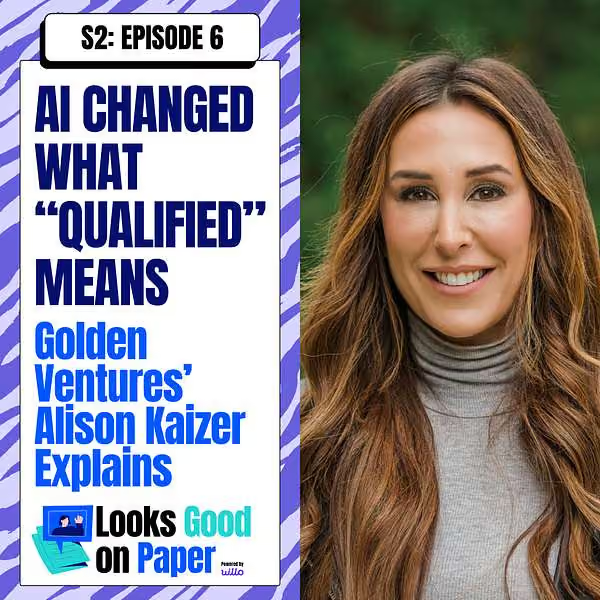
AI Changed What “Qualified” Means — Golden Ventures’ Alison Kaizer Explains
Subscribe on:


Anita Chauhan
Hi and welcome to our next edition of the Looks Good on Paper podcast powered by Willow. I'm Anita Chauhan your host and I'm joined today by Alison Kaizer. I'm so excited that you're here today. I'm going to do a quick intro. Alison is a partner at Golden Ventures where she works hand in hand with early stage founders to tackle one of the toughest challenges building the right team fast. She specializes in talent strategy from pre-seed through series B and has placed everyone from founding engineers to first marketers. With a decade at the intersection of venture, talent, and startups. Allison is known for her candor, precision, and belief that great companies are built by great people. And I am so excited that you're here today. I know all the work that you do in the Toronto Tech scene and the Canadian Tech scene. And yeah, I'm really glad that you're here giving your wisdom today. Thanks, Allison.
Alison Kaizer
Yeah, happy to be here and excited. Hopefully what I share is actually helpful.
Anita Chauhan
I'm sure it is. Alright, so you know the drill. Three questions, speed dating style, rapid fire, 15 minutes, and we're gonna get going right now. So what's the biggest hiring mistake companies keep making even though it's clearly not working?
Alison Kaizer
Sounds good.
Yeah, I think the biggest hiring mistake is resume bias or hiring for pedigree. It's very easy to look at someone's resume and say someone solved this problem before they're gonna know how to solve it again. It's gonna be easy for them. But from my experience, first of all, just because someone has solved a problem in the past doesn't mean that they're going to want to solve that problem again. Certainly high performers are always looking for new challenges. They want to be stretched, they want a carrot that's going to entice them to join a new company and And generally, as an early stage startup, isn't going to be compensation. So it's going to be solving a new interesting problem. I think that's a major factor. The other is there's a bias that comes with saying to yourself, I know how to solve this problem. I've done it in the past. And so what you will find is someone will revert to an existing playbook that doesn't necessarily work for the problem that you're trying to solve. Not saying experience doesn't matter, but just this idea that someone is failsafe because they've solved a similar problem in the past or they're coming from a similar company or role is something that I've seen actually end up being problematic many times.
Anita Chauhan
Yeah, I think what this is obviously because we asked this question with a lot of our guests, but this is something that comes up. I think we just are so biased towards like, you know, this person has done this, so therefore they can do it again. But then we don't think about like, well, did they have a whole team behind them helping them do this? What were the conditions that they did this in the last job? And, you know, is it the same market? Is the same business, right? There's so many factors that go into this. Absolutely. So yeah, I think like I'm wondering just from things that you've seen, how do you avoid doing that when you're hiring or how do you help companies avoid that?
Alison Kaizer
Yeah, I was going to kind of dig into this a little bit later when you asked about hiring if you can't look at a CV, but It really comes down to structured interviewing, which I can share some more insights on as we get to the later questions.
Anita Chauhan
Yeah. Yeah, absolutely. Okay, so why don't we jump into the second one? So what's a hidden bias companies unknowingly have even when they think they're being progressive in their hiring?
Alison Kaizer
Yeah, this is one that I've seen come up recently and I posted about this on LinkedIn a few weeks ago and it got a lot of engagement, which is seniority bias. So especially with the advent of AI, what I'm seeing happening very frequently, which is really interesting. It certainly wasn't like this a few years ago. You have these candidates coming in that on paper look quite junior. Maybe they only have a couple of years of experience or really are just graduating from school, but they actually have a lot more relevant in particular, like technical AI experience than an engineer that is much more senior on paper, maybe a staff level, but actually hasn't been operating in an AI native environment. So you have this really unique situation where the person that is actually more senior from a technical perspective is much more junior in terms of years of than the more senior on paper engineers on a team. And so There's a bias to think, more experience means more senior and oftentimes now you have these like very very scrappy junior marketers, salespeople, engineers that have been playing with AI for a number of years that are actually more senior when it comes to to aptitude.
Anita Chauhan
Absolutely. I think about this obviously being in tech. There's just so many things that come up and how do you like make sure that you're hiring for those new skills? What are good indicators that this person would be proficient? in these things as you're going through the hiring process? Is there anything that you've seen?
Alison Kaizer
Yeah, I was actually just chatting about this with someone about an hour ago, but a couple of things. So companies like Zapier have done a really good job of actually releasing rubrics that they're leveraging in their hiring process, in their performance reviews around AI aptitude and AI literacy. I think it's very natural to say, we want to make sure someone isn't using AI in their interview process. We want to know that this person is doing all of the work on their own. But from my perspective, that's almost like saying someone can't use a calculator in their math exam. We need to know that they, you know, they can do this without any tooling. I would be much more likely to say to someone, I know you used AI or I hope you did. How did you use AI in this interview process? How did you leverage it? And I would look for the people that were most creative in their problem solving, had the strongest aptitude and would expect them to continue to operate that way in their role once we hire them. And then certainly, you know, as you're interviewing, making sure that you're talking through in person, whether it's a presentation, whether it's technical problems to really dig in on someone's thought process and aptitude, recognizing that it's likely and actually positive that they used AI as part of their interview process.
Anita Chauhan
Absolutely. I think it's just that switch of thought, right? How we see AI. It's here, we can't get away from it. I have a background in writing and I think a lot about like someone, my sister is in publishing and she's always like, I will never look at a manuscript that I think has AI. And I'm like, you gotta know the signs. You're gonna know, yeah, it's happening, it's here. You're not gonna get away from it. So I think it's smart. And I think about like a lot of talent professionals and we see a lot of stuff happening online where it's like, well, know, this job description is written in AI and then the candidates are responding with AI driven stuff and I love what you said though it's so it's great because it's like how can they actually use it creatively walk us through that step process and show us show us your work and see and then maybe we can apply that to actually what you're gonna be building when you're working with us
Alison Kaizer
You're gonna have to.
Right, and it also means that look, there's a difference between something that's done with AI and it's completely generic, but when I use it, I'm always just taking something that I've already written and asking if there's a way to refine it a little bit further, but it's still my idea. So given the fact that the playing field has been leveled now and everyone has access to the tools, there's no excuse for, you know, these minor errors when it comes to your writing and there's no excuse for being lazy around, you know, answering questions as part of the interview process if there's a written component. What's going to make you stand out is creative thinking, and that's going to come from how you partner with AI as opposed to just leaning on AI to do the work for you, right? Or you're not going to stand out. So it's a tool, same as spell check, same as, you know, any of these other tools that existed in the past. Remember we used to go to the library and then there's Google suddenly and you can look anything up and, You know, It just means that the playing field is now equal from a resourcing perspective and there's still an expectation of a quality output.
Anita Chauhan
Yeah, absolutely. So I guess like the natural next question I have for you is how would you make sure to safeguard against it being generic or how can you encourage talent professionals to use this better in their hiring and sourcing?
Alison Kaizer
The best answer that I can give is, and it's always been this way, there's really no replacement for human judgment, especially when it comes to talent. It's that person that I speak to and I'll say to a founder, "I know on paper you might not think that you want to talk to this person, but trust me, this person is really impressive." And it's funny because There are all these AI tools that filter resumes and there are also all these AI tools people are using to build their resumes right now. But even back in the day before AI was really a thing, when I was using Greenhouse and hiring en masse at Ritual, we would have certain questions that we would have people answer as part of their application process. Then we would mark if something is required, and someone said no, it would auto reject them. For example, do you have experience in this tech stack? Do you have people management experience? Do you have the legal right to work in this country at this time? And it would auto reject. These AI filters are the same. And so it's understanding what the guardrails and parameters are that you want to build to allow for some level of flexibility for those kind of like undercover superstars to come in While leveraging it so that you can be more efficient, especially if you're an early stage startup with a very, very small team.
Anita Chauhan
Yeah.
Yeah.
Absolutely. Yeah, I think that is probably one of the biggest things too. I also work with a lot of startups and I think about just like, what type of people do you want and how can you use it thoughtfully, right, to expand your resource potential, right, and actually equip your team to do more faster until you get to that point where you can scale. It's a big thing. Absolutely. All right, thank you. And now we're gonna jump to the last question and then there's a wild card right after. So if you were to suddenly remove CVs from your current hiring process, what would that look like?
Alison Kaizer
Yeah, and I like this question because it kind of brought me back to when I first started in tech and I was at a company called Ritual. And at this time there really weren't a lot of startups, so it was very hard to look at someone's resume and say, "We want to hire this person, they have startup acumen." We were pulling a lot of people from professional services and from other industries and that meant that we had to really hire for aptitude and there was practically no resume bias when it comes to like relevant experience. and so Without getting into too much detail, We basically had these interviews that we had built that tested the fundamental pillars of what you needed to be successful at an early stage startup. There was one around values, there was one around sales acumen, and we had different versions of it depending on the role. If you were going to be a, you know, a senior externally facing salesperson, versus someone that would just be internally interfacing and cross-functional, there was still an expectation that you could pass this interview and you were going to be a comfortable communicator cross-functionally. So that like sales and communication interview. There was one around ambiguous problem solving and analytics. And then there was one that was operational where you would build a business and you had to break even. And it looked like creative problem solving and thinking on your feet in general business aptitude. And those were the interviews, right? And so we were looking for people that could think on their feet, that it's strong problem solving acumen that, you know, express that they were aligned with our values were Strong communicators as appropriate for their role and nothing else. It wasn't about the CV at all. And it really worked. Actually, we built an amazing team. I think the employer brand for early Ritual folks remains very strong in the market to this day. So I've solved that problem. And if I could go back there, I would, honestly. It was one of the most effective hiring processes I've seen to this day.
Anita Chauhan
Yeah.
Yeah.
I love that. First of all, yes, Ritual had a great employer brand. I knew people that worked there. They were first of all, so happy working there. it's just, It felt like you guys did really good job hiring the right people. And you know, you can tell, right? We can tell when the company takes the time to do those things. And I wish we could all go back to that time. We are seeing this though, right? I feel like there's companies who are like assessments, pre and then getting back to the part of the screening process now, right? Where it's just like, we have to get them through at least this much and then we go through but I still think that people over index on the CV way too much. And it's also through fear a little bit of fear like if we don't have this, almost like, a calling card?
Alison Kaizer
I mean, I look at a lot of resumes. Talk to a lot of people, and I'm definitely looking at their past experience because it's indicative of At this point if you've had ample opportunity to join startups and you never have there's probably a reason right I still think that people in big late-stage companies can go early stage but often it's a shock to them and they think they want to do it and then they realize that they don't so I always give people advice that are looking to make the transition to maybe start with project-based work, do a little bit of advisory work and there's certainly risk for someone taking an absolute pivot. And experience matters. I'm advisory because I have experience, right? People look to me to leverage my experience. It's not that your history and your resume don't matter. I think it's more so this idea that because someone has a great resume, therefore they're going to be effective in the role. So I would look for a combination of strong experience, but still having comfort with ambiguous problem solving, still being great with these types of panel interviews And not just someone that's going to lean exclusively on their past experience. It's actually a combination of the two.
Anita Chauhan
Yeah.
Absolutely, I love that. think that approach is very similar to what you were saying around the AI tools, like finding this meeting of the middle, right? How do we balance this kind of like, this is the reality of our situation now. We're learning how to integrate a lot of these tools in, we had to figure out how to make these processes work for us and find the right candidates at any point, right? And I think finding that kind of meeting in the middle for both things, Like how you support your hiring process with better, thoughtful tools, AI, tech, whatever is coming down the pipeline, but then also still keeping it human. So I have one last question for you. It's our wild card question. And I'd love to hear a story of when somebody looked good on paper, and turned out not to be. Or vice versa, where there's a great hire that, you know, looked good on paper, that didn't look good on paper and then turned out to be really great.
Alison Kaizer
Yeah, I'll do the latter. Someone that didn't necessarily have a lot of experience, but ended up being really great. And was actually for my team hiring a recruiter. I was looking for a technical recruiter, someone that was general, a generalist, but was interested in hiring for engineering. And I remember I spoke to a lot of people that were coming from these tech startups and, you know, companies with really good brands. And I realized very quickly that they were used to getting inbounds. They were getting a lot of inbound applicants. They weren't necessarily comfortable with like the hustle of going out and sourcing. And someone referred this candidate to me and said, she's really smart, she's really interested in going into early stage, she's really interested in tech. And I gave a case study where I basically said, these are three or four open roles that we have right now. I want you to go sit down and look for three or four profiles that you reach out to for each of these roles and explain your thought process as to why. And there were some other factors around like candidate funnel metrics and so on. But essentially I said, I want to understand how you would approach hiring for these technical roles. And when she came back with this case study, remember it vividly because she had reached out cold to a bunch of engineers on LinkedIn, asked them to have conversations with her and came with a result that wasn't 100 % spot on, but it was 85, 90 % spot on, along with this desire to really learn and prove herself and this hunger and this hustle and showed an incredible amount of coachability through my feedback within the interview process. So I ended up hiring her and she was very, very good and one of the best people that I've ever hired. So I think that's a very good example of having an interview process that really tested for the skills that were required and digging into thought process and strategic problem solving as opposed to relying on someone that on paper came from tech hiring and you know, at a startup and therefore would have been like the perfect person and in this case it really worked out.
Anita Chauhan
Absolutely.
Absolutely and the last podcast with a Anuj that we posted he spoke about like that passion, right? Those are like the things that you can't really You know measure with some of these other things like when you think about what you're talking about with like the hiring process for ritual and the Assessments and these softer skills, right? Giving case studies and giving them opportunity to show up in that way. Maybe they just have like a hunger, right? You think like give them an opportunity to give people an opportunity to show that right? Maybe like a nudes brought this up in the story like last recording where he was like, you know, just You never know. Someone might want like have like family history of something and they want to get into this company because they care about it. Maybe their parent was sick with something and they the mission really fits with them because they're solving this, right? So give people a chance to do that and show those more human skills. I really love that. I love stories of that because I myself have actually I run marketing teams, but I actually don't have a marketing degree. And I talk a lot about this in some of the different podcasts I do, but It's so interesting, would somebody have given me a chance, would I have gone through any of these filters if I didn't have it, right? And I have so much passion for marketing. I was just telling my partner earlier today that's like my zone of genius and I didn't even know it was going to be and I ended up in it. But these are the things that we should be looking for, people who are excited about the work they do, that will bring something to the company and help us push it forward.
Alison Kaizer
Yeah.
I totally agree. I totally agree. And that's where that values element becomes so important. Looking for someone that wants to run through walls, that has that problem solving aptitude, that has that ownership mentality, all those amazing early stage startup things, but that's a conversation for another day.
Anita Chauhan
Absolutely. Thank you so much, Allison. Those were all my questions. You did an amazing job. Thank you for your wisdom and your energy. I am so excited for the world to hear this.
Alison Kaizer
Thanks for having me. I really enjoyed it.

More episodes from the Looks Good on Paper podcast

Stay close to the conversation
New episodes, hiring insights, and data-informed thinking — delivered occasionally and intentionally.