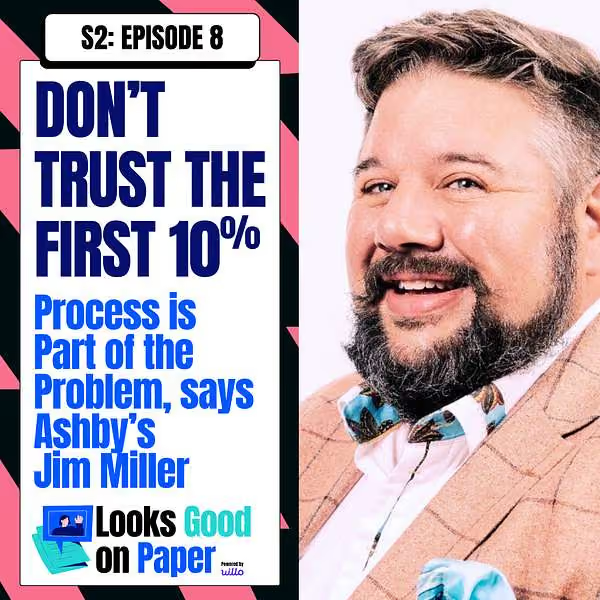
Don’t Trust the First 10%: Process Is the Problem, Says Ashby’s Jim Miller
Subscribe on:


Jim Miller, VP of People & Talent at Ashby, joins Anita to unpack what’s really broken in modern hiring—from over-indexing on referrals to misusing AI in recruiting. If you’re a founder, talent leader, or recruiter, this one’s a playbook episode.
What you’ll learn in this episode:
- Why over-relying on employee referrals can quietly damage quality of hire, talent density, and culture
- How Ashby designs job postings and closing dates to review 100% of applicants fairly
- A practical framework for protecting hiring manager time and raising the hiring bar
- Why resumes aren’t going away anytime soon—and what a “choose your own adventure” application flow could look like
- How intentional AI deployment will reshape hiring volumes and productivity by 2026
Guest Bio: Jim Miller, VP People & Talent at Ashby
Jim Miller leads the People and Talent team at Ashby, a modern recruiting platform built for high-growth teams. With 25+ years in talent acquisition, Jim has hired software engineers in London agencies, built Google’s early engineering org in London, led global inbound recruiting for 4–5 million applications a year, and even co-designed Google’s in-house ATS in just 30 days. After leading TA at FullStory and becoming an Ashby customer, he pitched himself into his current role—where he now helps teams scale hiring with both rigor and empathy.
About Willo / Looks Good on Paper
Looks Good on Paper is a snackable podcast for people leaders, recruiters, and founders, powered by Willo—the async video interview platform that helps teams hire more thoughtfully at scale.
📌 Chapters
00:17 – Welcome to Looks Good on Paper & intro to Jim Miller
00:47 – Jim’s journey: agencies, Google, FullStory, and pitching himself into Ashby
02:10 – The biggest hiring mistake: over-relying on employee referrals
04:13 – How Ashby treats referrals, inbound, and sourcing as one unified pipeline
05:54 – The hidden bias: only reviewing a slice of your applicant pool
07:38 – Using deadlines and data to review 100% of candidates (without burning out teams)
08:53 – Protecting hiring manager time while improving quality of hire
09:54 – Could we remove CVs completely? Legal, risk, and workload realities
12:11 – “Choose your own adventure” applications and helping candidates find the right role
13:58 – Jim’s 2026 prediction: intentional AI, productivity, and fewer hires
16:18 – Parkinson’s Law, Pomodoro, and making AI efficiency real for teams
16:51 – Wrap-up, Ashby resources, and where to learn more
⭐ If you enjoyed this episode, please follow the show, leave a rating or review, and share it with someone in your talent or founder circle—it really helps us reach more listeners.
Show Resources
- Willo: willo.video - The most cost-effective way to screen candidates at scale. Interview candidates anywhere & at any time
- CV Free Toolkit: cvfree.me/join - Break up with the CV and get everything you need to modernize your hiring approach with skills-based assessments
- Anita Chauhan: linkedin.com/in/anitachauhan - Connect with the host
Anita Chauhan
Hi and welcome to the Looks Good on Paper podcast powered by Willow. Joining us today is Jim Miller. Jim is the VP of People and Talent at Ashby, where he's helping shape how modern recruiting teams scale. He spent over two decades building high-impact hiring teams from startups, scale-ups, and global tech companies, and he's one of the rare people who can talk about recruiting from both the human and the data side. Hi Jim, welcome to Looks Good on Paper! I'm so excited to have you here. I'm gonna throw it to you. Why don't you tell us a little bit yourself and your journey? How did you get here?
Jim Miller
Thank you. Yeah, thanks for having me on. So I'm Jim. I lead the people and talent team here at Ashby. And I've been in TA for twenty-five years next May. I had five years in agency in London, hiring software engineers. And then I was the first individual contributor software engineering recruiter for Google in London. So before there were any engineers in the office, I helped build that out. I led the first sourcing function for Google outside of the US. And then spent five or six years running global inbound for Google, based in the US. So I moved over to the US ten years ago from the UK. All four or five million applications a year coming through my team. And then my fun moment in the fifteen years at Google was being a designer of G Hire, which is Google's in-house ATS that we designed in 30 days. Designed and built an ATS from scratch in 30 days in 2011. After Google, joined Full Story as the head of TA, where I became an Ashby customer. And then I pitched myself for a job at Ashby that didn't exist. And thankfully, they said, we hoped you'd ask. And here I am two and a half years later.
Anita Chauhan
Oh my goodness, what a story! Okay, first of all, I feel like we could do a whole podcast on you building an ATS. I'm sure you already have. I talked about this ad nauseam. But that's so amazing. I'm really excited to have you here today. And I'm just thinking about all the wealth of experience seen from across what, 25 years of doing this. Just obviously you have some opinions on hiring and have seen the good, the bad, and the ugly. You know the drill. Three questions, and a Wildcard card, speed dating style. And we're gonna kick it off with the first one. What's the biggest hiring mistake companies make even though they know it's clearly not working?
Jim Miller
I think the biggest hiring mistake companies make is relying on employee referrals. Whether it's from paying out bonuses, which just causes a ton of noise as everyone tries to throw everybody in the system on the off chance that their referral will get through and they'll get a bonus, to the cultural impact of hiring a lot of people from one company, or just the the fact that there's an element of bias built into the fact you have to know somebody who's in the company already. And I've seen this go to an extreme where systems are built to prioritize employee referrals. And what happens there is you miss out on the rest of the talent pool who may be stronger, but because they don't have that connection with the company already. There's no opportunity for them to be seen. These folks who've got real aspirational goals of working for your organization and can diversify the thoughts and the people within the org. So I think that's one of the biggest mistakes companies can make. They're doing it because it's the potentially the easiest way, the lowest volume of applications to deal with. But net downstream from that, it can have a real impact on quality of hire, the talent density, and therefore the performance of your company as a whole.
Anita Chauhan
Yeah, absolutely. And I think a lot, you know, obviously with your experience for like working with really big names that it is encouraged, like bring someone you know, we'll incentivize this for you to bring someone you know. But I worry about that kind of, you know, that bias that comes in, which we'll talk about in the next question. But, you know, we see ourselves in this other person, we're only bringing in that same type of person over and over again. And to your point, what does that do to the overall company and how it grows and moving towards, you know, whatever that next stage, that series B, D, whatever. How are you going to grow in a way that actually helps move the company forward if your people are from the same kind of grouping and group think happens?
Jim Miller
Exactly. Yes.
Anita Chauhan
Amazing. Yeah, so I think like, you know, that's something that we hear a lot about on this this podcast lots of people have brought that up where not necessarily that employee referrals is the problem specifically, but I see this being a function of that. And I know you had mentioned as well like there was a quality of hire problem there, too. and this You know, it's one of those things like how given that there is such a volume of candidates applying right now with so many unfortunate layoffs happening. How do you make sure? How do you incentivize people to bring the right people in, but not just overindex on that one thing? What mechanisms do you have in place for that?
Jim Miller
Well, we don't actually pay out bonuses. Referrals are just an organic part of the pipeline. We post every single job externally, and we post for a period of time. Average is five and a half days that a job is posted for, and that time period is all data driven to attract the right talent pool to fill the role two or three times over. And the idea is that we create choice at the end of the process, choice being the biggest driver of quality. To do that effectively you have to look at 100 percent of the applicant pool. We're using time to restrict that, as a throttle in effect, to make sure we do get to 100 percent of the pool. So everybody inbound, everybody who is a referral and everybody who's sourced, and internal mobility candidates as well, all get viewed same time as part of the same full pool shortlisted and then the very best move forward in the interview process objectively. That's how we do it. for us here, we were at 62 percent of our hires have come inbound in the last 12 months and referrals are down around 17%.
Anita Chauhan
That's great, wow. So it's a really great framework and I know that those listening to this will be, that will be so helpful for them. All right, and go. Yeah.
Jim Miller
One thing I should add there is that we also measure quality of hire. It's a piece of functionality we have within Ashby. And there is no real difference between those different channels in terms of the outcome. The quality of hire of the people we hire, there's no difference between the different channels, which says our interview process is working right. But it's also a great indicator that you shouldn't rely on one particular channel like referrals.
Anita Chauhan
Absolutely. All right, love it. All right, moving on to the second question, which we've kind of alluded to already, but what's the hidden bias companies unknowingly have even when they think that they're being progressive in their hiring?
Jim Miller
I've just touched on it actually, and it's the fact that they don't review 100 percent of the pool. There's a lot of noise around the noise of application volumes right now, be they from the mass layoffs or because of AI, automated fake applications, and so on. If you only review the first ten percent of applications within your applicant pool, you're creating a statistical bias. By definition, there is only one best candidate in your pool overall. And they are very unlikely to be within that first ten percent. The math is pretty straightforward. If you think about it, there's also only one best candidate from every demographic, whichever way you want to slice and dice demographics. So they are also statistically unlikely to be within that first ten percent. Now it's impossible for us to really judge who is the best candidate based on paper, but to your general theme of resumes... No, that is the first task of a TA team to use that paper to decide on who is best. So you put a group of people forward, a slate of candidates forward for the role. But if that slate only comes from the first ten percent of your applicants, that statistical bias comes into play. Now, they think they're working very efficiently, very smartly, but they're not. What actually happens is your company's quality of hire and representation will both start to fall. Because you're not identifying who the best talent is within that pool and the best talent from any demographic because of the methodology of only reviewing a proportion of your applicants.
Anita Chauhan
Absolutely. So I guess that goes back down to like, you know, going all the way to the beginning and it's like, what is your team actually reviewing or what tools and systems or methodology to your point do they have in place to be able to then actually see the whole pool versus that slice of it? And what do you recommend?
Jim Miller
Well, that's why we put date time limits. So every single job that we post that's non-evergreen has a deadline for application. And we promise, and we state this in our job descriptions, that we will review 100 percent of the applicants. So that gives our applicants time to do their very best in their application to give themselves the best chance of moving through into the interview process and being hired. So there's multiple different levels of benefit for candidates from that process. And we're transparent about that. The closing dates are published on the day the job goes live. And the timelines are all data-driven, as I say. We're designing the process to generate a big enough pipeline to create choice to ensure that we hire the very, very best. And for a startup, high-growth company like ours, hiring quality is the critical output from my team.
Anita Chauhan
Absolutely. I've been in many startups in my lifetime and I do a lot of mentorship with them and I know that resources, biggest need and hurdle, finding the right fit and making sure that you get it right. There's a lot of pressure around it. I think that's really interesting because I think when you do that time to like, you know, actually Having the date limits posted, it's not whoever comes first through the door, right? And it's like that race to making sure that, you know. Let me get it. I see what can other candidates as well. And When I was a hiring manager, like the influx that came in first, I would get overwhelmed, and I would shut it off, so I wouldn't even get the full scope. And you miss out, to your point.
Jim Miller
Yeah, we don't even start resume review until after the closing date. So my team can plan their workload and they have time set aside after the closing date and time to do that body of work. So everyone gets reviewed in the same moment. We're actually protecting the calendars of the hiring managers, protecting their time because only the strongest candidates get into the process. And they play a role in that long listing and short listing exercise to decide who gets to that next stage. So it's not one person's set of eyes. It's generally three different people making a decision on who gets into that shortlist here.
Anita Chauhan
I love that. I love that. It's because my next thing was like, man, that feels overwhelming when you do close the date. But in effect, it actually helps in the long run when you say it that way. I see that framing is much better. This is something I wish that so many of the people I talk to for the podcast or in general, a lot of the talent professionals I work with would know or have the ability to maybe implement.
Jim Miller
We actually have our own podcast offer accepted. Sorry to plug a different one on here. Episode 42 of Ashby's offer accepted is Anna and my team talking about that cohort hiring model. And I have a paper on our blog talking about that statistical model of inbound and screening and so on, and all the math is in there. So folks can feel free to go to Ashby's homepage and the blog.
Anita Chauhan
Amazing. We will put that in the show notes for sure. I think that'll be something so interesting. And I have seen the podcast as well. It's great. I hope to grow this to that as well, to that level. All right, so now we're on to our third question, which is one of my favorite questions, actually, to your point about us having a theme here. If you were to suddenly remove CVs from your current hiring process, what would that look like?
Jim Miller
I don't think it is yet possible. And it's not because of a lack of desire. It's because of a lack of alternative format and evidence. And as far as I can tell from my experimentation, it's actually an increase of work for the teams, not a decrease in work for talent teams. And that workload is what causes a lot of the biases, the statistical bias piece that I was talking about earlier, where they then have to build efficiencies into process. The other side of this is there are risk issues with this. The resume in its own right is a document. The job description is a document. The pairing of those two together, the evidence of does this candidate objectively meet the requirements as stated on this document? That forms a protection for companies, especially if they're government contractors in the US. So that piece is absolutely critical. So to go up a level, if that became the drive for folks to go to a non-resume application process, they'd have to overcome all of those hurdles first. So I don't actually see the resume disappearing anytime soon and I don't think the technology is there to enable a non-resume workflow to be successful yet.
Anita Chauhan
This is one of the challenges too, because we think all of our systems are actually built around it as well, right? So nothing to your point has been, there's no alternative. I do see there was one gentleman that came on, Joshua Skloot, and he is building something where it is kind of a, it's almost like on a blockchain type of situation where the candidate owns their own information and they share it almost on a LinkedIn style type of profile online. And it makes it easier then to hire through like a recruiter, the recruiter can build a long-term relationship with the person through interacting with that person through that profile. And I think like things like that where maybe it's like less about just having a LinkedIn, because some people that have come on here when I asked this question have been like, yeah, you know, I think LinkedIn has become that, I guess in lieu of another solution, right? It has made it easier. It's true, absolutely.
Jim Miller
What's LinkedIn if it's not a resume with a different name? That's the trouble.
Anita Chauhan
And that's the trouble. And which was better, who owns the data? That's the whole other side to it as well, right? So this is, it is one of those things where we do, I think everyone can unanimously agree that there are issues with the way that it's run. But I do, I do see that where it's like, especially I've worked, I've worked with government type of companies, also recruiters that deal with RFPs for the Canadian government, things like that. And you do need that kind of backing and that data and that assurance that comes with the document, as traditional as it is. or like a resume. The resume has been around since since 1482. I'm not sure if you knew that, but it's been around forever. But I think that what I love about this question is that allows us to dream. So like, what could it be? And if you were able to say like what you wish it could be, do you have an idea of how it could look?
Jim Miller
I think there's an element of choose your own adventure to this where, and we were attempting this at Google with our careers site at one particular point where you start off not knowing about the company, you don't have to understand the company's org chart or their job descriptions or anything else to want to work there. And you can navigate your way through from a variety of questions from different starting points to get to the end results. And if the system is then asking you the questions for you to answer, to give the evidence of you meeting the criteria, the likelihood is you're probably putting these from a resume type document anyway, because it's a nice way to organize things. But being able to give specific evidence as to how you meet the criteria for a certain job. There's an element of self-validation there. And remarkably, what happens is you reduce the number of applications because each human often makes multiple applications to a company because they can't navigate to which is the best fit role for them. I've got tons and tons of data from my time at Google about that very fact that the more you force the human to choose only one role or a small number of roles, the more accurate they are and the better the chance they have of actually being hired. So if you can get that worked in with this process, then I think that would be very interesting. And there are some AI solutions out there that are getting to that point of being able to replicate that element. You still need to create then that document of record. Which would look remarkably like a resume. As a piece of evidence, the interview is to prepare from, and candidates to anchor on, and so on.
Anita Chauhan
Absolutely, So if really there's no getting away from it is what you're saying!
Jim Miller
There's always a document that describes the thing, I think, until things have gone beyond my capability to comprehend, future-wise.
Anita Chauhan
Okay, fair. And now we're on to our wild card question! All right, so if you could predict one hiring or talent trend that everyone will be talking about in 2026, given all the data I'm sure you parse through, what would it be?
Jim Miller
2026. I'm actually on a panel talking about 2026 next week, so this is good prep. The obvious thing to talk about is AI, but I think the trend is actually going to be the realization that we haven't really been seeing the ROI from the deployment of AI yet. And that's because of a lack of intentionality in the deployment. So you've got a plethora of employees using personal licenses with a variety of different providers to do content creation for their day-to-day job, which makes them efficient. It costs money, but you've still got the same number of people using these tools. Then you've got the SaaS tool ecosystem in your whole company with a myriad of different use cases, and each of them are introducing AI functionality. And that functionality is coming in and there's a big launch fanfare. But you as the end user company are not necessarily analyzing the impact that each of these pieces is going to have on your workforce. Now if the whole idea is for the workers to save time, where is that time going? Parkinson's law of productivity, people have heard me mention this before, Luke Eaton hat tip to you it for showing me it in the first place. If you don't follow Luke, you should. Work will fill the time available for it. So folks are either going to go and make more cups of tea or they are going to do work that wasn't historically a priority. And so you've spent money on this shiny new AI thing and you as a company have seen no return on this. So I think it's going to be the intentionality of the deployment of AI. Time and motion studies to identify and isolate the time to be saved, which in itself will then manifest into the headcount plan of we don't need as many people in this space. So in 2026, the number of hires to be made will be that much lower versus Deploying technology in a peanut butter style across the board and everyone becoming much more efficient and producing more, which is a lovely thing to happen. But I think that the hiring theme is fewer hires so that you pressure the efficiency gains to then actually see a return on investment, because you haven't yet.
Anita Chauhan
Absolutely. I'm sure you did see in August there was that big article that came out that 95 % of AI investment is not netting out yet. And a lot of these companies, there was a big stock sell off when that came out, but it's just interesting, right? To see the intent. I agree the intentionality is not there. I think that it is going to be a reckoning in the sense of like how we brought this tool into your point to actually help support the work that we're doing. It sounds like what you're saying as well, like it's just that you'll end up with like low priority work being focused on and then what's the point of it all in the long run. That law of efficiency, was the name of it? It reminded me of productivity.
Jim Miller
Parkinson's Law of Productivity. He was a naval historian and author from decades ago. And he wrote this work will fill the time available for it concept.
Anita Chauhan
That reminds me of, have you ever heard of doing a pomodoro? That's the same concept. So Pomodoro is a timing technique, a time blocking technique. And I'm pretty sure it follows that because the more you block your time, the more, so like say you're writing a blog or something, it typically would take you three hours. If you put it into two hours, you learn to fit it into that time and get better and more efficient at getting it done. Amazing. Well, it's the same idea. Anyways, thank you so much for that. I really think all of your insight, everything will give people something to think about plug in some of the stuff that you mentioned. I think our listeners will really love some of their blogs, all that stuff. Head over to the Ashby site, check out the podcast, check out the blog. Thank you so much for your insight, Jim, and all your years of experience. Good luck on the panel next week, and take care. Have a great rest of your day.
Jim Miller
Thank you very much.

More episodes from the Looks Good on Paper podcast

Stay close to the conversation
New episodes, hiring insights, and data-informed thinking — delivered occasionally and intentionally.