Human-Centric Hiring At Scale - Inside Clio’s Global Talent Expansion
Subscribe on:


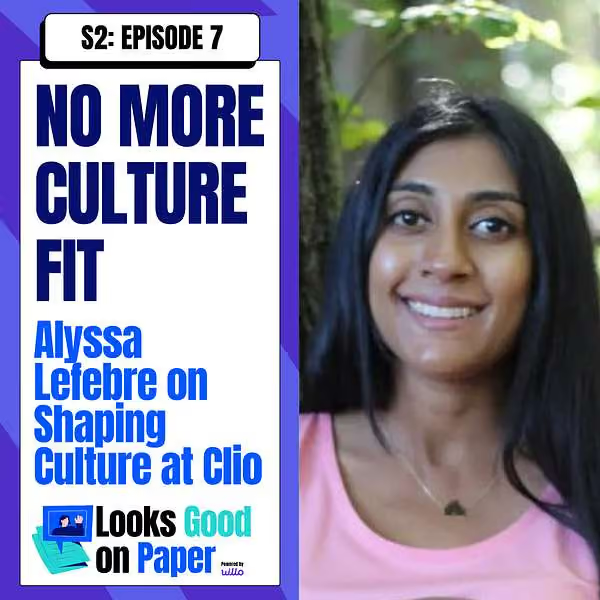
Clio’s hiring engine: real talk with Alyssa-Marie Lefebre (Senior TA Specialist, Clio).
How a 1,700-person legaltech scales recruiting without losing the human.
In this episode you’ll learn:
- The difference between culture fit and culture add—and how to interview for it.
- How to kill ambiguity bias with clear interview guides and prep.
- Why CVs/LinkedIn are useful and a “map of biases”—plus fair alternatives.
- Tactics for true candidate care at volume (prep calls, feedback loops).
- The TA stack behind Clio’s growth: Workday, LinkedIn, Gem, BrightHire/Gemini & more.
About Clio
Clio is a category-leading legaltech company transforming practice management with an AI-forward, human-centered approach. With 1,700+ employees, Clio continues to expand across EMEA and APAC.
About Looks Good on Paper / Willo
Looks Good on Paper is powered by Willo and hosted by Anita Chauhan. Simple, candidate-friendly one-way video interviews that help teams screen faster and fairer.
Watch & subscribe:
🎥 YouTube
💡 Follow Willo → https://www.willo.video
💬 LinkedIn
Chapters
00:00 — Welcome & guest intro (Alyssa-Marie Lefebre, Clio)
02:11 — Clio’s scale: 1,700+ people, global growth & AI shift
03:34 — Biggest mistake: “culture fit” vs “culture add” (and values that work)
06:56 — Rewriting values: the “Recharge Your Way” lesson
09:19 — Hidden bias: ambiguity in interviews (and how to fix it)
11:47 — White-glove candidate experience at volume
13:02 — If CVs vanished: LinkedIn’s role & bias awareness
15:18 — Multiple application paths & equitable review systems
16:44 — Skills-based hiring, feedback calls & fair assessments
17:48 — The stack: Workday, LinkedIn, Gem, BrightHire/Gemini, no-code ops
20:40 — How to reach Alyssa (LinkedIn) & close
Guest Bio
Alyssa-Marie Lefebre is a Senior Talent Acquisition Specialist at Clio, where she’s helping build high-performing teams with scalable, people-driven processes. With nearly a decade in tech recruiting Alyssa champions transparent interviews, equitable evaluation, and candidate experiences that enable long-term growth.
📌 Love the show? Follow, rate ★★★★★, and leave a quick review—your support helps more people discover smart, human recruiting conversations!
Show Resources
- Willo: willo.video - The most cost-effective way to screen candidates at scale. Interview candidates anywhere & at any time
- CV Free Toolkit: cvfree.me/join - Break up with the CV and get everything you need to modernize your hiring approach with skills-based assessments
- Anita Chauhan: linkedin.com/in/anitachauhan - Connect with the host
Anita Chauhan
All right, welcome to another edition of Looks Good on Paper powered by Willo. I'm Anita Chauhan your host for today, and I am joined with Alyssa Lefebre, a senior talent acquisition specialist at Clio. She helps the company build strong people first teams through data-driven strategies that support long-term growth. I'm gonna throw it back to you, Alyssa, to share a little bit about maybe what I've missed, and I'd love to hear a little bit how you got to Clio and your experience and just a little bit of the company as well.
Alyssa Marie Lefebre
Yeah, absolutely. Thank you so much for having me. This is fantastic. I always get very nervous being a part of this type of stuff, especially when it's like just free flow speaking. So I have a very casual approach, I think, and just, you know, how I'll approach this. So just as a heads up. But yeah, My name's Alyssa. I've been in talent acquisition in tech for about a decade now, which is kind of scary to say. I don't know how that happened. But anyways, I've really fallen in love with you know, hiring for high performing talent within companies that are truly human-centered, that are growing, that are scaling really quickly. That's kind of where I thrive best in companies that are really just scaling and growing. So I came to Clio with that intention. We're growing a ton. I think we've hired over 500 folks this year alone.
It's insane. It's a machine. Clio is in the legal tech space. We started out in 2008, which is, you know, it's just amazing to kind of see the growth trajectory from when we first started in 2008 to now. And yeah, We're doing really exciting things in the AI space, really transforming into an AI legal tech company. My talent acquisition team, or the team that I'm a part of, I should say, we're a team of 30-ish people. These are rough numbers, but it's a machine. What I love most about Clio is our human-centered approach.
When it comes to hiring, when it comes to our employee experience, when it comes to our policies internally, that's kind of what drove me closer to Clio and I wanted, you know, kind of encouraged me to want to work there. I'm really drawn and attracted to companies that have a strong sense of, again, just being human-centered in the way that they think about their experiences and are high performing, right? So those two tandem just kind of really, you know, drove me to want to be a part of the Clio, the Clio journey. Yeah, so that's a bit about me and my bread and butter has always been talent acquisition. But I've delved a bit into employee experience. I've delved a bit into other aspects of PeopleOps, but talent acquisition is really where I've spent most of my time. Yeah.
Anita Chauhan
That's awesome. Yeah. Amazing. Yeah, Clio is, I mean, I'm also a Canadian based in Toronto and that's really been such a big name for us across like Canada and something so proud. First of all, it's a massive company. How many employees in total do you have? Around five? Yeah.
Alyssa Marie Lefebre
Yeah, I think We're again, this is because we're just hiring a ton. It's like, I like to say over 1700 people. So it's around that ballpark number. Yeah. And just a huge financial success, right? Like last year, Last year we raised a $900 million USD fundraise. It was the largest fundraise a startup worldwide has ever achieved, right? This year we acquired. We've been acquiring a lot of smaller kind of companies, you know. In this case, we acquired two companies this year that are really going to transform, again, how we play in the AI space, and how we step into the enterprise market in EMEA. We're becoming more global in the EMEA and APAC regions. It's just such an exciting place to be in, in comparison to a lot of the tech market right now where there's a lot of layoffs. And where there's a lot of like, cost cutting, Clio is really poised to invest back into its business and invest in its people. So just overall, it's such a gem of a company.
Anita Chauhan
We love to hear it. And this is the thing, right? When a company does a really good job within their policies and with their HR and like people like look at how an employee speaks about the company, right? It really does matter, right? And we see that coming through. So you know the drill for this podcast. We have three questions, speed dating style, that we ask. Same questions every season and then one wild card. And we're going to kick it off now with our first one. So, what is the biggest hiring mistake that companies keep making even though they know it's clearly not working.
Alyssa Marie Lefebre
That's a great question. And I kind of landed in three spots, but I swear they tie it together. So I'll take you on a journey. So the first is culture fit versus culture add. I find that when companies adopt culture add, their hiring teams are and their recruiters are more poised to ask questions about if candidates bring different perspectives to the teams that they're currently hiring for. Like what perspectives and what skill sets are missing on the team that can really level us up. I think that's such a healthy question. And it helps us create more high performing, diverse teams as opposed to echo chambers, which which is what I think "culture fit" kind of encourages more of. I think culture fit encourages us to think in a way where you interview a candidate and you're like, "Oh, is this person like me? Or does this person level up a team in the way that I think that they should?" Right? So I really love when, you know, companies embrace that culture add. So I think getting like that culture fit mentality is certainly kind of a big mistake that companies might still be making. Now you cannot practice culture add with poorly defined and exclusionary core values. So this is the journey into the second point.
Yeah, and when I say poorly defined, I mean, you know, values that are not truly understood by the wider organization and exclusionary in the sense that your values are just fit in disguise, right? So you want to be able to, you know, have values that are truly understood by everyone in your organization and your hiring team, right? You want to be able to equip your hiring team with the right guides and tools so that they know how to interview for your values. And you also want to have a critical thinking part baked into your process, ideally before a requisition even gets to a talent acquisition team. Really thinking about if a value is counterproductive to hiring for someone on your team, right? So an example would be of a company value that could exist at a company in some shape or form is be scrappy. So, and that's kind of like a common value that you could see at maybe a startup. If an interviewer doesn't understand that value and just asks questions, can just, that assessment could just be based on gut feel and bias, which is not not good. And then in the same vein, how about if you're hiring for a role where being scrappy isn't totally relevant or even opposite to what you need? Right? So that's, you know, something to consider as well. Right. You can end up penalizing a perfect candidate for not embracing a value that, you know, the job doesn't even require. So these programs, culture add, you know, cultural values, they're iterative, right? And you really need to make space, right, at your companies for constantly evolving these programs and critically thinking about these programs. Which brings me to my third massive point, which I think a lot of companies are making mistakes on right now is eliminating diversity, equity, and inclusion programs. There needs to be a leader whose job it is to challenge this stuff, to dig deeper, to really ask questions, right, and to challenge, and they need to be cemented at the tops of the organization so that it's that ethos that's built at the top and felt throughout the rest of the organization. So that third massive mistake I think is a huge one. That's, I don't know it even does, yeah.
Anita Chauhan
Yeah, and it ripples down to your other two points. So if they don't have the values internally outlined from the very top, how can you expect a hiring manager to then be able to find the right fit, but then also balance it out with what I need on my team versus what I think that my company's telling me that we need, to your point about being scrappy. So one of the things recently, We actually had someone from Microsoft Canada speak as well, and I was very, very interested in how do you build for a big company. Microsoft's massive, right? So it's like how you make sure all of those values get brought down to that individual hiring manager, department head, whomever is doing the hiring, right? And I feel like, you know, given that you guys at Clio are hiring so much right now that this is something that is probably so relevant at this point. So what are some of the ways that you're doing that in-house?
Alyssa Marie Lefebre
Yeah, so sorry, just to repeat your question, what are some of the ways that we're re-evaluating or reassessing these programs? Yep, so I'll give you a great example of one. We had a value that was well-intentioned. It was called Recharge Your Way. Unfortunately, we found that, well not unfortunately, I should say it's a good thing that we found that our data points to assess this value were failing in the sense that people were confused about this value, the meaning of this value, and they were only recognizing it at our Impact Awards, which is our company-wide awards that happens during our People Day, where you can nominate teammates for values, for things that they've done and tie it back to our values. So, Recharge Your Way was constantly being recognized for surface level things. A lot of it actually had to do with fitness, right? So, Recharging Your Way in the sense that you know making sure that you have balance in your you know, in your life, so that you can kind of come back to work and you know contribute you know consistently right So a lot of people were associating Recharge Your Way with with fitness which is not very inclusive, and not very reflective of how everybody would you know consider the chart.
Anita Chauhan
Yeah, what's Wellness, right? It's not even across the board, just fitness. Yeah.
Alyssa Marie Lefebre
Exactly. Yeah. Yeah. So we did company wide listening tours. You know, We looked at the data, we have data points, right? We have our pulse surveys that go out on a regular basis. We have our impact awards. So there's just constant data points and data checks to really make sure that your team is communicating how they're embracing values, I think is really important. And really having a team and a dept again, making space, having folks in your people operations team that are focused on this stuff is so important. If you have a talent acquisition team that's also taking on evaluating values and also looking at how equitable our entire hiring process is, those programs aren't going to be fully baked out. You need folks who really take ownership and really dig deeper and are finding ways to optimize. So that's my, that would be kind of my answer to your overall question through that example is that just having a stocked team that really can look and dig deeper into these things. We've changed since then changed our, our value to play the infinite game and did a company wide rollout about what it means to you know, play the infinite game. So, you know, and it's really all about building holistic, sustainable habits for long term momentum. That's what it's all about. So, yeah.
Anita Chauhan
I love that. What I also love is that your team wasn't afraid to, no matter how big the company was, to go back and reassess and be really critical about, you know, is this working? Is this actually reflective of our company DNA? What we want our employees to feel, you know? And again, tying it back to that overall, it comes from the top. So I assume it comes from a very, like, understanding of what type of culture you guys want and making sure that everybody feels included. Awesome. Thank you.
Alyssa Marie Lefebre
We're going through huge amounts of growth right now, right? Like probably the highest amount of growth that we've ever kind of gone through as a company. And we're still iterating on our values. We've made time for these structural things, right? And we have the people in place to challenge these programs continuously. So that's so important, yeah.
Anita Chauhan
Absolutely. And I think like it's one of those things that a lot of companies are gonna have to embrace now and make it kind of part of how they operate. All right, so now on to question number two. What's a hidden bias companies unknowingly have even when they believe that they're being progressive in their hiring?
Alyssa Marie Lefebre
That's a good question. Where I landed was ambiguity bias when it comes to the interview process. So I'll give you an example of what I mean. Let's say I'm setting up a 60 minute chat with a candidate and a hiring manager. And the way I describe the chat or the interview to the candidate is, it'll be a casual chat, just talking about your experience and digging maybe a bit more technically because that person is the hiring manager for the role. And that's it. That's how I prep the candidate. That leaves the candidate in this weird guessing game where they're trying to figure out, what am I being assessed on? What is this person actually looking for? What kind of questions am I going to be asked? So it creates nerves. It creates this, you know, this weird dynamic, right, where candidates are coming in and not necessarily knowing where to focus on and ultimately getting penalized for just not, you know, being able to storytell or have that you know, that innate kind of skill set of being able to navigate those social settings, right? Like some folks can step into a really ambiguous situation like that and kind of figure it out and discover. But for many roles, that's not a core skill set that you're really looking for. And it's unfair to assess that in a first rounds of interviews with a hiring manager, right? So what I love that we do here at Clio is we create interview guides for candidates. So I would usually send that to candidates if I intend to progress them through the interview process so that they can see what the entire process looks like. Yeah, and I'm also a big fan of empowering your interviewers. For instance, I recruit a lot for software engineers. So we have an entire roster of folks that administer our pair programming and systems design technical interviews. What the business has done is empowered those facilitators to write blog posts about how they would recommend candidates to prepare. So you get additional technical content from folks who are kind of constantly interviewing candidates, which I usually link back you know to candidates who I'm talking to so that they can get some additional perspective on our process.
And I also love prep calls. Like I'm a big believer in making time for prep calls with candidates so that you can jump on a 15 minute call and really talk through an interview process with them, talk through any questions that they might have and give them that space to feel a bit more at ease with the interview that they're stepping into. But again, that all ties back to what I was saying at the beginning. Having a company that gives space to your people operations team to be able to provide a white glove experience like that. If you have a recruiter with 15, 20 reqs on their plate, they're not going to have time to prep. Yeah.
Anita Chauhan
Yes. This is something that we talk a lot to, right? Like All the people on the podcast, like how do you do it leaner? How do you do it faster? A lot of it's like, you know, one last week was talking to someone who was from Myovision, Justin Krulicki, and he's phenomenal, and he was just saying how he had 5,000 applicants for one job, and he's like, I don't, like how do you even parse through that? I mean, so Willo is a one-way interviewing screening tool, that's what we do, and so that's one of our ethos is like, how do we make this obviously easier for people? But some companies like Clio, I love to hear that there's the support and the ability for someone to be like, here's actually, here's the plan, here's the process. Every single candidate gets a really great experience, it sounds like. And well prepared so they can show up as their best self.
Alyssa Marie Lefebre
Yes, exactly. Yeah, really going back to that white glove experience and One of the reasons why I jumped on the train of joining Cleo because they're big, they're a big believer in that type of candid experience. So yeah.
Anita Chauhan
I love it. Awesome. Okay. So now we're on to our last question, but not really our last question. Question number three, if you were to suddenly remove CVs from your current hiring process, what would that look like?
Alyssa Marie Lefebre
Excuse me. Okay, so this is an interesting one because I'm of two minds. I kind of went down the rabbit hole with this question. That's just a common trend for me. I'm kind of like that. So I see incredible value in CVs, more so LinkedIn profiles. I think LinkedIn profiles are the new CV in the sense that it's dynamic. You can click it on posts, you can see how people engage, you can see recommendations. It's all kind of the same format, you know, so it's easier on the eyes. I'm a big fan of CVs and LinkedIn profiles, more so LinkedIn profiles. But I also see it as the single biggest source of bias in the interview process. A CV is a story to someone's journey. It's not just a list of skills, but it's context that leads to meaningful human interviews. I actually struggle in networking events when I don't have someone's CV or like LinkedIn profile. More so in front of me because I find that I can't ask probing questions. Like I can't really understand that person's journey beyond, okay what do you do? Okay cool like what's your type? It just doesn't lead to the human kind of interview that I love to conduct which is really getting to the root of what motivates someone, what drives someone. What does someone want as a next step in their career and how can we make that happen for them? You know in this case here at Clio, right? And you really can conduct that type of interview Through looking at someone's experience right and seeing their journey I'll use myself as an example, right? Like I you know, I very I'm very intentional with how I use my LinkedIn.
I have a short stint on my LinkedIn profile. Like I was at a company for a short period of time and I left. I think it was like a six month stint or something shorter. I intentionally leave that on my profile because I want people, I want folks to ask me about that. At least when I was interviewing, I want people to ask about that because I want to discuss what's important to me out of a company, right? I lead into my LinkedIn with mom of two boys. That is very important to me that employers know, at least when I was interviewing, I want companies to know that my job is to be a mother first. Sorry, it's a non-negotiable for me. And if that detracts you, I want you to be detracted from my profile. I do not want you in my profile. Exactly.
Anita Chauhan
Absolutely. Yeah, yeah, because you don't want to join a company that won't see that as a value. Yeah.
Alyssa Marie Lefebre
Now I know that's, I recognize that's a very privileged thing to say, right? And there's privileges that come with, you know, putting up barriers so that you don't have certain companies. I totally recognize that, but that's kind of how I use my CV. Now, the way I describe my CV only works in the hands of companies that are actively and relentlessly training their managers on bias and have strong diversity, inclusion, equity, and belonging programs, right? In the hands of an untrained manager or untrained hiring team, a CV is a map of biases, right? A name, graduation year, address, university versus college or whatever, maternity leaves, layoffs, whatever it is. It is a map of biases. So, you know, it depends. It really depends, right? I think if... So the way that I see it, you can't really, I don't know if I agree with totally eliminating a CV, but maybe creating more alternative opportunities for candidates to apply to a job. So for instance, maybe having something more of a skills-based submission, right Where you know candidates can you know submit something more skills-based but even that can be biased and that's a heavy lift on candidates. I don't know if candidates want to like disclose so much you know technical content because then companies could be crowdsourcing information it's there's so many issues like with any alternative I think that I think we just have to think back at the companies that we're applying to and just making sure that they have the right systems in place to look at each submission, whatever it is, equitably. So that's kind of how I would redirect. I think it's on the company's part to really be able to put in the work. But I do like the idea of multiple ways to apply for a job Because then you can target folks that are more inclined to submit a video, folks who don't like videos and want to just do a CV. Or folks that want something more skills-based because maybe they didn't work for the most cutting-edge companies and they want to showcase that they still have strong skill sets but don't want company names to hamper them from actually, you know, kind of advancing in the interview process. So having, you know, unique ways for candidates to apply based on who they are and then having the systems within the company set up so that you're not biased towards one submission over the other, right? Being able to look at submissions properly. I think it's, yeah.
Anita Chauhan
I love it. I love it. I feel like it's like really nice balance too, because it's like What I'm learning as well, obviously, as we're learning about like different learning styles and how different people show up to your point earlier about like, you know, asking someone to step into an interview or screener without realizing what to expect. Imagine we could do that where it's almost like a middle pathway, choose your own adventure style thing. Right. But, you know, I think that what's so lovely is right now there's a lot of tools that will allow this to happen. Right. And like we're big advocates at Willo of skills based hiring and that's why we were talking where it's like how can we actually make this process better so you don't end up with 5,000 applicants and having to parse through it by yourself as the only talent person in a team, right? Absolutely.
Alyssa Marie Lefebre
One thing that I really love with being leveraging tools or being able to use tools, so I've been really into giving candidates like feedback, like jumping on 15 minute feedback calls, especially for candidates that reach nearer towards the end of our interview process and have invested a good chunk of time. With us, I've been really leveraging AI tools to really help me parse through large amounts of feedback so that I can distill down. So it's not a heavy carry on my end. Like I can spend an hour going through and parsing through scorecards, right? But, you know, leveraging AI really cuts down that time so that I can get on a call and have more meaningful discussions and have that interaction. So I'm a big, you know, believer in leveraging all of these tools to again, create that white glove experience.
Anita Chauhan
I love it. So That leads me into the wild card question. So why don't you tell me a little about your tech stack? Given that you're doing such a high volume of hiring right now, I'd love to hear about your tech stack and what you guys have internally with Clio that you swear by right now.
Alyssa Marie Lefebre
Yeah, so we're actually, so we use, in terms of our ATS system, we use Workday, which is great for, you know, receiving applicants and kind of mapping out that, you know, that candidate journey. And that's been working fine. We use LinkedIn, obviously, for headhunting. We use a tool called GEM. GEM has been really great for sourcing for candidates. It's kind of like an AI-powered tool that helps source for candidates and kind of target folks that have engaged with us in the past, whose profiles might have been kind of lost in the depths of an applicant tracking system or really helps target unique ways of searching in LinkedIn, like playing around with Boolean search strings, things like that, to really target different types of candidates and really extend out your reach. Gem has been a really big source of candidate generation for us and has really helped up our volumes with respect to just our outreach, right? Being able to be a bit more personal, being able to be more targeted and pointed with our searches. So I know that the team is really big on using gem and setting up campaigns in gem. And then we use, well, we're kind of looking at bright hire for kind of AI note taking. That's going to be adopted, I think in the next like couple months or so. I don't have the exact timeline for that. Very excited about that. In the meantime, I've been using Gemini for kind of, you know, sometimes when you're on a call with candidates, you're like very furiously taking notes. Like it's fast, it's furious, it's kind of a doctor's slap. I mean, it's just all over the place. And then I got like arrows and stuff. It's wild, right? So I find that Gemini, for those who don't have like a bright higher type of AI specific note taking tool, Gemini has been really great and you can set up gems to be able to really you know, you can upload a job description, you can give it and feed it all that information that it needs to be able to summarize notes for you. So I'm a huge believer in the kind of like using Gemini specifically for my note taking or assisting in my note taking cleanup. And I think that that's everything that we use.
Anita Chauhan
Love to see an AI driven company using AI tools. We love it. Yeah.
Alyssa Marie Lefebre
Yeah, Noco Calum is another good one. Shout out my colleague Harrison. He's, if you want to know anything about optimizing your day as a recruiter, I can connect you with Harrison because he's been fantastic at knowledge sharing. He loves just AI, machine learning. That's his jam, that's his space. But he's really been fantastic at knowledge sharing with the rest of the team as to how we can leverage these tools to create efficiencies in our day and further create that more white glove experience. So yeah, shout out to Harrison. He's been fantastic. Yeah, that's where I got all my info from.
Anita Chauhan
Phenomenal. One person on the team that's like that. Sometimes I tend to be that person. I give so many recommendations for tools. Thank you so much for being with here with us today. I love the conversation and all of your thoughts and what you're building over there at Clio. So fun. And just one last thing. How can people find you if they want to chat?
Alyssa Marie Lefebre
Thank you so much. This was a pleasure. Yeah, thank you. Yeah, just add me on LinkedIn. My name shows up as Alyssa hyphen Marie Lefebre Add me on LinkedIn, message me. I'm always happy to talk talent acquisition. I love I love speaking to folks within my craft. I don't have enough people in my circle that are, you know, kind of recruiters other than the folks that I work with. So I always love, you know, chatting with folks, networking with folks or candidates. If you want advice on how to better story tell in interviews, to prepare yourself for interviews happy to jump on calls and assist in any way that I can and give back. I love doing that stuff. So yes. No problem. Thank you.
Anita Chauhan
Thank you so much. Alright.

More episodes from the Looks Good on Paper podcast

Stay close to the conversation
New episodes, hiring insights, and data-informed thinking — delivered occasionally and intentionally.