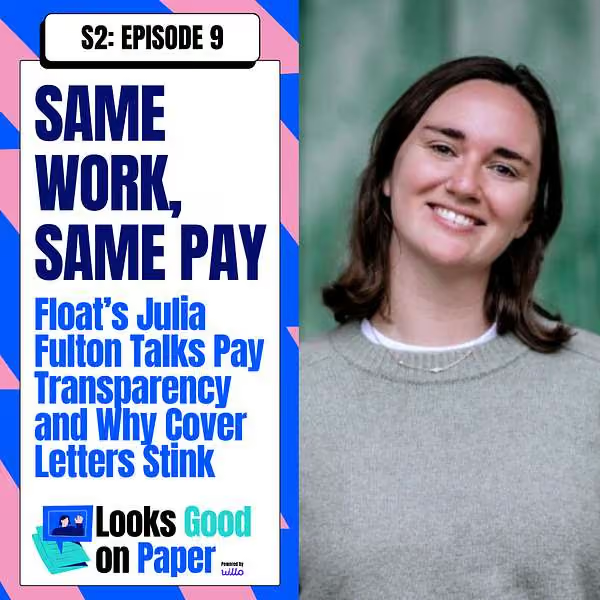
Same Work, Same Pay: Float’s Julia Fulton Talks Pay Transparency and Why Cover Letters Stink (S2E9)
Subscribe on:


This week Julia Fulton (Float) joins us on Looks Good on Paper to break down why hiring in 2025 has got to shift away from praising perfection, to rewarding potential. From compensation transparency to why she’s never read a cover letter, Julia breaks down what top teams are doing (and should be doing) differently in 2025.
In this week's episode we'll cover:
- Why sharing compensation upfront changes everything for candidates (and why everybody deserves to know)
- How hiring the "perfect fit" conceals the hidden bias that limits team growth
- What might help replace the CV - and why authentic responses matter more
👧🏻 Guest Bio
Julia Fulton is the Talent Manager at Float, a global, async-first company whose philosophy is all about doing your best work, while living your best work life. Float is fast on the rise, and for Julia, it’s all about championing the candidate experience, and having complete transparency — rooted in her own path into tech, and the belief that great hiring balances rigor with undoubtable humanity.
📄 About Looks Good on Paper / Willo
Looks Good on Paper is your weekly source for hot takes from modern talent leaders, recruiters, and powered by Willo, the async video platform helping teams hire faster-and more thoughtfully-at scale.
Chapters
00:00 – Intro to Looks Good on Paper & Julia Fulton (Float)
00:54 – Julia’s hiring philosophy and Float’s async global model
02:15 – Biggest hiring mistake: hiding compensation + key details
03:45 – The “Spider-Man meme” salary dance and why it’s broken
04:26 – Float’s radical transparency + public employee handbook
04:45 – “Same work, same pay” across geographies
06:38 – Candidate experience, no ghosting, and re-engaging talent
08:03 – Hidden bias: hiring perfection vs. growth potential
09:41 – Non-traditional backgrounds and the skills we underestimate
11:41 – If CVs disappeared: application questions & Loom alternatives
14:19 – Why generic cover letters (even AI ones) fail
16:18 – Letting candidates present in their strength format
17:38 – Role skills vs. interview skills
18:12 – AI in hiring: where it helps and where humans stay vital
19:49 – Going analog again: protecting voice and culture
20:37 – BoBo the cat cameo + wrap-up
Are you a talent leader and want to be on the show? Let us know!
We’ve got plenty more hot takes, so if you enjoyed this episode, follow/subscribe and leave a quick rating or review. Thanks for listening!
Show Resources
- Willo: willo.video - The most cost-effective way to screen candidates at scale. Interview candidates anywhere & at any time
- CV Free Toolkit: cvfree.me/join - Break up with the CV and get everything you need to modernize your hiring approach with skills-based assessments
- Anita Chauhan: linkedin.com/in/anitachauhan - Connect with the host
Anita Chauhan
Hi and welcome to this week's edition of the Looks Good on Paper podcast powered by Willo. Today we're joined by Julia Fulton. Julia is a hiring leader at Float and one of the peak emerging leaders of 2024. Huge for our global listeners. That's a really big honour in Canada and I'm so excited to have you here, Julia. From what I hear and have seen online, you're really known for your human first approach to hiring. I can see that you really champion the candidate experience and I'm really excited to kind of have your thoughts here today. I'm gonna throw it back to you. I'd love to hear a little bit more about like your role, how you got here, and tell me a little bit about Float.
Julia Fulton
Yeah, totally. Thanks so much for having me. I'm really excited to chat today. Yeah, I joke about just like all my hills to die on basically is where it all comes from. And I think, you know, My approach to hiring really came through being a candidate trying to break into tech specifically. And it just, yeah, I don't know. I think it made me really remember and really champion candidate experience in the work that I do.
just yeah, Nobody really loves being on that side of the seat and so how can we get what we need while still creating a great experience that then you can come back and serve us later down the line. Yeah, that's kind of how I think about my work. I work for a company called Float. I'm the talent manager there. Float is really cool. We're a global organization. There's about 55, 60 team members at this point, but we hire all across the world and we don't really have sort of like a core time zone or anything like that. We work very intentionally, asynchronously in order to ensure that everybody can kind of work on their time zone, push their work forward and also live their lives. We call it our sort of philosophy around it is your best work life. So yeah, it's awesome. I've been there for about a year and a half and yeah, really, really fun.
Anita Chauhan
Amazing. So glad to have you here today. I'm going to dig a little deeper into that more global async type of stuff that you talked about. I'm excited to hear about that. But you know the drill. It is the same three questions every season, speed dating style and why we get started? So what is the biggest hiring mistake companies keep making even though they know it's clearly not working?
Julia Fulton
The first one that came to mind is not sharing compensation and other stuff upfront. Comp is the big one, it's the buzz one, and there are lots of laws and regulations that are changing that. first of all, but still. But still, we can be a lot better and more clear about the way we're sharing compensation. But I also say other stuff because candidates are like...
Changing jobs is a really big decision and taking the time to interview and to choose to interview with a company is a really, you know, for some people, it's a big time commitment that they don't want to make on a whim. So, and yeah, Organizations have things like benefits packages. They know their PTO policy. They know these things. And if they truly are competitive, I think a lot of organizations can be better about sharing these things upfront because it's what candidates want to know. I think sometimes we forget that we're all working so that we can like make a living and live our lives. And so let's just like be upfront with the information that people are actually looking for at the end of the day.
Anita Chauhan
It's true. And it's funny because it becomes one of those, It feels like a dance, a song and dance. It's just like, you get into the interview, the screening, what are you, what's the comp, what are you looking for, what do you need? But we all know it's gonna come out, just put it up front.
Julia Fulton
Exactly. Yeah, well, you have a range for the role. I have a budget for my life. Why don't we just be so clear about that? But but you start, you know, like, yeah.
Anita Chauhan
Yeah, it's so weird. Why do we play this game? It feels like this really weird social quirk that has just existed for so long.
Julia Fulton
I, it's the Spider-Man meme. Like I think about it all the time where it's like, it's like, what are your salary expectations for the role? Well, what's your budget? Well, what are you making right now? Well, what's the person in the role making right now? Like, it's just like, Hey, just say it. Someone just say a number and it should be the organization hiring.
Anita Chauhan
Just put it out there.
I love that. And I think it's so true. I'm really am also seeing a lot of that legislature come out. I think it's really important. I think it's really unfortunate when I hear stories like I'll go through like subreddits on candidate experience and stuff like that and people like job hunting or whatever, and people are just complaining about like I went through all of this and then they lowballed me. Right. So it's like, you know, thinking about, you know, obviously you saying at the beginning that you care so much with the candidate experience, I see that's obviously such a big thing for you. At Float, do you guys implement this?
Julia Fulton
Yeah, we do. I actually had one thread I was gonna say really quick before we get to that, but what was it? hopefully it comes back. Yes, we are very transparent at Float with everything from compensation to, I mean, our entire employee handbook is actually public facing on Notion, which is something that is like so awesome. And this is what I was gonna say actually, is that these things also really like make your process more efficient because then you know that the people you're spending time with in the interview process have already like opted in to what it is they're going to receive offer wise. It saves so much. I never negotiate because our salary is really, We also have a same work, same pay philosophy. So every senior software engineer at Float makes the exact same no matter where they're based or how much experience they're coming in with or what have you.
Yeah, it's my favourite. It's like one of my many favourite things about how we operate at Float. So it also is beneficial to you, the hiring team, to share this stuff because it just means that candidates are opting in knowing what they're going for.
Anita Chauhan
I that. I think also like I've been, I love that same pace, same work type of idea because I've done a lot of hiring as a fractional CMO and as a head of marketing for a few different companies through my time. And I remember we were hiring in New York for a partnerships manager that was going to be under me, the head of marketing. And that person, because of being in New York, was slated to make more than me. The department head who was managing the person. And I remember how I felt some sort of way about it. And I told myself like, Anita, you gotta be a bigger person. It's in the interest of the business. But was like, I'm doing 20 jobs and this person's doing one.
Julia Fulton
Ugh.
Literally, you're like, Should I just change my address to be New York based? And like, would that solve all of this?
Anita Chauhan
Right? And they're like, you know, it's the place, it's competitive. And I'm like, yeah, this makes me feel great as a leader. But I really appreciate that so much, especially as more companies become global. I feel like we're probably going to see a lot more of that.
Julia Fulton
I hope so. It is something that I am so proud of and I didn't implement it at Float by any means, but it's something that makes me so proud when I'm talking to candidates that it's just the level of clarity and transparency is something that we try to do. across a lot of different ways we operate as a business and The compensation piece of it is one that I'm just like, I'm so bullish on.
Anita Chauhan
That's huge, it's amazing. And think those little touches will give you, I think about a lot of like employer branding and stuff like that and those types of things will definitely give you guys a really great name. Companies that implement things like this, that care about the employees, whether or not they are hired and brought on, this is something that lasts longer than that interaction.
Julia Fulton
100%. It's the same that I feel about like not ghosting candidates and that sort of thing, which is another one of my hills to die on is like you might, you know, this candidate might not be the best candidate for that particular role or it might not work out, but like if they have a good experience with you, like gossip, they'll gossip about you in a good way. Like that's amazing. Like you'll fill your pipeline by people who've heard about you or this particular, you know, candidate might come back and that's, I love when that happens. We actually had that happen twice this year where we had candidates that applied for a role a year ago, didn't work out. And then they came back and applied and then are now team members. And if we were crappy and if they didn't have a good time interviewing with us, like they shouldn't want, they shouldn't come back. Do you know what I mean? Like it's such a good, that's such a good moment of like, nice, we're doing our jobs right when that happens.
Anita Chauhan
Love that. I feel...
Absolutely.
Yeah and that they would come back again and they want to, even though they didn't get it the first time. and it didn't work and it didn't work out it worked out this time and they were willing to try again that's huge i also think though like I love hearing that actually happens because I feel like it's a phantom you know I hear a lot of like hiring leaders saying things like "Oh, we'll keep in touch and keep you in mind for other roles" and that never happens so it's great to see you guys do it.
Julia Fulton
Exactly.
Well, I do commend the candidates for, you know, keeping an eye on job postings because it's hard to manage that pipeline. It's something that I think, I think TA people are a little like, maybe under-resourced for or don't, like, I don't think ATSs do this super, super well. And also I don't think we always remember, like, realize how strong a pipeline is of people that have been through and enjoyed the process in the past. Yeah.
Anita Chauhan
Yeah, that's true.
Yeah, it's true, it's true. Alright, so now on to question number two. What's a hidden bias companies unknowingly have even when they try to be progressive in their hiring?
Julia Fulton
This is a bit of a harder one to sort of figure out what I wanted to say, but I landed on Something we've been struggling with a little bit at Float, which is over indexing on like perfection, like under indexing on growth potential is how I'd wrap it up into a nice bow. I think a lot of the times we like seek perfection in candidates, and we treat any sort of like areas of growth as a red flag. and that pro That's how i'd probably describe like what the pet peeve is for me is like they don't have experience developing this type of strategy." Bit of a red flag, or whatever. And I think we forget how much we all learn all the time in our roles. I've learned so much since I joined Float. And I think when we over index on like one to one fit of like job, you know, Maybe seeking perfection is one way to look at it.
Yeah, we do ourselves a real disservice of finding people who are eager to learn and eager to take on new challenges and that sort of thing. I also think it gets us in trouble when we hire people who are like an amazing fit for the job on day one Because you might actually consider that overqualified in terms of like role satisfaction in the long term. Because you want someone joining your team who's gonna feel challenged by the role in a year. And if somebody's gonna be able to crush it on day one in every single area that you can foresee, they might be a little bit bored kind of quickly. And so you hope you have growth opportunities for people like that, but if you don't, then I think it's something to keep in mind in the like, you know, head count planning exercises of it all where, yeah, there's Like it's actually important to leave a little bit of room for growth so that you can have people who are happy and challenged.
Anita Chauhan
Absolutely. I also think that I've talked about this with a few other guests on the show where it's like, this idea that there's no accounting for that passion. And like When someone has like a hunger to learn something and like tries to solve it and has those insightful moments, like what does that bring to the process they're building? the strategy that they're doing? it's like, I mean, listeners will have been like, will be like "Anita, it's all the same, same." But I actually don't have a marketing degree. people gave me a chance and I brought my all to it. And you know, and now here I am, running marketing teams. What?
Julia Fulton
you
Dude, I didn't go to HR school. I worked as a summer camp director. That was my first career out of university. It was working full-time YMCA summer camps. But, and you know, I'm so grateful to people in the People of People group. We were chatting about it in the tech world who sort of welcomed me in and helped me reframe the many legitimate skills that I had from that industry to working with people in tech. So Yeah, there's so much to be said about like, similar like, my gosh, people who have worked in restaurants.
Anita Chauhan
Yeah.
Yeah. my gosh, they are crazy good.
Julia Fulton
Get them on your team. Like hospitality, my God. Yeah, so I think we often think that the best person for the role is someone, and lots of times this is true as well to be fair, where especially more technical or more senior roles or these sorts of things. But yeah, I think we under index some of those skills like problem solving, resourcefulness is a really big one at Float where we all work asynchronously and I gotta kind of find an answer to something because my boss is asleep in Australia. She should be. You know what I mean? So it's yeah it's not always just about kind of the technical skills or the like bullet points on the job description. We want to leave a little bit of room for people to grow, learn, be ambitious, all of these kinds of things.
Anita Chauhan
Absolutely, I love that. think that also thinking about kind of like for job satisfaction to your point earlier point, but then also to make sure like they bring it and It does something for the company culture to see people growing in this way. So I feel like it's a win across the board. I wonder how you can do that where it's like you find someone that's the right fit, but has that growth potential and what you look for and that type of stuff. But why do we want to question number three? Okay, if you were to suddenly remove CVs from your current hiring process? What would that look like?
Julia Fulton
Okay, what do you mean what would that look like? Do you mean dream world or like what would, how would I get what I need? Help me understand the question.
Anita Chauhan
Yeah.
A good visioning exercise. I like some design thinking and that's why this question came up. It's like let's ask because you know we've chatted about this you know the cv free movement that Willo was pushing forward you know it was really tough for a lot of the people to imagine a world. I think that's why it's scary to When we don't know what else could be we can't imagine right? Like I have I'll share something with everyone here today. I hate cars. I think a lot of people are dependent on cars because they can't imagine what it'd be like without it. And if we start imagining a world with a CV or a car, because they're clearly the same, what would that look like?
Julia Fulton
Yeah.
Hmm.
Okay, thank you for helping me with the question. So I went through a little thought experiment and I thought it was kind of funny where I landed, which I never thought I would say, but cover letters. I digress, trust me, I digress, because I hate, I haven't read a cover letter in my entire career. That's literally, I've never asked for one. If I see one, I don't read it, like, please no. What I do love, what we do at Float is we, well, love hate, is that we ask some questions as part of the application. like, my candidate experience hat is like, no, like don't make them like, If people are applying, you know, all over the place, that's a lot more time than we're realizing to, we want to be careful what we're asking of them. And cognizant, so that we're not asking too much. However, I do think a balanced and like level of application questions with good and thoughtful questions that you're actually going to read is sort of my middle ground there. So I've enjoyed that. And you know, in the age of AI, it's gotten a lot more challenging. And I've had to like MacGyver my questions to get them to be a little bit more specific. And that's OK. I can flex, right? All good. And so when I think of what's actually valuable, when I'm reviewing applications, does, like the CV is a little bit more of a like box checking exercise, like am I seeing what I need to see in terms of like job titles and know, orgs as you've worked at, like these kinds of things. But what I get really excited by is thoughtful, authentic, bespoke answers to our application questions. of What about Float looks exciting to you? and like What's a problem that you saw in the job description that you'd be stoked to solve, or that you've done before, what have you. So when I was going through this thought experiment, I was like, oh, I actually think that would be. I wouldn't mind that much if I didn't have a CV because those are the pieces I like the most. The application questions. So I was like, well, maybe I'd flesh those out a little bit more and maybe add a few more to just like gather a bit more information. And then I'm like, no, this has just turned into a cover letter, which is something I famously hate. I hate. So I had a little laugh to myself about that, but that's kind of where my mind went. It's like, let's get someone's like authentic answer. But something we do at Float for some roles is also get And because we work asynchronously, Loom is a tool that we use a lot where you record videos, yeah, screen sharing, kind of thing. So another thing is sort of like, oh, record a Loom explaining an answer to this question. And I also have kind of a love hate relationship with that because again, from a candidate's POV, they're like, well, you're probably not even going to read my, like they don't know if you're really going to review their application. So it is tough. I find it tough to ask for stuff like that. But these are some things that I'd sort of like dance with expanding on if we were to do away with the CV But I hate the fact that it's essentially a cover letter with a hat. Yeah
Anita Chauhan
Yeah, it basically is. But more purposeful. Let's be real here, it's purposeful. it's actually you're being... I think that if you were to do that it sounds like you'd be thoughtful about the questions you'd ask. It wouldn't just be a free-for-all because I think that's the modern cover letter just like the modern CV is rife with issues. I feel like everything is AI. Wait, it's not really AI, right?
Julia Fulton
Certainly. Certainly.
And it's also not specific. It's like, dear hiring manager, I'm like, goodbye, sorry. Like my name's on the job, but like, you know, we let's two can tango here. So it's just the problem, the biggest maybe problem with it right now is it's not specific. And so the questions I would ask and the questions I do ask would be highly specific to like what I actually want to know and care about from a candidate, not just like a formatted letter as if we're like sending it in the mail, which, you we're not. Yeah.
Anita Chauhan
Done, bye.
Yeah.
you
We're not. We're not. Yeah, I love that. And I think like you've touched upon stuff that I've like I've heard in, you know, just the spaces that we both hang out in. and also in the conversation I've been having on the podcast, this idea that like there's no perfect solution to this. But what it sounds like is a lot of people are like a very for candidates, give them a chance to show passion, to show authenticity. And to figure out from the from the hiring side, like having skills based questions. And being able to determine through that, but then also allowing them to choose their own speed because some people might not be able to show up on video. Some people are better with writing. So it feels like right now there's no real clear-cut answer to replacing it, but what you did say around the resume or the CV is ubiquitous. That it's almost like a calling card. It's almost like a box checker. It is almost so needed in the form that it's in. And so I always ask, okay, if that's what like places right now, what could replace that? And what I'm hearing is LinkedIn. What do you think about that?
Julia Fulton
Yeah, literally. Well, what you were saying before reminded me of like in elementary school when you could kind of like do a present, like I remember I did a presentation on the Canadian Shield and they were like, do it however you want. I was a little theater kid, so I did a song. And anytime I did a song for a school presentation, which is like five times, like I can remember five different songs, like A's across the board, teachers were like, wow. And so, The opportunity to present yourself in a way that is like specific to you and like strength based is a great point. And so for Float, when I applied a year and a half ago, they asked for a Loom video. And I was like, I'm not gonna like sit in front of my computer and film a Loom. And at the time I had been doing a lot of like short form content with my other job at the time, like TikToks and stuff like that. So I just went out for a walk and I recorded a like TikTok style video answering the question. and they were like the Lord. They were like, that's the best application video we've ever seen. And to be fair, it's probably one of the only ones where the person wasn't in front of a camera. And so I think, and it's, yeah, I don't know. I'm not trying to like, toot my own horn, but I think when we set candidates up for success is when we can like allow them to sort of really, yeah, present in a way that shows their strengths and their skills.
Anita Chauhan
Mm-hmm.
Absolutely.
Absolutely. I honestly thought you were going say that you made a song and I was going to be like, this is the best interview I've ever had. And please share it with us so I can share it with everybody. Honestly, I feel like that resonates so much. I think like being able to just show your like show what you're good at. And yeah, not everyone's going to be on video like the way that obviously you and I are showing up on video right now. Right. Like we have totally different energy. I also was in theater. I also have this energy. So I have that type of thing that I can bring and that's actually where you and I shine, right? But someone might not be that comfortable on camera and that is something that I've heard a lot about. Even because like Willo, as I mentioned, is a one-way video interviewing tool and we do know that like this is actually a really cool way to really shorten the screening process by using a tool like Willo and other tools that are out there. But I know that not everybody shows up in that way, right? So how do you optimize for the candidate? So it's just very much like that's why I'm so excited to talk to you because I know you care so much about the candidate experience. Like how do you get good hires from a TA perspective, but then also allow those people to shine, right? So that's the question.
Julia Fulton
Mm-hmm.
Yeah. I think, and I think another thing that I jotted down but didn't choose as one of my answers is that I do think we over-index on interview skills. And I think we know that, but it's such an important reminder that like, hey, like I don't need someone to do the STAR method if that's not, like if like communicating in those sorts of ways are like crucial to the job. So I think it's like role skills versus interview skills, very easy to smoosh together, but very important to separate.
Anita Chauhan
Yeah.
Agreed. Agreed. Okay, and we are on to our wild card question. And I have, you know, just we kind of talked a little bit AI, but this is refreshing because the whole conversation was about AI, which is sometimes is with my with my guests. It's like that. I'm a little tired. No, I'm just joking. I was wondering, though, How do you feel about using AI in the hiring process? And do you use any tools? What like is it like positive? Is it negative? How do you feel about it?
Julia Fulton
It's getting, yeah, it's getting there these days.
I, my opinion's always changing because I'm, cause it, cause because of the landscape that we're in. I think there are great, great things we should be doing to, that can like really streamline. and make things more efficient. A great example is note taking. I can actually listen and ask better probing questions and develop a better relationship with candidates when I know that my notes are over here and I'll go through them after and I'll still, and here's the important part, actually this is a perfect example, is it's not a 100 % replacement of my note-taking activities because I'm not just copy pasting the notes from MetaView into my ATS and saying, "Done." It's super important for me to still go through and like when I'm sort of formulating my thoughts based on you know the metrics that we hire for and this sort of thing. I'm still spending some time doing that for sure, but I'm able to like conduct better interviews provide a better candidate experience and definitely save some time by using that. I think, I guess like to summarize my thoughts on AI in the interview process are there's lots of areas where it can be great. And I think we need to remember that it's not kind of foolproof. And so to still be really like diligent and meticulous and like thoughtful about where we're using it and like also where we're not, like where do you still want to have that full human element? And that's a decision you make like just because we can doesn't mean we should for everything.
Anita Chauhan
Absolutely.
Agreed.
It's true. Absolutely. And actually, in the interview that's coming up tomorrow with Jim Miller from Ashby, he says that I asked him, like, what does the trend look like for 2026 when it comes to hiring and AI? And he's like, more intentionality. And you hit it right on the head. Just being more intentional about the tools you're using, how you're using it. And nothing is a replacement for the human nature of the work that we do. Right. So it's really important to keep that.
Julia Fulton
Yeah.
Yeah, I think a lot of people are going a little bit full circle. We were talking about this with internal documentation. We're big on writing at Float because of the way that we work. And I think a lot of us have, like I, sometime last year was like, or no, yeah, in the past few months was like, I'm going back to analog more or less because I I just realized that I was sick of cutting down fluff. And I was like, I probably could have actually done this in about the same amount of time. And it's, it would preserve my own voice a little bit better if I wrote with myself and then use AI tools for things like grammar and, you know, suggestions and these sorts of things. But yeah.
Anita Chauhan
Absolutely.
polishing, tidying up, yeah, because I feel like what we're observing is like a flattening of culture and our style and our individuality. Absolutely. Well, that's all the questions I have for you today. And also, thank you for having your cat present. Please, what's your cat's name?
Julia Fulton
diluting of voices and styles, totally. Yeah. Yeah.
Yes, her name is Bo- her name- her formal name is Bo but she goes by BoBo.
Anita Chauhan
Bo Bo, adorable. She has been very lovely to watch and she's obviously contributed so much to the conversation. Obviously. Thank you so much. Julia it has been lovely to chat with you. Thank you for sharing your thoughts and coming and taking a chance on the podcast. Awesome. Okay.
Julia Fulton
and I wouldn't be where I am in my career without her, let's be clear. Obviously.
Thank you so much for having me. This was a blast.

More episodes from the Looks Good on Paper podcast
Stay close to the conversation
New episodes, hiring insights, and data-informed thinking — delivered occasionally and intentionally.