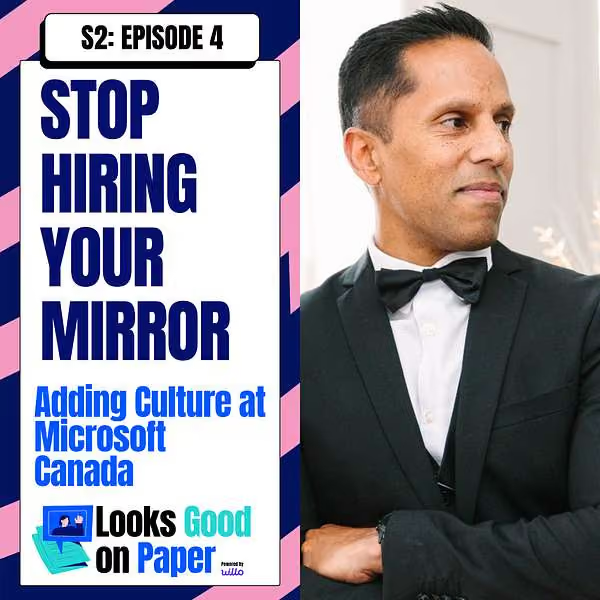
Stop Hiring Your Mirror: Culture Add at Microsoft Canada
Subscribe on:


What if your best hire doesn’t “fit” your culture—they add to it?
Microsoft Canada’s Kree Govender shares a practical stack you can try this month:
- hire culture add (not clones),
- test with the Three A’s: Attitude, Aptitude, Assimilation (to change),
- run STAR interviews with independent panels to avoid groupthink,
- use AI tools like Microsoft Copilot to surface hidden bias,
- and swap vanilla CVs for 90-second video/audio intros that actually show how people think.
In this episode you’ll learn:
- How to design for culture add and positive tension on purpose
- The Three A’s hiring lens (Attitude, Aptitude, Assimilation)
- Why STAR + independent interviewers raise signal and reduce bias
- How Copilot helps measure (not guess) interviewer bias
- When a 90-second intro beats a CV for early screening
Watch on Youtube
Chapters
00:00 Cold open — “Stop hiring your mirror”
00:26 Culture add vs culture fit (and why tension helps)
02:05 The Three A’s: Attitude, Aptitude, Assimilation (to change)
03:30 STAR interviews + independent panels (no groupthink)
05:00 Don’t guess bias—instrument it with Copilot
06:45 CVs → 90-second video/audio (what to ask for)
08:50 Leadership: Create Clarity • Generate Energy • Deliver Success
10:30 Model • Coach • Care in practice
12:20 What to pilot this month + wrap
Try one tactic this month and tell us what changed: 90-sec intro videos, STAR-only prompts, or independent panels?
👉 Watch and Subscribe for operator-grade hiring conversations here, or on Youtube.
Resources
• Willo — screen smarter at scale: https://willo.video
• Connect with the host, Anita Chauhan (Willo)
• Guest: Kree Govender, SMB Canada Leader @ Microsoft
Share this with a leader who still starts with CVs.
Show Resources
- Willo: willo.video - The most cost-effective way to screen candidates at scale. Interview candidates anywhere & at any time
- CV Free Toolkit: cvfree.me/join - Break up with the CV and get everything you need to modernize your hiring approach with skills-based assessments
- Anita Chauhan: linkedin.com/in/anitachauhan - Connect with the host
Anita Chauhan
Hi and welcome to this edition of the Looks Good on Paper podcast powered by Willo. I'm Anita Chauhan, your host, and we're here today with Kree Govender who leads Microsoft's SMB division, Microsoft Canada's SMB division, where he helps thousands of small and mid-sized businesses scale through cloud innovation and through the right people, really. That's the big part of how he can do what he's doing. So he's built a career on leading high-performing teams and fostering ethical human-centered leadership. For Kree, great hiring isn't just about filling roles, it's about empowering people to drive transformation from within. I'm gonna throw it to you in case I missed anything, Kree. Thank you for being here.
Kree Govender
That's a wonderful welcome and it's great to be here with you today again Anita
Anita Chauhan
Thank you. Yes, that's right. Because we did talk at Startwell for the Toronto Tech Week for the amazing event that Starwell put on that Kasim and his team put on for Tech for Canada. And I know we chatted a little bit. You did answer one of my questions already. It was great. And I'm so excited to have you again. And you know the drill. Three rapid fire questions, speed dating style. I'm really excited to hear your thoughts, given all the work you've done with Microsoft and in Canada and growing this business. So why don't we get started? The first question is, what's the biggest hiring mistake companies keep making even though it's clearly not working?
Kree Govender
Yeah, and this is bringing an organization like Microsoft the size and the scale of it. It's really amplified on that front. And I would say it's not spending enough time really assessing what this person is going to bring in terms of the culture fit that they bring into an organization. Far too often we look at credentials, which is really the ticket to entry to get into the interview process. and then start evaluating people largely on what are the core KPIs and metrics and the job description that we want them to fulfill. And sometimes we look for bias in terms of is this person like the existing team that we have? Are they like me? And it's sometimes very subconscious in this space. And we're trying to train through that rather than train it out of our systems. At times you need that. But really having a diverse mix of people and a culture add someone who's going to create positive tension within the team in certain decision making can really elevate your performance to the next level.
Anita Chauhan
I absolutely agree. mean, there's study after study that show that diversity of people and thought can drive innovation, right? And I feel like, you know, given the fact that you are driving innovation in your role and for the company, you probably see the necessity of having a team that replicates that as well, right?
Kree Govender
Absolutely and I think now more than ever before as we start to see organizations start to flatten and we also see the rise of these 5 to 10 people organizations especially in these SMBs hyper agile these digital natives that are able to punch significantly above their weight for those founders especially as they're making hiring decisions they've really got a guard against that because when your team is light and lean and nimble you really want to try and have a significant amount of diversity. It's like really setting up the best soccer team. You can't just have a team full of strikers. You've got to have people playing in the right positions that foster the entire collective performance.
Anita Chauhan
Agreed, right? It is a team sport. It's always funny. Another bias I've heard in some of the conversations I've had is that people always look and create that kind of sports analogy. But I think it actually does work to some degree. Like you have everybody on the team plays a specific role and is needed. So for your teams, let's say, like how do you optimize when you're hiring for that kind of like agility and team spirit?
Kree Govender
I'm literally in an interview process right now hiring for an individual over the next two days and the way that we go about it at Microsoft is we have three separate interviewers which isn't anything special I'm sure many organizations do exactly that but we're each given very specific tasks that we need to test and ask for it's left up to us in terms of how we want to go about asking those questions so they're not prescribed to us but the candidate on the other end doesn't necessarily know how we're going to do that. what we default to largely are situational based questions. using the STARS model, tell me about the situation, what was the task, what was the action you took, the results and the success that you received as an outcome of that. But for me to answer the question a little bit more directly, the route that I go about doing this is I'm always testing for what I refer to in some way shape or form as the three A's. The first A for me is attitude. What type of attitude is this person bringing? So how do you show up in terms of that initial engagement? What type of hunger and drive do you have? Are you trying to find me in other platforms and ways to connect with me? Like how far are you willing to try and push the envelope in a compliant manner to show me the type of attitude and hunger and drive that you have? And combined with that in terms of attitude is what's the type of attitude are you going to bring to this team? So I'm not necessarily always looking for the most boisterous person or someone who's an extrovert. Sometimes a quiet confidence is what you need to almost balance out some of the others in the team. So that's the first thing. So the second one is aptitude. So being in the interview process, there's already an understanding that you have the smarts to be in there and I'm never one who fully evaluates purely on your credentials or your past experience. I want to know, do you have the ability to learn and relearn because the world that we're in right now is shifting so quickly and so many things are being disrupted and every year in Microsoft people are being asked to play different positions. So having the aptitude to learn and relearn and go and play in a different position is critically important in this process of of reinventing self. And the final A is your ability to assimilate change. Once again, in this very high turnover, fast moving environment that we sit in, the ability to move from, oh gosh, change is happening to me, rather than change is happening with me is critical in my mind. So those are the three things I test for through my questioning.
Anita Chauhan
Oh, I love it. It's amazing. It's three A's. And it's so easy to remember. And I think like all of these things are so mindset driven and it shows you right that flexibility, I think, like who I bring onto my team and who can like add to it. There's a value add there through everything that you said. Right. So I think it's really cool. Yeah, you're right. To get to even that point, you would have had already the process to understand like, oh, there's the resume. I understand who this person is. And, you know, this person at this level, like now let's see how they can work with the team and start looking at through that lens. Amazing. Alright, so now on to question two. What's a hidden bias companies unknowingly have even when they think that they're being progressive in their hiring?
Kree Govender
Yeah, this goes back to kind of what I touched on way up front, which is we're looking for people that sound like us. We're looking for that confirmation bias and the relevancy. So if somebody sounds like you hails from a particular part of the world or has had a similar prior working experience, automatically you start to gravitate a little bit towards them because there's a commonality that's in there. And we're all human, this is something that occurs for each and every one of us. But it's really tough sometimes to separate that out and take a step back after the interview process and actually sit and think about it and say how much of this is based on the areas of commonality that we've had and what are the things in terms of the practical aspects that this person is going to bring to this role day in, day out. Sometimes there is a need for a mix of that, so it's not binary, hey let's really cut it straight down the line and separate the two but rather what's the right mix that we need for this environment. Sometimes you may need that especially if you're as an example a senior leader and you've got a chief of staff sometimes having that degree of commonality because you're living in the cockpit every single day together on some very critical business decisions that can actually help you be a tighter unit but you've got to have the awareness you've got to have the ability to step away and outside of the recency of the discussion to really let it marinate before you can approach it with fresh eyes. So what I tend to do is I tend to, now using technology, I use Copilot to transcribe everything so I can try and stay present and available in the discussion. And then I give it time and I let it just sit in my subconscious. Next day at the gym, I'm kind of replaying it a little bit with fresh eyes. And then I've got some really interesting prompts that I've developed over time and some of them just based on what Copilot knows about me. I ask it and I say, what are some of the hidden biases that may be in here based on everything that you know? And sometimes it shares things about me that even I didn't realize. So I've tuned it and trained it based on the number of assessments I've done, the working genius, my Enneagram and Belbin assessments, et cetera. So things that are a little bit deeper. so that it gives me a different perspective and I'm not just purely evaluating on feel and what I'm seeing in terms of data in front of
Anita Chauhan
I love that so much. I am a big fan and proponent of using AI in this way as well. And one of the things we do bring up a lot, you so Willo is an AI tool now. We have integrated an aspect of what we call Willo Intelligence into the platform, which is a one-way video interviewing tool. And we can see like, you know, people come to us and are saying all the time, like, we want AI for our hiring processes. you know, we don't know exactly what that means, but we want AI. And we think it's like, you know, it's important and it's so interesting because it's like, what is actually a value add that can be added, right? Through something like this. And hearing what you're saying, it's like actually checking our biases by using these things. However, you I know a lot of people have opinions on things like Myers-Briggs, Enneagram, all of these things. Yes, take it with a grain of salt. But what if you do have this data and you understand yourself in this way and you can, like you say, take a pause to really sit with it and then reflect against those things in a thoughtful, more data-driven way, supported by AI?
Kree Govender
Absolutely. Just to add on to that piece, the final button will allow you to get to the next question. But what I've done is I've built an agent and I've not just powered it with these work assessments that I've done. I've pointed it to pretty much everything in my life. all my LinkedIn posts that I've written over time, I've taken 10 years worth of journals that I've converted from image into text and I've pushed it in there. So it's almost a digital copy of me. So it's It's got some very interesting.
Anita Chauhan
absolutely. Kree, you and I are very similar. I have done the same thing. yeah.
Kree Govender
there we go. That's topic we've got to delve into.
Anita Chauhan
I think it's always just so interesting you have like all this data on yourself. Why not use it to help form future actions, right? Like why not if you are taking all of this stuff, right? So, but I think that's really helpful. think a lot of time thinking about bias, find a home or like within your professional life, like we are all subject to it. We all do it. And it's just being aware of the potential of doing that even especially when it comes to work, right? And you are hiring people and you're like it's someone's livelihood, right? These candidates and eventually potentially your colleagues and people you're going to work with in this capacity, give them that respect of really taking your time and thinking about how they're actually going to fit, them up for success. Amazing. Absolutely. Okay. So last question and then our wild card. So not really our last, but if you were to suddenly remove CVs from your current hiring process, what would that look like?
Kree Govender
Absolutely. Couldn't agree more.
Yeah, I would actually welcome that. And here's the thing. As a hiring manager, having been in a hiring manager position for a greater part of 15 to 20 odd years, over time, what I've seen is the rise of CVs or resumes that all are quite vanilla. So they're all in this one page format and the same type of font. And when you're sifting through hundreds of those, what I'm really looking for at that point in time, is variety. a profile that actually looks different and stands out is the one that kind of catches my eye. like, you've done something different. You're in a sales process here. So if CVs were eliminated, I would be very happy. If we moved to something that was video-based, having a short form content, deliver your value proposition in 90 seconds to me in a video, I would be far more engaged. Interestingly enough, there was a role that I had applied for not too long ago. And one of the things I tried to use to differentiate myself was I used a tool to actually generate an AI audio summary of my resume. And once again, connected to my LinkedIn profile and so forth, I said, you may not have time to look at my entire resume. You can listen to this while you're on the go. So I prefer doing that as well now. So I've got candidates I'm in the gerbis when I'm at my most creative in the morning and I'm much more attentive and I have these audio summaries of the resumes going. So if we had to eliminate that and move to something that's much more engaging and allows me to consume content on the go, I would be much happier for that as an interview intake process.
Anita Chauhan
I love it. mean, obviously, like I mentioned, Willo does that and helps with the screening process. Just given the sheer amount of applicants that hiring managers and talent professionals have to deal with on an ongoing basis, it's always nicer to have some sort of like set up where you actually can digest what you're getting in an easier way. And also, that's a big thing, too, I think about it's like content delivery or information delivery in a way that works for the hiring manager or for the person that's taking it in. Right. Like maybe, you know, maybe it isn't that you just need to look at a resume or use the ATS, like having a video, seeing that personality come through is really important for you, right? Like, it's key, right?
Kree Govender
So I'm so glad that Willo is on the progressive side of this and is really forging the path in terms of things that we as hiring managers want. So kudos to you.
Anita Chauhan
Yeah. they're amazing. It's such a great, great company. And we're also seeing a lot of companies moving towards this. That's one of the reasons that we're having this conversation or removal of CVs or just decentering the CV from the process entirely. And our last wild card question for you is I'm really interested. You you work at a really big organization, like one of the top organizations in the world that gets to redefine a lot of things. I'm wondering if there's stuff that, you know, Microsoft is already starting thinking about when it comes to hiring and how do you make sure that you kind of have the same standards or how are you looking across the organization when you're hiring to pick the right people. I'd love to hear a little bit about that.
Kree Govender
There's a few elements to this. as people managers or hiring managers, there's something that we refer to as our MEC community, our Manager Excellence Community. And this happens with a high degree of frequency at least every month where we connect as a cohort, either in a particular geography and even broader than that. And we touch on a number of different things, be it on culture, be it on our philosophy which is model, coach and care and a whole range of topics as well. So as managers we're consistently being trained, engaging with our peers and also learning best practices at a global level. As a hiring manager you have to do certain mandatory training in terms of what's a great way to interview, how do you have blindside type feedback, how do you capture that within the tool and ensure that your assessment of an individual is not being influenced by another interviewer that's in the process as well. So everything's kept lined up until you put your response in and that's the only time you're allowed to see it in terms of the other interviews that have also interviewed candidates. So we try and do a lot there to ensure that the person is operating almost in asylum and making an individual assessment in terms of a higher, no higher or potential future hire. But the thing that always grounds us are the three things in terms of our leadership principles which is create clarity for yourself as well as the individual on the other end, generate energy and the final one is deliver success. So those are our three leadership principles and we'll find a way to both demonstrate it for the person on the other end but also try and elicit from them how they've done that even though they're not familiar with the Microsoft framework through curious questioning. So that's one. The second one is then as it relates to people, is the three pieces that I mentioned a little bit earlier, which was model, coach and care. So they're very simple frameworks. It's not as complex as you would, you would think. And I think that's the beauty of it. We're able to gravitate towards those things and interweave it into the discussions and the questioning so that it's not obvious. But when you look back at it and you're able to replay the conversation, you're able to assess hey, how did this person show up in terms of delivering success? And could they connect those leadership principles and how did they demonstrate modeling, coaching and caring as well?
Anita Chauhan
Amazing. Amazing. I assume it's really difficult to make sure every single hiring manager is able to do all of those things exactly the same. So it's interesting, right, the trust that the company also probably gives you to go ahead and make sure using these principles and frameworks, how can you actually bring the right people on board to make sure that they are successful in the run.
Kree Govender
Absolutely. Absolutely.
Anita Chauhan
Alright, thank you so much, Kree. This has been such a lovely conversation, as I knew it would be. Really excited to get all your thoughts and your words out into the world. yeah, I look forward to our next conversation.
Kree Govender
Likewise, and thank you. Thank you for running this. This is phenomenal because I hope that I'm able to serve others, but equally so I've learned so much from all of the other episodes that you've produced as well. So thank you.
Anita Chauhan
Thank you, Kree. All right.

More episodes from the Looks Good on Paper podcast

Stay close to the conversation
New episodes, hiring insights, and data-informed thinking — delivered occasionally and intentionally.