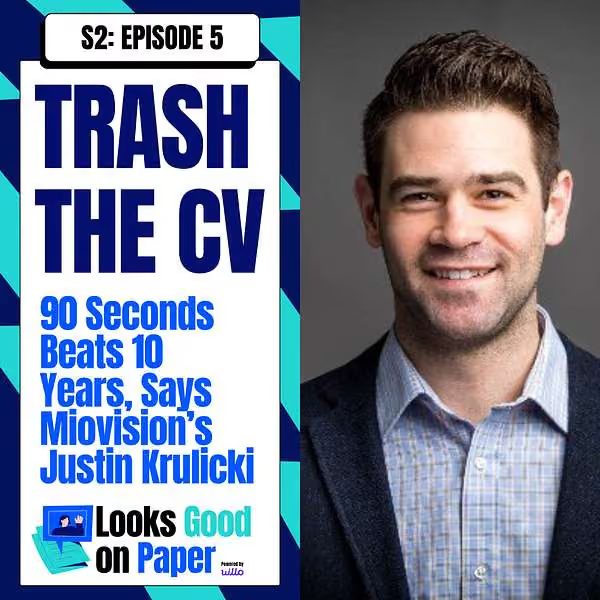
Trash the CV: 90 Seconds Beats 10 Years (Miovision) - (S2E5)
Subscribe on:


What if your best hire lists 4 years on paper, but delivers 8 years of outcomes?
Miovision’s Global Talent Acquisition Manager Justin Krulicki, breaks down why tenure and industry bias are quietly derailing your hiring process, and how a 90-second video intro can beat a CV before you even read it.
In this episode you’ll learn:
- Why “years served” is a weak signal, and what better metrics to use
- How to cleanly structure interviews into Technical ▪ People ▪ Values (without overlapping)
- Why we asked for 90-second intros in one real req: 5,000 resumes. Zero portfolios. Three videos. Only the videos got callbacks
- How well-trained interviewers (not repeating the same question six times) prevent groupthink
- What a “no-CV” future could feel like, and how AI might soon rank those intros before you open a resume
🎧 Listen on Spotify
Watch on Youtube
Connect with Justin Krulicki
Linkedin
About Miovision
Miovision builds intelligent mobility solutions that help cities optimize traffic in real time. Think AI + camera systems + computer vision to understand movement across cars, cycles, and pedestrians.
About Looks Good on Paper / Willo
Looks Good on Paper is our interview-first podcast. It surfaces practical operator lenses for hiring, team building, and leadership. Powered by Willo.
⏱️ Chapters
00:00 — Outcomes over years
00:28 — The real cost of tenure & pedigree bias
02:00 — Passion & outcomes as hiring currency
02:35 — Avoiding bias: measure tech / people / values
03:45 — Trained interviewers vs. groupthink
07:00 — No-CV intake: 90-second intros & the 5,000-resumes story
11:20 — Tooling: ATS, AI & video-first recruiting
13:20 — Wrap & next steps
Show Resources
- Willo: willo.video - The most cost-effective way to screen candidates at scale. Interview candidates anywhere & at any time
- CV Free Toolkit: cvfree.me/join - Break up with the CV and get everything you need to modernize your hiring approach with skills-based assessments
- Anita Chauhan: linkedin.com/in/anitachauhan - Connect with the host
Anita Chauhan
Hi everyone and welcome to our next recording of the Looks Good on Paper podcast powered by Willo. I'm here today with Justin Krulicki, who is the Global Talent Acquisition Manager at Miovision, where he helps scale teams that are building the future of smart cities. Pretty cool. Formerly with Masterclass, he's led hire across Canada, focusing on engineering talent and helping companies attract the best through thoughtful human-centered recruitment. Justin, thank you so much for being here with us today.
Justin Krulicki
Yeah, thank you for having me.
Anita Chauhan
It's be really fun conversation. think what you guys are building is super cool and your background is so cool. So I'm excited to hear your thoughts on my three questions plus a wild card.
Justin Krulicki
Yes, I'm especially excited for the wild card, so let's How do it.
Anita Chauhan
I'm also excited. I never know what it's gonna be until I say it. So I just come up with it in this part of the moment. But why don't we jump in? You know the drill. Three questions, speed dating style, rapid fire. Same every season. So first one. What's the biggest hiring mistakes companies keep making even though they know it's clearly not working?
Justin Krulicki
Yeah, good question. So I think one of the biggest mistakes that companies often make is they get very fixated on industry experience. They get very fixated on, want 10 years of experience, I want five years of experience. And they realize the mistake becomes they're also discounting. A lot of folks maybe have four years of experience and won't apply. But also it's not about number of years of experience to me. It's about what you've accomplished. And I can't count how many candidates I've come across where they have maybe a little bit less years of experience, if you will, than maybe an ideal candidate for a role, but what they've accomplished is so impressive that it equates to somebody who's maybe spent eight to nine years in a role. And so, yeah, it's a mistake I've seen kind of throughout my recruiting career, hearing it from others in my network as well. That's become a big mistake is how fixated they get on the number of years of experience they're looking for.
Anita Chauhan
Yeah, definitely. I also think like there's no accounting for like passion, right? So like as like a hiring manager, how How do you optimize for things like that?
Justin Krulicki
Yeah, I think it starts with your company and having, whether it's company behaviors, company values, and being able to then make a data-driven decision because you've interviewed them based on that, right? An ideal process for me is you've got attributes associated with the ideal candidate and what you're looking for, accomplishments, experiences, but then you How do have company behaviors or values and you're assessing for that as well. And then when you have the combination, you're finding the ideal candidate.
Anita Chauhan
Yeah, for sure. And especially if you are working with a hiring manager or department manager, understanding their needs at that moment and bringing that into account as well, Awesome.
Justin Krulicki
Yeah. Yeah, exactly, Yeah.
Anita Chauhan
Awesome. And so from your experience and the stuff that you worked on, How do you make sure that this actually goes through your whole team and make sure that this actually can, know, people don't just look for pedigree or look for time spent or just rely on like a resume and what they're seeing when they're hiring.
Justin Krulicki
Yeah, I mean, I'm myself pushing back pretty hard in the intake call and, you know, talking about some profiles that I've maybe found for the role because I know what's coming down the pipeline and hey, here's a couple options. You know, I'll give you a good example. There was a role I was trying to fill a while ago, this had been a few years ago, where the hiring manager was pretty adamant that they wanted a sales manager who had, you know, 10 years of experience and had managed teams before. And I presented that type of candidate, but I also presented a candidate who had never been a sales manager before, but they had learned from three other managers, two of which were phenomenal, the other was not great. And so they had told me on the call when I was doing my recruiter call, hey Justin, here's what I've learned. Now here would be my approach in this first ever sales manager role for me. And we ended up actually bringing them through the interview process and I think it maybe accepted another offer, but the point is most companies, the mistake they would make there is they would discount that candidate instead of trying to see more of a diverse profile based on different types of experience. And I think that's a mistake companies are really making. They don't look at diverse profiles. They are very fixated on one specific and not always the best way forward.
Anita Chauhan
Absolutely.
Oh, and I feel like, you know, the rigidity can like really exclude some really good opportunities, right? Also, just going to say, I was like, I've done a lot of hiring. So I'm I'm not a recruiter, but I worked adjacent a lot. I'm a hiring manager. And one thing I How do see is like not everybody is meant to be a people manager, too. So for this case as well, you know, you could have a 10 years, but you could be someone who doesn't really enjoy doing it. So bring someone in that has the passion.
Justin Krulicki
for sure.
Yeah.
Exactly.
Yeah, and like it's not all about the specific requirements to your point. It is about the passion and what they can bring to the team. know, industry experience is another one where companies get very fixated on, want this industry experience, but that can actually eliminate a lot of very innovative candidates that have worked in a different industry. can bring a different mindset that will elevate the product that they're trying to build, let's say. And so that is another mistake that I think they need to avoid.
Anita Chauhan
Absolutely. I like there could be a litany of them, but we're going to be very positive here. All right. And on to question number two. What's a hidden bias companies unknowingly have even when they think that they're being progressive in their higher practices?
Justin Krulicki
Yeah. Yes.
Yeah, I think it comes down to not the ones that aren't making the most data-driven decisions, right? you know, in the end they feel like they've had a strong interview process and I've put a candidate through, you know, five interviews, but in the end, maybe the five interviews really started assessing the exact same things. And they're not really, you know, they're not assessing specific items. We talked just a few minutes ago about behaviors or company values and then attributes. And I've always broken it down to, you should have technical must haves you're looking for. Then you should have kind of people competencies and then you've got your values for your company. then you can make the most data-driven decision. And I think a lot of bias comes into play when, yeah, maybe the candidate meets with six different interviewers and you think you've got this amazing and long process that's gonna bring you the best decision, but in the end you're not actually focused on enough specific items and then bias starts to creep in because you haven't focused on those items. Mm-hmm.
Anita Chauhan
Yeah. And just as a counterpoint, I wonder, you know, if we are optimizing for company values and we're thinking about this, what can we How do to combat potential group think that comes from that, that then would be replicated across all of the interviews that this person would have?
Justin Krulicki
Yeah, yeah. You know, I think, yeah, I say that question again. I'm, yeah, yeah.
Anita Chauhan
Yeah. So I'm wondering, like, you know, if you're having these six, let's say six rounds of interviews and we're trying to optimize for company values and we're looking for a certain thing, maybe we're looking for a certain type of person that looks like the rest of the team, how How do we avoid that? How How do companies avoid pushing those things and bringing in those diverse candidates, but still optimizing for a fit?
Justin Krulicki
Hmm.
Yeah, I mean, I think it's the type of interviewers you have, right? They're well trained. They understand how to dig in a little bit deeper than just a surface level question as well. Yeah, I feel like that can get you to where you wanna be. Yep, yeah, yeah.
Anita Chauhan
for sure. Awesome. Okay, and our third question. If you were to suddenly remove CVs from your current hiring process, what would that look like?
Justin Krulicki
Yeah.
Yeah.
Yeah, I love this. I've pushed for this to be honest that I've posted about this. Yeah. So I've always said, I think the way forward is you're applying with a portfolio, right? You're applying with a personal website and I get it can be tough for recruiters to go through 500 potentially personal websites. But look, I put a post out recently that talked about, Hey, you want to stand out in this market. Candidates are complaining. They're not getting, you know, responses back and I'm qualified and so on and so forth. And I told them just send a of yourself explaining why you're qualified, create a portfolio, whether it's a PDF, whether it's a PowerPoint, something different than a resume to make you stand out. I had 5,000 applicants for a recruiter role and I had maybe three send me a video and I had zero send me a PDF or portfolio. And if one person just sent me that PDF or portfolio, I was gonna give them a call no matter what. Zero out of 5,000. And so that to me is the way forward, right? It showcased some work and add a video to explain why you're so motivated and maybe you're not the most qualified person but you've got that energy that you know that the recruiter's looking for. I look at a resume for about 10, 15 seconds, gives me a decent picture of you know, their profile and their experiences. It might be the last time I look at that resume to be quite honest. They're not contemporary anymore. And yeah, I think there's way better ways to showcase who you are. Resume gives you that snapshot, but you've got to build off the snapshot is what I always say. And that, yeah, that's going to give you a bit. Look at, you're never, the other thing I always say is you're not applying, you're not applying to get a job. you're applying to get an interview. Once you get the interview, a lot of things, variables can come into play and you're finally in and you're able to showcase yourself and what you can bring to the table. It's about getting that first conversation. And I think if candidates flip their mindset to that, might change the thinking around, I'm gonna just submit my resume to a million jobs. Yeah.
Anita Chauhan
Hmm.
Yeah, absolutely. And how they actually arrive and present themselves for sure, right? Yeah.
Justin Krulicki
Exactly, Yeah, yeah.
Anita Chauhan
I think it's at this point like a numbers game. lot of them are just like applying to everything. So it's just, you know, it's hard out there for sure. But it's I think it's a symptom of where we are right now and the way that things are working when it comes to hiring that candidates are finding the jobs that they want or they feel like they're getting passed over and recruiters feel like they can't find the people to fit the roles because people aren't shining or able to really step out from the crowd. Five thousand recruiters are applying.
Justin Krulicki
for sure.
It's true, yeah, absolutely.
Anita Chauhan
Yeah, and you said two very important things about that. this podcast is actually powered by Willo. Willo is a one way video interviewing tool. So we're big advocates of that as a screening process. Yeah, we see this as probably obviously the next step of, you know, how hiring should be. But one of the things that we care so much about is the idea of decentering the CV because there are like, to your point, so many better ways to showcase your talent. We're also to assess and screen, especially for people in your roles. Like, how are you going through all of these candidates and actually finding people that are fit, right? If you're just using the resume as a snapshot. But there's a lot of hesitancy to remove the CV from the process. I think there's a lot of people that are holding on to it. And one of the reasons I asked this question is because I want us to dream big. Like, what would the world look like if we didn't have the CV? It's been around since 1482.
Justin Krulicki
Mm-mm.
I know. Yeah, I mean, I'd be excited to see what it looks like. I think, you know, I think we can get there. But that being said, I How do think then there's probably the need for additional tools. Like I would love for people to apply with a video and a portfolio. But again, the reality is how can I then go through potentially 500 applicants of videos that are, you know, five, six minutes in length, but AI is improving. Well, what if there was AI that could evaluate the videos, right, so to speak, and understanding the things that Justin specifically looks for, which might be different than Anita too, right, but it has my persona to it, and then maybe that AI program can evaluate those folks. And then, to me, we're always still gonna jump on a call, right, we are, because I think the human can dive deeper and pick up on, you know, tones and stuff like that, but that would be the dream scenario for me, yeah.
Anita Chauhan
Energy, absolutely, absolutely. I love that future. Speaking of like, you know, tools and tech, the wild card question here is tell us a little bit about your tech stack right now. I'd love to hear what you have going on and what your favorite tools are for hiring right now.
Justin Krulicki
Yeah, well, it's a good question, it's good timing. So I joined Miovision about a year ago. Miovision has done a ton of hiring in a fantastic way with very limited resources and tools. You know, we use an ATS Jazz HR, which is not necessarily scalable, but quite good for what you pay for. And we use LinkedIn Recruiter, and that's pretty much it. But I come from a world previous to this where I saw the benefits of Greenhouse, and I saw the benefits of Jam, and the integration and doing sequencing. And so the answer is we don't have much from a tooling perspective right now. However, and I've used Vidyard actually as well to How do video outreach. So one thing I How do for more senior roles, VPs and stuff like that, I'll send a personalized video when I'm sourcing instead of a message. And that has brought back some extra results. So our tech stack will likely include something like that. It'll include a new ATS that's going to be much more robust some AI functionality in there as well, sourcing automation, scheduling automation. So that's the future state in 2026. And then we're going to give candidates a far better experience as well. That's the goal.
Anita Chauhan
I love it.
Amazing. Awesome. I love hearing it. think one of things that we hear a lot and I hear being in the space is people just want AI, but they don't know where they're going to use it. So I like that you're being thoughtful about how you're going be using it in your process. Awesome. Thank you so much for your time, Justin. It was really great chatting with you. I'm really excited to have your thoughts out there in the world. And yeah, everyone stay tuned for the next episode of Looks Good on Paper podcast.
Justin Krulicki
Yeah, no for sure for sure
Thanks Anita.

More episodes from the Looks Good on Paper podcast
Stay close to the conversation
New episodes, hiring insights, and data-informed thinking — delivered occasionally and intentionally.