76.9% of hiring teams now use AI in parts of their recruitment workflow. Yet not a single one believes AI can handle every stage of the hiring process on its own.
This tension captures the state of AI recruitment in 2026. Employers use AI to summarize information and analyze patterns. But they don’t trust it enough to fully replace human oversight in final hiring decisions.
To understand exactly where things are headed, we spoke to 100+ HR professionals in our 2026 hiring trends report.
Here are the 5 top AI recruitment trends shaping hiring in 2026. Plus what they mean for recruiters and talent acquisition leaders today.
1. AI Adoption Has Gone Mainstream But Teams Are Still Finding Their Feet
In 2026: 76.9% of employers streamline parts of their hiring workflow with AI, and 64.9% do so more than they did last year.
.webp)
The point? AI is now part of everyday recruitment. At Willo, we see this shift happening in real time. 70% of our customers use Willo Intelligence to review interview insights faster and more confidently.
A quick look at the issues with no-AI recruitment quickly explains why more talent teams are moving away. Without machine learning, high-volume hiring stays manual and slow. And employers with limited resources often chose referrals over standard recruitment processes.
Julia Arpag, Founder and CEO of Aligned Recruitment, explains it succinctly:
“We work with a lot of in-house talent acquisition managers and specialists, and we just see how overwhelmed they are. Obviously, when they open up a job for hiring and get hundreds of candidates in like a day, how do you sift through? …Typically, the company will just go and find someone that they know."
But now, thanks to artificial intelligence, you can:
- Access instant interview transcripts and summaries,
- Compare applicants against consistent criteria, and
- Spot top talent worth moving to the next stage, and
- Make scheduling interviews (live) as seamless as possible.
If you’re already implementing AI-powered tools into your hiring practices, our guide on ethical AI candidate screening will help you avoid common pitfalls along the way. And if you’re looking to begin or increase your AI usage moving forward, here are a few talent strategies to keep in mind:
- Embrace AI where it removes friction, not humanity. Routine tasks like interview transcription and summaries are sweet spots for AI. But for decisions that hinge on context, empathy, and negotiation, people must lead.
- Don’t follow the bandwagon. Find your why first. Look closely at the bottlenecks in your hiring process, then bring AI in where it can ease your work.
- Be transparent with your processes. Clearly define what AI is or isn’t helping you with. This clarity grounds your team and ensures that candidates don’t feel as if they are being evaluated by an impersonal machine. It also helps with compliance and employer branding.
The takeaway: AI is here to stay, and the teams that get it right will be those approaching it thoughtfully and incrementally.
2. AI-Assisted Applications Make it Harder to Assess Candidate Authenticity
Talent leaders today increasingly use AI to streamline processes, but so do job seekers. This explains why 76.6% of employers now get AI-assisted applications and struggle to verify authenticity.
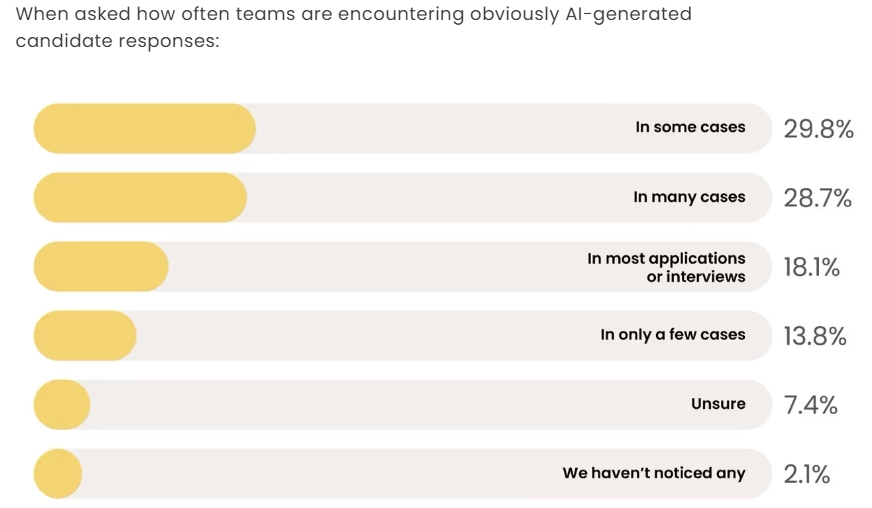
This doesn’t mean that every AI-enhanced application is unreliable. It has simply become harder to tell what is truly coming from the candidate and what has been heavily shaped by AI.
Host of Willo’s Looks Good on Paper podcast, Anita Chauhan, affirms this issue:
“Right now we're seeing a huge increase in the number of AI-generated CVs, applications. Basically, if you've got a written-based application process, AI is completing it for you.”
So candidates leverage AI to instantly polish their credentials and generate perfect interview answers. But rather than being spoiled for choice, HR leaders falter.
Because in a pool of AI-enhanced talent, the most valid questions are:
How can I tell whether I’m reviewing a candidate or the version AI models helped them create?
and
Does the person behind the application think, communicate, and perform at the level they claim when it matters?
Our take on the way forward:
- Move beyond written applications. For example, video/audio interviews make it more difficult for AI to do the heavy lifting. Candidates have to explain their thinking out loud and can’t rely on generated text while recording.
- Ask questions that reveal processes. Ditch the usual broad questions like “Why are you a good fit for this role?” and get more specific. Ask candidates to walk through how they solved a problem or made a decision. It is harder to fake experience when you have to give context.
- Look for consistency across touchpoints. A candidate’s CV, screening response, and live interview should tell the same story. If someone’s written application is perfect, but they can't explain the same experience in conversation, pause to reflect. It may be about what they’re more comfortable with, but it could also signal a skill gap that’s worth investigating.
The takeaway: Authenticity will become harder to judge as generative AI tools improve. Instead of panicking or rejecting candidates with AI tells, ask them to prove themselves beyond the polished version on paper.

Every Candidate Sounds Great on Paper. Now What?
Get 20+ AI-proof interview questions - with follow-ups that spot the difference between real experience and a rehearsed answer.
3. Human Judgment Is More Valuable Than Ever As AI Use Continues to Grow
No doubt, AI aids faster candidate screening and high-volume hiring. But when the scales tip too far in favor of AI over human input and judgment, it leads to myriad problems, from subtle biases to compliance risks and missing out on top talent.
That’s why organizations aren’t rushing to paint over everything with an AI brush. They get that tasks like salary negotiation, final hiring decisions, onboarding, and cultural integration must stay human-led.
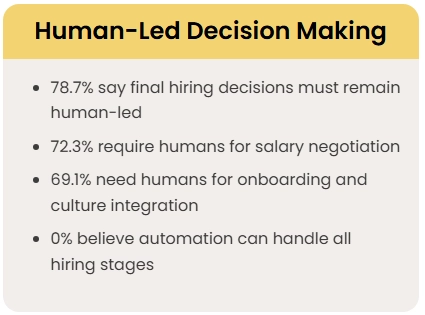
Because yes. AI in recruitment is great, but humans must take the front seat.
AI can summarize what a candidate said. But it cannot fully understand why they said it or how they might grow into a role.
AI saves time by automating hiring tasks like resume parsing and feedback organization. But you can't trust it to independently qualify candidates or handle conversations that demand tact and empathy.
At the same time, global AI hiring policies call for certain levels of transparency and human-centricity. So while AI driven recruitment has its upsides, it falls sorely short in critical thinking and genuine relationship building.
Then there are the issues of AI-assisted applications and figuring out authenticity we discussed earlier; combined with AI screening, it’s like AI evaluating AI.
Take Tyler Independent School District, for example. The company's HR Coordinator, Artimese Braddy Lawrence, says Willo helps surface genuine candidates. In her words:
"With AI, a lot of resumes and cover letters are automatically generated. So how do we really tell if, on paper, this person is who they are? This (async) live interview recording has helped us determine who we would like to invite for a further interview."
This human judgment layer gives recruiters room to notice things AI may miss. E.g., how a candidate explains experiences, their confidence, whether their story is consistent, and if they’re truly interested in the role.
How to center human judgment in your recruiting workflows (with or without AI):
- Create moments for candidates to show up as themselves. AI can easily polish resumes and cover letters. But structured video interviews and role-based questions clarify candidates' thinking and communication skills.
- Do not ignore your gut feeling or rely on it completely. Human judgment is non-negotiable, but you will get the best from it when you back it with a standard process. Use standard questions, scorecards, and hiring criteria to avoid making decisions based on vibes alone.
- Keep sensitive conversations human. Salary negotiation, onboarding, and culture integration all need to be handled personally. Qualified candidates should not have to discuss such critical issues with a machine—it can come off as lazy, distant, or rude.
The takeaway: AI agents clearly have a part to play, but human recruiters put the H in HR, and hiring is fundamentally a people decision. Period.
4. Recruiters Now Rank Resume-First Screening Below Skills-Based Hiring; When AI is Involved
Many moons ago, resumes were the holy grail of hiring, determining whether a candidate got through the door or booted at the driveway. But many teams today center skills-based hiring: 40% are actively moving from resume-first screening and 10.1% already have.
The reason? Resumes can tell you what someone studied, where they worked, and the achievements they claim. But they can’t show how a candidate thinks, communicates, solves problems, or behaves in actual work environments.
So beyond the classic CV (and in this exact order), recruiters and hiring managers now trust more practical signals like these to match candidates efficiently:
- Behavioral interviews,
- Hands-on demonstrations,
- Real-time problem solving, and
- Portfolios or work samples.
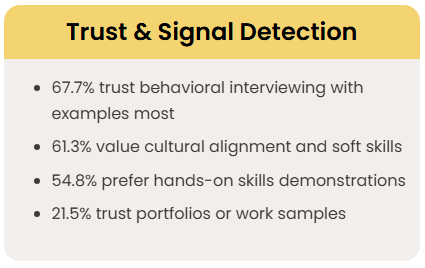
Candidates can edit, inflate, or AI-generate resumes. But with skills-based hiring, they must describe their experiences, solve real problems, or show how they would do the work in practice.
Anita Chauhan provides more context with her take on how just resume analysis gives too much power to a subjective document:
"According to Business Insider, 75% of people lie on their CVs. Or as some people would say, embellish the truth, which is probably just misleading in and of itself. Secondly, they're inaccurate, self-edited documents that have heaps of bias from the eye of the observer."
That’s why a candidate can look perfect on paper but find it difficult to defend their claims during an interview. And another candidate may have an “average” resume but perform much better when given a structured question or a practical task.
Here’s where AI recruitment tools with standard skill assessments and smooth integrations make a difference.
The wrong apps cause more issues, from scattered manual processes to siloed candidate profiles and tool toggling. But tested and trusted platforms like Willo do the exact opposite.
Willo supports multimodal screening through AI-powered video interviews, audio responses, file uploads, and text-based assessments. It also offers 24/7 user support, so no one gets stuck at any point.
That’s why teams like Madison Reed use Willo to move beyond resume-first screening to flexible video and audio responses. As Arianna Watters, Regional Talent Acquisition Partner at Madison Reed, says: “A resume doesn’t tell a story, a person does.”
This is the rationale for skills-based hiring. Candidates get ample room to show up more authentically and shine beyond a CV. And TA teams get clearer context to confidently choose who to advance.
Some best practices to explore for effective skills-based hiring:
- Only test skills that matter for the role. Don’t assess candidates randomly or based on gut feel. Outline the abilities, behaviours, and values that’ll enable success in the role, then build your job description and screening process around them.
- Keep screening questions and rigor consistent across candidates. Skills-based hiring is great, but it won’t save a flawed recruiting process where everyone gets judged by different standards.
- Review work samples and practical tasks instead. A portfolio can tell you a lot more about potential job performance than a resume ever will. Same goes for short work simulations, scenario-based questions, and hands-on exercises.
The takeaway: Skills-based hiring is gaining momentum because it centers the talent and expertise behind a perfect CV.
5. Structured and Fair Hiring Continues to Gain Momentum as Recruiting AI Evolves
Keeping candidate sourcing and screening processes objective is key to surfacing the best quality hire. So structured and fair hiring has been (and still is) a big topic in recruitment circles.
It’s easier planned than executed, though, especially without automation. But with the help of AI (among other factors), 72.8% of employers now feel more confident in the fairness of their hiring processes.
Most teams no longer leave fairness to chance or let personal preferences and gut feeling sway judgment. Rather, they combine preset hiring criteria and AI automation (76.9%) with:
- Uniform assessments (69.9%),
- Bias-awareness training (50%), and
- Diverse hiring panels (42.4%).
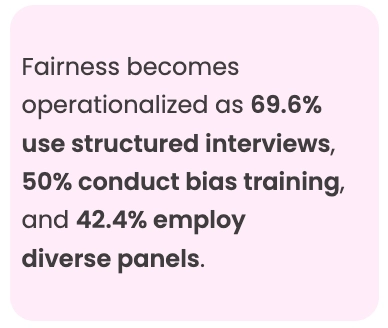
Where an unstructured process may have one interviewer prioritizing candidate confidence and others focusing on years of experience or alumni networks... Structure significantly reduces unfair screening. So beyond just saying every candidate has a fair shot, you must prove it by standardizing your interviews.
But fairness in hiring does not end at structure. Inclusion is also part of the conversation.
As Theo Smith, Co-author of Neurodiversity at Work, says:
“The biggest mistake is not providing people with the opportunity to show their best selves.”
On another note, equal treatment and fair treatment are not always the same thing. For example, some candidates may need clearer instructions or a different interview format to thrive. Fair hiring removes the systemic barriers that keep strong candidates looking mediocre.
Some practical bias mitigation strategies for recruiting teams:
- Train your team to spot bias. Bias isn’t always obvious, so it can easily go unnoticed. It may show up in who feels most familiar, went to a big name school, or reminds a hiring panelist of some past good hires. If you don’t train interviewers to detect bias, it can subconsciously cloud their decision making.
- Set up role-based scorecards beforehand. These help you turn interview feedback into unbiased, standard metrics for evaluating candidates. So, you don't have to rely solely on AI systems or whatever interviewers happen to remember in the moment.
- Use diverse interview panels. A single perspective should not carry the whole process. Assembling interviewers with varying backgrounds helps you assess candidates more holistically and fairly.
The takeaway: Fairness isn’t just driven by good intentions. It thrives when bias awareness, balanced assessments, and DEI co-exist.
Times are Changing: The Way You Hire Should, Too
As AI in recruiting evolves, hiring teams should consider each rising wave to design workflows that:
- Balance ethical AI implementation with human insight,
- Streamline repetitive tasks like bulk interview invites,
- Match increasingly high compliance expectations, and
- Deliver exceptional candidate experiences and predictive analytics.
Use Willo, the multimodal AI recruiting tool that combines async video/audio interviews with multiple choice questions and file uploads. These varied, nuanced inputs provide more candidate context so you can confidently decide who to move to the next stage.
Get a free 7-day trial or book a demo to see how for yourself.
.jpg)