If you're comparing TestGorilla and Criteria Corp, you're most likely trying to solve the same problem: too many applications, not enough time to screen them properly, and too much riding on the shortlist to get it wrong.
The challenge is that while both platforms are designed for structured pre-employment testing, they address different aspects of that problem.
- TestGorilla is built to get you from a pile of applications to a ranked shortlist as fast as possible — free filtering tools, a wide test library, and results that are ready to act on the moment candidates finish.
- Criteria Corp works best for teams where the cost of a wrong hire is high enough that speed takes a back seat. It offers deeper psychometric testing, game-based assessments, and structured interview tools designed to give you a more complete picture of each candidate before a decision is made.
To help you understand which one is the better fit for your team, we went through both platforms in detail. We review pre-screening, candidate assessment, scoring and ranking, team collaboration, and pricing, so you can make the call without the guesswork.
Here's the quick summary.
TestGorilla vs Criteria Corp: A 1-Minute Summary
- For pre-screening, TestGorilla is the clear choice for fast and cost-effective filtering. Qualifying questions and AI resume scoring are both free on every plan, built specifically to cut volume before assessment begins. Criteria's platform starts with an assessment. You're expected to bring a filtered candidate pool before it becomes useful.
- For candidate assessment, the choice depends on what you're trying to learn. TestGorilla provides more assessment tools: AI video interviews built into the core flow, 350+ tests, and auto-scored results across every tool. Criteria provides deeper options for psychometric testing. Five named psychometric categories, game-based cognitive and EI assessments, and adaptive testing.
- For scoring and ranking, TestGorilla gets you to a shortlist the moment assessments are completed — no recruiter work required to produce it. Criteria produce multi-dimensional profiles across cognitive, personality, EI, and risk categories. A richer picture of each candidate, but one that takes more time to act on.
- For team collaboration, the platforms solve different problems. If your hiring managers need visibility into ranked results, both platforms deliver. If your interview stage involves multiple evaluators rating independently before results are combined, Criteria's structured interview tool is built for that. TestGorilla isn't.
- For pricing, TestGorilla suits teams who want to start small and scale. The free plan is effective for screening a handful of applicants. Criteria suits teams who are ready to commit at volume; the uncapped subscription works in your favour if throughput is high and predictable.
If you're looking for a candidate screening tool or Testgorilla alternatives that let you screen faster, shortlist with confidence, and start with flexible payment for seasonal and year-long hiring, check out Willo.
How TestGorilla and Criteria Corp Compare Across the Candidate Screening Process: In-Depth Review
Pre-Screening: Which One Is Better for Early-Stage Filtering?
TestGorilla is the clear choice here. It has a native pre-screening layer built specifically for volume reduction — and it's free on every plan. Pre-screening isn't something Criteria was designed to solve; you're expected to bring a filtered candidate pool before the platform becomes useful.
TestGorilla
Before any assessment begins, you get two tools that cost nothing to run at any volume. Qualifying questions sit in front of the assessment as yes/no or multiple-choice knock-out gates. A candidate who fails them never enters the paid pipeline — no credits charged, no recruiter time spent.
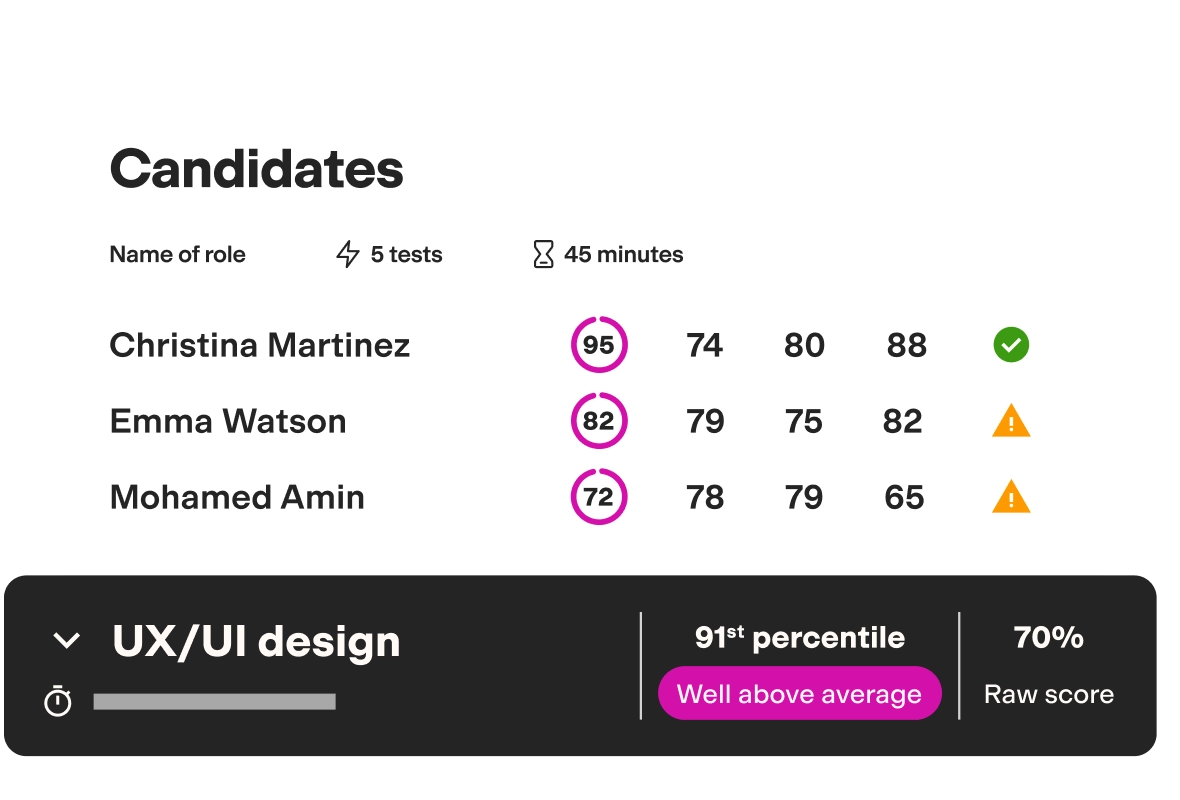
AI resume scoring evaluates every incoming resume against criteria drawn from your job description, strips personal details, scores each resume 0–5 per criterion, and ranks candidates by percentile against platform-wide data.
Both tools are listed as free on TestGorilla's pricing page regardless of plan tier. The commercial logic is deliberate: credits only activate when a candidate reaches the assessment stage. If you're managing 2,000 applications across 50 roles, the volume reduction happens entirely before you've spent a penny.
Criteria Corp
Criteria's platform starts with an assessment. Resume collection and candidate communication are supported, but there's no qualifying question layer, no AI resume scoring, and no knock-out filter before assessment begins.
That’s because the platform is built primarily for psychometric assessment, and it works best once a candidate pool has already been shaped. If you're bringing a pre-filtered shortlist, that entry point works. If reducing application volume is the problem you're trying to solve, that's probably not what this platform is built for.
What this means for your team
If your ATS or existing process already handles filtering, Criteria's entry point at assessment is a clean handoff. If it doesn't, you'll need to build that layer elsewhere before Criteria becomes useful — and TestGorilla's free pre-screening tools are the more complete answer to that problem.
Candidate Assessment: Which One Helps You Better Provide a Deeper Candidate Fit Assessment?
TestGorilla provides access to a larger domain of skill tests and faster testing time through auto-scored results. Criteria is built for psychometric precision: a curated instrument set, adaptive testing, and assessment categories that TestGorilla simply doesn't offer.
TestGorilla
TestGorilla's assessment is built around one idea: get you from job description to ranked candidates without your team doing the scoring work. The AI video interview is the clearest expression of that.
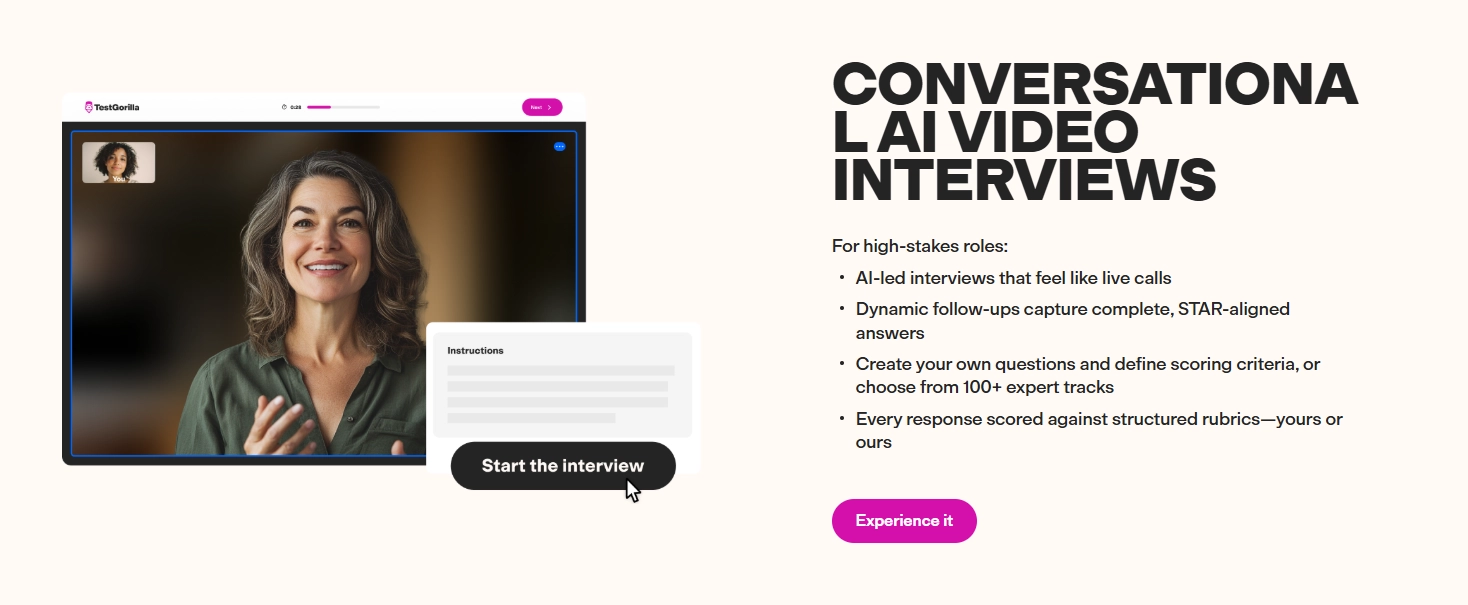
open the results view, and scores are already there — no phone screens scheduled, no calls conducted, no manual notes to consolidate. At high volume, that's not a minor convenience. It's the difference between a process that scales and one that doesn't.
The ceiling appears at psychometric specialisation. There's no dedicated emotional intelligence instrument, no workplace risk or integrity assessment, and no game-based format. If those matter for the roles you're filling, TestGorilla won't cover them.
Criteria Corp
Criteria's assessment is built for a different problem than volume. Where TestGorilla asks "how many candidates can we process quickly," Criteria asks "how accurately can we measure the ones who matter."
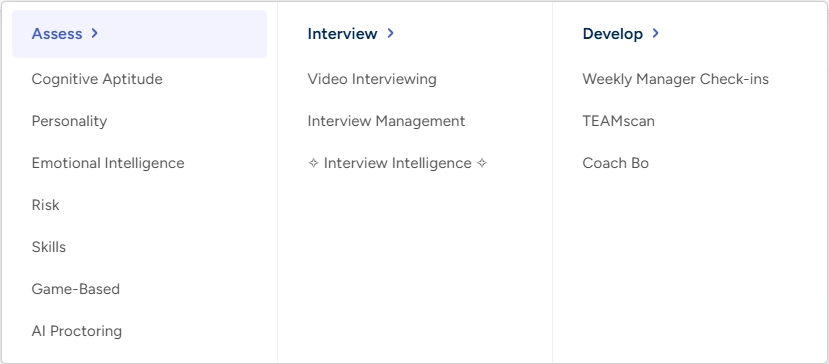
Consider the EI and risk categories in Criteria. Emotify — a game-based assessment — measures how candidates perceive, understand, and manage emotions in realistic scenarios. Similarly, the Workplace Safety and Productivity Profiles flag integrity and counterproductive work behaviour before a hire is made.
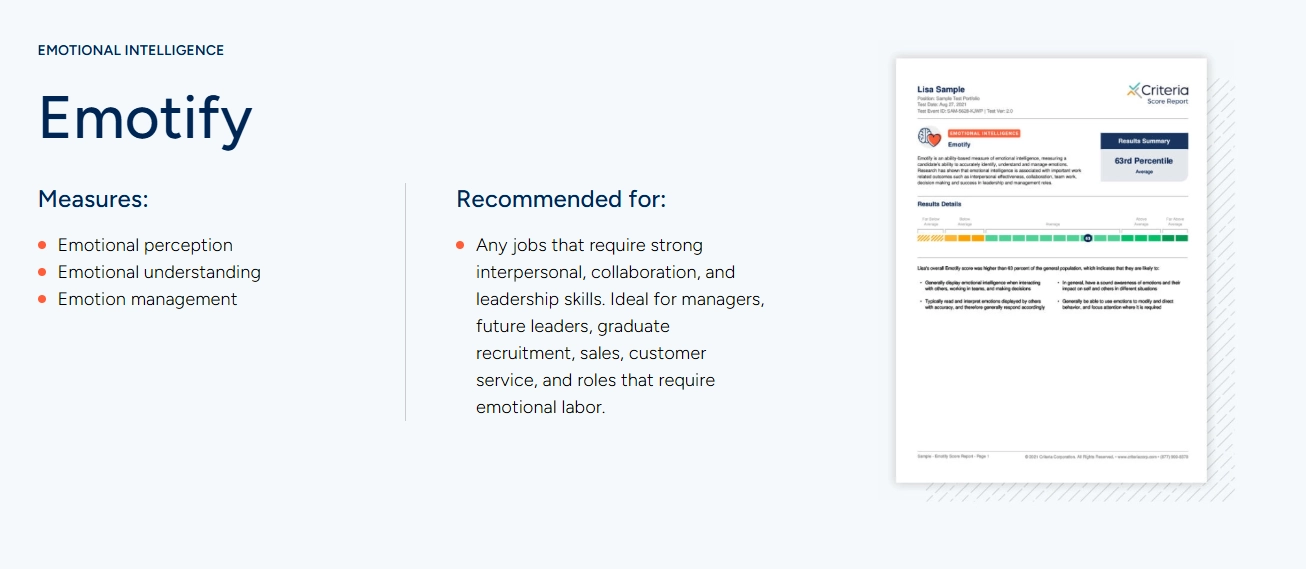
These features, compared against TestGorilla, reflect a fundamentally different view of what assessment should produce. If you're filling customer-facing, logistics, or safety-critical roles where a bad hire carries real downstream cost, that distinction is worth the interpretation overhead.
The trade-off is that Criteria requires more time and skill to set up at first. The output requires human interpretation before a shortlisting decision can be made, and at high volume, that interpretation time compounds quickly.
What this means for your team
If you're screening high volumes across a wide range of roles, TestGorilla's auto-scored, modular library is easier to action at speed. If the roles you're filling carry enough stakes that deeper measurement justifies the interpretation overhead, Criteria's instrument set gives you more to work with. High-volume teams hiring for customer-facing or safety-critical roles face the sharpest version of this tension — and Willo is the only competitor that solves it.
Candidate Scoring & Ranking: Which One Is Better for Identifying the Top 10%?
TestGorilla gets you to a ranked shortlist the moment assessments are complete — no recruiter work required to produce it. Criteria produces richer candidate profiles, but each one requires your team to read and interpret multiple score dimensions before a decision can be made.
TestGorilla: Faster option to get a ranked shortlist
Every assessment tool in TestGorilla auto-scores on completion. Skills tests produce percentile rankings calibrated against real performance data from across the platform. AI video interviews generate 0–5 scores per criterion, with clear reasoning attached to each one. Custom questions are scored by AI against criteria you set — or criteria the AI generates from your job description.
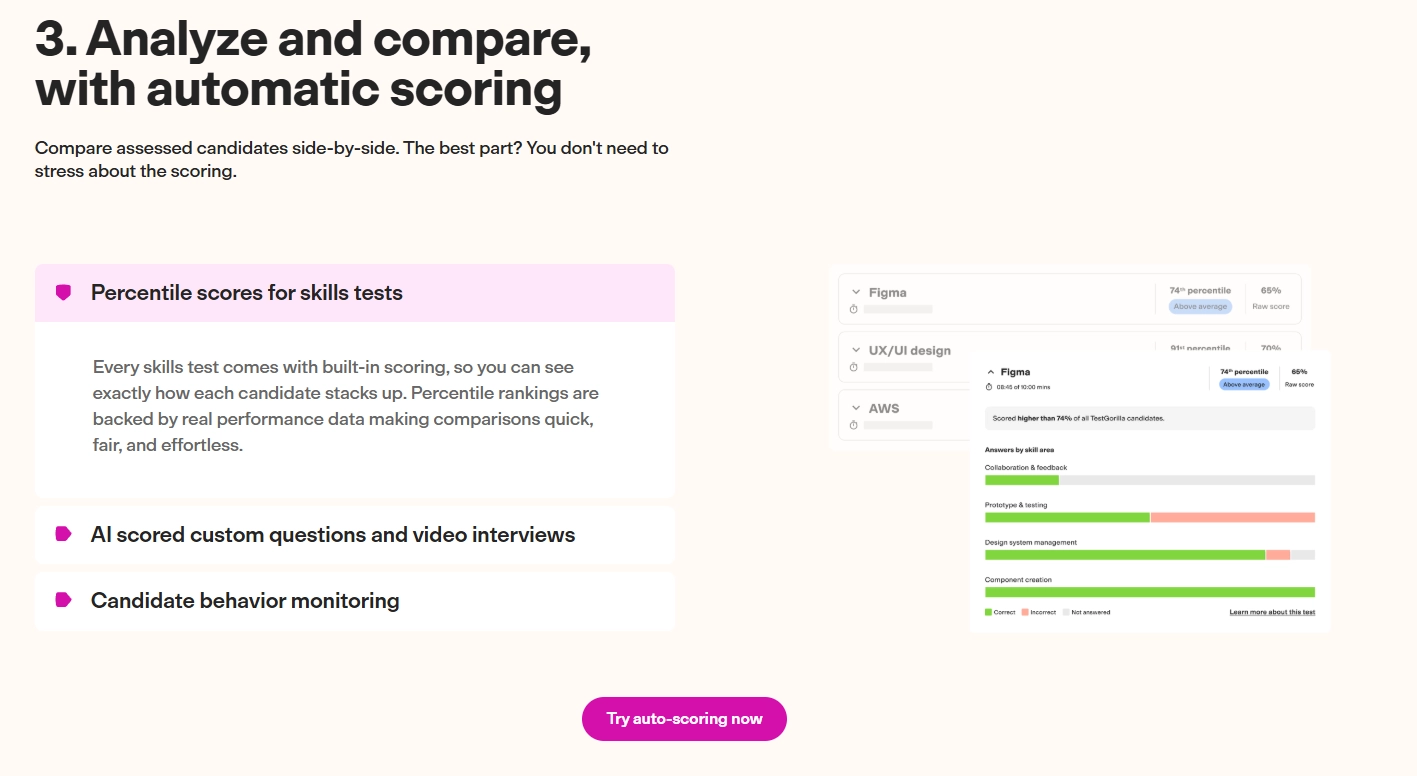
By the time you open the results view, the work is already done. You get a single dashboard where all candidates are ranked by overall score, per-test breakdowns are visible at a glance, and bulk actions are available to reject or advance groups without touching individual profiles.
One honest caveat: the weighting logic behind the composite score isn't disclosed in TestGorilla's public documentation. You can see per-test scores, but not the formula that produces the overall rank.
Criteria Corp: Richer profiles, more interpretation required
Criteria's scoring output is built around a different premise — that a single composite number flattens information that matters. Instead of a ranked dashboard, you get a multi-dimensional profile per candidate: cognitive aptitude, personality, EI, and risk categories, each producing its own score report in real time.
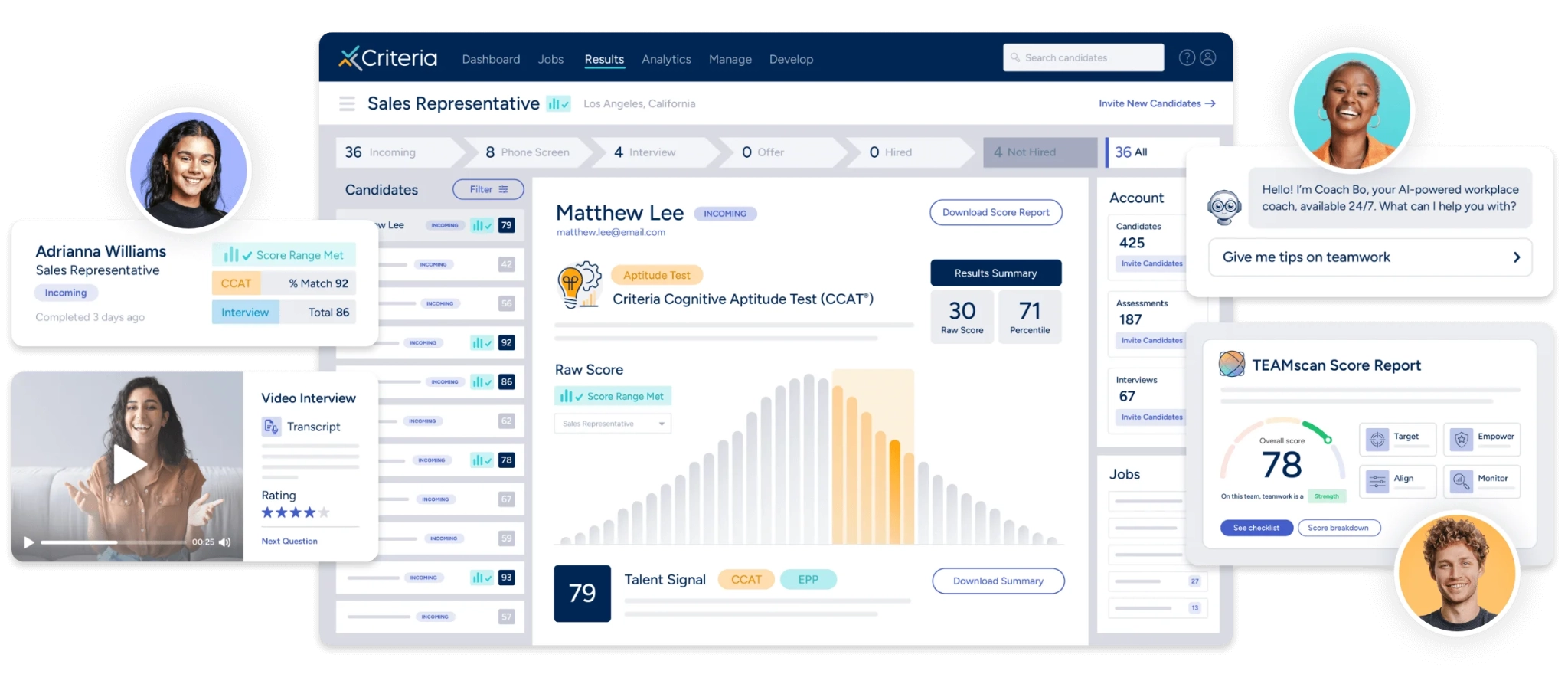
Additionally, cognitive scores come with validated predictive claims. EI and risk outputs give you a signal that a composite rank can't surface. For high-stakes roles where a wrong hire is expensive, that profile gives your team more to work with before a decision is made.
The operational consequence at volume is equally real. There's no auto-ranked dashboard. Every profile requires a recruiter to read and interpret multiple dimensions before the shortlist takes shape. At 50 candidates, that's manageable. At 500, it's a bottleneck.
What this means for your team
If your hiring cycle is driven by speed and volume, TestGorilla's auto-ranked dashboard is the more immediately actionable output. If your decisions are high-stakes and a wrong call is expensive, Criteria's multi-dimensional profile gives you more to work with — but demands more from your team to get through it. The right call depends less on which scoring model is more accurate, and more on which one your process can absorb at the volume you're running.
Team Collaboration: Which One Supports Better Hiring Decisions Across Your Team?
If collaboration means giving hiring managers visibility into ranked results, both platforms deliver. If it means running structured, multi-evaluator interviews where independent ratings are collected before anyone compares notes, Criteria has purpose-built infrastructure for it that TestGorilla doesn't match.
TestGorilla: Shared visibility, not structured evaluation
TestGorilla's collaboration model is built around the ranked dashboard. Hiring manager seats are unlimited at the highest pricing tier, ensuring any number of stakeholders can view candidate results, add notes, and flag candidates without consuming a paid seat.
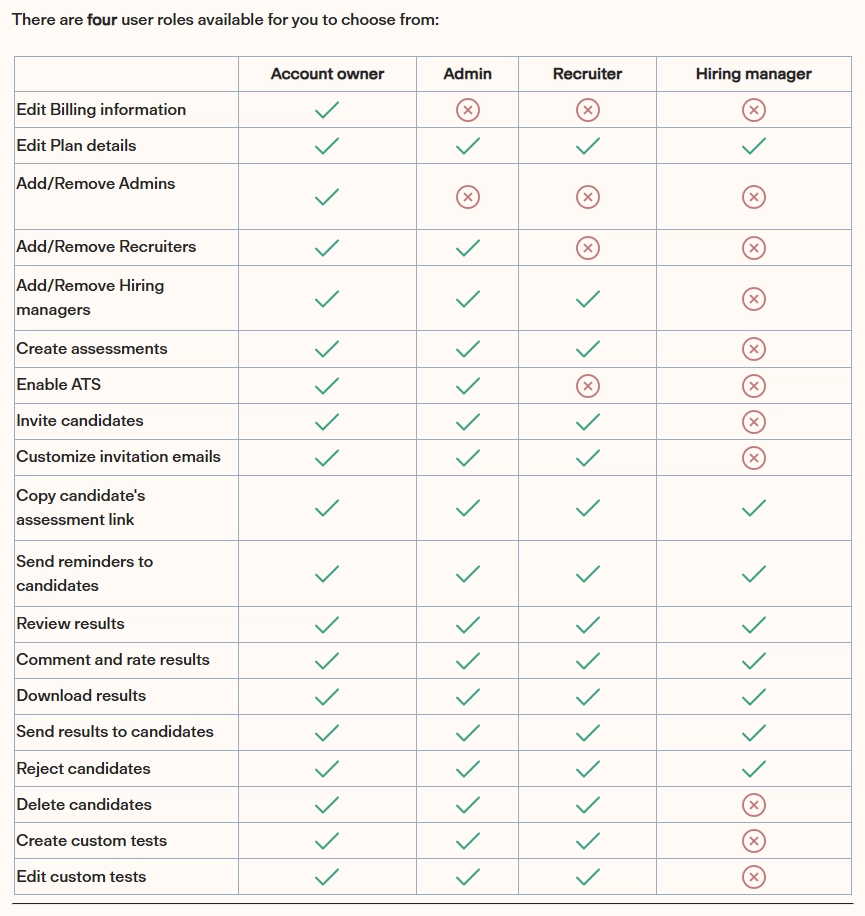
Everyone works from the same ranked list. No separate handoff, no results living in someone's inbox. For teams where collaboration primarily means "can my hiring managers see the shortlist and give input," that's enough.
The limitation is that there are no capabilities for multi-evaluator review. There's no described mechanism for assigning candidates to specific reviewers, collecting independent ratings before they're discussed, or preventing early consensus from shaping how the rest of the team evaluates. Collaboration happens around the output — not through a process built into the platform.
Criteria Corp: Independent ratings, structured by design
Criteria's live interviewing product is built around one principle: evaluators should rate independently before results are combined.
Each evaluator is assigned to an interview, receives a direct link on any device, follows the same question guide in order, and submits their ratings before seeing anyone else's. All scores flow back into a single view.
The deliberate separation is a bias-reduction mechanism — structured interviews conducted this way are associated with significantly higher predictive validity and lower evaluator bias than unstructured alternatives.
For high-volume hiring where shortlisting decisions need to be defensible, consistent, and auditable across multiple stakeholders, that structure matters more than it might appear on a feature list.
What this means for your team
The distinction here is less about feature count and more about what kind of collaboration your process actually needs. If your hiring managers need visibility into ranked assessment results and the ability to compare candidates, both platforms give you that. If your interview stage involves multiple evaluators whose ratings need to stay independent until they're collated, Criteria's infrastructure is built for that problem. TestGorilla isn't.
TestGorilla vs Criteria Corp Pricing: What You're Actually Paying
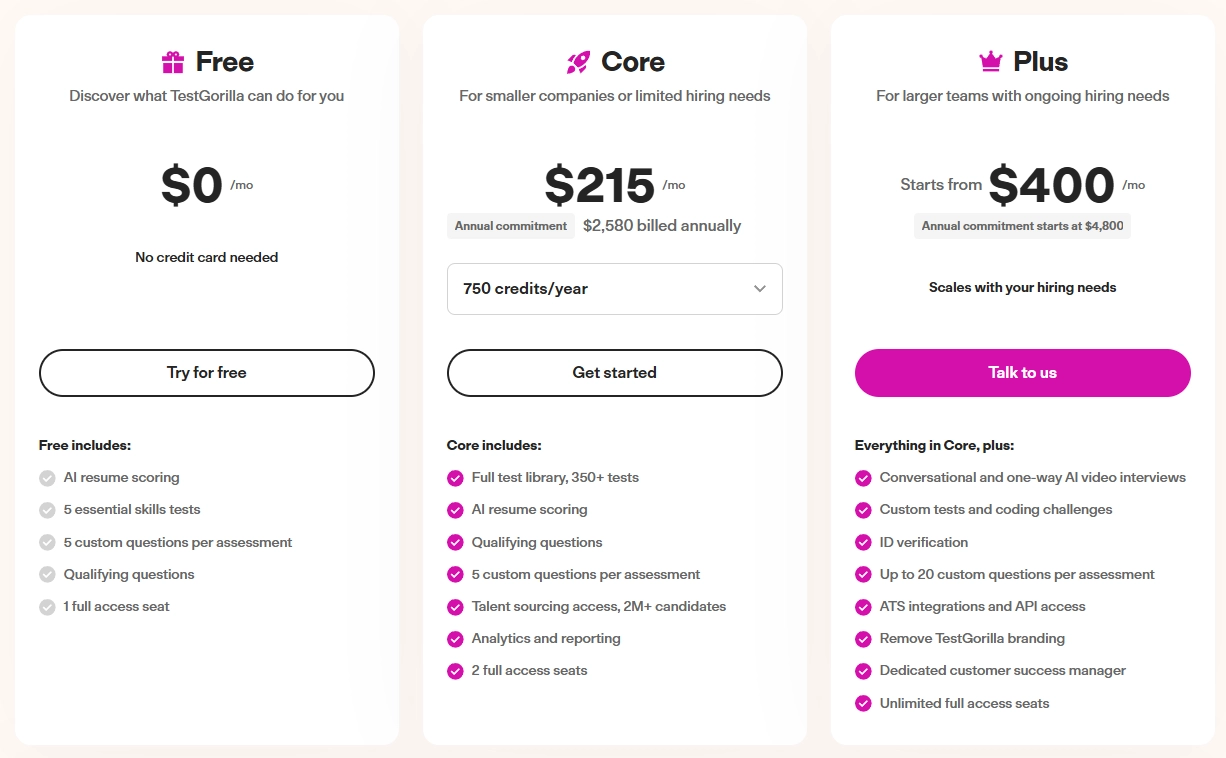
TestGorilla and Criteria price differently. TestGorilla’s pricing is credit-based [charged per candidate assessment] + an annual fee. Criteria uses an annual subscription model with uncapped usage and no public numbers.
Here's the breakdown.
TestGorilla Pricing
Credit costs per candidate:
- 0 credits — qualifying questions, AI resume scoring, custom questions
- 1 credit — skills tests, one-way video interviews, sourcing invite, ID verification
- 2 credits — conversational AI interviews
Credits are charged when a candidate starts an assessment. If they fail qualifying questions first, no credits are used.
For high-volume teams, this structure has a specific advantage: the volume reduction at the top of the funnel costs nothing. You only pay when a candidate reaches assessment — and the tier you're on determines which assessment tools are available to you.
Want to learn more about Testgorilla’s pricing? We cover 5 pros and cons you should know in this Testgorilla pricing review.
Criteria Corp Pricing
Criteria uses quote-based pricing that’s tailored to your needs. Here’s the breakdown:
All plans require a 12-month minimum commitment. Usage within your tier is uncapped, with multi-year and bundled discounts available on request.
For high-volume teams, the uncapped model is the key commercial signal. Once you're inside a tier, volume is absorbed into the subscription rather than metered per candidate. That works in your favour if throughput is high and predictable. The trade-off is that budget planning requires a sales conversation before you can run the numbers.
What This Means for Your Budget
TestGorilla's model suits teams who want to start small, prove value, and scale. The free plan is genuinely functional, pricing is public, and costs are tied to actual usage. Criteria's model suits teams who are ready to commit at volume. The uncapped structure benefits high-throughput organisations, but you won't know what you're paying until you've had the sales conversation.
You should also note that TestGorilla's most powerful features, ATS integrations and conversational AI interviews, are only available on the highest tier. On Core, you're running one-way video without ATS sync. Criteria's AI features — video interview scoring and AI proctoring — are add-ons at every tier. The base subscription gives you the assessment portfolio; full automation requires paying beyond it.
How to Choose Between TestGorilla and Criteria Corp for High-Volume Hiring
Neither platform is the right answer for every team. The decision comes down to where your process breaks down — at volume, at depth, or at the interview stage — and which tradeoffs you can live with.
Choose TestGorilla if:
- Your primary challenge is application volume. The free pre-screening layer reduces your candidate pool before a single credit is spent — no marginal cost, no ATS workaround required.
- You need a shortlist without recruiter interpretation overhead. Results are ranked and actionable the moment candidates finish — your team reviews decisions, not score reports.
- You're hiring for technical roles at scale. The programming library — IDE, code playback, algorithmic challenges, custom coding tests — goes deeper than anything Criteria offers on technical assessment.
- Your team is lean and needs to move fast. The AI job builder, auto-scoring across every tool, and bulk candidate management are built for small teams running high throughput.
- You want to evaluate before committing. The free plan is functional, pricing is public, and you don't need a sales conversation to understand what you'll pay.
TestGorilla might be a poor fit if:
- The roles you're filling require emotional intelligence profiling, workplace integrity assessment, or safety risk evaluation. These instruments don't exist on the platform.
- Your process demands psychometric depth over breadth — adaptive testing, role-specific personality variants, game-based formats — and auto-scoring isn't enough to justify the trade-off.
- You need post-hire development tools alongside your hiring infrastructure. TestGorilla's platform ends at the shortlist.
Choose Criteria Corp if:
- You're filling roles where a wrong hire is expensive and getting the right person matters more than processing speed. The EI, risk, and adaptive cognitive instruments are built for that level of scrutiny.
- Game-based assessment matters to your candidate strategy. Cognify and Emotify have no equivalent in TestGorilla.
- You need post-hire development infrastructure alongside assessment. The Develop™ suite — TEAMScan, Coach Bo, manager check-ins — covers territory TestGorilla doesn't touch.
- Your interview stage involves multiple evaluators who need to rate independently before results are combined. Criteria's structured interview tool is built specifically for that process.
- You run consistent, predictable volume and are ready to negotiate a subscription that absorbs it. The uncapped usage model works in your favour once you're inside a tier.
Criteria Corp might be a poor fit if:
- Your primary challenge is top-of-funnel volume. Without a pre-screening layer, the filtering burden sits somewhere else before Criteria becomes useful.
- You need to act on shortlists quickly. Criteria's output is richer, but each profile requires interpretation time that compounds at high volume.
- You need pricing transparency before a sales conversation. The quote-only model makes it harder to build an internal business case before you've spoken to their team.
- You need ATS integrations from day one at a lower price point. Criteria includes standard ATS integrations from their Professional entry tier — unlike TestGorilla, where integrations are gated behind Plus.
What is a Better TestGorilla and Criteria Corp Alternative for High-volume, Skill-based Hiring?
Willo is the only Testgorilla and Criteria Corp alternative that makes it possible for you to screen faster and shortlist with confidence, without a 12-month contract standing between you and your shortlist. Lite runs pay as you go, per live role, with no annual commitment. Enterprise runs on an annual plan, built for teams hiring at consistent scale.
- TestGorilla solves the volume problem well — free pre-screening, auto-ranked results, and a wide test library.
- Criteria solves the depth problem well — psychometric precision, structured interview tooling, multi-dimensional profiles.
- Neither of them ensures you get the hiring signals you can trust without trading off confidence, flexibility, or trust.
Here's how it works:
- One-link asynchronous video screening — with skill-testing and knockout questions built in. You send candidates a single link. They record on their own time, on any device, with no app download or login required. Multiple-choice knockout questions sit at the front of the interview — candidates who don't meet basic requirements are filtered out before a single video is watched. You only review the people who already qualify.
- Willo Intelligence — AI provides hiring signals you can trust. Every response is transcribed and summarised by AI: skills flagged, communication style noted, areas for follow-up identified. What you get isn't a composite rank — it's a qualitative read of each candidate that you can act on in 10 to 15 minutes per profile. The final call stays human. Willo's AI never grades, scores, or removes a candidate automatically.
- Authenticity checks are built into every interview. Willo detects whether a candidate is reading from a script or using AI-generated answers. In a hiring environment where 76.6% of teams are encountering AI-assisted applications, knowing whether the person in front of you is authentic matters before you invest in a full assessment.
- Flexible pricing, scoped to how you hire. Lite runs pay as you go at $59 per live role (as of August 2026), which suits teams with seasonal or unpredictable volume since you only pay for the roles you're actively screening. Enterprise runs on an annual plan from $3,799/yr, tailored to teams that want a fixed rate locked in at scale. Both plans come with a 14-day free trial. See current pricing at willo.video/pricing.
This fits your team if:
- You're screening high volumes and need to reduce the pile before anyone watches a video
- Candidate authenticity matters — you're hiring for roles where communication, energy, and genuine fit are selection criteria, not afterthoughts
- You want AI to support your reviewers, not replace their judgment
- You need flexibility. Lite fits seasonal hiring and variable volume, since you pay per live role only when you're screening, with no 12-month contract to commit to first. If you're hiring at consistent scale, Enterprise gives you a fixed annual rate instead.
- You're hiring across time zones and need candidates to complete screening on their own schedule
Want to see Want to see how it works? Get started with a 14-day free trial on Lite. Running enterprise-scale volume? Book a demo to scope Enterprise for your team.how it works? Book a demo to start your 7-day free trial.