HireVue is a structured hiring platform often chosen by enterprise teams that need standardized video interviewing, AI-assisted candidate screening, and audit-ready decision trails.
The platform enforces consistency across every stage of screening: standardized questions, assessment frameworks, scoring rubrics, and automated ranking before recruiters review candidates. That structure is the key benefit but also the potential trade-off.
If you're evaluating HireVue, the core question isn't whether it works. It's whether your hiring process actually requires AI-enforced decisions before human review, or whether that same structure creates friction when your recruiters still need to make the call themselves.
HireVue at a Glance
Pros ✅
- Enterprise-grade compliance infrastructure: FedRAMP authorization, SOC 2, ISO certifications, and third-party algorithmic audits built in
- Handles massive screening volume: Designed to process tens of thousands of applications with automated pre-filtering
- Enforces consistent evaluation: Standardized rubrics and templates prevent drift across distributed hiring teams
- Deep ATS integrations: Mature bi-directional sync with enterprise platforms reduces duplicate data entry
- Comprehensive audit trails: Every action logged for defensible, compliant hiring decisions
Cons ❌
- No transparent pricing: Starts around $35k/year; true costs unclear until after sales conversations
- Requires dedicated operations ownership: Configuration, template maintenance, and ongoing administration demand full-time attention
- Long implementation runway: 6+ weeks before the system is functional; not suitable for urgent hiring needs
- Rigid workflows: Making mid-cycle changes often requires duplicating and reconfiguring entire interview templates
- AI ranking opacity: Scoring logic isn't always transparent; recruiters often watch videos anyway, despite paying for automation
Exploring multiple options? See our complete guide to HireVue alternatives to compare platforms based on pricing, implementation speed, AI approach, and candidate experience.
Why You Can Trust This Review
At Willo, we live in the candidate screening space every day. This review is grounded in real implementation patterns, verified user feedback, and direct platform comparison.
Here's what we did:
- Analyzed verified user reviews: Scanned recent G2, Capterra, and TrustRadius reviews for recurring patterns—specifically looking for themes mentioned by multiple users across different organizations
- Fact-checked against live documentation: Pricing estimates, feature availability by tier, and compliance claims verified against HireVue's public materials and G2 data
- Compared against agency and mid-market needs: Scored against hiring team priorities, recruiter capacity, speed to hire, candidate experience, and total cost of ownership
This guide should give you a clear view of where HireVue adds value, where it might not, and how it affects your team’s approach to hiring.
HireVue Pricing: What It Actually Costs
HireVue does not publish transparent, self-serve pricing. According to G2 reviewer data, pricing starts around $35,000 per year for the Essentials package, with Enterprise plans requiring custom quotes.
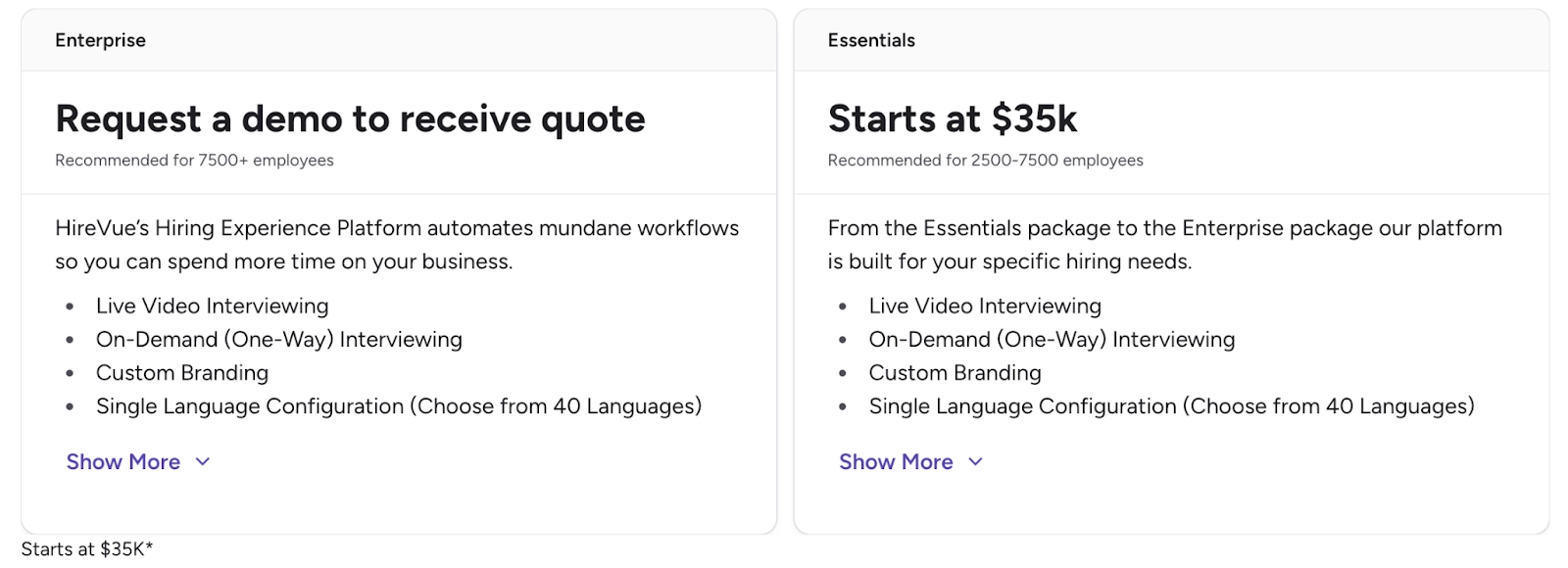
The pricing structure itself tells you how HireVue is meant to be used: as a company-wide hiring infrastructure, not a role-by-role or seasonal tool.
HireVue Pricing Tiers (Based on G2 Data)
Essentials (starts around $35k/year)
Typically recommended for organizations with roughly 2,500–7,500 employees. Includes:
- Live and one-way video interviewing
- Custom branding and configurable interview questions
- Candidate support and accessibility accommodations
- Scheduling, interview retakes, and response-time controls
- Enterprise roles, permissions, and SSO
- Core compliance coverage (GDPR, SOC 2, ISO certifications)
This tier covers structured video interviewing mechanics but excludes advanced assessments, AI screening, and analytics features that define HireVue's enterprise positioning.
Enterprise (custom pricing, typically 7,500+ employees)
Enterprise plans extend beyond interviewing into full hiring governance and automation:
- Role-based, game-based, coding, and audio-only assessments
- AI-supported screening, benchmarking, and adverse-impact testing
- Advanced analytics and validated assessment content
- FedRAMP certification and expanded compliance controls
- Deep ATS integrations and dedicated customer success ownership
- Multilingual and multi-brand configuration at scale
At this level, HireVue functions as hiring infrastructure—the platform enforces how screening, evaluation, and documentation happen across the organization.
What the Pricing Model Implies
HireVue's pricing assumes you are committing to a standardized hiring operating model with internal ownership and long-term, high-volume usage.
Costs scale with:
- Number of candidates processed annually
- Breadth of modules enabled (assessments, AI, analytics)
- Compliance and security requirements
- Integration depth with enterprise ATS systems
G2 reviewers frequently note that HireVue becomes cost-effective when hiring volume is consistent and enterprise-wide. When usage is uneven, limited to certain roles, seasons, or departments, the economics are harder to justify.
Key Takeaways for Your Budget:
- Calculate total cost of ownership (TCO): Factor in the base subscription, implementation costs, internal hours for configuration and maintenance, ongoing training, and ATS integration work. The $35k floor often becomes $50k–$100k+ when fully deployed.
- Volume matters more than headcount: Pricing works when you're processing 30,000+ applications annually. Below that threshold, per-candidate costs rarely justify the infrastructure.
- Compliance adds cost, even if unused: FedRAMP and algorithmic audits are built in. You pay for them whether regulatory requirements apply to you or not.
- Custom pricing means negotiation leverage varies: Enterprise quotes depend on your negotiating position. Teams report widely varying final costs for similar configurations.
Compare this to Willo's published pricing. Enterprise starts from $3,799 per year on a tailored annual quote, well under HireVue's $35,000 floor, with native ATS integrations and governance built in. For lighter or occasional hiring, Lite runs $59 per live role, pay as you go, with no contract. Either way, setup takes days, not weeks, and you know what you're paying before the first sales call. See current pricing at willo.video/pricing (as of August 2026).
Talk to us to see exactly what Willo costs for your team size, or get an instant estimate with our cost savings calculator.
Real User Reviews: What Are Customers Saying About HireVue?
We didn't just skim G2 and Capterra. We went deep—scrolling Reddit threads, YouTube comments, LinkedIn posts, and even Blind discussions where recruiters and candidates vent without a filter.
The goal was to surface what users actually love, what drives them up the wall, and the patterns that show up again and again, regardless of where they're talking.
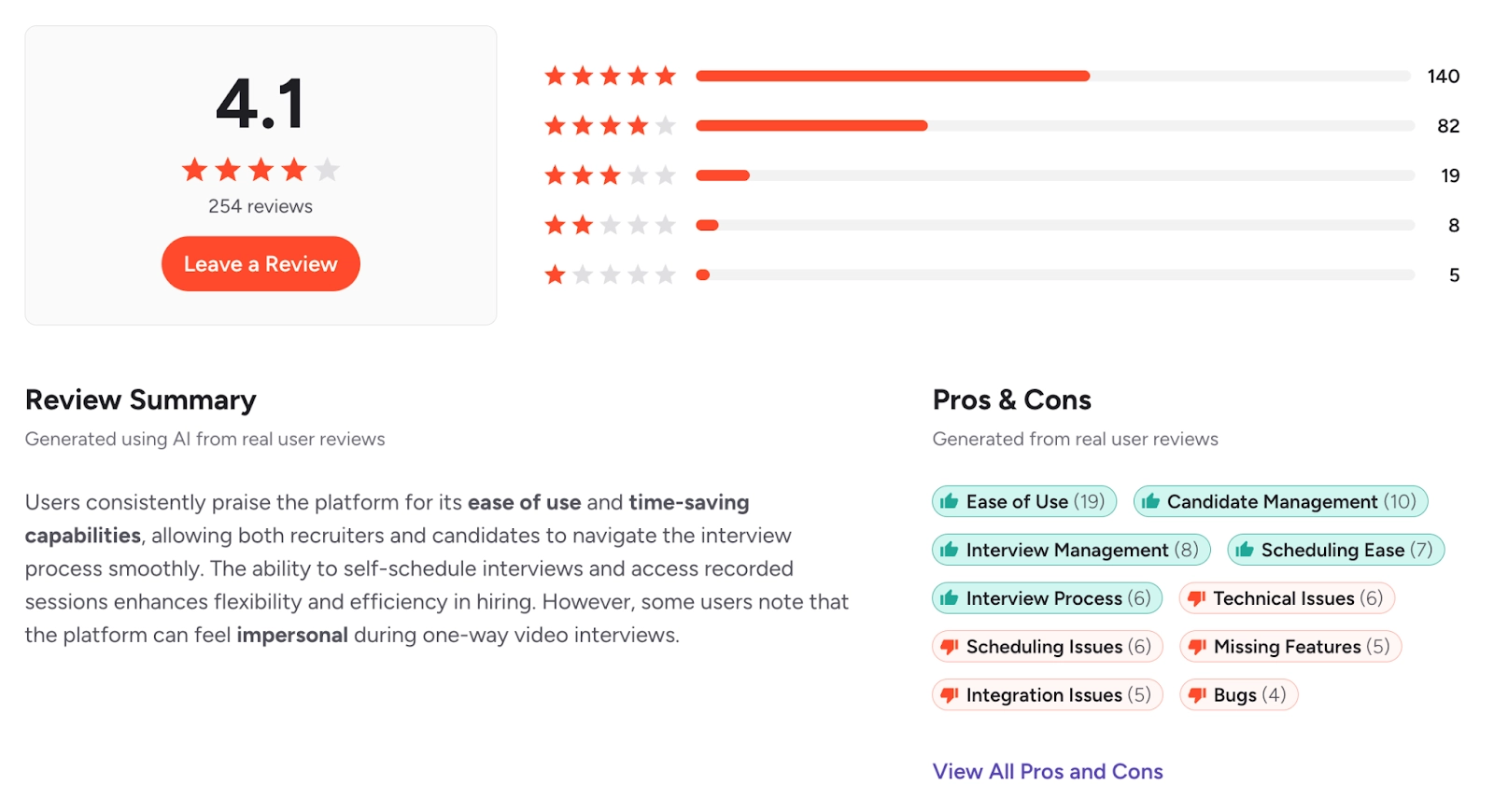
- Overall G2 HireVue Rating: 4.1/5 ⭐
- Overall Capterra HireVue Rating: 4.2/5 ⭐
HireVue Pros: What Users Love
✅ Handles high-volume screening at enterprise scale
When you're processing tens of thousands of applications, HireVue's automated workflows and pre-filtering capabilities become operationally necessary. One G2 reviewer from an enterprise noted:
"Valuable for high volume recruitment or to identify a targeted shortlist. Ability to add multiple candidates at a time and clone jobs for similar roles."
✅ Easy access to scheduling through their phones
HireVue creates accessibility for candidates by allowing them to schedule and complete interviews directly from their phones. A verified G2 reviewer in staffing and recruiting noted:
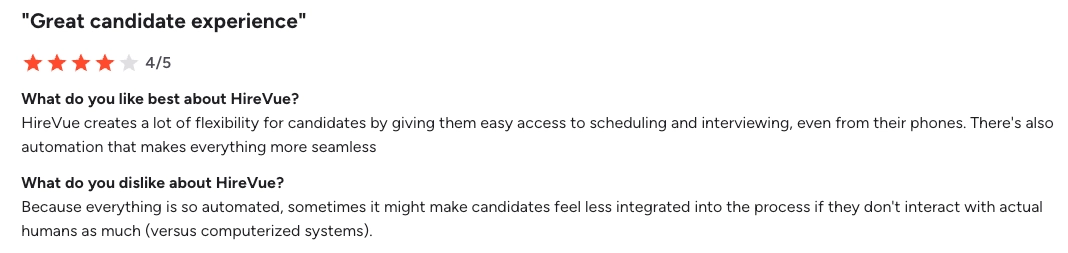
✅ Asynchronous interviews save time in high-volume hiring
HireVue's recorded interview format lets candidates complete interviews on their own schedule, which helps during high-volume hiring. One G2 reviewer noted:
"HireVue is a time saver when it involves a long and massive hiring process. It allows candidates to record their interviews at their own pace and helps recruiters to have all the information they need to move forward with the process."

The same reviewer noted it would be helpful to have direct links to share individual recorded interviews with hiring managers.
Where HireVue Users Get Frustrated
❌ AI scoring before human review leads to biased outcomes
As AI becomes more involved in hiring, how it's designed and applied matters enormously. Thoughtful, human-led AI isn't just an ethical consideration; it’s what hiring professionals actually want. According to the latest hiring trends research, 78.7% of talent professionals believe final hiring decisions must remain human-led.
Tools that analyze and score assessments: speech patterns, tone, facial expressions, or body language, before any human review, provide faster evaluation. However, they may also disadvantage candidates with untraditional career paths, disabilities, neurodivergent candidates, or those whose communication styles don't fit a narrow algorithmic norm.
That's why Willo Intelligence is designed to provide assistive support to hiring teams, rather than replacing human judgment.
- Structured summaries — creates a concise overview of each candidate response, highlighting key skills, communication style, and competencies so recruiters can quickly understand a response without losing its nuance.
- Gap identification — identifies areas where a candidate's answer lacked detail or warrants further exploration, giving hiring managers specific, targeted questions to carry into subsequent human-led rounds.
That way, hiring teams can manage high application volumes and move through early-stage screening faster, without sacrificing the quality of insight that leads to better hiring decisions.
❌ Limited ATS integration options compared to lighter alternatives
While HireVue integrates with major enterprise ATS platforms like Workday, SAP, Oracle, and iCIMS, the integration ecosystem is narrower than many teams expect.
According to HireVue's technology partners page, supported integrations include primarily enterprise-grade systems:
- Workday
- SAP
- Oracle/Taleo
- SmartRecruiters
- PageUp
- iCIMS
- Greenhouse
- Eightfold
- Avature
- Infinite
- Oleeo
- Cornerstone
For teams using mid-market ATS platforms (BambooHR, JazzHR, Breezy HR, Lever, Ashby) or newer recruiting tools, native integrations often don't exist. HireVue is not available in Zapier's app library, which means you’ll find it difficult to build workarounds using no-code automation tools. This means teams must rely on manual exports, CSV uploads, or custom API development—workarounds that undermine the efficiency HireVue is meant to create.
Even when integrations exist, they require IT involvement for initial configuration and ongoing maintenance. Sync issues, field mismatches, and data conflicts require troubleshooting across multiple vendor support teams.
If your recruiting stack doesn't align with HireVue's enterprise-focused integration list, you'll spend more time managing the connection than benefiting from automation.
❌ Rigid workflows make mid-cycle changes difficult
HireVue assumes hiring is stable and repeatable—roles, rubrics, and workflows are expected to hold over time. When hiring needs shift, that structure becomes a constraint. One G2 reviewer described how that plays out in practice:
"As a platform designed to drive automation, HireVue can be difficult to adapt when workflows change… adoption became difficult for our leaders, and we were forced to rely on other tools."
.webp)
Hybrid interviews, role changes, and candidate reuse across requisitions all introduce friction when the system enforces decisions teams aren't ready to lock in.
How HireVue Actually Works in Your Daily Workflow
HireVue isn't a simple "add video to your hiring process" tool. It's a full hiring operating system that governs how screening, evaluation, and documentation happen—often before recruiters ever review candidates.
Understanding what that actually looks like day-to-day is critical.
Step 1: Configuration and Template Setup
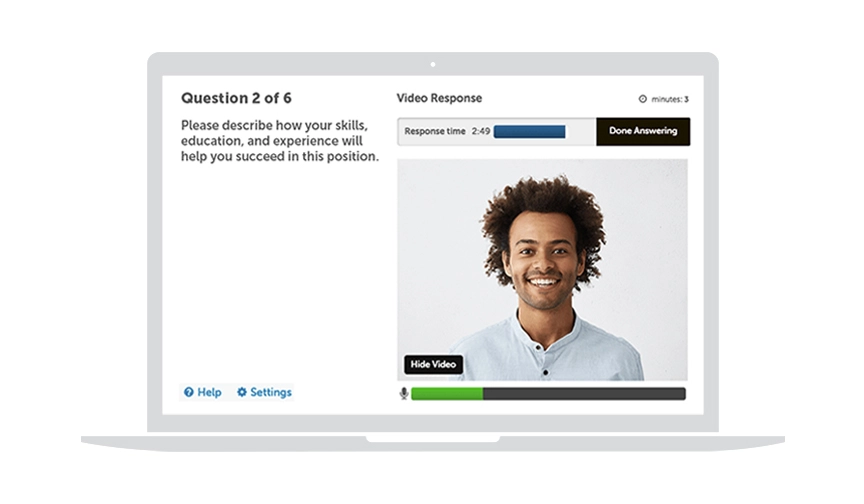
Before you screen a single candidate, someone has to configure HireVue. That means:
- Defining interview templates with standardized questions
- Setting scoring rubrics and evaluation criteria
- Selecting assessments (if using Enterprise tier)
- Connecting HireVue to your ATS with bi-directional sync
- Setting up user roles, permissions, and access controls
Who does this work? Typically, recruiting operations or talent acquisition leadership. When that ownership exists and is well-resourced, the setup pays off. Templates get reused across roles and locations. Reviewers follow the same rubric. Hiring managers see consistent evaluations without rebuilding the process for every requisition.
When that ownership doesn't exist? The setup becomes a bottleneck. Configuration often takes 6+ weeks depending on scope, integrations, and internal buy-in. Templates feel rigid, and making changes mid-cycle requires duplicating and reconfiguring entire workflows.
Step 2: Candidate Screening (Async Video or Live)
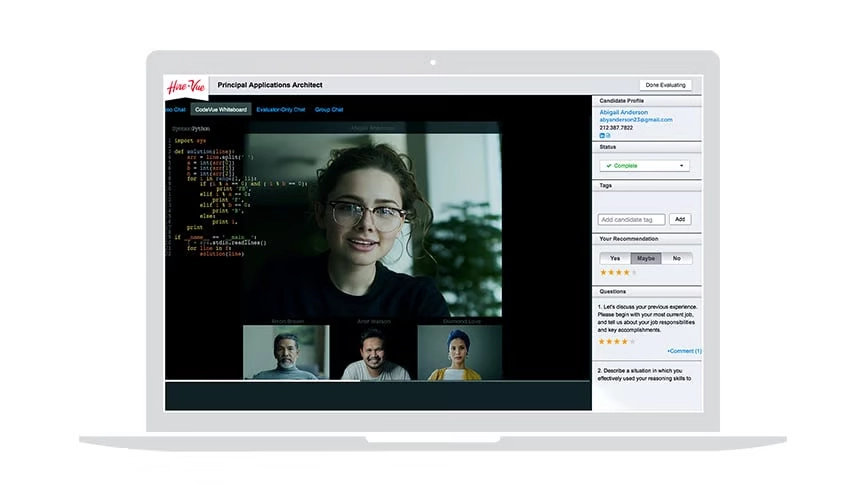
Once configured, HireVue controls how candidates are screened:
- Candidate receives automated invitation: Email with instructions and a unique link
- Candidate records responses: Structured questions, timed responses, optional retakes (depending on your settings)
- Optional assessments: Skills tests, game-based psychometric assessments, or coding challenges (Enterprise tier)
- AI scoring and ranking: If enabled, HireVue analyzes transcripts and generates candidate scores before human review
At high volume (thousands of applicants), this creates leverage. Recruiters can move large candidate pools through screening without watching every video. Scoring remains consistent regardless of who reviews first.
At lower volume or when judgment needs to stay with recruiters, this model creates friction. The AI ranking logic isn't always transparent. Some roles don't map cleanly to structured assessment formats. Recruiters often end up watching every response anyway—after paying for automation intended to reduce that work.
Step 3: Recruiter and Hiring Manager Review
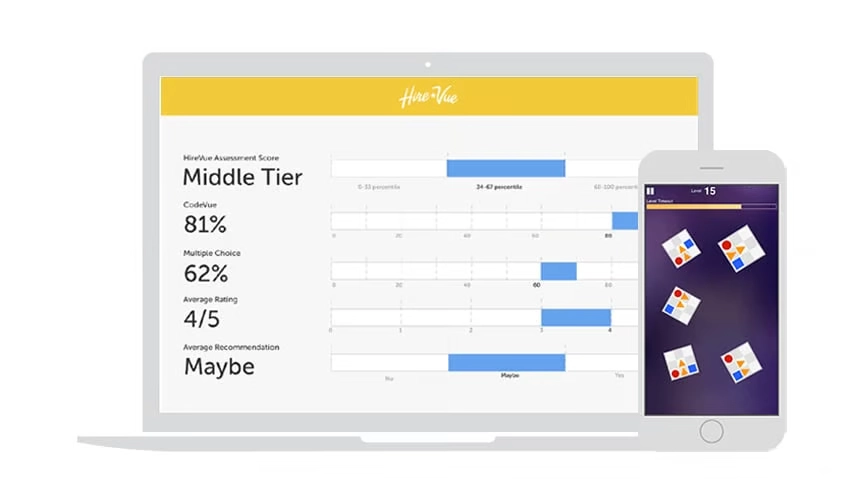
Recruiters and hiring managers review candidates inside HireVue's interface using structured feedback forms to capture ratings, comments, and decisions. Every action is logged against the candidate record.
What works: In organizations hiring across teams, locations, or time zones, this standardization helps. Everyone reviews candidates the same way. Audit trails exist for every decision. Compliance teams can pull reports without chasing down emails or spreadsheets.
What creates friction: For recruiters moving quickly between requisitions, the interface adds steps. The learning curve is steeper than expected. Filtering and exporting options are more constrained than recruiters expect. During peak hiring periods, those extra clicks slow review down when speed matters most.
Step 4: Scheduling and Communication Automation
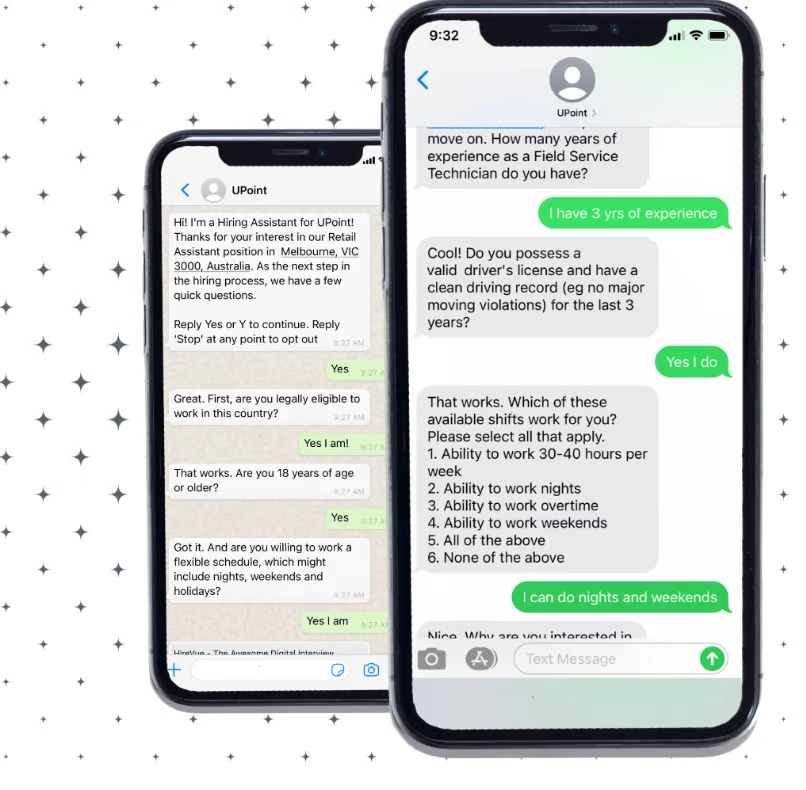
HireVue automates candidate communication—invitations, reminders, and scheduling for live interviews—through system-driven workflows rather than recruiter-controlled outreach.
At scale, this reduces coordination work. Candidates move through stages without recruiters manually following up at every step.
When employer brand and tone matter, automation introduces risk. Emails land in spam. Templates don't reflect role-specific context. When something breaks, recruiters have to intervene manually—often without clear visibility into what failed or why.
Step 5: When Something Breaks
This is where the two-platform dynamic becomes real. When a candidate doesn't receive an invitation, when video playback fails, when ATS sync drops data, or when AI scores don't make sense—who do you call?
Is it a HireVue problem? An ATS integration issue? A candidate's browser or device? You often spend time just figuring out which vendor's problem it actually is.
When HireVue Is the Right Choice
HireVue makes sense when your hiring infrastructure needs system-enforced consistency and algorithmic pre-filtering—and you're prepared for the implementation complexity, cost, and rigidity that comes with it.
✅ Volume makes human review of every candidate operationally impossible
You're processing tens of thousands of applications annually—not hundreds or low thousands. At this scale, recruiters cannot watch every video, and automated pre-filtering becomes a necessary infrastructure rather than an optional efficiency.
The $35k+ annual cost and 6+ week implementation timeline become justified when hiring volume is sustained and unreviewable by humans alone.
✅ You have dedicated hiring operations ownership
Someone on your team owns HireVue full-time: configuration, template maintenance, workflow optimization, integration troubleshooting, and user training.
Without this dedicated ownership, the platform's complexity falls on recruiters as additional admin work instead of removing the screening burden.
✅ You need FedRAMP authorization or enterprise-grade compliance infrastructure
You're a federal contractor selling to U.S. government agencies and require FedRAMP-authorized platforms by mandate.
Or your organization operates at a scale where comprehensive compliance infrastructure—SOC 2 Type II, ISO 27001, third-party algorithmic audits, and built-in bias reporting—provides legal protection and risk mitigation that justifies the cost.
HireVue builds all of this in. The question isn't whether compliance matters (it always does), but whether your organization's size, legal exposure, and risk profile require this level of compliance infrastructure, or whether standard GDPR/CCPA compliance and good hiring practices meet your needs without the additional overhead and cost.
✅ Your hiring process is stable and repeatable
Roles, rubrics, and workflows hold over time. You're not frequently adjusting interview questions mid-campaign, reusing candidates across requisitions, or pivoting hiring strategies based on market conditions.
HireVue's rigid template structure works when standardization matters more than adaptability.
✅ You have implementation runway and can absorb longer deployment timelines
Configuration, ATS integration, training, and change management take a minimum of 6 weeks, often 12+. Your hiring timeline allows for this runway, and leadership buy-in exists before rollout begins.
If you need to start screening candidates next month, chances are HireVue won't be ready in time.
✅ Candidate experience concerns are secondary to operational consistency
You're hiring for volume roles where standardized evaluation matters more than human interaction.
One-way video interviews and AI evaluation are acceptable to your candidate pool, or drop-off from senior/privacy-conscious candidates doesn't impact your hiring outcomes.
When HireVue Isn’t a Fit
HireVue doesn't fit when your hiring constraints are recruiter capacity, screening speed, flexibility, or candidate experience—not algorithmic filtering.
❌ You want to leave hiring decisions with humans, not algorithms
Your volume is hundreds to low thousands per cycle, high enough to need better tools, but still reviewable by human recruiters.
You need systems that help recruiters screen faster, not algorithms that pre-filter before humans get involved.
In this scenario, you'll pay for AI ranking, then watch videos anyway to apply your own judgment—eliminating the efficiency gain while keeping the cost.
❌ There's no dedicated owner for hiring operations
No one on your team can own HireVue configuration, template maintenance, and troubleshooting full-time. That work would fall on recruiters as additional admin tasks instead of removing screening burden.
The platform's complexity requires dedicated operations ownership to create value instead of friction.
❌ Your hiring process needs flexibility and adaptation
Your hiring needs shift mid-cycle: interview questions change, role requirements evolve, workflows need adjustment based on candidate feedback or market conditions.
HireVue's rigid template structure—where mid-cycle changes require duplicating and reconfiguring entire workflows—becomes a constraint rather than a benefit.
❌ Your ATS isn't in HireVue's integration ecosystem
You're using mid-market ATS platforms (BambooHR, JazzHR, Breezy HR, Lever, Ashby) or newer recruiting tools that don't have native HireVue integrations.
HireVue isn't available in Zapier's app library, which means you can't build workarounds using no-code automation. You're forced into manual exports, CSV uploads, or custom API development—undermining the efficiency the platform promises.
❌ You need to start screening candidates within weeks, not months
Your hiring timeline requires immediate deployment. HireVue's longer implementation (configuration, ATS integration, training, change management) doesn't align with urgent hiring needs.
You'll either delay screening or run parallel processes while waiting for the system—creating more work instead of removing it.
❌ Candidate experience is a competitive differentiator
When the screening process feels opaque, inaccessible, or uncomfortable, candidates opt out — not because they're unqualified, but because the process didn't work for them. This is particularly true for:
- Candidates with privacy concerns around how their data is collected and used
- Candidates whose communication styles, abilities, or backgrounds don't align with rigid algorithmic evaluation criteria
Every withdrawal is a missed opportunity. And in a competitive hiring market, the organizations that design a more inclusive, transparent screening experience are the ones that attract the broadest and strongest talent pools.
❌ Your pricing model needs predictability and transparency
HireVue's opaque, custom pricing (starting ~$35k/year, scaling with modules, data sources, and compliance requirements) makes budgeting difficult until after sales conversations.
If you need transparent, predictable pricing where costs are clear before the first call, HireVue's model creates uncertainty rather than confidence.
If HireVue Isn't a Fit, What's the Alternative?
The decision isn't "HireVue or nothing." It's where decision authority sits in your screening process.
HireVue uses AI to score, rank, and filter candidates before human review. Recruiters review what the algorithm surfaces.
Willo keeps decision authority with recruiters. Humans review every candidate; AI generates transcripts, summaries, and highlights to accelerate review—not replace it.
Human-Reviewed Screening at Scale: The Willo Approach
In this model:
- Candidates record responses to structured questions asynchronously
- Recruiters review every response and make hiring decisions
- AI supports review by generating transcripts, summaries, and highlights—but does not score, rank, or determine who moves forward
Screening no longer depends on scheduling. Recruiter effort shifts from coordination to review. Decisions remain human, but throughput increases because responses can be reviewed in batches rather than live conversations.
Because there's no algorithmic filtering layer:
- No scoring logic to tune or validate
- No assessment library to maintain
- No AI rankings to explain or defend
- No framework enforcing decisions before recruiter review
AI augments recruiter judgment rather than replacing it.
When Willo's model fits better:
- Humans make hiring decisions, not algorithms
- Screening volume is high but still reviewable (hundreds to low thousands per cycle)
- Primary constraint is recruiter capacity and screening speed, not compliance mandates
- Setup can happen in days, not weeks
- Transparent pricing and predictable costs matter
- Candidate experience is a competitive advantage, not a secondary concern
Setup is measured in days rather than weeks. No 6+ week implementation runway. No dedicated hiring operations team required.
Compare HireVue vs. Willo: See how system-enforced screening differs from human-reviewed screening at scale, side by side.
Final Verdict: When to Use HireVue and When to Choose Willo
The decision comes down to where the selection authority sits in your hiring process.
Choose HireVue when:
✅ AI must filter candidates before human review—volume makes reviewing every candidate operationally impossible
✅ Dedicated hiring operations ownership exists for full-time configuration and maintenance
✅ Implementation runway of 6+ weeks is acceptable
✅ Standardization matters more than flexibility—hiring processes are stable and repeatable
HireVue is built for system-enforced screening. The structure is the point, and the trade-off is flexibility, implementation time, and cost.
Choose Willo when:
✅ Recruiters need to make hiring decisions, not algorithms—automation should support human judgment, not replace it
✅ Setup, implementation, and onboarding need to happen fast. Willo gets you up and running on your timeline, without a long implementation commitment.
✅ No dedicated hiring operations team to manage configuration and maintenance
✅ Transparent, predictable pricing matters
✅ Candidate experience is a competitive differentiator—privacy concerns and accessibility matter
Willo is built for human-reviewed screening at scale. AI accelerates review; recruiters make decisions.