"The screening tool you pick can make a big difference - it can either help you hire faster or create bottlenecks that slow everything down."
Is your current candidate screening tool starting to hold you back as hiring volume grows? Did candidates stop completing interviews? Reviewers fall behind? Or are you spending more time moving context between tools than making decisions?
Both HireVue and Spark Hire can help you replace inefficient candidate screening processes with asynchronous video interviews, but they handle scale very differently:
- HireVue requires that you lock in structured, AI-supported assessments upfront to keep decisions consistent across large teams and high volumes.
- Spark Hire keeps setup light and recruiter-led so you can launch and adjust roles quickly, but it comes with more manual work.
Here's how the two platforms line up on the factors that matter most in daily operations:
The choice comes down to whether you want the platform to enforce standards (HireVue) or give you room to adapt while you manage consistency yourself (Spark Hire).
If you're looking for a more cost-effective and top-rated alternative to both HireVue & Spark Hire? Check out Willo.
HireVue vs Spark Hire? A Quick 30-Second Rundown
Short on time? Here's the executive summary.
I've compared both platforms across what actually matters when you're screening candidates at scale—and thrown in Willo as a third option worth considering.
HireVue vs Spark Hire: Feature Deep Dive
When you're screening dozens (or hundreds) of candidates per month, the platform you choose determines whether interviews actually happen—and whether you can make confident hiring decisions from them.
Both tools promise to replace phone screens with scalable video interviews, but they take very different approaches to setup complexity, scoring methodology, and team workflows.
Here's what matters most when comparing video interviewing platforms:
- Assessment Creation & Configuration - How fast can you launch? How flexible is it later?
- Assessment Types - What can you actually measure beyond "how well they talk"?
- Candidate Scoring - Who decides which candidates advance: AI or humans?
- Candidate Invitation - Will candidates actually complete the interview?
- Candidate Experience & Completion - What breaks when internet is spotty or devices are old?
- Hiring Team Collaboration - Will managers actually watch and rate videos?
- Post-Assessment Workflow - What happens after interviews are done?
Let's dig into each one.
1. Assessment Creation & Configuration
If you need to set up a role-specific interview that reflects your employer brand and asks the right questions, without needing a degree in computer science, both HireVue & Spark Hire can help you.
The difference is that with HireVue, setup might take a month. Once configured, the structure tends to remain stable to preserve comparability.
Spark Hire's setup can be completed in a few days, but you'd need to tweak it occasionally to ensure consistency.
Here's how it works:
HireVue
With HireVue, you work inside the Interview Builder. A tool that enables you to create job-specific interview questions by pulling from a large library of pre-validated question sets created by industrial-organizational psychologists.
There, you can select behavioral, situational, or technical questions tied to specific competencies, and you can layer in game-based cognitive tests or coding challenges.
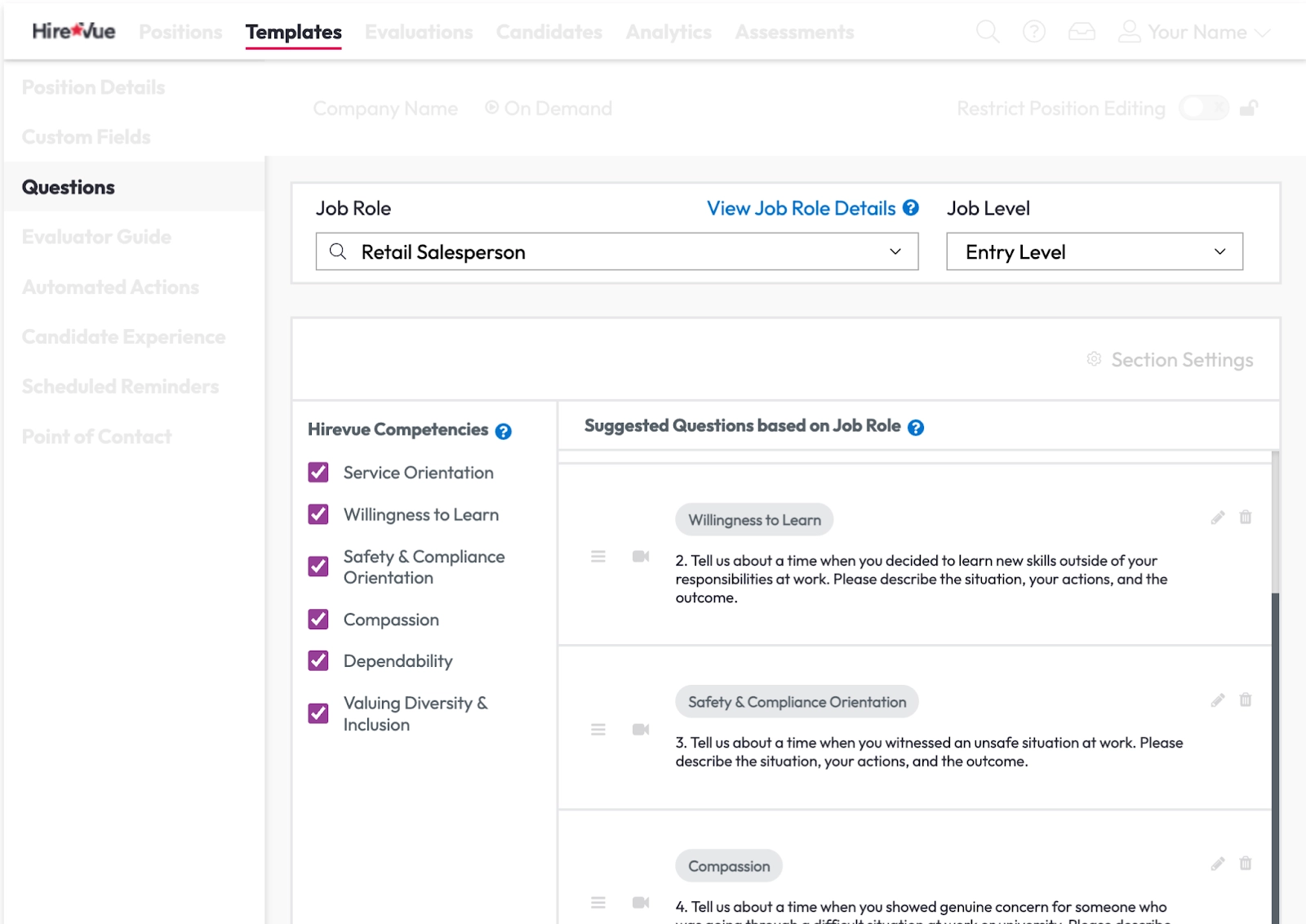
But before you do all of that, HireVue encourages a job analysis phase upfront so the questions and eventual AI scoring stay predictive and compliant. Once configured, the structure stays fixed to preserve comparability. That way, if you need to hire 500 people for the same role and want a scientifically backed score for each, HireVue's configuration is world-class.
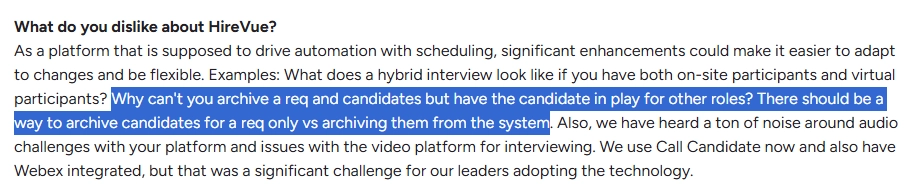
The caveat is that if you want to change questions on the fly for every single interview, you might find it cumbersome. And that's where HireVue's trade-off sets in. Users note that changes that feel routine in smaller teams, like adjusting interview formats, handling hybrid interview scenarios, or reusing candidates across multiple open roles, often require workarounds rather than simple edits.
For example, Kyra, a Sr. Talent Acquisition Manager, complains that "a way to archive candidates for a req only". The structure that ensures consistency across 500 hires also means you can't easily flex when one strong candidate might fit multiple openings.
Spark Hire
Spark Hire takes a lighter approach.
You build from a central question library you create yourself or pull from their bank, then add behavioral profile assessments with multiple-choice components. Configuration happens fast; many teams launch their first interview the same day.
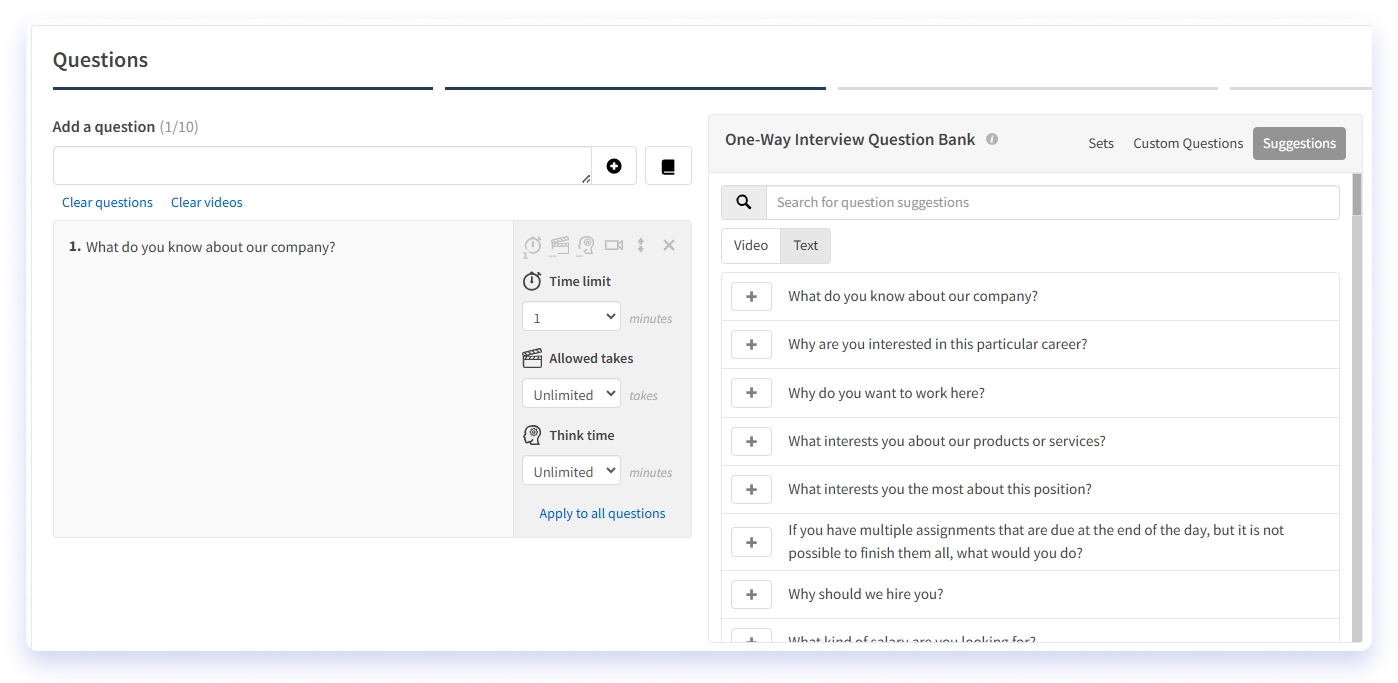
Like HireVue, Spark Hire also allows you to control prep time, response limits, and retakes per role, with full branding through logos, colors, and introductory videos. The interface feels straightforward without needing extensive training.
But here's the kick: while you keep the flexibility to tweak questions role by role, you carry the responsibility for keeping evaluation standards consistent across searches – which, frankly, is difficult for most teams.
This happens for two reasons.
Firstly, Spark Hire lacks the deep customization that HireVue offers, especially for highly complex, global roles. For example, Spark Hire users have noted the inability to brand different departments uniquely. You are typically limited to one global company brand.
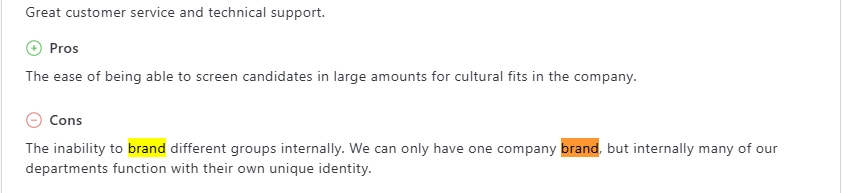
Secondly, Spark Hire's connection library to third-party ATS is solid but not extensive. As a result, the interview context might not always carry forward automatically. Recruiters might have to compensate by copying links, re-entering feedback, or reconstructing decisions downstream. One recruiter captured how Spark Hire's limited connection with Greenhouse caused manual rework for their team.

What this means for you:
- Use HireVue when roles follow similar competency models and decisions must stay comparable across many reviewers.
- Use Spark Hire when roles vary and you need to launch quickly while managing consistency yourself.
Willo's Advantage
When you find yourself needing more room to tailor interviews without the heavy reconfiguration of HireVue or the growing manual alignment demands of Spark Hire, many recruiters turn to Willo for a setup that balances structure with practical flexibility at a contained cost.
- You screen faster with access to over 1,500 ready-to-use templates.
- Use Willo directly inside your preferred ATS without separate login
- Combine video responses, audio-only options, multiple-choice, text, and file-upload questions.
That way, hiring teams get consistent evaluation that does not depend on perfect upfront design or constant calibration meetings.
See how Willo works:
2. Assessment Types
If you need to measure more than just how candidates answer questions—and rank them objectively—what you can assess and how it gets scored determines whether the platform actually reduces your workload or just shifts it.
Here's the core difference:
HireVue offers a full assessment suite with AI scoring that ranks candidates automatically. Spark Hire focuses on video interviews with manual human scoring.
What types of assessments can you measure in HireVue & Spark Hire?
HireVue
HireVue combines multiple assessment types into one candidate experience. That includes video interviews, cognitive games, coding tests, and job simulations. All feed into a unified competency profile.
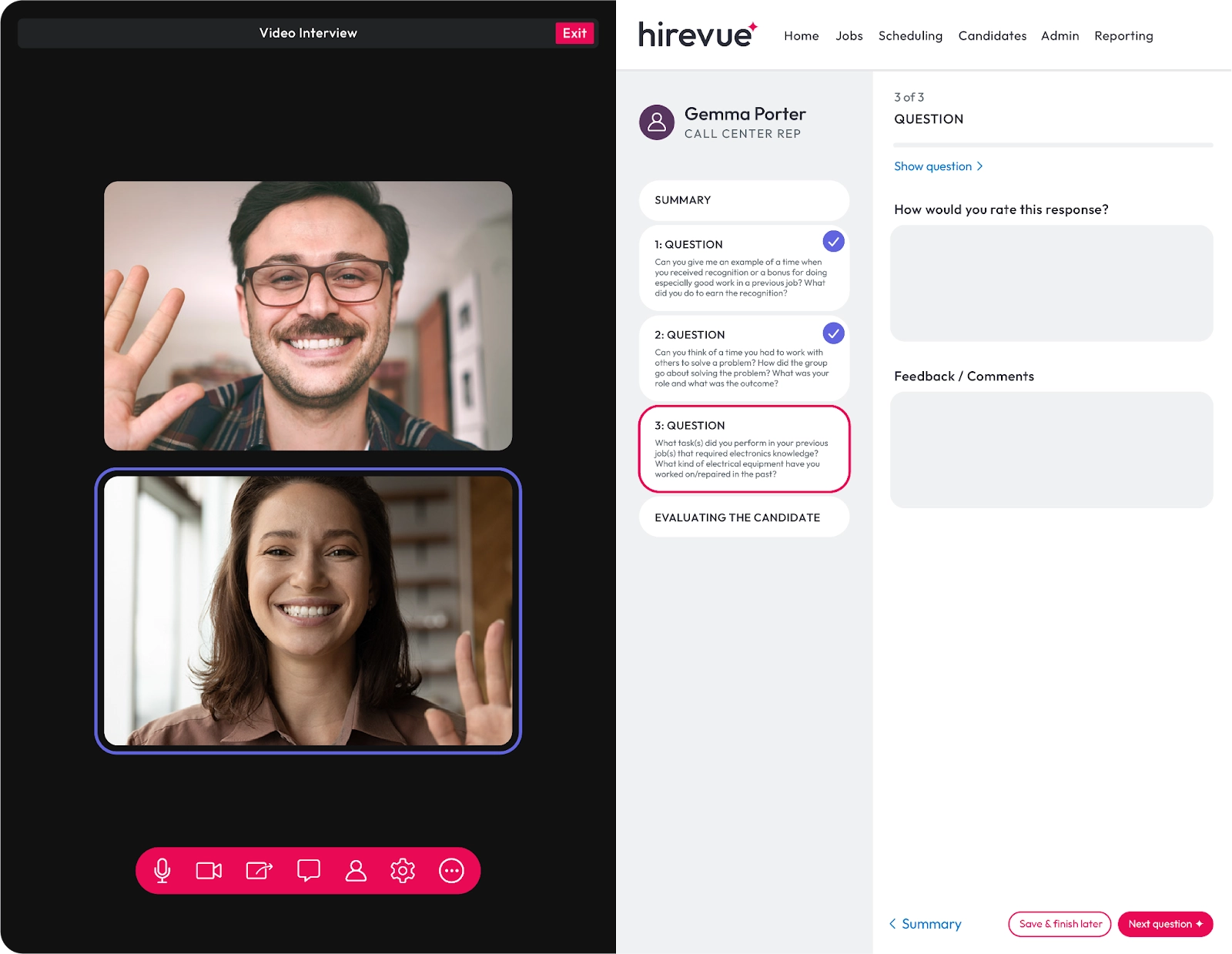
However, the complexity and time required to setup these features might be a challenge. Additionally, requiring game-based tests or coding extends candidate commitment from 15 to 45+ minutes, which increases drop-off when candidates have other options.
Spark Hire
Spark Hire keeps it simple with video responses plus optional behavioral assessments (multiple-choice tests measuring traits like conscientiousness or stress tolerance). The platform recently added transcription, so you can search for keywords or read along while watching.
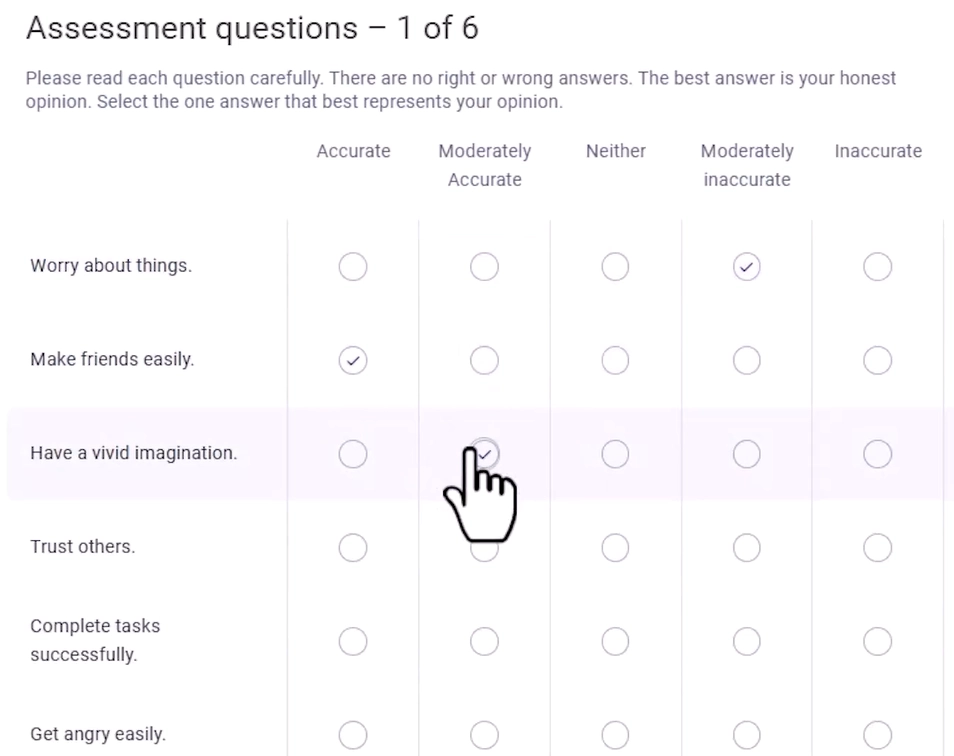
But Spark Hire offers limited measurement depth. If you need to validate technical skills or cognitive ability before interviews, you might not get that data from Spark Hire alone. You're relying on self-reported experience and presentation.
3. Candidate Scoring
Once candidates complete their assessments or interviews, the next question becomes how results translate into hiring decisions— especially when you're reviewing hundreds of applicants per role.
Here again, HireVue and Spark Hire reflect different philosophies.
HireVue applies automated scoring based on the competencies you define during setup.
Candidate responses are analyzed across structured criteria such as communication patterns, problem-solving approaches, and role-specific behaviors, and are scored on the specific competencies you configured. The system then produces standardized scores and ranked tiers, allowing recruiters to quickly identify top-performing candidates without manually reviewing every submission.
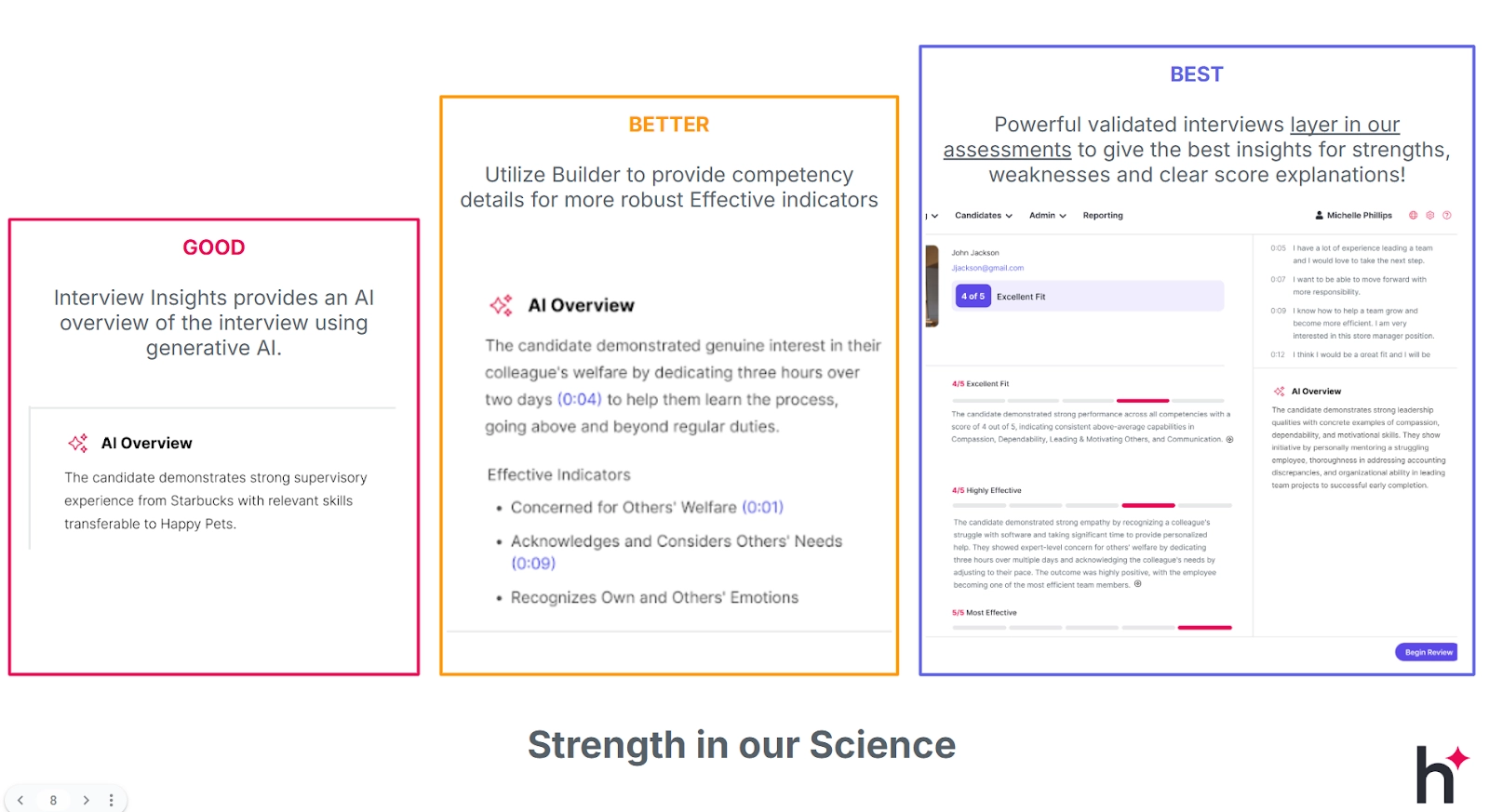
While you can immediately prioritize the strongest 50 out of 500 without watching every video, the trade-off is interpretability and control. Because scoring is algorithmically generated, hiring managers may need additional explanation to understand individual outcomes.
Automated ranking also requires confidence that your upfront configuration accurately reflects real-world success. When criteria are misaligned—or when candidates experience technical issues during assessment—edge cases can be routed incorrectly unless human oversight is added. Critics also note that timed video and game-based assessments can disadvantage neurodivergent candidates who communicate differently.
Conversely, Spark Hire relies on human reviewers.
Reviewers watch videos and rate candidates using a 5-star system. The platform helps with efficiency—2x speed playback, skip to specific questions, and timestamped comments.
If three hiring managers watch the same candidate, Spark Hire averages their scores to create a "Team Consensus" ranking. This collaborative approach reduces individual bias, and the comment section forces reviewers to justify ratings based on what candidates actually said.
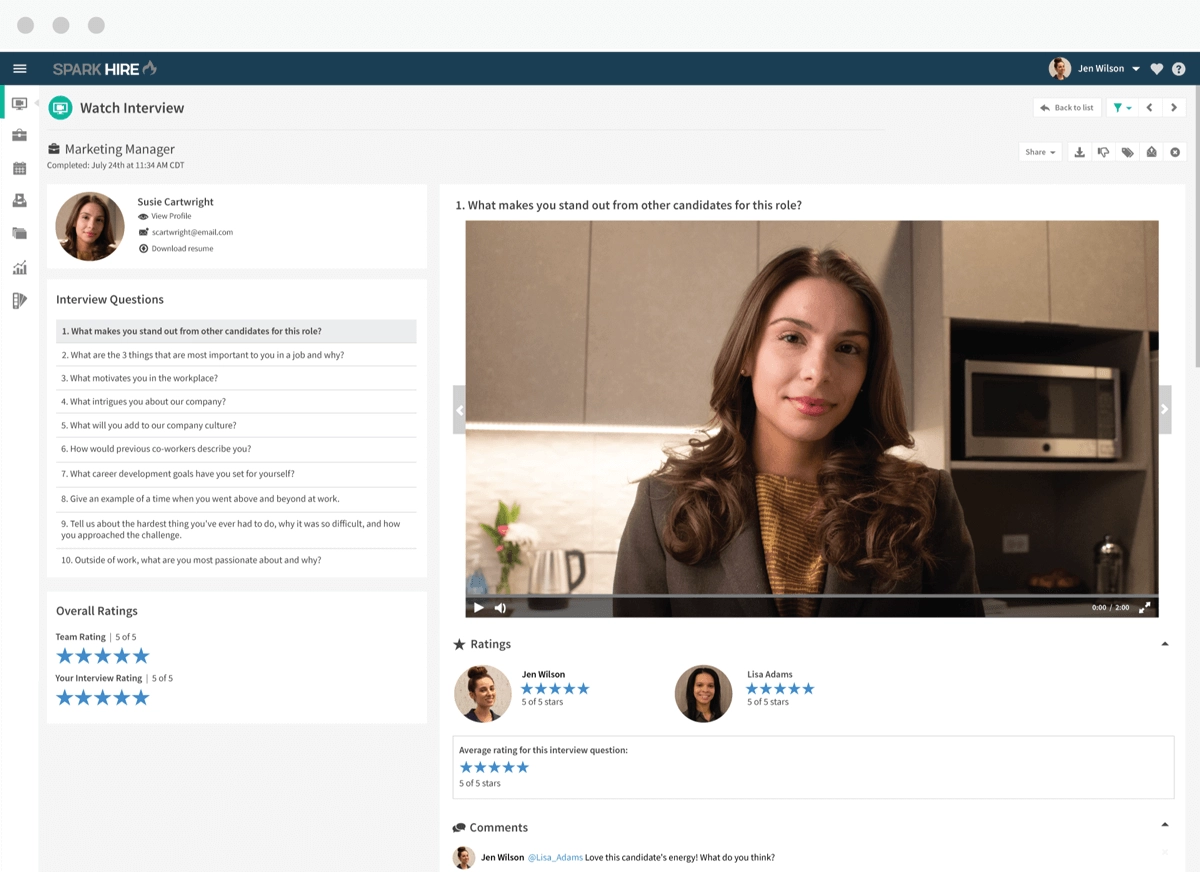
As you can tell, Spark Hire's approach requires more time and puts consistency at risk. Spark Hire won't automatically rank your 500 candidates. Even at 2x speed, reviewing hundreds requires significant human time. Without AI enforcement, different reviewers might weigh competencies differently, letting unconscious bias creep in.
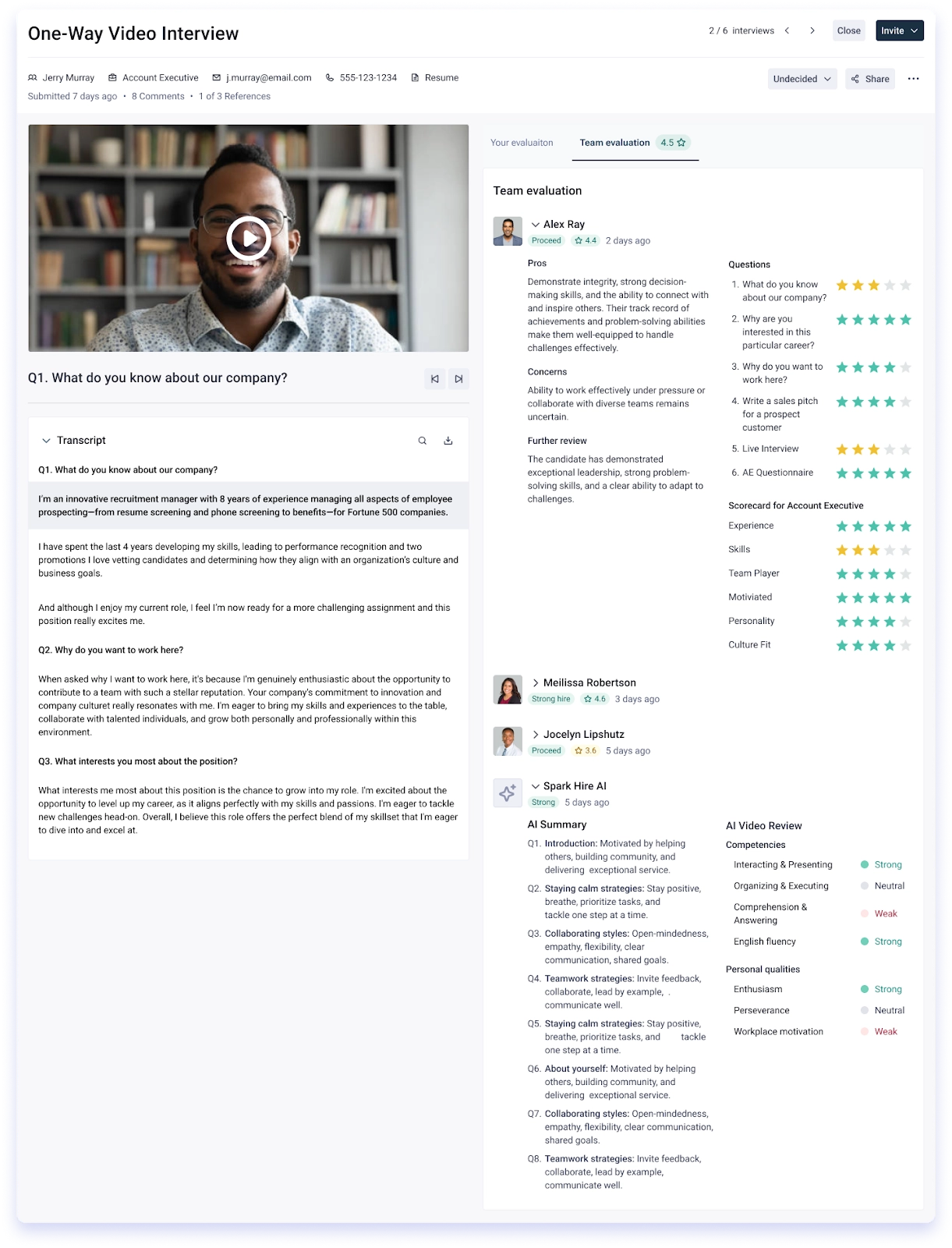
What this means for you:
- Choose HireVue when you need rapid prioritization and are comfortable with AI-supported ranking handling first-pass decisions.
- Choose Spark Hire when transparency and direct human judgment matter more than automation, even if that means absorbing more manual review effort as volume increases.
4. Candidate Invitation
If you need to get an interview in front of candidates wherever they are (LinkedIn, Indeed, SMS) and ensure they actually click the link, both HireVue and Spark Hire can help.
The difference in their approach is that HireVue provides deeper candidate invitation automation and more channels for capturing candidate interest than Spark Hire, but requires a more complex setup upfront.
HireVue offers interactive candidate invitation methods.
The platform can embed a conversational AI chatbot on your career site that pre-qualifies applicants before they see the interview link. Someone lands on "Apply Now," the bot asks screening questions, and qualified candidates get the link immediately—no recruiter involved.
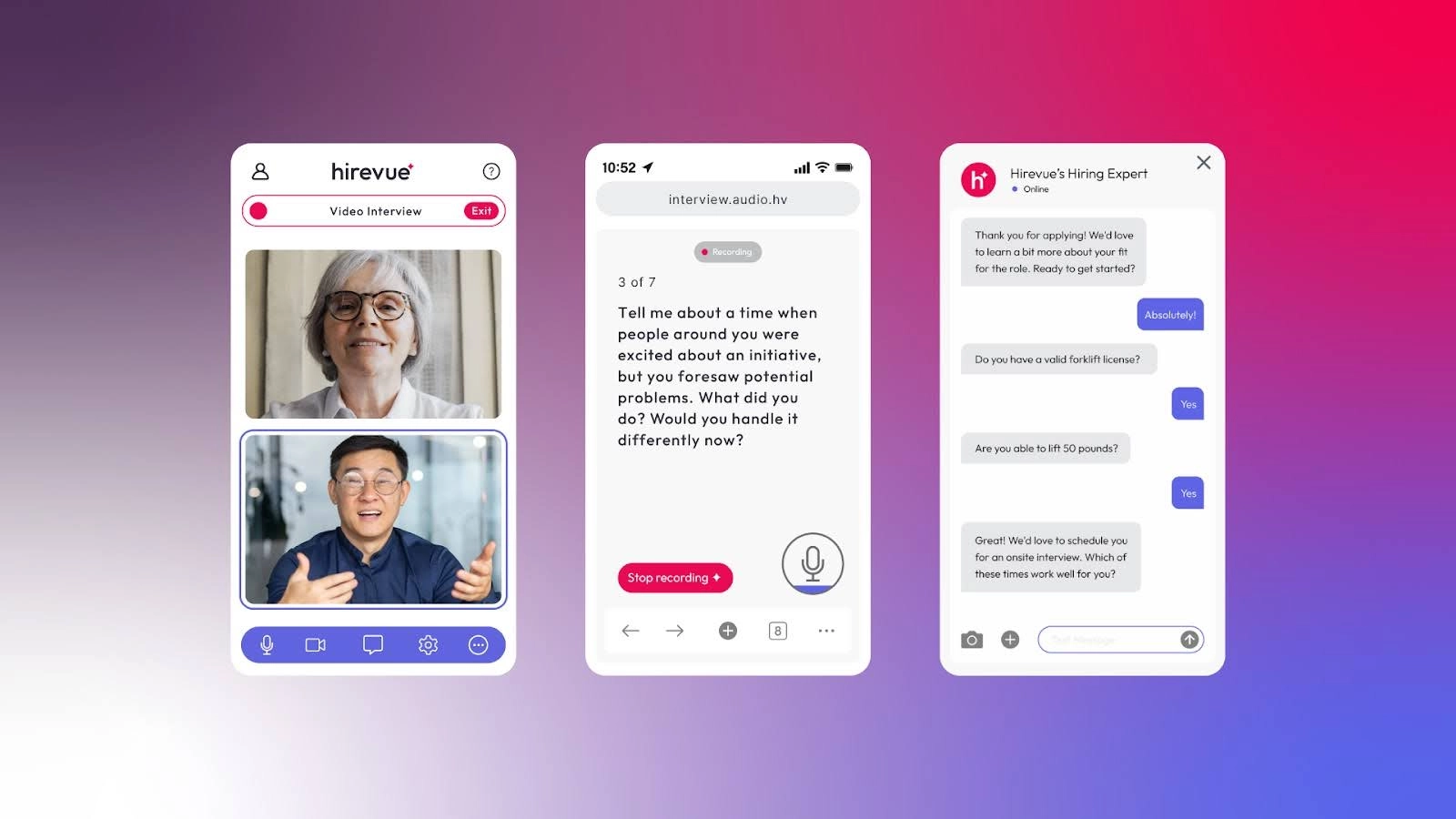
For roles where speed matters (hourly, seasonal, retail), candidates can text a short code from a job posting to start the interview on their phone. The SMS goes out automatically, they reply START, and they're in– within seconds. This works especially well when sourcing from mobile-optimized job boards.
The platform connects to enterprise ATS to trigger invites the moment an application arrives. A candidate applies at 9 PM, and by 9:01 PM they have an interview link without a recruiter logging in.
Spark Hire works best for sending branded email to a curated list of applicants.
You send branded email templates or grab a direct interview link and drop it into LinkedIn messages, Indeed replies, or SMS through your own tools. The link works immediately, no login, no account creation. Candidates click and start.
The platform integrates with 40+ ATS for stage-based triggers, but compared to HireVue, you're managing the outreach channels yourself rather than relying on built-in SMS or chatbot handoffs.
What this means for you:
Both HireVue & Spark Hire reduce the lag between application and screening, but HireVue's built-in SMS and chatbot options often pull higher initial engagement in hourly or distributed roles. Spark Hire relies more on your existing outreach channels, which works when your team already has strong application flow.
5. Candidate Experience & Completion
At scale, candidate experience directly affects funnel health. Completion rates, technical reliability, and accessibility determine whether your screening process surfaces qualified talent—or quietly filters it out.
Both platforms cover the fundamentals: mobile-friendly interviews, practice questions, branded introductions, and no required account creation. The differences emerge under real-world conditions, especially when candidates are applying from older devices or unstable connections.
For instance, even though HireVue is built for global scale and unreliable internet, video quality still suffers significantly in low-bandwidth situations—one recruiter noted that for candidates "in remote areas without strong internet connectivity, HireVue video quality suffers a lot, it all becomes very blur."

Spark Hire typically requires a stable connection throughout the interview as well. When technical issues occur, candidates may need to repeat responses or switch to alternative formats, which introduces inconsistency into the screening experience.
One user noted: "Lots of glitches on the candidate's side of videos not coming through. We rarely faced this issue with HireVue." Another recruiter described having to move candidates to phone interviews when technical issues couldn't be resolved.

In summary:
Both HireVue and Spark Hire provide sufficient candidate engagement features. But Willo removes even more friction: In addition to the basic features, candidates can also switch device mid-interview without losing progress, which is perfect for candidates in areas with low bandwidth. In serious technical cases, 24/7 candidate chat support resolves issues instantly.
6. Hiring Team Collaboration and Decision-Making
If you need hiring managers to actually watch interviews and provide feedback without you chasing them down, the collaboration model matters more than the features list.
Here's the core difference:
HireVue contains collaboration inside the platform with shared transcripts, AI highlights, and structured feedback forms. Reviewers work against the same competency view, with side-by-side comparisons available. While feedback stays organized but requires platform login. Managers need to log in, learn the interface, and use the structured system.
Spark Hire removes participation barriers with secure shareable links that open without accounts. Timestamped comments, @mentions, and side-by-side video viewing happen directly on playback. It also encourages more participation with unlimited reviewer seats and consensus scoring.
What this means for you:
- Use HireVue when you need defensible, structured decisions across many reviewers and can invest in onboarding.
- Use Spark Hire when hiring managers must participate without training and you're comfortable managing alignment yourself.
7. Post-Assessment Workflow
If you need to move candidates from "interview complete" to "next round scheduled" without manually updating statuses or sending individual emails, how the platform handles the post-assessment pipeline determines whether automation actually saves you time or just breaks differently.
For HireVue:
The moment a candidate completes their assessment, the system triggers automatic notifications with AI scores. For candidates above your threshold, HireVue can auto-send scheduling links for the next round. For those below, it triggers rejection emails automatically.
This means you can move high performers forward faster but also risk losing control over who gets rejected. In cases where technical errors affect a candidate's video assessment, you might end up rejecting a potential fit.
One recruiter described the real consequence: "There are sometimes glitches with the calls that go through HireVue" and assessments can appear unsubmitted due to technical errors.

When automation runs without oversight, strong candidates can exit the pipeline automatically before a recruiter has reviewed edge cases.
In Spark Hire:
When a candidate completes their interview, you get notified, but nothing happens automatically. You review, make the call, then trigger the next step. The platform provides bulk action tools (select 50 candidates, change status to "Shortlisted," auto-send emails), so you're not clicking 50 individual buttons. But you're still making 50 individual decisions.
If you're using one of the ATS integrations, status changes sync back automatically. The trade-off is manual effort. Spark Hire won't auto-shortlist the top 10%. If you're dealing with 500 weekly applicants, you're still reviewing and selecting manually.
What this means for you:
- Use HireVue when your screening criteria are clear, and you trust AI scoring to route candidates correctly.
- Use Spark Hire when you want final say on every decision, but don't want to spend hours on status updates.
HireVue vs Spark Hire Pricing Comparison
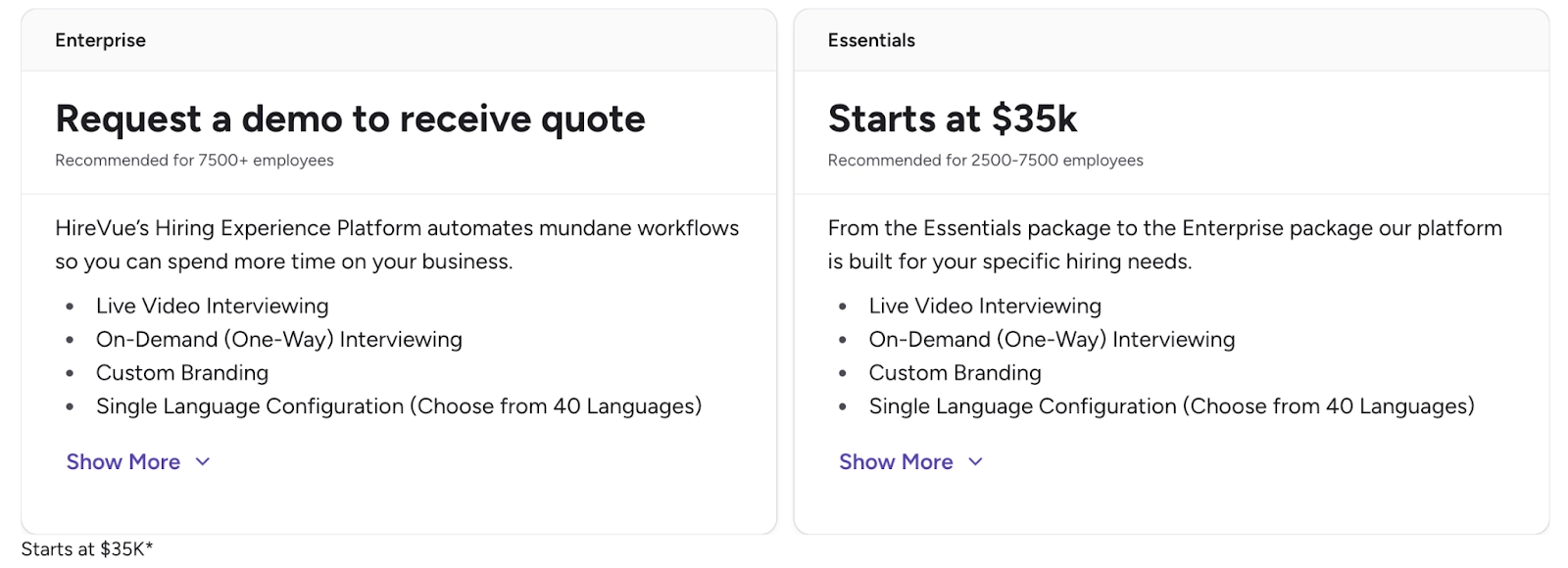
HireVue operates on custom enterprise quotes based on company size, expected volume, and add-ons. Recent user reports place typical annual contracts starting around $35,000, with implementation and support factored in.
Spark Hire, while offering transparent monthly plans, sells capabilities as separate modules (2026 pricing):
- Video Interviewing: $249/month annual (unlimited jobs/users)
- Behavioral Assessments: $249/month annual (unlimited)
- ATS (Recruit Pro/Growth): $299–$499/month annual
Bundling offers savings, but full modern screening (video + assessments + ATS) frequently exceeds $700–$1,000/month.
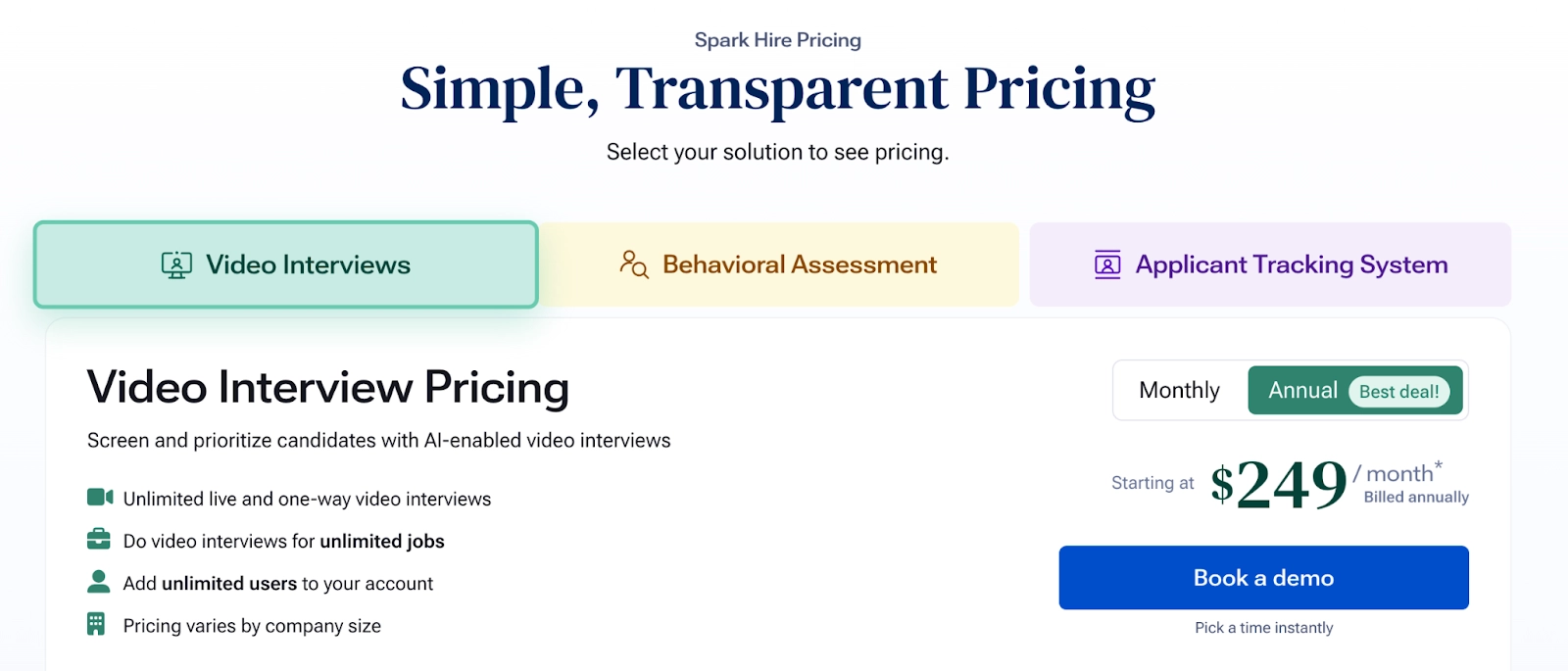
All plans include unlimited video interviews.
If you're looking for a Spark Hire alternative...
...with comparable (and often deeper) candidate screening capability in one predictable plan that scales without separate purchases, Willo might be the right choice for you.
Willo includes everything in one platform:
Book a demo today or see how Willo compares to Spark Hire for candidate screening in 2026.
Final Verdict: HireVue vs Spark Hire
The choice between HireVue and Spark Hire ultimately comes down to where you want responsibility for consistency to live. Both platforms support asynchronous screening. They simply distribute operational ownership differently.
HireVue centralizes control in the system.
Once roles are configured, evaluation criteria remain stable, scoring is automated, and downstream actions (like scheduling or rejection) can be triggered based on predefined thresholds. This works best when:
- Screening structures must remain consistent across large hiring teams
- Decisions need to be auditable or defensible later
- Recruiters are expected to follow standardized workflows
- You're prepared to invest upfront in configuration and governance
The trade-off is reduced flexibility mid-process and higher initial commitment in both cost and setup.
Spark Hire places control in the hands of recruiters and hiring managers.
Teams can launch roles quickly, adapt interview content as needs change, and collaborate through shared links without formal onboarding. This fits environments where:
- Roles vary frequently
- Hiring managers are deeply involved in early screening
- Interview criteria evolve from search to search
- Lower upfront commitment is preferred, even if effort scales with volume
The trade-off is that consistency must be actively managed by people, and manual review increases as applicant numbers rise.
Most teams eventually find themselves somewhere between these two extremes—wanting both adaptability and continuity as candidates move through the funnel.
That's typically where platforms like Willo enter the conversation, focusing on preserving interview context across stages while avoiding both rigid standardization and fully manual coordination.
Looking for a More Balanced HireVue & Spark Hire Alternative? Here's What Willo Does Differently
Many teams comparing HireVue and Spark Hire discover they want neither extreme rigidity nor mounting manual work.
They want a structure that supports human judgment without locking it upfront, and they want everything needed for modern screening in one predictable package instead of separate modules.
Willo positions itself exactly there: a human-led platform that includes video interviewing, structured assessments, AI assistance (transcripts, summaries, authenticity checks), customizable scorecards, and seamless ATS integrations in a single plan. Unlimited users come standard, candidates access via browser link with no account creation, and pricing starts lower while covering the full workflow without add-on surprises.
Recruiters who switch often cite:
- Simpler candidate access that lifts completion rates
- Context that travels automatically with the candidate record
- Costs that stay contained even as volume grows
If the trade-offs below start sounding familiar, Willo frequently enters the conversation as the option that removes the shared pain points.