What you'll learn
- How the pre-recorded video interview process works
- The 12 common interview questions, with sample answer frameworks
- How to build a reusable bank of examples instead of memorizing scripts
- Where to find strong examples when you have limited work experience
- The additional behavioral, situational, skills, and motivation questions to prepare for
If you've been invited to a pre-recorded video interview, you’re probably thinking about what questions to expect and how to prepare in advance. This guide helps with both.
Pre-recorded video interviews use regular screening questions spanning your experience, motivation, strengths, teamwork, problem-solving, and goals. The difference is that you answer them on camera, often without an interviewer to guide the conversation or ask follow-up questions directly.
Meanwhile, nearly 28,000 applicants across 33 companies in 11 countries responded better to longer prep time and re-recording flexibility, but less favorably to more questions. However, not every employer will give you the perfect one-way interview scenario.
That’s why having an idea of what they’ll ask you and the responses they’re looking to see is important. It helps you organize your thoughts, prepare examples, and explain your answer clearly—and confidently—to a camera.
What is a pre-recorded video interview?
A pre-recorded video interview, also called a one-way or asynchronous video interview, lets you answer interview questions on camera without speaking to the interviewer live.
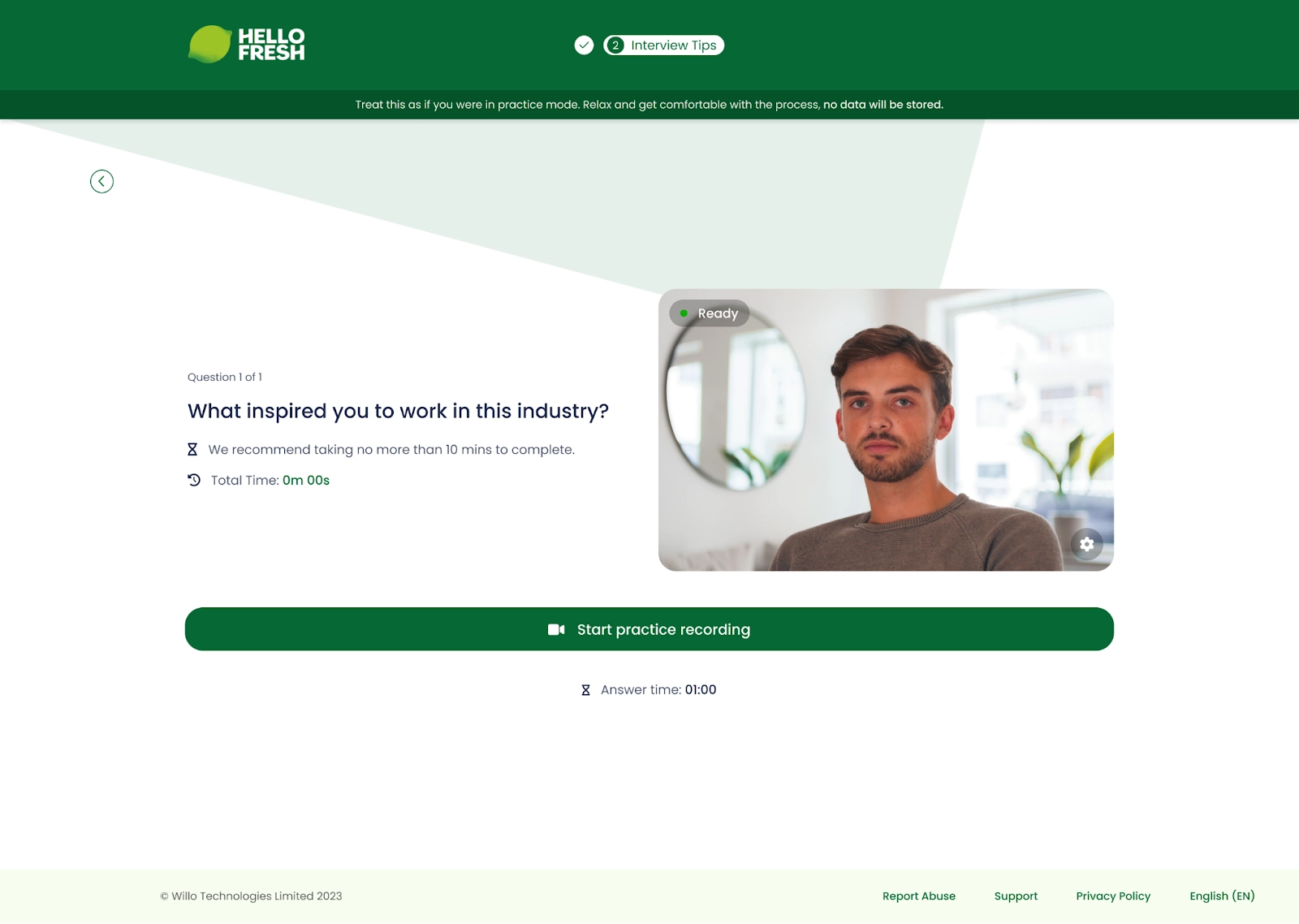
Instead of a one-on-one conversation, you'll generally receive a set of questions and record your responses according to the employer's instructions, on your own time. Some recruiters also include introductory videos and record some or all of the questions they send you to make the async interview feel less impersonal.
The exact interview process varies, but it usually goes like this:
But don't assume every pre-recorded interview works the same way. The employer controls many of the interview settings, so the instructions attached to your specific interview matter.
Before you start, check the instructions you've been given to confirm:
- If you get practice interviews (often unlimited)
- How much preparation time you have (if any)
- How long you have to answer each question (usually about 1 to 3 minutes)
- Whether retakes are available (this varies by employer)
- When the interview needs to be completed (though you can respond at your convenience, hiring teams set submission deadlines to stay on course)
- Whether there are any technical requirements (like headsets, specific supported browsers or devices, camera resolution, etc.)
While employers enjoy key benefits like multiple reviewers assessing candidates simultaneously, saving time on live screening, and reducing evaluation bias, you also get to respond under less pressure.
For a broader guide to preparing for a pre-recorded video interview, including ways to get comfortable on camera, see our top tips for candidates (with worksheets and practice exercises).
12 common pre-recorded video interview questions
The questions you'll receive depend on the employer and the role, but many pre-recorded interviews cover the same core areas (behavior, skills, problem-solving, and more), even if they’re worded slightly differently.
Here are 12 common pre-recorded video interview questions and how to approach them.
1. Can you tell me about yourself?
“Tell me about yourself” is often one of the first interview questions.
The interviewer wants a concise introduction that gives them a sense of who you are professionally, what experience is relevant to the role, and what you're looking for next.
A useful structure is:
Avoid turning your answer into a chronological history of everything you've done since school. Instead, focus on the parts of your professional background that help the interviewer understand why you're relevant to the role.
2. Why do you want to work here?
This question is about the company, so your answer should be specific to the organization.
Before the interview, research the company and identify one or two things that genuinely interest you. It could be its product, a recent project, its approach to the industry, or something about its mission.
Then connect that to your own interests or experience. Show that you've considered why this company, rather than simply why any company.
3. Why are you interested in this role?
“Why do you want to work here?” and “Why are you interested in this role?” aren't quite the same question. The first focuses on the organization, while the latter focuses on the job itself.
Your answer should center on:
- The responsibilities of the role
- Your relevant skills and experience
- What you want to learn
- What you could contribute
Use the job description to identify the parts of the role that genuinely match your experience or interests and can help you answer this question properly if it comes up.
4. Why should we hire you?
This is an opportunity to connect your strongest evidence to what the employer needs.
Start with the job description. Identify two or three requirements where your experience gives you something useful to offer. Your answer should make it easy for the interviewer to connect what you've done with what they need.
5. What are your strengths?
Choose strengths that align with the role, then support them with evidence.
Rather than simply saying you're organized, adaptable, or a good communicator, give the interviewer an example that demonstrates the strength in practice. Don’t just tell the recruiter or hiring manager what you’re like; show them what you've done.
6. What is your biggest weakness?
Many candidates choose a weakness that secretly sounds like a strength. Instead, use a more straightforward structure:
Answering this way shows that you recognize the issue and are doing something about it
7. Can you tell me about a time you solved a problem at work?
For a past-experience question like this, the STAR principle can help you structure your response:
Briefly explain what was happening, what you were responsible for, what you did, and what happened afterward. Keep the focus on your actions and avoid spending most of your answer describing the situation.
8. What was it like when you last worked as part of a team?
Teamwork questions are an opportunity to demonstrate collaboration, but make sure your own contribution doesn't disappear behind “we.”
You can talk about the team's result, but make it clear what you contributed. Explain the role you played, how you worked with the other people involved, and what happened as a result.
9. How would you adapt to organizational change?
Instead of simply confirming that you're adaptable, tell the interviewer about a time when you had to adjust.
What do you do when a project suddenly takes a different direction? Maybe the deadline changes, the requirements are different from what you expected, a team member leaves, or you have to learn a new tool quickly.
In this question, the interviewer wants to see how you handled the change, what you did next, and how you kept the work moving.
10. Can you describe a time you received difficult feedback?
A useful structure here is:
The strongest part of this answer is what you did with the feedback. Show that you listened, considered what you were told, and made a change where appropriate.
11. How have you handled a situation where you made a mistake or experienced failure?
Choose an example where you can clearly explain:
The point isn't to find an example where everything went perfectly afterward. It’s to show that you can recognize what went wrong, respond, and apply what you learned.
12. Where do you see yourself in five years?
Think about the skills you want to develop, the type of work you want to do, and the direction you want your career to take. Keep your answer connected to the role, but don't feel the need to predict your entire career in detail.
What makes a strong video interview answer? What recruiters actually look for.
A strong answer doesn't just tell an interviewer what you did. It gives them enough detail to understand why you did it and what happened as a result.
The second answer shows the situation, your decision-making, your individual contribution, and the result. That's especially useful in a recorded interview because you may not have an interviewer there to ask, “Why did you do that?” or “What happened next?”
So when preparing a response, think through what happened, what you did and why, and the outcome of those actions. This gives you a more useful answer than simply listing what you accomplished, particularly now that recruiters prefer specific examples and situational answers with personal context over traditional, possibly AI-polished, applications.
How to answer video interview questions when you don’t have much work experience
Are you a student, recent graduate, career changer, or early in your career? You can draw examples from outside a traditional full-time job, including:
- University projects
- Internships
- Student organisations
- Volunteering
- Freelance work
- Part-time jobs
- Personal projects
- Any roles where you got to apply transferable skills
The important thing isn't whether the example came from a formal job. It's what you did.
A university project can demonstrate problem-solving. Volunteering can demonstrate teamwork. A personal project can show initiative. And an internship can give you examples of adapting to new environments.
Focus on the experience and the evidence it gives you, rather than worrying about whether the example sounds “professional” or “formal” enough.
Quick tips to answer confidently when you’re on camera
The questions might be familiar, but answering them on camera without a recruiter there changes how you need to approach them.
Beyond the obvious, like keeping your environment quiet, dressing professionally, and ensuring good lighting and an internet connection, here are our top pre-recorded video interview tips:
- Give yourself a moment: If preparation time is available, use it to identify your example and the main point you want to make. You don't need to start speaking immediately.
- Get to the point: There's no interviewer prompting you with follow-up questions, so your answer needs enough context to stand on its own. Give the interviewer the information they need without spending most of your response setting up the story.
- Don't read a script: A prepared answer can sound very different when you read it rather than actually explain it naturally. Use preparation to organize your thoughts, not to memorize every sentence.
- Practice saying answers aloud: The goal is to get comfortable explaining your experience naturally on camera. Practicing aloud or with a friend also helps you notice when an answer is too long, unclear, or difficult to defend.
- Keep the format in mind: Answer length depends on the hiring team’s settings. So work within the time and conditions you're given rather than trying to hit a universal target.
- Maintain eye contact: Look at the camera lens throughout the interview (or at least as much as you possibly can) to show confidence and avoid seeming like you're getting external help.
Other video interview questions to prepare for
The questions above cover some of the most common areas, but you may also get questions like these.
Behavioural
- Tell me about a time you handled conflict.
- Tell me about a time you had to meet a difficult deadline.
- Tell me about an achievement you're proud of.
Situational
- What would you do if you received conflicting instructions?
- How would you handle a difficult customer?
- What would you do if you had incomplete information?
Skills and prioritization
- How do you prioritize competing deadlines?
- How do you approach learning a new skill?
Motivation
- What kind of work environment helps you perform at your best?
- What are your long-term career goals?
The exact questions will depend on the role, so use the job description and our free interview question generator (tested and trusted by HR leaders) to identify other areas to prepare for. This tactic also works for in-person interviews.
Want to practice your answers before an interview?
Preparing your answers on paper is one thing. Saying them out loud on camera is another.
Our free Video CV lets you practice recording answers to preset questions, re-record your responses, and share your finished video with a link to potential employers.