- Not all video interview software is great for one-way candidate assessment. The best option depends on your exact needs.
- To choose, compare how each option fits your hiring workflow, AI usage policy, target candidates, and preferred interview formats.
- Options like HireVue, Spark Hire, and Willo are best for high-volume candidate screening across enterprise and mid-market teams.
This guide compares seven video interview software options on how well they support one-way candidate screening. We evaluated each on how well it reduces the impersonality one-way screening can add, drawing on actual product interfaces and verified G2 and Capterra reviews. Features and pricing change quickly, so confirm details directly with each vendor before you commit.
You’re juggling multiple requisitions and high-volume applications, but your team doesn’t have nearly enough time or capacity to review everyone fairly and confidently. If that sounds familiar, you’re not alone.
According to Greenhouse's 2026 Benchmark Report, recruiters now manage 411% more applications annually than they did four years ago. Meanwhile, the average recruiting team has shrunk by more than half over the same period, meaning more applications and fewer people to review them.
Video interview software is one solution, but it comes in several forms: live interviews, one-way (asynchronous) recorded responses, and newer AI-led formats.
This guide compares 7 popular video interview software options based on how they handle one-way candidate screening. We’ll cover:
- How each option makes one-way video interviews more personal for candidates.
- Their key limitations and strengths so you can compare them objectively.
- What customers say about them, not just our own analysis.
- How to choose the right option for your TA team.
Here are the top 7 tools for one-way video interviews [and what they are best for]
- Willo: High-volume hiring teams that want AI-supported screening without automated decision-making
- HireVue: Best for large-scale enterprises that are screening many candidates for similar roles
- Spark Hire: Best for mid-market teams who want to keep both live and async interviews in the same place
- Hireflix: Best for lean teams with straightforward, low-volume screening needs
- VidCruiter: Best for large organizations with complex workflows that need the platform to adapt to them
- InterviewStream: Best for regulated-sector teams with strict compliance requirements
- Jobma: Best for companies hiring across multiple countries, languages, and assessment formats
Want an in-depth look at each tool, including costs and key differentiators? Skip to the comparison section below.
What makes a great one-way video interview software?
One-way video interview software works best when it humanizes the screening process, gives you full customization control, and enables consistent human review. Whatever features a platform stacks on top, a genuinely useful one-way tool should:
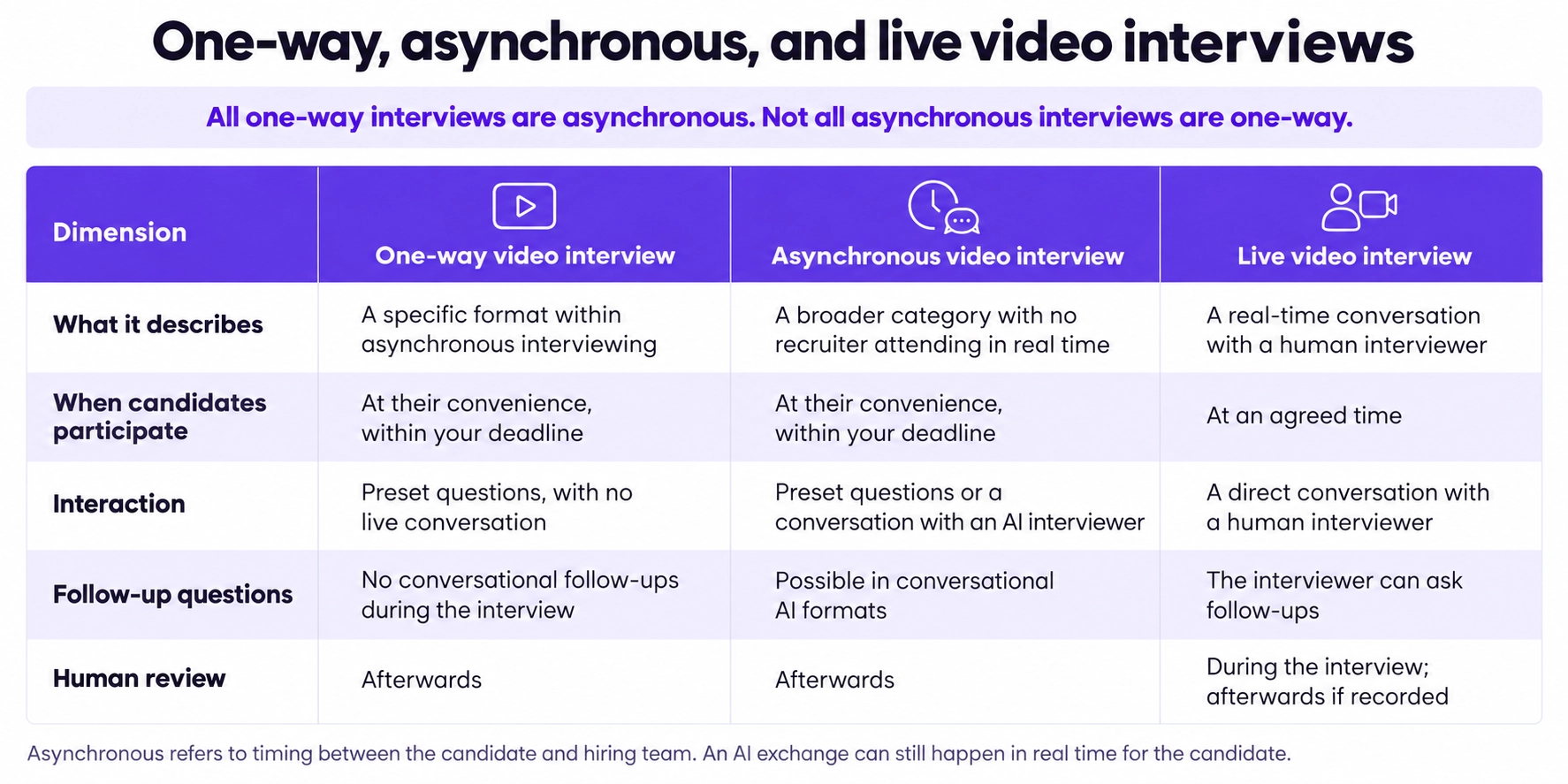
You can also read our comparison of the best asynchronous video interview software in this guide.
Are one-way interviews great for all hiring scenarios?
Despite their benefits, one-way video interviews aren't always the best fit for every scenario. Here’s a quick guide to when to use or skip them.
Use one-way interviews:
- For early-stage screening: When you need to determine who should make it to the live interview. Or when you already have standard in-house assessments but need to narrow the candidate pool first, and resumes aren't enough.
- For high-volume, entry-level, or customer-facing roles. When a role like sales or business development pulls in hundreds of applicants, a short recorded response reveals verbal confidence and communication style faster than a live call with every underqualified applicant.
- When resumes all start to look the same. Early-career and graduate applicants often submit polished, near-identical resumes, especially with AI writing assistance now common; a quick video response surfaces genuine personality and interest that a resume can't.
- When you're hiring across time zones. Recorded responses remove the scheduling back-and-forth of coordinating live calls across a distributed or global candidate pool.
Where one-way interviews don’t fit:
- For senior or specialized hires. Experienced candidates in low-volume, senior-level searches generally expect real-time engagement, and asking them to record a one-way video instead can cause drop-off.
- When you're actively recruiting passive candidates. Courting someone who's employed and weighing other offers takes a real conversation to probe their motivations and make the case for the role — something a one-way format can't do. Read our guide on how to source, interview, and hire passive candidates to learn more.
- When your candidates prefer a phone call over a video link. In some operational, trade, or service roles, applicants are more likely to ignore a video request or feel excluded by the format than to complete it, which can hurt your completion rate more than it helps.
7 best one-way video interview software compared
1. Willo
Best for: High-volume hiring teams that want AI-supported screening without automated decision-making
Willo is AI-assisted candidate screening software that gives your team the confidence to decide which of hundreds of applicants should move forward.
How Willo works for one-way video interviews
You:
- Set a Blueprint for the role you’re hiring for, detailing must-haves and differentiators.
- Draft the same interview questions for each job applicant.
- Record your intro video (and each interview question if you want an even more personal touch).
- Send candidates an interview link so they can respond on their own schedule (within a set timeline).
Candidates:
- Receive the interview link, read the instructions, and take practice tests (if you offer them).
- Record responses on their own schedule, without creating an account, logging in, or downloading an app.
- Retake any answers they don’t like or feel confident in (if the interview setting allows that).
- Submit the completed interview video.
Willo:
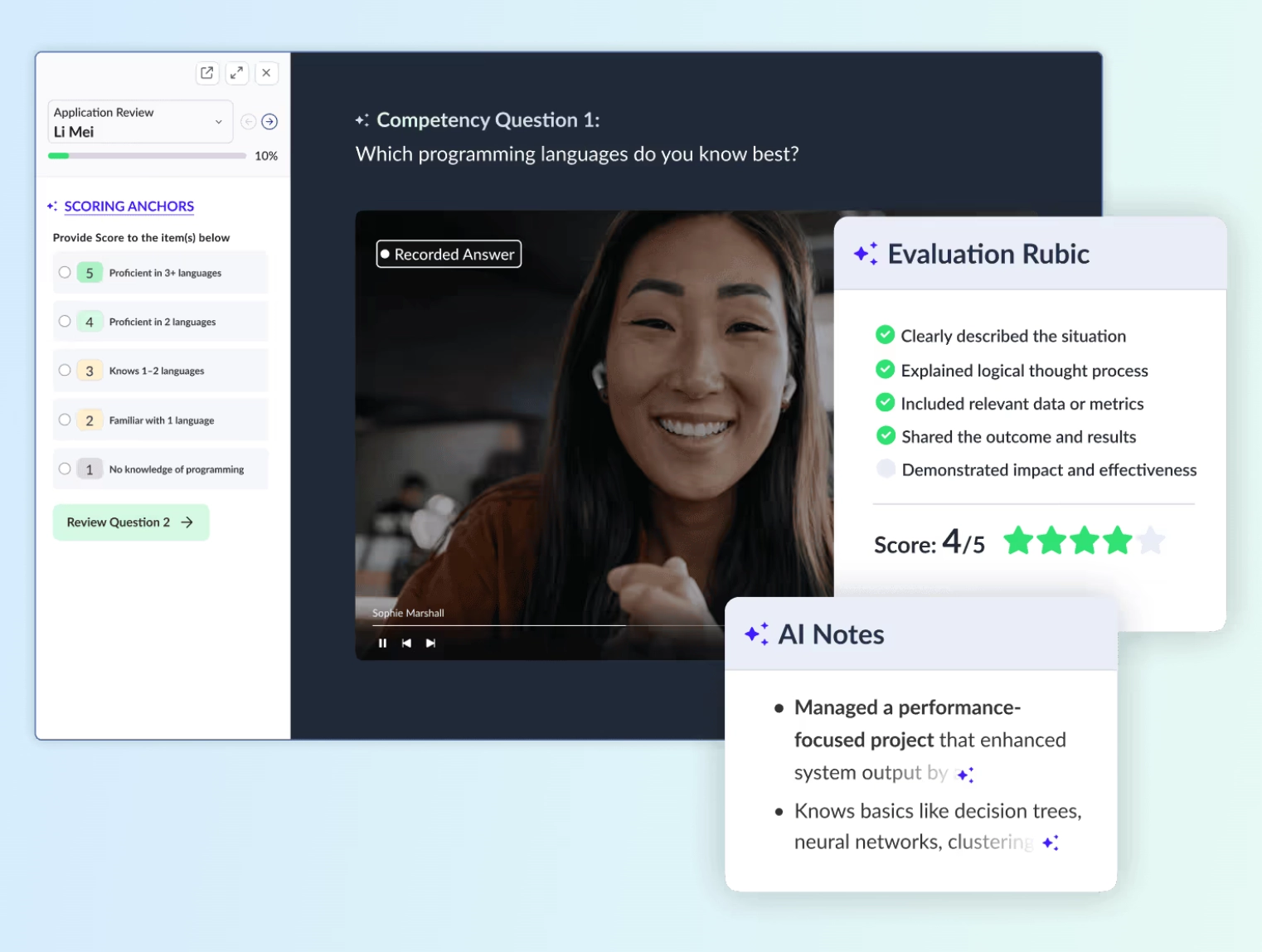
- Scores each response against your preset Blueprint, surfacing the strongest candidates.
- Links each score back to the exact timestamped moment in the recording that influenced it, so you can jump straight to the clip without rewatching the full video.
- Generates AI summaries and interview transcripts you can review and probe as needed.
This way, reviewers can quickly see why a candidate ranks where they do, before deciding to advance or reject them.
You can also schedule live interviews via direct integration with meeting apps once you’ve decided a candidate makes the cut. And if a hiring manager or auditor questions your shortlist or hiring decision, it’s easy to point them to the evidence without panicking.


Key features
ATS depth
Willo offers both native ATS integration with two-way sync and API/Zapier-powered connections. Once you connect Willo to your team’s ATS, it transfers interview data one way into candidate profiles on the platform and vice versa, preventing manual tool-toggling or lost insights.
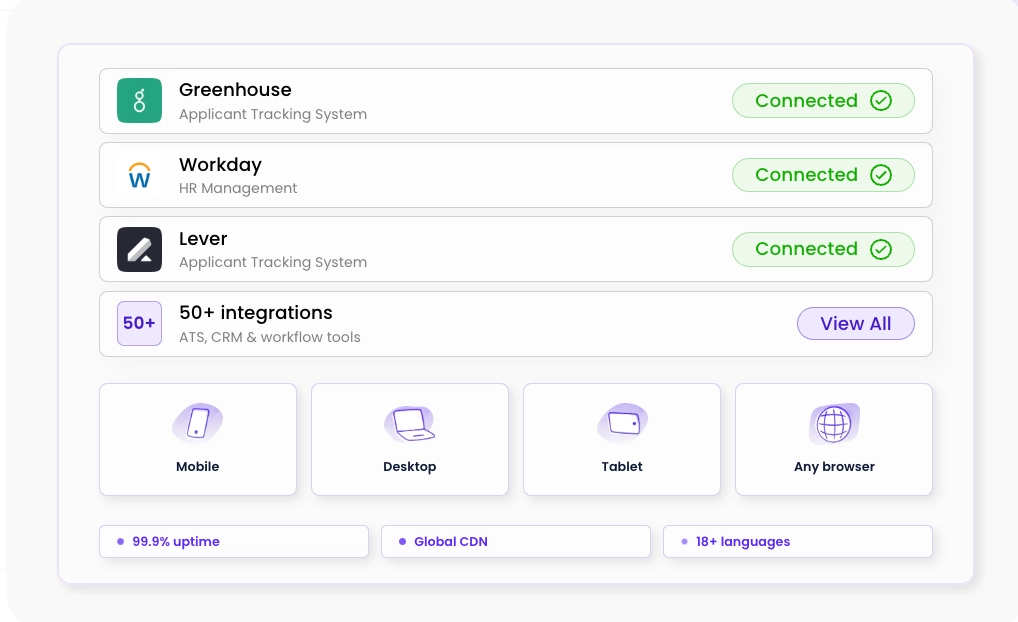
It supports over 50 native ATS integrations, including Ashby, AXLR8, BambooHR, Workday, Greenhouse, Jobvite, Workable, Rippling, JazzHR, and more. Willo also enables 5000+ API and Zapier syncs for connecting to other ATS and CRM tools not natively supported.
Multi-format responses
One-way video interviews save time and can help reduce bias, but not every candidate performs their best on camera. Willo lets you combine video, audio-only, file uploads, and text responses in a single hiring cycle, e.g., video for client-facing roles, audio-only for accessibility, or text for quantifiable or technical answers.
This flexibility directly addresses one of one-way screening’s biggest fairness problems: a format that rewards only people comfortable with video ends up filtering for camera confidence rather than job fit.
.webp)
The strong writer for a copywriting role who freezes in front of a lens can get a fair hearing with text responses, and a confident speaker for a customer service or sales job whose CV undersells them can stand a strong chance of getting hired.
Willo also auto-scores objective and multiple-choice questions that check non-negotiables like location, work permits, or certifications, filtering candidates - especially for technical roles - without requiring reviewers to sit through responses from objectively unqualified candidates.
While video and audio answers submitted on Willo still need recruiter review to keep final decisions human, AI-generated transcripts and summaries help speed things up.
Configurable retakes and response time
A one-way interview gives a candidate one shot to get it right, unless the platform or employer allows multiple takes. For example, Willo lets you configure retake allowances from zero to unlimited and set response windows from one to five minutes per question.
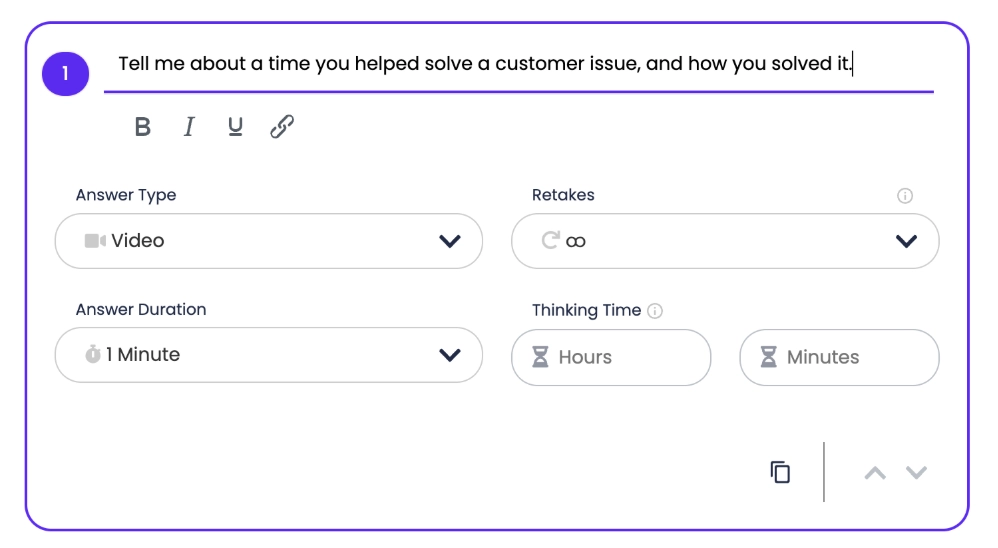
This is another way to soften the impersonality one-way screening can otherwise bring. A rigid, single-take format under a tight clock adds real pressure that has nothing to do with whether someone can do the job. It just tests how well they perform semi-live, on a timer, under pressure.
Letting a candidate re-record a fumbled answer, or giving them a longer window for a question that needs more thought, does ease the experience and boosts your employer brand. This is particularly useful for graduate hiring or campus recruitment where applicants are often less experienced and more bashful.
Authenticity and cheating detection
76.9% of hiring teams encounter AI-generated or AI-assisted applications, and as these get harder to catch, one-way video interviews carry a specific risk live screens don’t: nobody’s on the call to notice a candidate getting external help.
Willo's RealTalk analyzes speech patterns, pacing, and phrasing in video responses to flag scripted, teleprompted, or AI-generated answers. And between 2025 and 2026, the tool flagged 5.8% of interview responses as potentially AI-generated.
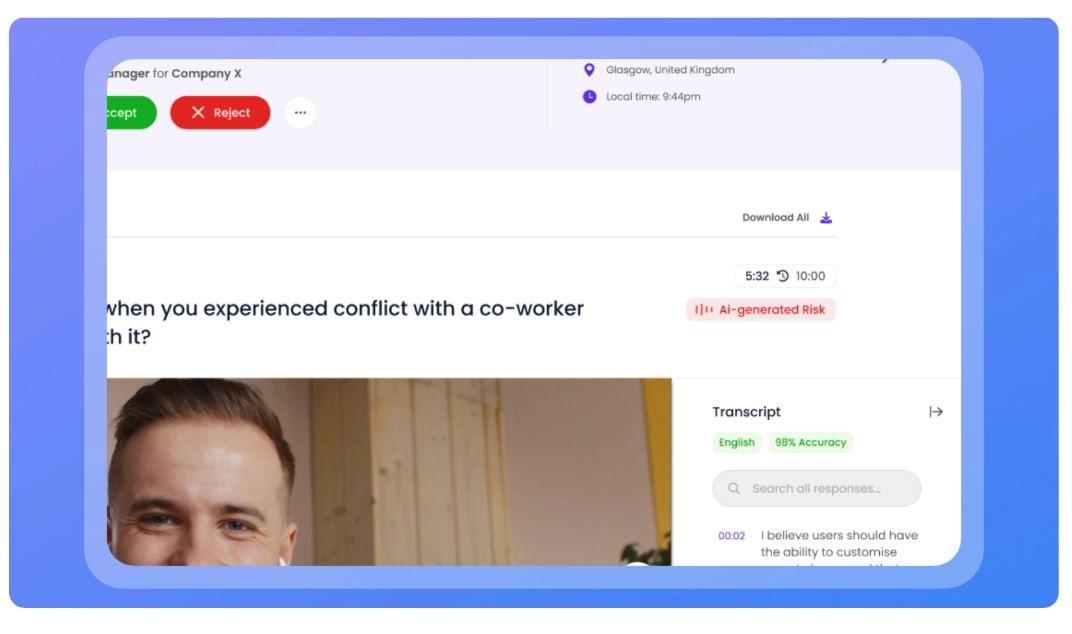
Heavy-handed proctoring like webcam lock, browser monitoring, and environment scans tends to unsettle candidates mid-interview.
Willo simply prevents tab-switching and copy-pasting, then assesses the final response transcript for suspicious pauses and AI-sounding language - effectively avoiding making the interview feel like an interrogation.
Consistent, evidence-linked candidate scoring
Beyond just scoring a response, Willo shows you the evidence behind each score. So once you’ve set your hiring criteria and built your Willo Blueprint and scorecard based on it, you can score each candidate on the same criteria for fairness.
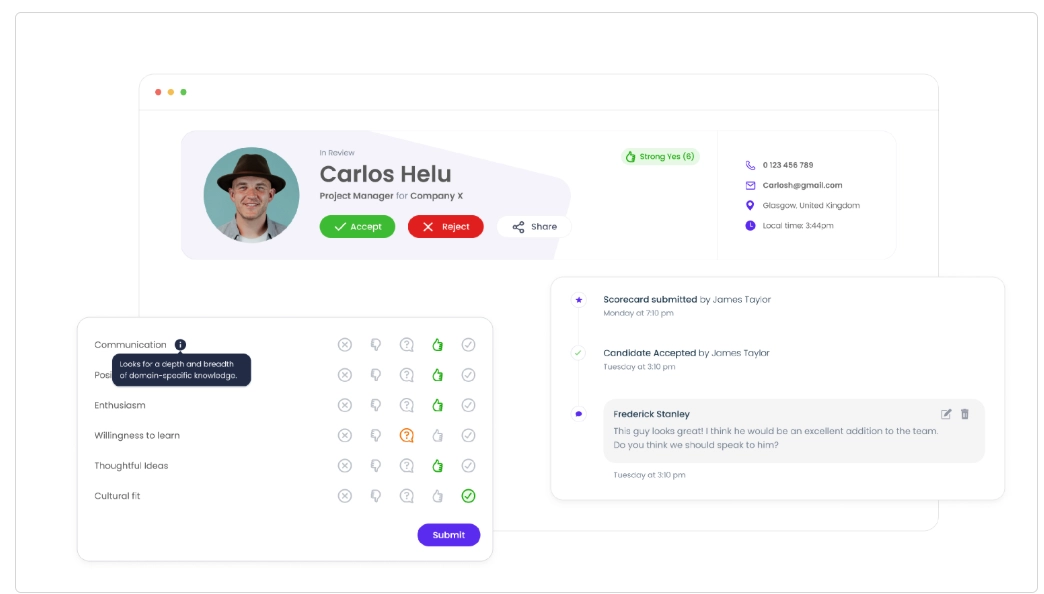
For one-way interviews where there’s no live interviewer in the room to catch nuance in real time, the recorded answer has to quite literally speak for itself. And with just a bare score or inconsistent evaluation, a reviewer can’t tell whether a candidate actually addressed the question or has just mastered the art of sounding confident.
Willo also suggests follow-up questions to ask each candidate to collect additional context, verify skills, and confirm job fit.
Pros
- Evidence-linked scoring, not a black-box number. Every score links to the exact timestamped moment that earned it, so reviewers defend evidence, not a number.
- Multi-format captures signal beyond video alone. Video, audio, or text, per question, so a strong candidate who freezes on camera still gets a fair read.
- No-login candidate flow. One link, no account, no app, which keeps completion rates higher.
- RealTalk addresses the AI-authenticity problem. Flags scripted or AI-generated responses via speech pattern analysis, no invasive proctoring required.
- Broad native ATS coverage. Native or API/Zapier connections to Workday, Greenhouse, Ashby, and more.
- GDPR compliant and ISO aligned. Clears the baseline most procurement and legal reviews check first.
- Built to scale. Served 5,000+ organizations across 100+ countries, from a handful of roles to 50,000 interviews.
Cons
- No live interview mode inside the platform, though there’s an option to schedule them and sync directly with meeting tools like Zoom and Google Calendar.
- (Deliberately) not built for teams that want fully automated video scoring, as that takes away the human decision-making layer from the workflow.
Pricing
Willo has two core pricing tiers based on hiring frequency and volume:
- Willo Lite: $59/live role, best for occasional hiring
- Willo Enterprise: Starts at $3,799/year, best for teams that are always hiring
Willo also offers a 50% discount for verified non-profits and a 14-day free trial for teams looking to test-run before committing.
Why teams choose it: Willo gives reviewers evidence, not just a black-box AI score, so shortlist decisions hold up under scrutiny. It also offers flexible pricing for both occasional and at-volume hiring.
2. HireVue
Best for: Large-scale enterprises that are screening many candidates for similar roles
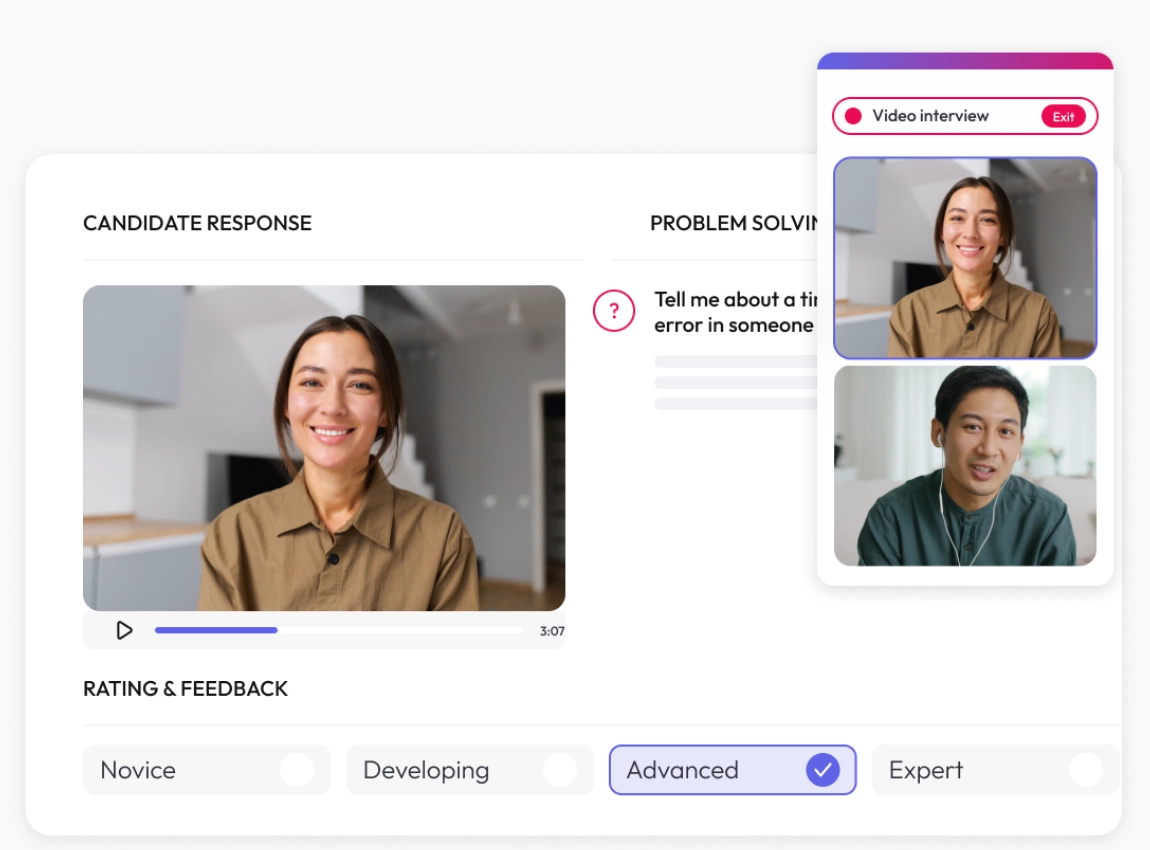
HireVue is enterprise video interviewing software built for large-scale, standardized hiring. It runs both one-way and live interviews on one platform, with assessment design backed by IO (industrial-organizational) psychology research.
The platform offers automated triage at volume, analyzing verbal content, speech patterns, and visual behavior to score every response numerically. It then surfaces a pre-filtered shortlist for human review instead of asking teams to assess every application manually.
This approach suits structured, high-volume roles where consistent scoring criteria matter more than case-by-case nuance. However, the main tradeoff is that some non-knockout rejections become automated rather than remaining solely in the human-recruiter domain.
Key features
- Live and one-way asynchronous video interviews with custom branding and structured question templates.
- Identifies team-wide hiring patterns and predicts candidate success based on historical performance data
- Sorts applicants from highest to lowest algorithmic match, filtering pools from 2,000+ to the top 100 for human review
- Pre-built video interview templates for common enterprise roles (graduates, customer service, sales)
- SOC 2, GDPR, and industry-specific certifications for regulated hiring at scale
User reviews
“Offers a strong set of features — from on-demand video interviews to structured rating guides and AI-enabled assessments.” - Vlnay B.
“It would be great to have links to each recorded interview to share with Hiring Managers.” - Julian M.
Pros
- Consistent evaluation criteria at scale, reducing bias or subjective favoritism claims
- Deep analytics reveal hiring patterns and bottlenecks across departments, improving workforce planning
- Broad assessment formats (game-based, technical, language)
Cons
- 12+ week implementation for complex deployments
- Black-box scoring on subjective one-way responses draws candidate skepticism.
- Occasional call quality glitches, and ATS integrations that don’t always auto-pull resume data.
Pricing
Starts at around $35,000 a year; contact the team for actual pricing.
Why teams choose it: HireVue scores every response the same way, and it's built to handle high-volume hiring without breaking.
3. Spark Hire
Best for: Mid-market teams who want to keep both live and async interviews in the same place
.webp)
Spark Hire combines asynchronous screening with live video interviews on a single platform, so teams don't need separate tools when different roles call for different interview formats.
Its core differentiator is consolidation: a company can screen 50 customer support reps asynchronously and interview 5 department heads live through one vendor, one training process, and one consistent candidate experience, rather than managing two disconnected systems.
Built-in scheduling handles the live side, while automated workflows cover async invitations and reminders. Spark Hire also offers a native ATS for those who don’t want a separate applicant-tracking platform.
Key features
- One-way asynchronous screening and live scheduled video interviews within the same platform
- Schedule and send interview invitations at scale with customizable templates and reminder sequences
- Calendar syncing for live interviews eliminates back-and-forth email coordination
- Automated reference request and collection built into the hiring workflow
- Connects to Greenhouse, Lever, BambooHR, JazzHR, and other popular applicant tracking systems
- Pre-built interview question sets organized by role and industry
User reviews
“Ensures that our recruitment team is interviewing the right candidates.” - Todd M.
“I wish there was a way for candidates to "blur" their background or set up a themed background for one-way Interviews. Some folks show up with mayhem behind them, and it is very distracting for the evaluator.” - Miranda H.
Pros
- A single platform for both async and live interviews reduces vendor costs and simplifies procurement.
- Modular pricing rather than an all-in purchase, so you only pay for the core functionalities you’re interested in.
- AI summaries speed up review without fully automating judgment calls.
Cons
- Slight learning curve and longer onboarding time from running two formats in one tool.
- It offers its own applicant tracking module, so you may feel pressure to switch from your current ATS.
- Deactivating past interview packages or customizing the platform’s AI tool can sometimes be difficult.
Pricing
The video interview module pricing starts at $299/month (billed monthly) or $249/month (billed yearly) and scales based on the number of users and interview volume. Spark Hire also bills separately for its other two modules: Applicant Tracking System and Behavioral Assessment.
Why teams choose it: Spark Hire runs live and one-way from one dashboard, and it works well for lean teams without enterprise budgets.
4. Hireflix
Best for: Lean teams with straightforward, low-volume screening needs
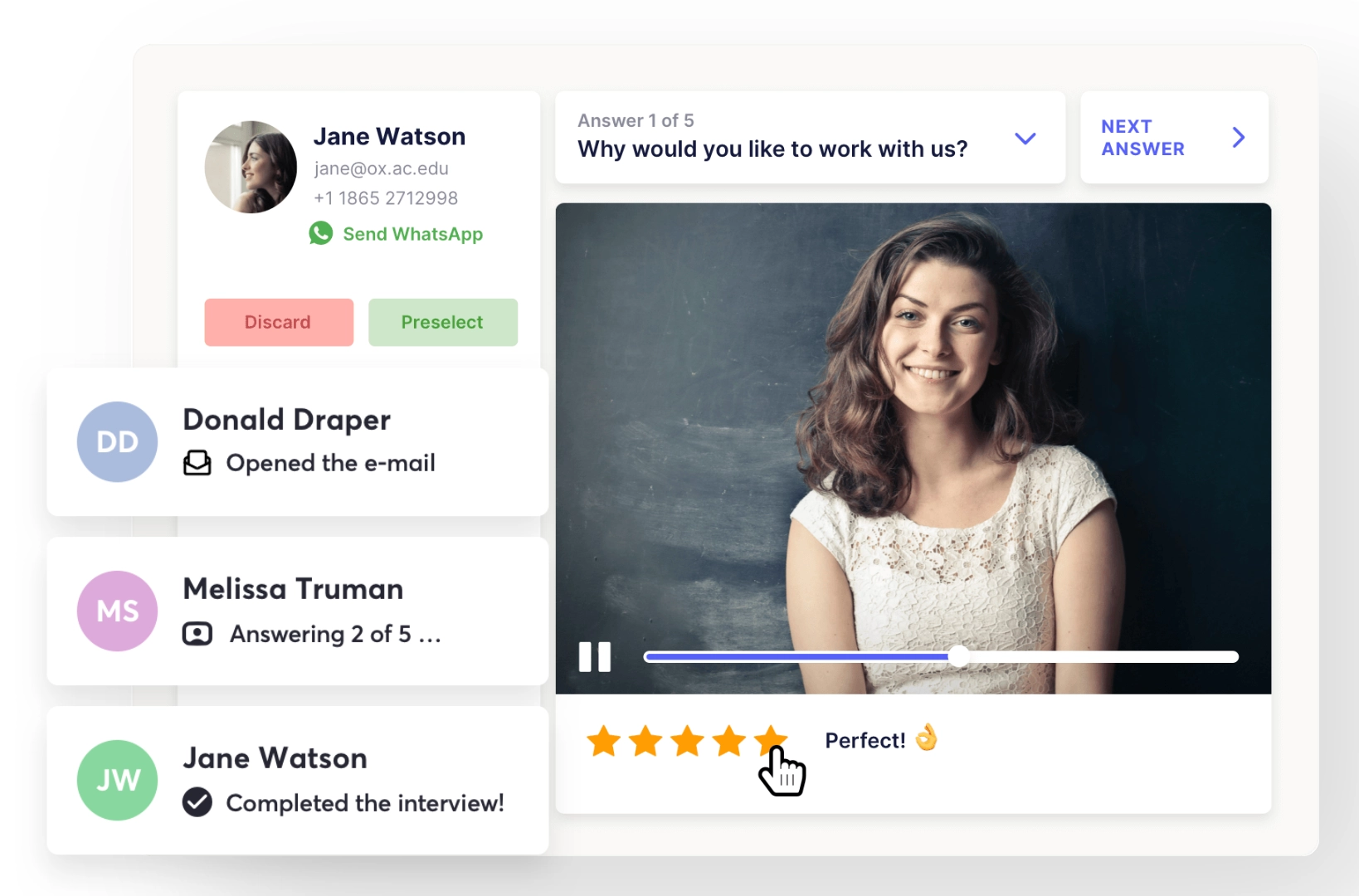
Hireflix strips one-way video interviewing down to the essentials: no live interviews, text responses, or file uploads.
It offers flat monthly pricing with no per-position or per-response limits, keeping it simple and predictable for procurement planning. Every tier includes unlimited seats, job postings, and candidate responses, so a small team doesn’t spend more for hiring in a busy month or get penalized for going quiet the next.
The trade-off with Hireflix is depth, though. It does not offer AI scoring or generated summaries, and its reporting is basic at best. But setting it up is pretty easy, meaning teams can literally launch the same day they buy.
Key features
- Candidates access interviews via a link without account creation or password management
- Recruiters can configure it to let interviewees run test interviews to prep themselves before starting the actual version they’ll be submitting.
- Connects to popular applicant tracking systems for candidate data sync.
- Candidates can complete one-way interviews on smartphones without desktop requirements.
- Create custom video interview questions with preparation time and response length controls.
- Automated alerts when candidates complete interviews.
User reviews
“It’s a practical, well-designed tool that fits easily into everyday recruiting workflows.” - Carlos M.
“The product is overall fantastic, but I’d love to see a bit more customization around branding and maybe a few extra integrations with smaller ATS tools.” - Ugur O.
Pros
- Fast, low-friction candidate flow, as there are no login requirements to trigger interview abandonment
- Requires minimal onboarding and training since the interface is simple and focused on just one thing: one-way video screening
- Automated text transcripts and smart reminders help speed up candidate review.
Cons
- No live interview support, so you’ll need to set up another tool for that stage.
- No native AI scoring or question generation, no transcript search, automated summaries, or pattern detection across candidate pools.
- Limited analytics and reporting compared to broader platforms.
Pricing
Tiered pricing based on team size:
- $150/month billed monthly or $75/month billed yearly, for companies with less than 50 employees
- $300/month billed monthly or $150/month billed yearly, for companies with 50 to 250 employees
- Custom pricing for corporate organizations and recruitment agencies with high-volume processes.
Why teams choose it: Hireflix does one thing, async screening, and it keeps every extra feature out of the way.
5. VidCruiter
Best for: Large organizations with complex workflows that need the platform to adapt to them
VidCruiter builds custom one-way and live video interview workflows for enterprises with hiring processes too complex for off-the-shelf tools. It is particularly useful for regulated industries, multi-location hiring, or processes that require specific approval chains before a candidate can move forward.
Rather than fitting your process to the software's limits, VidCruiter lets you build the workflow around actual requirements, from custom branding to job-related criteria, multi-stage approvals, and industry-specific compliance documentation. It also has assessment and scheduling modules built in beyond just the interview.
That depth of customization is what makes VidCruiter a fit for large or regulated organizations.
Key features
- Configure multi-stage approval chains, conditional routing, and role-specific one-way interview paths matching your exact hiring process.
- Fully customize candidate-facing pages, emails, and the video player with your company branding.
- Proctored pre-employment testing, skills assessments, and cognitive ability tests integrated with one-way video interviews.
- Automated calendar coordination for panel interviews and multi-interviewer sessions after candidates scale the async screening stage.
- These run alongside the interview process, so reviewers get a fuller candidate picture without a separate manual step.
- GDPR, SOC 2, and industry-specific security standards for regulated hiring.
User reviews
“I like the time saved from doing phone call references.” - Vanessa S.
“Lack of HubSpot integration is our one big blocker.” - Corey B.
Pros
- Deep customization accommodates unique enterprise requirements instead of forcing process changes to fit the software, especially when you’re looking to incorporate one-way video interviewing.
- Comprehensive feature set (video, assessments, scheduling) and responsive user support reduce the need for multiple vendor relationships.
- Easy-to-follow audit trails support compliance while broad HRIS and ATS integrations prevent the hassle of platform-toggling.
Cons
- Custom-quote billing only; no live pricing information available on their site to pre-assess without contacting the team.
- Feature depth can make the platform overwhelming or complex for teams with limited technical experience.
- Email templates lack extensive branding flexibility.
Pricing
Contact VidCruiter for custom pricing.
Why teams choose it: VidCruiter enables customizable workflows and ensures an audit trail of all hiring decisions.
6. InterviewStream
Best for: Regulated-sector teams with strict compliance requirements
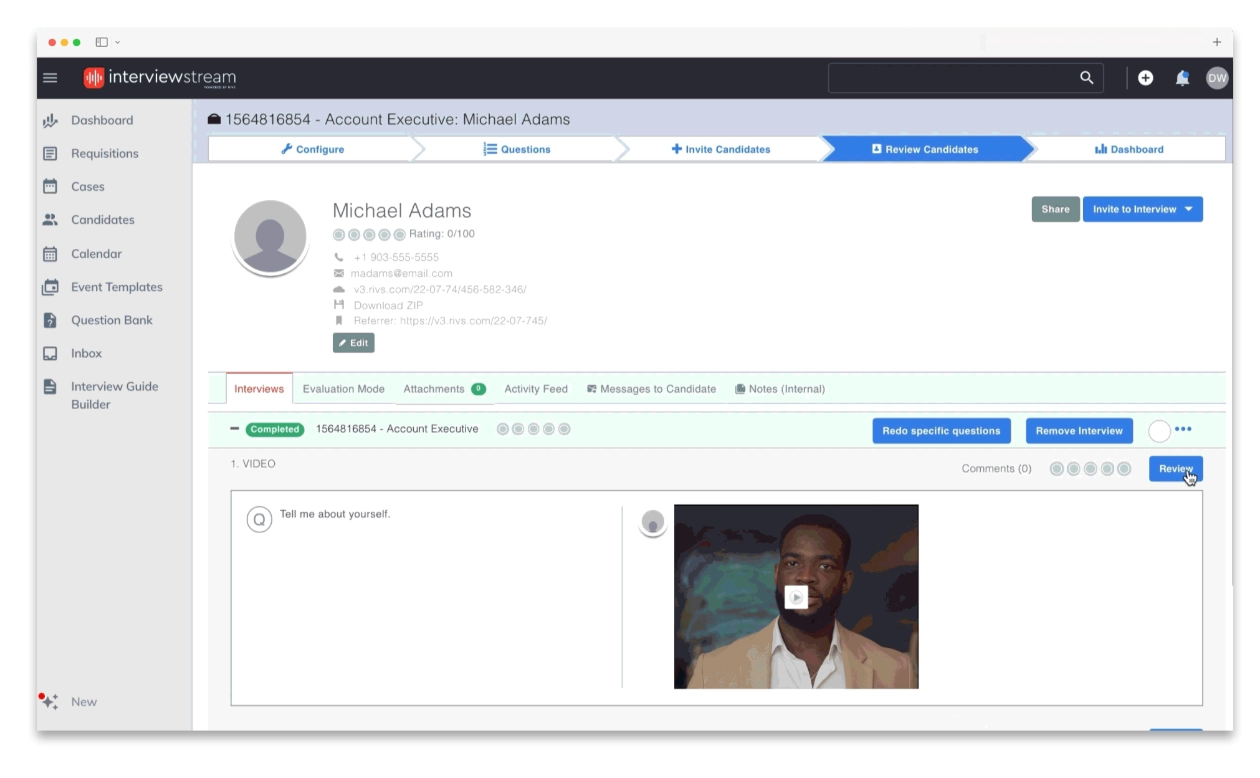
InterviewStream specializes in regulated industries, where hiring compliance, documentation, and sector-specific workflows aren't optional. It’s built for education, healthcare, and government hiring, so you can run one-way interviews with confidence that it supports the paperwork and audit trails those sectors actually deal with.
For example, InterviewStream plugs into the systems K-12 education already runs on, like Frontline Education and PowerSchool, so if you use either, it’s a great choice. It also offers an open API to connect to any other ATS and bundles interview scheduling and employee onboarding with video screening, so hiring admin stays in a single interface.
Outside regulated sectors, InterviewStream’s compliance-heavy feature set is often more than most teams need.
Key features
- Pre-built one-way interview workflows for education, healthcare, and government roles with built-in compliance checks.
- Post early-stage one-way screening, InterviewStream offers calendar management for panel interviews common in academic and government hiring.
- Automated audit trails, EEOC reporting, and defensible hiring records for regulated-sector requirements, including HIPAA and GDPR.
- New hire paperwork and orientation workflows integrated with video interviewing.
- Established connections to Frontline Education, PowerSchool, and other platforms dominant in regulated industries
- WCAG-compliant candidate experience for government and education requirements
User reviews
“Pretty easy to use and has a nice integration into Bullhorn” - Joey B.
“The downside is when the video and sound don't match. There tends to be a lag at times.” - Amy T.
Pros
- Purpose-built for regulated industry compliance needs, rather than generic features adapted to regulations.
- Deep expertise in education, healthcare, and government hiring nuances reduces implementation risk.
- Integration partnerships with industry-standard ATS platforms ensure smooth data flow.
Cons
- Narrow industry focus limits applicability for commercial sectors outside education/healthcare/government.
- Pricing not disclosed publicly. The tool requires sales engagement to learn costs and compare options.
- The feature set may be excessive for organizations with straightforward, non-regulated hiring needs.
Pricing
Contact InterviewStream for custom pricing based on organization size, industry, and hiring volume.
Why teams choose it: InterviewStream is compliance-first by design, and it extends past screening into onboarding.
7. Jobma
Best for: Companies hiring across multiple countries, languages, and assessment formats
Jobma delivers video interviews in candidates' native languages, built for organizations hiring across multiple countries and regions at once. This enterprise-scale suite offers one-way, live, and AI-assisted interviews side by side, with language support built into all three.
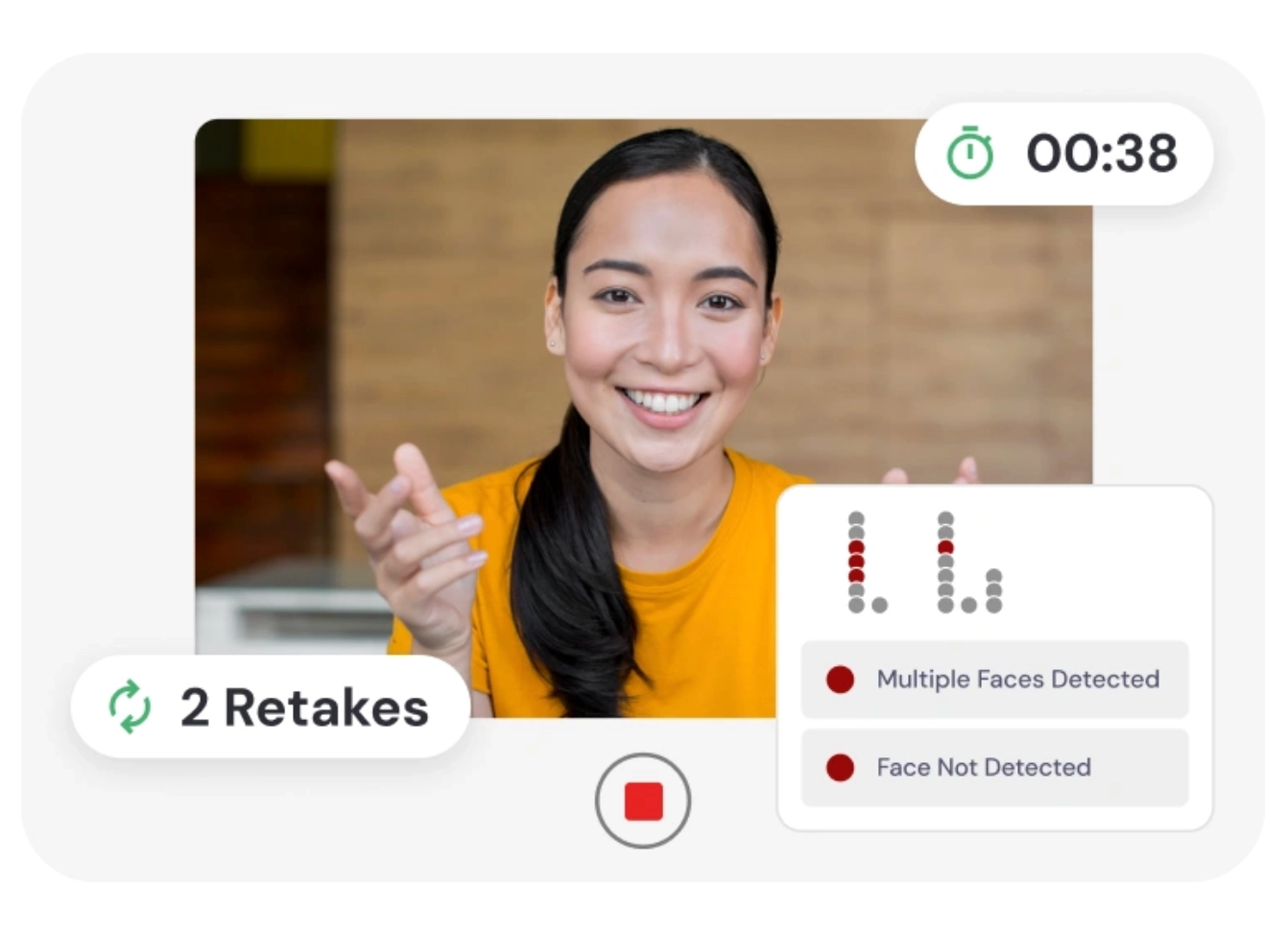
Its subscription-based annual plans are sales-led, and beyond video, Jobma runs AI-assisted proctoring that flags multiple faces, tab-switching, and mobile device use during a response. It also offers identity verification to confirm who's actually on camera.
That combination- genuine multi-format range, real language depth, and authenticity checks- makes Jobma the right call for high-volume, cross-border hiring. It’s also what makes the platform overkill for anyone hiring in a single market or language.
Key features
- Native-language interview experiences across 60+ languages, not basic translation overlays.
- Enables quick interview setup and keeps interviews structured despite the flexibility of async responses. Supports coding, language, written, and audio assessments.
- Candidates in emerging markets can complete one-way, live, or agentic interviews on smartphones, with no desktop access requirements.
- Aligns with SOC 2, GDPR, and CCPA standards for audit-readiness.
- White-label candidate experience with company logo and colors.
User reviews
“It has given both candidates and recruiters the flexibility and time needed to complete the (interview) process.” - Heinz B.
“The AI does not pick up a fake AI-generated voice for the voice audition.” - Sue K.
Pros
- Strong language localization designed for multi-language hiring from the start, not retrofitted translation features.
- Broad assessment format range (one-way, live, AI-assisted, coding, written, audio, etc.) in one platform.
- Mobile-first design works well for candidates in emerging markets with limited desktop access.
Cons
- Quote-based pricing means you can’t plan or budget without speaking to the team directly.
- Offers no monthly or per-role plan, just annual contracts, which can be inconvenient for short or temporary hiring windows.
- Covers one-way interviews well but isn’t as strong for coding assessments, so it might not be a fit if you have serious technical-hiring needs.
Pricing
Contact Jobma for custom pricing
Why teams choose it: Jobma supports interviews in dozens of languages and scales across borders without switching tools.
How to choose the right one-way video interview software
Once you've decided one-way video fits your process, the one-way part of these tools works roughly the same everywhere. What actually differs is what's built around it.
Some platforms do one-way and nothing else, some fold it into a broader live-interview or enterprise suite, and some pair it with other assessment formats entirely. Which of those matters to you comes down to the hiring scenario you're actually solving for.
- If you're screening high volumes of entry-level or customer-facing candidates (sales, business development, and similar roles where communication style is the thing you're actually assessing), you need a tool that helps you move fast without watching every response start to finish. Willo layers AI-assisted evidence into the review without automating the decision; HireVue leans further into algorithmic scoring for even bigger volume.
- If you're hiring across countries, time zones, or languages, look for a platform built for that specifically, rather than one that happens to support it. Jobma is built around multi-language, multi-region hiring from the ground up.
- If your hiring is occasional or low-volume, a single-purpose tool that does one-way interviews well and nothing else keeps setup simple and cost predictable. Hireflix fits this without asking you to pay for or learn features you won't use.
- If you want live and one-way interviews in the same place, without the overhead of a full enterprise suite, Spark Hire runs both formats on one platform, sized for mid-market teams rather than enterprise contracts.
- If you're hiring for complex, multi-stage, or compliance-heavy processes. In regulated industries—government, healthcare, education, or large organizations generally—the workflow, audit trail, and compliance depth matter more than the one-way feature itself. VidCruiter and InterviewStream are built around exactly that.
- If you want more than video alone, and structured, criteria-based scoring on top of it, Willo combines video, audio, text, and file-upload responses with objective-only auto-scoring, so richer signal doesn't mean giving up a human-reviewed decision.