- An AI interviewer uses AI to conduct or score interviews, though the four formats sold under that name differ sharply in who actually judges the candidate.
- A defensible choice should let you see who judges, what evidence a human can review, and what the candidate is told before they start.
- If AI-led interviews don’t feel quite right, Willo takes a different approach: it collects and structures interviews, then leaves the judgment to you.
If applications are arriving faster than your team can review and screen candidates, you may have considered buying an AI interviewer software to handle the volume. And you wouldn’t be alone. Hiring teams are under pressure to screen faster and build a stronger shortlist today. But only 76% of recruiters spend at least 30 seconds reviewing each CV.
However, how an AI interviewer might help your team depends on your specific hiring problem and what you believe a good screening workflow should look like.
- Do you want AI to speak with candidates when a recruiter is unavailable?
- Do you want it to assess and score their answers?
- Perhaps you only need it to transcribe, summarise and organise candidate evidence so your team can review it more efficiently.
These are some of the questions you'll need to answer in your search for an AI interviewer.
In this article, you’ll learn:
- What exactly does an AI interviewer do
- The different ways AI interviewers work
- How candidates experience the different approaches
- How popular platforms handle early-stage screening with AI interviewers
- Factors to consider when evaluating an AI interviewer.
What "AI interviewer" actually means
For employers, an AI interviewer is software that uses artificial intelligence to screen and interview job candidates. It is typically used during early-stage screening, before a live interview with the hiring team, to ask candidates questions, assess their answers or do both.
The end goal is to help your team screen a larger applicant pool consistently and gather enough evidence to decide who should progress.
Here is where things can become confusing. An AI interviewer can broadly refer to two applications:
- AI conducts the interview. The software presents questions to candidates through voice, text or an on-screen avatar. Depending on the product, it may follow a fixed script or ask follow-up questions based on the candidate’s answers.
- AI assesses the interview. Candidates answer preset questions by video, audio or text. The software then transcribes, summarises or scores their responses against predefined criteria.
In some cases, AI conducts the interview and assesses the answers afterward.
This distinction affects more than how quickly you can move candidates through the pipeline. It also shapes the candidate experience, the evidence available to your team and how much influence the software has over who makes it to the live interview.
To make those differences easier to understand, let’s explore the four main ways AI interviewers typically handle early-stage interviews.
Is this the same as AI candidate screening?
You might be wondering what is the difference between an AI interviewer and AI candidate screening? It’s simple:
AI candidate screening is the broader process of using AI to help evaluate applicants before a live interview. It can include CV analysis, eligibility questions, skills assessments, recorded responses and candidate interviews.
An AI interviewer is one way to collect and assess candidate evidence during that process. It asks candidates questions, evaluates their responses or does both. Depending on your workflow, it may work alongside other screening methods rather than replace the entire screening stage.
For a broader comparison of the available approaches, read our guide to AI candidate screening and assessment tools.
Four ways AI interviewers support early-stage screening
Despite delivering the same end goal (identifying the strongest candidates for a role), AI interviewers come in four distinct formats, and we've analyzed each based on who actually does the judging: human or AI?
Ps: By human judgment, we mean someone with the authority to change outcomes, see the underlying evidence, transcripts, and recordings, and understand how the AI arrived at its judgment for defensibility.
Conversational voice AI interviewers
This type of AI interviewer works as a two-way dialogue. The AI asks questions, the candidate answers, and it can even provide instant feedback or follow up if something needs clarifying. By the end, it gives you a score, a breakdown of strengths and weaknesses, and a recommendation on whether to move them forward.
The experience depends heavily on how well the conversation works. In our research, negative reactions focused on interruptions, awkward pacing, questions that failed to respond to what the candidate had said and uncertainty about how the resulting score would be used.
Companies like HireVue, Eightfold, and Ashby all offer voice-based AI interviewing, but they all take fundamentally different approaches.
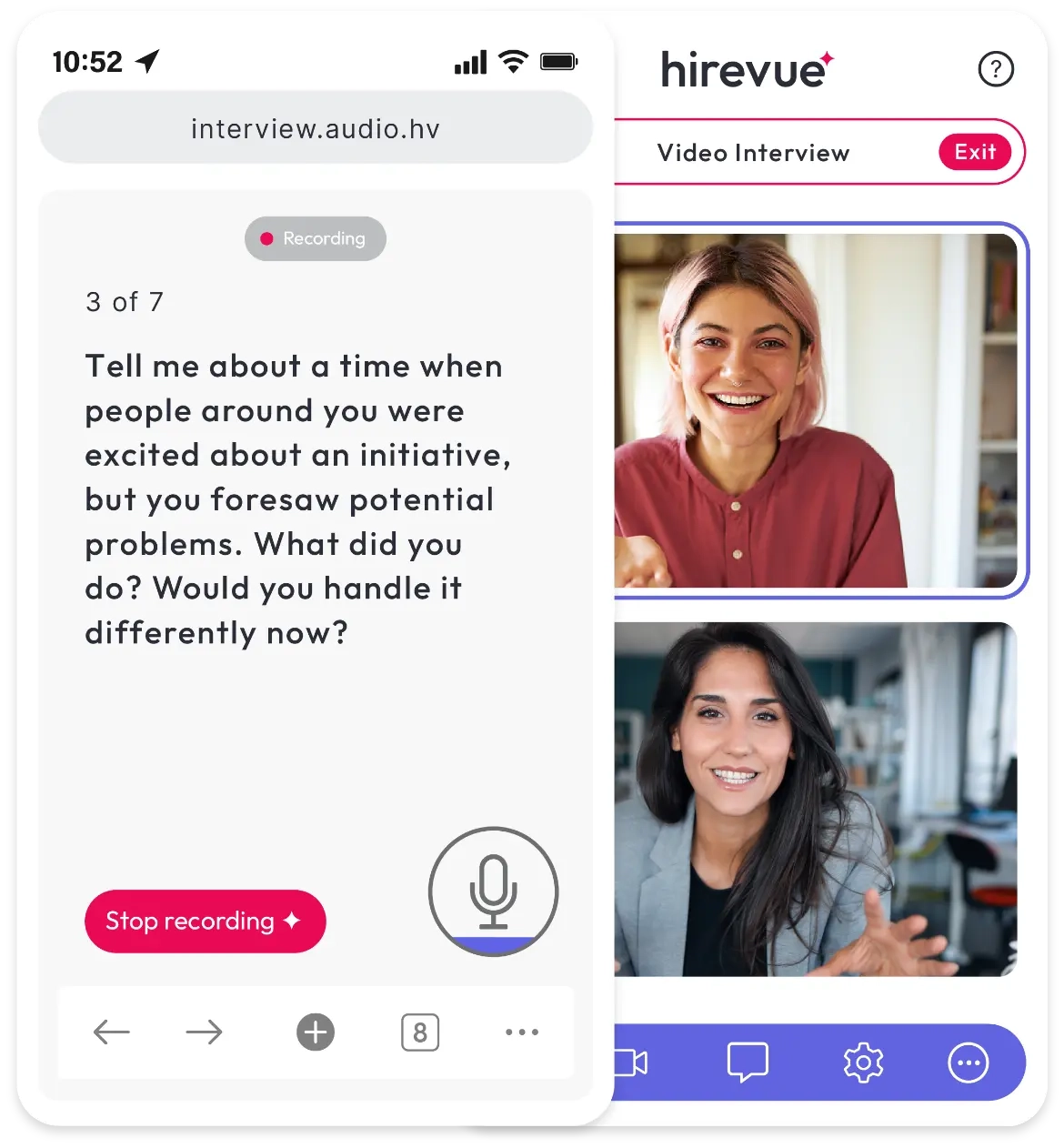
Who judges: AI plus humans. AI does the heavy analysis, but you still come in at the end to review everything before making the final call. And if you want to be transparent, applicants can ask to see their summary. Of the four types, conversational voice AI interviewers offer the most human access.
Avatar-based AI interviewer
This works similarly to conversational AI, but the major difference is that this type of AI interviewer appears as a simulated human-looking character that guides candidates through conversations.
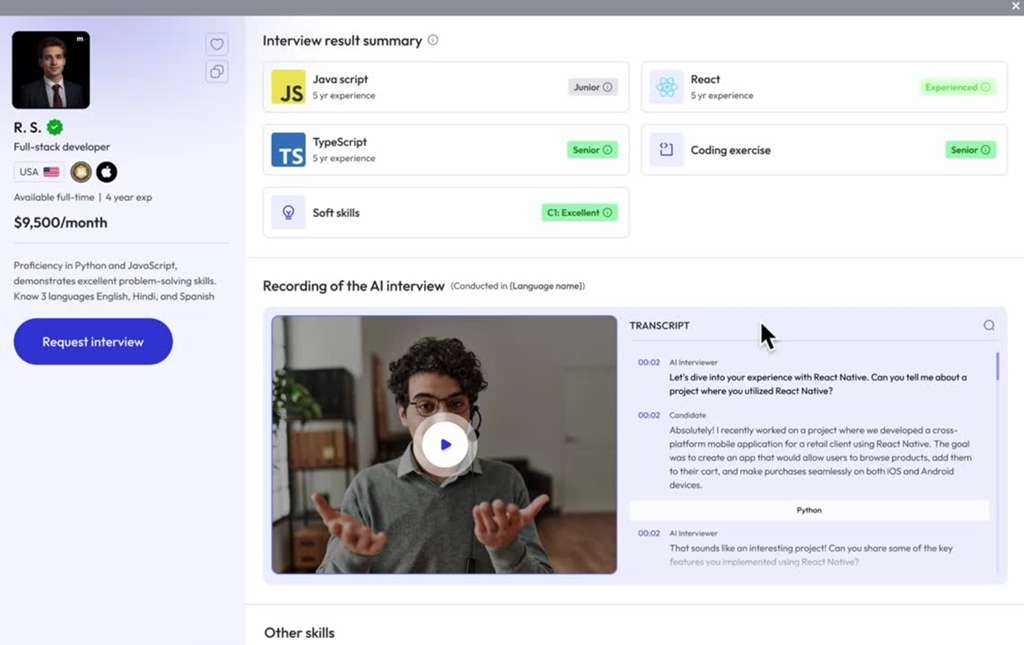
Micro1s Zara is a perfect example here. It uses an approach the vendor calls "adaptive branching." Essentially, the AI adjusts its follow-up questions in real time based on what a candidate just said, going deeper into a topic when the answer is strong and pivoting to check fundamentals when it isn't.
Who judges: AI and humans. You still get the final say after reviewing the AI’s output.
One-way video with AI scoring
Unlike the first two AI interviewers that conduct conversational interviews, candidates first record themselves answering preset questions you've set in advance. Then, the AI tool processes their replies, rates them across key qualifications, and delivers a summary of their performance.
TestGorilla and Humanly fit neatly into this category, though they also offer other features like skills testing and AI-scored resume review (TestGorilla), and full-funnel candidate engagement and scheduling automation (Humanly).
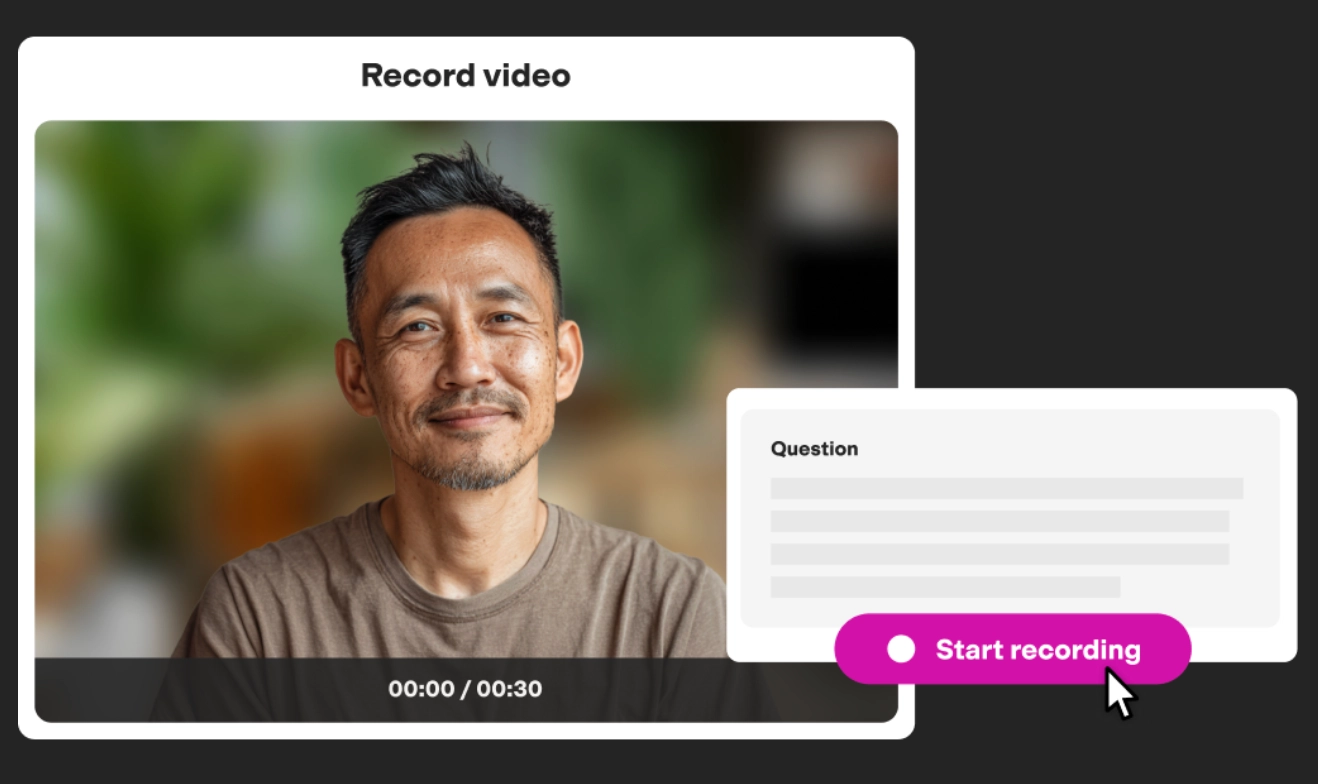
Who judges: AI plus human, or just AI. Some companies use the AI score as their final check without a human ever looking. Others use it as a guide, then have hiring managers watch recordings alongside gradings. We strongly recommend the second approach if you want to avoid missing out on qualified candidates.
Considering TestGorilla? See how its AI-scored assessments compare with other approaches in our guide to the best TestGorilla alternatives.
AI Text chat
This is the lightest AI interviewer version. A chatbot asks written questions, reads the answers, and grades them based on your scoring criteria. The output is usually a simple score or fit rating.
One tool that fits right into this category is Sapia. It works as text-only by design, meaning no video, voice, or facial cues.
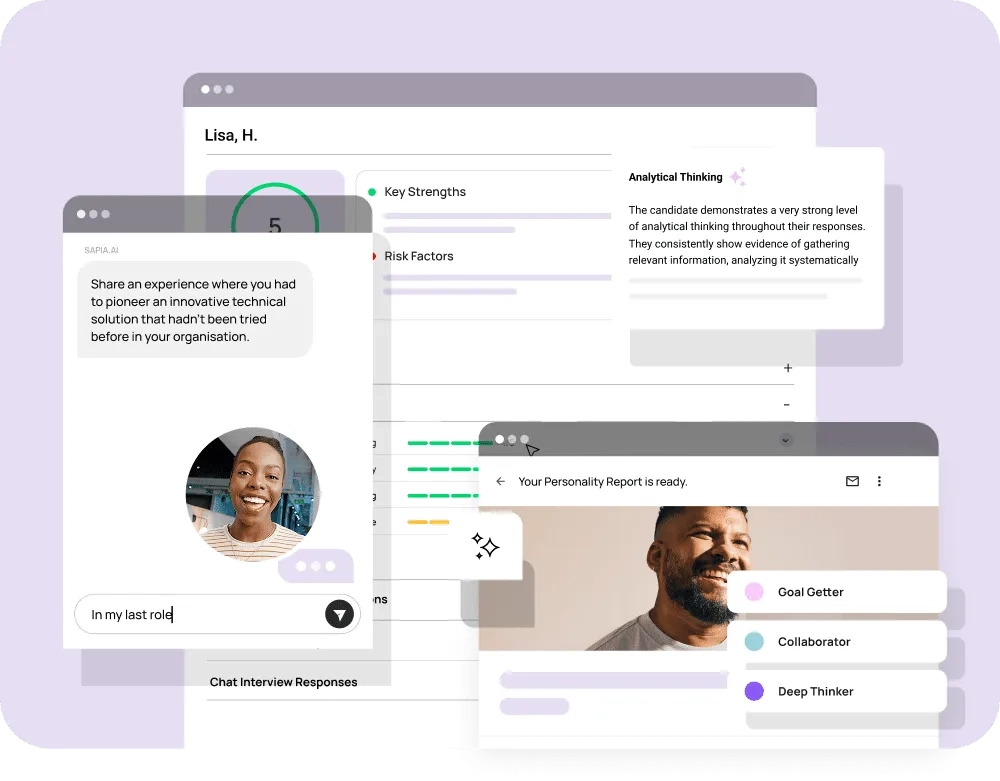
You can also consider Olivia from Paradox an AI interviewer, especially since it’s a text-based AI that screens candidates through chat and SMS and automates interview scheduling.
However, instead of simply producing a score or rubric judgment based on job-specific interviews, Olivia routes candidates forward or not based on their answers to eligibility questions.
Who judges: Usually the AI. Text chat AI interviewers are the most automated option because a human may never even look at a candidate unless they pass the bot's threshold. That’s why we recommend them only as pre-screening filters. But if speed is your priority, they work fine; you just have to be okay with the trade-offs that come with this approach.
What candidates actually think of AI Interviewers
Our research on candidate perception show that candidates are often against AI interviews, especially since they can't always tell how much a human vs. a bot is involved in judging them.
Here are the key concerns they tend to include:
- Interruptions and awkward pacing: Voice-based tools may interrupt candidates, cut answers short or leave unnatural pauses that make it difficult to concentrate.
- Limited opportunities to clarify: Candidates may be unable to ask what a question means, provide additional context or explain an answer that the system misunderstood.
- Unclear assessment criteria: Candidates may not know what the AI analyses, how their answers are scored or whether a person reviews the results.
- Privacy and data use: Recording audio or video can raise questions about what information is collected, how it is analysed and how long it is retained.
- Accessibility and fairness: Accents, disabilities, different communication styles and unreliable internet connections may affect how comfortably candidates complete the interview.
- An impersonal experience: Speaking to a bot, avatar or recording screen may make candidates feel disconnected from the employer, particularly when the purpose of the interview has not been clearly explained.
Avatar-based interviews introduce another consideration. Some candidates find having a face on screen more comfortable, uncanny or distracting.
A live example is this viral post on X, where a candidate couldn’t take the interview seriously after realizing it was an avatar.
These concerns do not change the reality that hiring teams still need a manageable way to screen consistently while protecting the candidate experience. You can support the right AI interview tool with tactics that reduce friction.
That includes explaining how AI is used, giving candidates appropriate alternatives or adjustments, and testing the experience yourself before introducing it into your hiring process.
For more practical recommendations, read Willo’s guide to creating a positive candidate experience.
How popular platforms use AI interviewers and which approach fits you
Start with the screening problem you need to solve, then compare how each platform involves the candidate, uses AI and returns information to your hiring team.
The table below reflects public product materials we reviewed in 2026. Where we could not independently demonstrate a capability, we describe it as a vendor claim.
Before choosing an AI interviewer, don't start by comparing vendor features. Instead, find out what the tool does plus how much control it has over the hiring decision.
Here are the questions that matter:
- Who judges the candidate? Is the AI simply collecting and organizing the candidate's answers, or is it scoring, ranking, or recommending who moves forward?
- Can the candidate see the rules? Before they start, do they know what they're being assessed on, what criteria are being used, and who will review their responses?
- What information does the AI use? Does it analyze the candidate's answers, or does it also use biometric signals such as facial expressions and voice characteristics?
- Are candidates told AI is being used? Candidates should know when AI is part of the interview process and what role it plays.
- Can a human genuinely override the AI? A human being present isn't enough. The reviewer needs access to the underlying evidence and real authority to change the outcome.
- Is the candidate being asked to perform for a simulated person? This is separate from who makes the final decision. Even if a human reviews the results, candidates may still react differently when they're asked to interact with an AI voice or avatar.
The more responsibility AI has for evaluating or advancing your candidates, the more important questions around transparency, human oversight, disclosure, and potential legal requirements become.
Of course, exact requirements vary, so this is simply something to consider, not general legal advice. For example, US employers must comply with local laws like NYC Local Law 144, which mandates them to disclose AI hiring tool usage and complete an annual bias audit.
For a deeper look at regulatory issues and best practices for high-volume recruitment, see our guide to AI hiring compliance.
Which situation fits each AI interviewing model?
Not every hiring team needs the same type of AI interviewer, so we’ve broken down which to explore or when to avoid them completely based on your exact context.
- Need an adaptive AI conversationalist and are comfortable with AI making an early-stage judgment? HireVue has an AI interviewer that asks follow-up questions, evaluates answers against a rubric, and scores them. Micro1 also describes its AI interviewer as adapting questions to the candidate to provide live results.
- Is scheduling or basic eligibility your challenge? You may not need an AI interviewer at all. But if you had to choose one, a conversational recruiting tool like Paradox can screen candidates against job requirements and automate interview scheduling via chat.
- Want structured screening through chat? A tool like Sapia is built around text-based interviews, with AI analyzing candidate responses against predefined requirements.
- Hiring for a small number of senior or specialized roles? You probably don't need to worry about AI interviewing. When volume is low, a human phone screen may still be the better use of everyone's time.
- Hiring in a regulated or high-scrutiny environment? Be especially cautious about handing judgment to a machine. If the consequences of an automated decision are high, human judgment should remain central regardless of the interview format.
The point isn't to find an AI interviewer for every situation. It's to identify the problem you're trying to solve first, then decide whether AI interviewing is the solution.
Want to build a stronger shortlist with human-led AI?
AI interviewers help return hours of recruiter time per week, reduce time-to-interview, and surface more qualified talent. But there’s a lot to consider: from the format you choose to how much automation versus human oversight it involves.
At Willo we believe the best place for AI in interviewing is simple: AI reads, a human judges. Every candidate completes the same async interview while our AI consistently scores their responses against what matters to your hiring team. That way, you have enough evidence to review confidently without handing over the hiring decision.
Our process has delivered outstanding results for companies: improving candidate experience and retaining human judgement.
- airBaltic went from interviewing around 70 candidates a week to reaching 100% of applicants.
- Toyota saved 161 hours while improving equity for neurodivergent candidates.
- EDF used our hiring features during a peak season with 17,000 applications.
If you’re searching for AI that reviews candidates accurately at scale while keeping the final judgment with a person, you know where to look.
Not fully sold on AI interviewers but still want to add some form of AI interviewing to your hiring process, read our guide on AI-assisted candidate screening to fully understand your options.