- A strong campus recruitment strategy starts with defining what “potential” means for your team and laying out a structured process to discover qualified talent.
- Tracking event attendance, candidate engagement, applications to hires, and accepted offers gives you important context for the next hiring cycle.
- Consider campus recruitment tools like Willo when your strategy involves screening large numbers of early-career candidates beyond the CV.
The career fair is over, and your team has hundreds of promising students on its radar. You remember strong conversations, impressive portfolios, capstone projects, and skills that didn’t fit neatly on a CV. Yet when it’s time to shortlist, those differences are hard to see on paper. How do you build a shortlist you can trust?
If this sounds familiar, you’re not alone. 97% of employers use on-campus career fairs to recruit interns. Once the fair ends, three challenges can make shortlisting difficult:
- Early-career CVs often give you little to distinguish candidates.
- Applications can arrive faster than your team can review them carefully.
- AI-assisted applications raise questions about what the written material tells you about the candidate.
With so much to review, it’s tempting to fall back on grades or a quick CV scan. But how useful are grades as a signal of potential? What evidence could help you see the strengths you noticed at the fair? And how can you gather that evidence consistently across a large applicant pool?
This guide answers those questions with eight practical tips for planning your campus recruitment campaign and making better-informed screening decisions.
Grades vs. potential: which one matters for campus recruitment?
When a campus intake brings in thousands of similar-looking applications, narrowing the pool by grades is easy and relatively defensible. But does a strong academic record show you how someone will perform at work? A 2023 meta-analysis by the Academy of Management says yes, especially if the role requirements resemble academic work.
You could also use grades as an easy filter to “hire for potential”. But there’s also no single definition of “potential” to rely on. What counts as potential for one role may be irrelevant for others.
In fact, a review of academic frameworks and employer surveys, covering nearly 2,000 organizations, found no agreed definition of a "work-ready" graduate. The same traits kept appearing (communication, initiative, interpersonal skills), but employers ranked and often named them differently. So yes, grades can be relevant, but they’re not a universal predictor of job performance.
A Maastricht University study that asked 903 employers to pick graduates from mock CVs and skill profiles points to yet another gap. At the CV stage, employers ranked job-relevant degrees and work experience over degree levels and school prestige. At the hiring stage, interpersonal skills and professional expertise mattered more.
So if grades and CVs offer incomplete signals, and potential can mean different things across roles, how exactly do you run effective campus recruitment? Echoing Yasmin’s take, you need to delve deeper. In my experience, that starts with defining what potential means per role.
8 tips to build a campus recruitment strategy that converts
- Define what “potential” means for each role
- Choose schools based on role fit and recruiting results
- Maintain a presence throughout the academic year
- Let students hear from recent hires and ambassadors
- Keep interested students engaged between events
- Give applicants more ways to demonstrate relevant skills
- Make the first screening step fast, fair, and mobile-first
- Measure which activities lead to accepted offers
1. Define what "potential" means for each role
“Hire promising graduates” sounds good on paper, but it doesn’t give recruiters much to work with. Promising in what way? And for which role?
First, look at what the job requires and agree on the few things that should matter most when you’re making a hiring decision. For an engineering intake, that could mean looking for evidence of debugging and collaboration. A strong GPA might be a plus, but it doesn’t tell you whether the person can work through a problem with a team.
The same approach won’t work for every role. What counts as potential for an engineer may not be what you need from a salesperson or marketer. So set your hiring criteria and decide what counts as evidence for each one before you start screening candidates.
That gives recruiters something more useful than a generic definition of “potential” or a blanket grade cutoff. It also makes interviews much easier to structure.
2. Choose schools based on role fit and recruiting results
Employers that return to the same campuses every year often do so out of habit and pre-existing relationships. But as Melanie (Mel) Smith points out, “we’ve always recruited from these schools” is not much of a strategy. Your talent needs can change, and if they have, you might need to adjust your school list too.
Prioritize what each role requires. If you’re hiring software engineers, for example, consider schools with strong computer science or engineering programs. And if the schools on your list already have that, you can keep them too. But look at what happened when you last recruited from there.
- What did recruiters think of the candidate quality?
- How many people did you hire?
- How many interns converted to full-time roles?
- Did those hires stay?
The Veris Insights School Strategy Scorecard adds structure to this process, helping hiring teams evaluate schools using quantitative and qualitative metrics such as conversions and recruiter feedback.
These provide a better basis for deciding where to spend your recruiting time and budget. Keep the schools producing the right results, reconsider the ones that aren’t, and leave room to test new campuses as your hiring needs change.
3. Maintain a presence throughout the academic year
Staying visible throughout the academic year ensures the career fair isn’t the only chance students have to interact with your company. They may learn about the role and speak to a recruiter at the event, but they’ll often move on to the next booth without getting much sense of what working for you would be like.
Start by building a campus recruiting calendar with a skills session, small project or case challenge, and hiring manager Q&A. Space these out throughout the academic year so you don’t stretch your team too thin. Recording and publishing each activity on your careers site will also be helpful for anyone who couldn’t attend live.
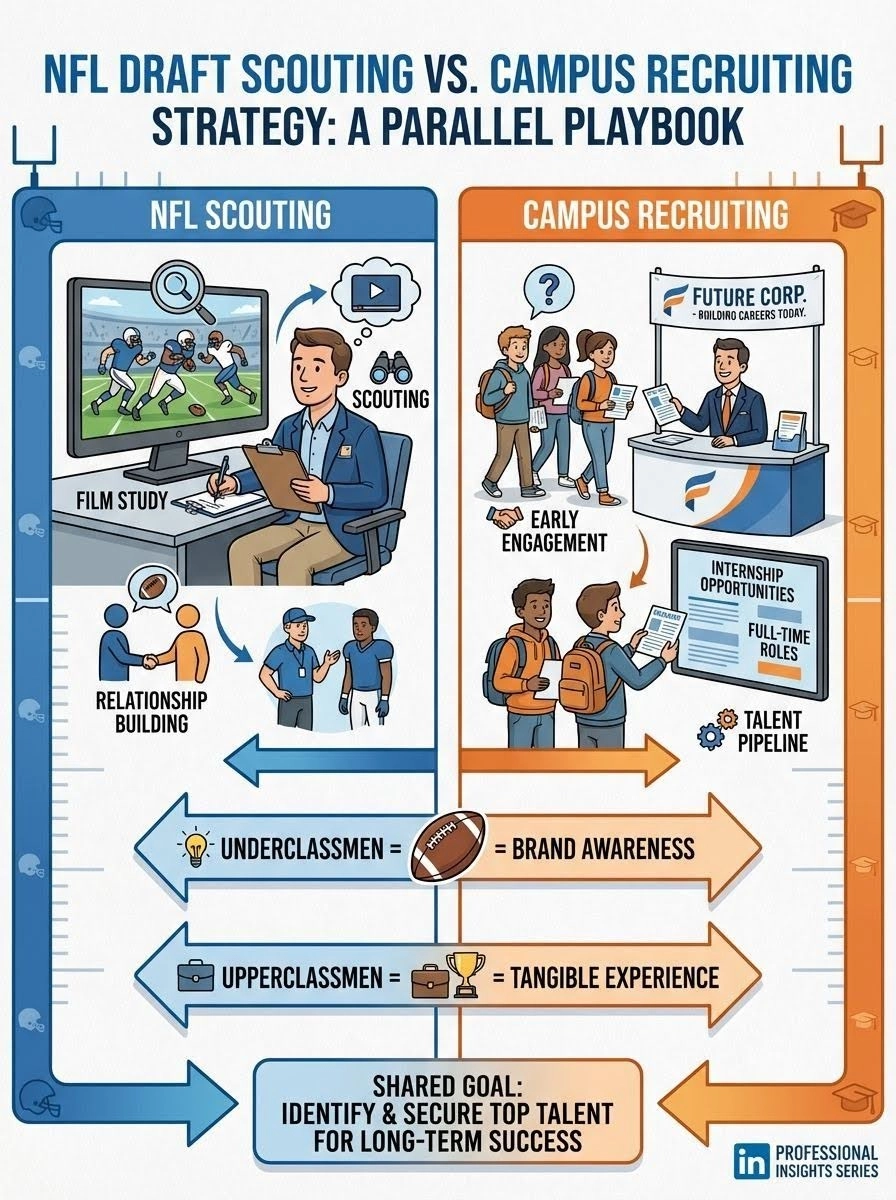
This way, students get several opportunities to learn about your company and meet some of their potential future colleagues before they have to decide whether to apply. Holly Maglin makes a similar point, comparing NFL scouting to campus recruiting to emphasize the value of building long-term relationships with students.
4. Let students hear from recent hires and ambassadors
Students are likely to have questions your recruitment team can't answer from personal experience. What is the interview like? How difficult will the transition from university to full-time work be? What does a typical day involve? During campus recruiting activities, your recent hires and former interns can answer those questions from firsthand experience.
For example, former interns who have accepted full-time positions can join campus visits, speak at student events, or join online conversations to answer prospective applicants' questions.
Even if you can’t get them in person, you could also record short invitation videos featuring recent hires, e.g.,
- A former intern turned full-time staff member can invite students to an upcoming career event, share a little about their experience, and explain what they'll learn by attending.
- A recent graduate could talk about their first few months on the job and offer advice on preparing for the selection process.
Give your ambassadors room to speak in their own words, including what surprised them or what they found challenging. Our guide to employee testimonials has more examples and advice on collecting these stories.
5. Keep interested students engaged between events
A student you meet at a career fair might not be ready to apply for several months. If you only contact them when applications open, their interest may have dwindled. So, stay in touch with prospects between events through occasional updates in different formats.
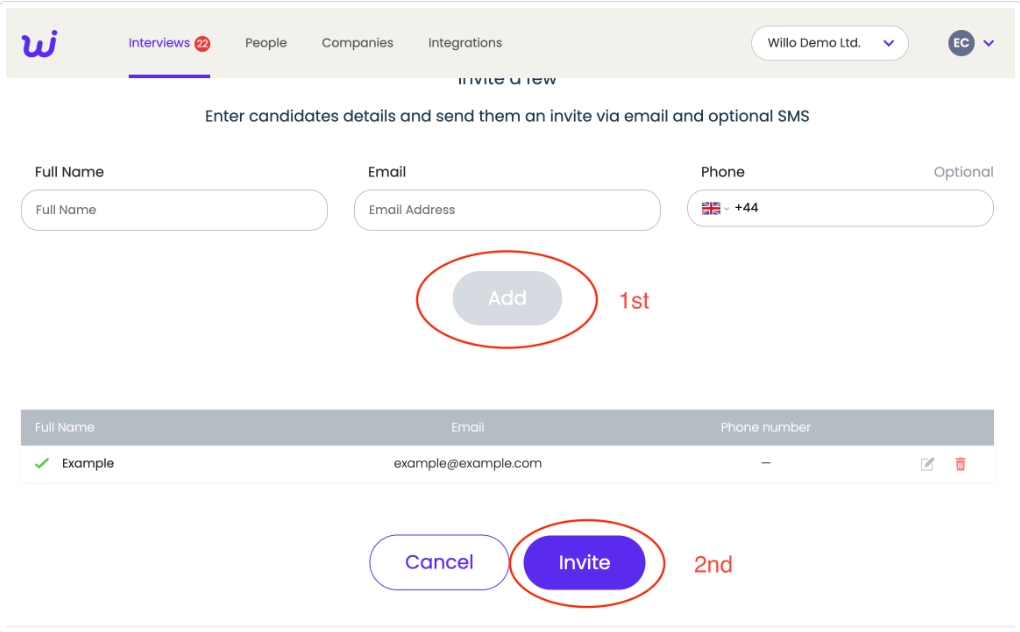
You could share information about an upcoming role, a team story, a learning resource, or the date of your next event. Email works for general post-event updates, while text can be more effective when you need a quick response, such as for interview sign-up reminders.
This strategy supports your employer brand because, when you’re ready to hire, students who have heard from you are more likely to respond well.
6. Give applicants more ways to demonstrate relevant skills
A CV can leave recruiters with very little to work with, especially when candidates are still in school or have only a few months of work experience. But that doesn’t mean there’s no evidence of what they can do. Look at coursework, volunteering, student projects, internships, and other transferable skills or experiences.
You can also ask candidates to provide that evidence directly. A few role-specific questions or a short task can show how someone approaches problems, explains ideas, or works through situations.
For some roles, a written response may be enough. For others, audio or video can give recruiters a better sense of how a candidate communicates. This is where the right graduate and early careers hiring tool comes in: to help collect and review responses from a large applicant pool.
Take Toyota Great Britain, for example. The automobile brand uses Willo for its emerging-talent hiring, assessing over 3,000 applications per year for around 30 open roles. Rather than relying on CVs alone, Toyota asks role-specific questions that give recruiters more information about what candidates can actually do.

Match your assessment method to the skill you’re trying to evaluate for best results. If you need to see how someone writes, ask for a written response. If communication skills are critical to the role, video or audio may tell you more. So beyond grades and whatever work experience appears on applicant CVs, recruiters have richer evidence to review alongside.
7. Make the first screening step fast, fair, and mobile-first
A campus candidate may complete your first assessment on their phone between classes or while applying to several companies at once. If the process takes too long or isn’t clear, they may drop off. So, keep the first step short and easy to follow.
Tell candidates exactly what they need to do, how long it should take, and when they can expect to hear back. Also, use the same questions and instructions for everyone so recruiters are comparing responses on the same basis and avoid bias.
Making the first step short and fair is only part of it, though. It also needs to be mobile-friendly, since students spend a lot of time on their phones and you’re looking to pull in a large number of applicants.
EDF UK is one company that has nailed high-volume new grad screening.

The energy firm had about 17,000 applications to process in one recruiting season, but still cut recruiter admin time by 50%. How? By letting candidates choose between video and audio responses and using screening software accessible on any device.
8. Measure which activities lead to accepted offers
After the recruiting season, run a recruitment audit to see what happened at each stage: where candidates drop off, which activities produce the best results, and which tools deliver the most ROI.
Specifically, confirm:
- How many students who attended each event or visited your booth went on to apply?
- Which schools or channels delivered the best quality applicants?
- How many of those candidates accepted the offer?
For example, a low event-to-application rate might prompt you to examine the specific event, who attended, and what happened after. If candidates from one school have a higher offer acceptance rate, look at the recruiting activity and candidate mix behind that number. Completion and attendance rates also show the exact stage(s) candidates drop off the most.
So while the numbers may not tell you that a particular career fair or university caused an accepted offer, they give you something to compare when deciding what to investigate, change, or repeat next season.
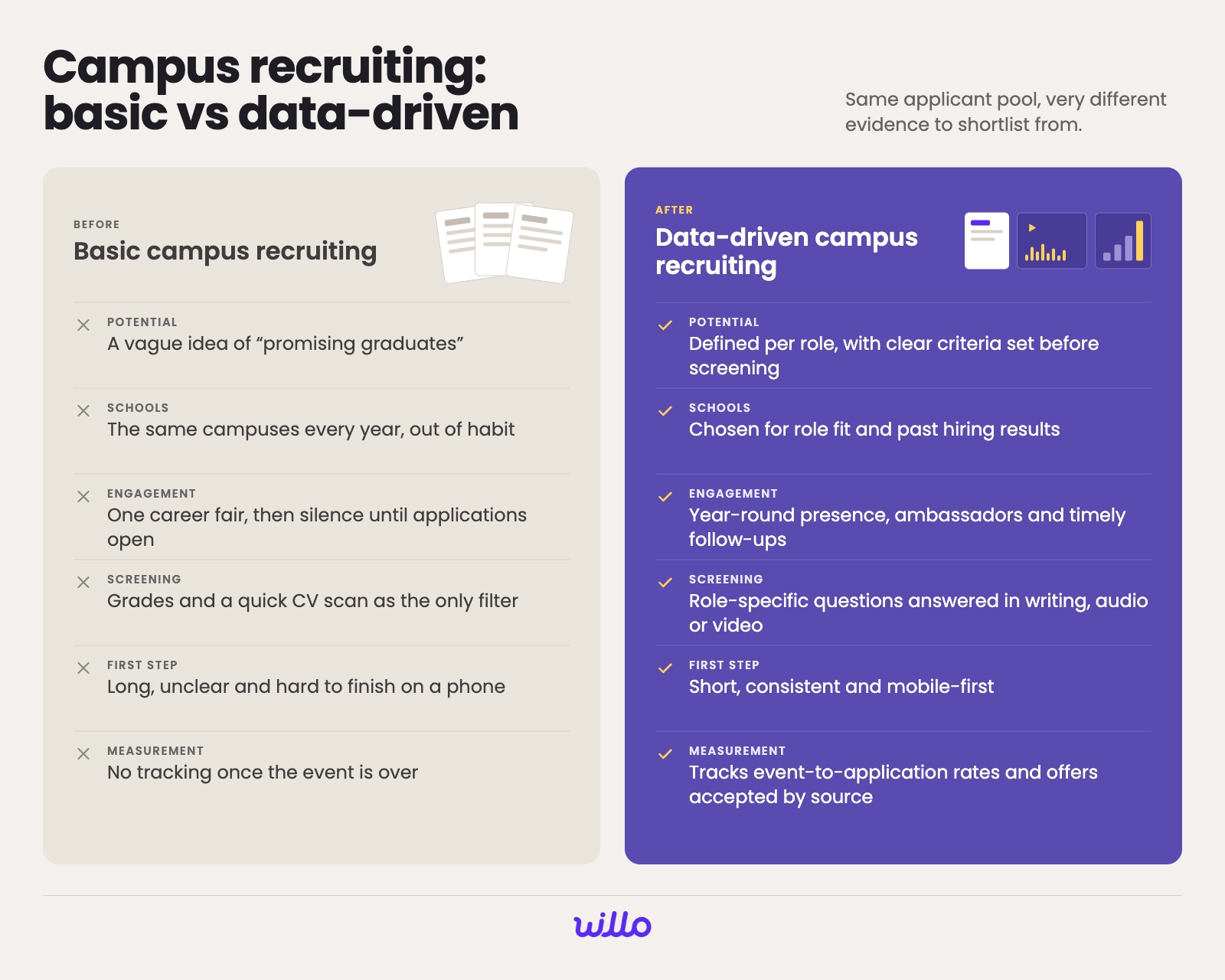
Base your hiring decisions on better evidence
Campus recruiting can leave you with a large applicant pool and surprisingly little evidence to work with. A CV tells you where someone studied and what experience they’ve had, but for early-career candidates, that is not enough proof of how they’ll perform in the role.
That’s why the strongest campus recruitment strategies give candidates more opportunities to show what they can do. Define the skills that matter for each role, ask questions that bring out evidence of those skills, and use the same criteria when you review responses. This gives you more than a grade and minimal past experience to base the first decision on.
Structured responses also make it easier for recruiters to compare candidates. And with Willo’s AI summaries, transcripts, and prompts, your team can:
- Review responses against the criteria you’ve set for the role,
- See how candidates perform against those exact standards, and
- Confidently decide who to move forward.