AI is now part of recruitment on both sides of the hiring process. Our 2026 Hiring Trends Report shows that while 64.9% of employers have increased their use of AI in hiring, 76.6% regularly encounter AI-assisted applications from candidates.
But with 78.7% of hiring teams still saying final hires should remain human-led, it's clear widespread adoption hasn't eliminated skepticism. The real dilemma, then, is how to use AI to make screening more efficient without letting it influence hiring decisions in ways you can't explain or defend.
At Willo, we’ve talked to hundreds of talent leaders to understand how they are using AI without bias today. But before we get into the best practices, the first step is to reframe your definition of "unbiased" as it relates to talent acquisition.
Can AI Make Candidate Screening Truly Unbiased?
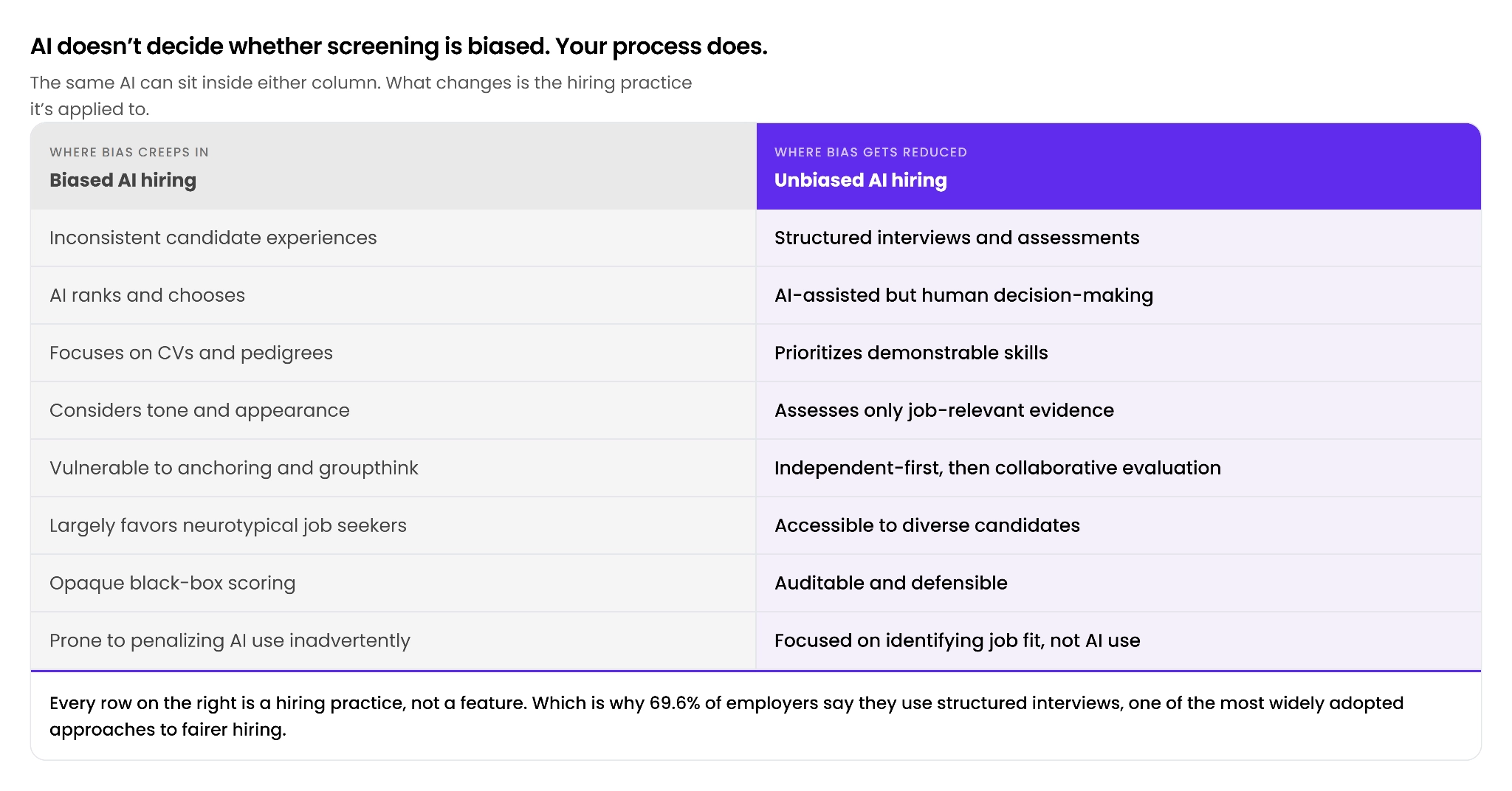
AI in itself doesn't make candidate screening unbiased. It makes consistent hiring practices easier to apply, and that's what helps reduce bias. So rather than searching for the elusive objective AI system, most hiring teams reduce bias by adopting structured hiring practices.
In fact, 69.6% of employers say they use structured interviews, making it one of the most widely adopted approaches to fairer hiring. That means AI's role is to help organizations apply these practices more consistently and at greater scale, not replace them. The question now becomes how to actually use AI to support fairer candidate screening at scale.
The image below illustrates what good and bad use of AI in hiring looks like in practice.
8 Best Practices for Fairer Use of AI in Candidate Screening
Once you stop asking AI to eliminate bias and start using it to reinforce good hiring practices like standardized assessments and human-led shortlisting, the path forward becomes much clearer. These eight strategies break down what that looks like day-to-day.
1. Give Every Candidate the Same Screening Experience
Bias often begins long before AI enters the picture. If candidates are asked different questions, interviewed under different conditions, or assessed against different criteria, inconsistency becomes a source of unfairness.
That's why a smarter algorithm isn’t the solution to reducing AI bias. A hiring process that gives AI a consistent foundation to work from is.
From using the same questions, order, and interview conditions for every candidate, to applying predefined evaluation criteria during each person’s screening. Standardization makes candidate evaluations fairer, more defensible, and ultimately more reliable.
EDF is one company that understands the importance of this approach. Every year, the supplier receives up to 17,000 applicants and hires hundreds of graduates and early-career talent.
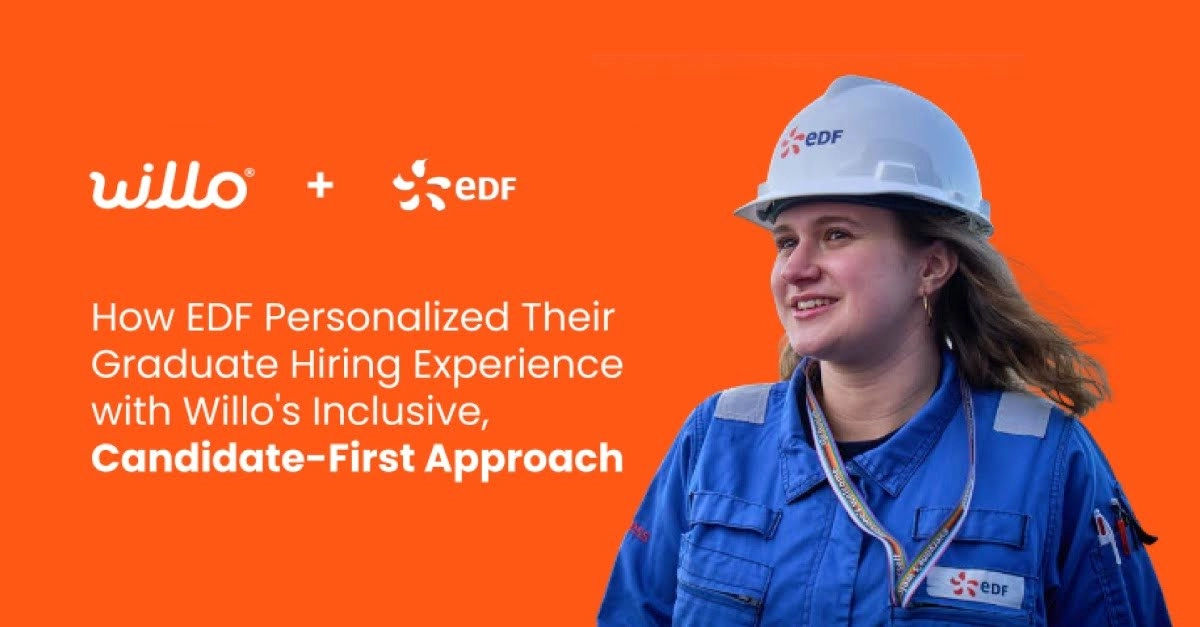
When you're screening that many candidates, consistency isn't just more efficient. It's what makes fair evaluation possible in the first place. Using flexible interview formats (video, audio, text, and files) standardized for thousands of applicants, EDF ensures that everyone receives the same opportunity to demonstrate their capabilities.
As neurodiversity consultant Theo Smith puts it, “The biggest mistake is not providing people with the opportunity to show their best selves.” EDF didn’t make that mistake, and as a result, the firm cuts recruiter admin time by 50% and delivers a more holistic candidate experience.
2. Use AI to Collect and Organize Evidence, Not Make Decisions
The safest role for AI is administrative, not judgmental. And that’s exactly the difference between AI-assisted review and AI-led hiring.
AI should transcribe interviews, summarize responses, surface themes, or highlight skills for review. It shouldn’t shortlist candidates independently, assign hiring scores, or auto-reject applicants.
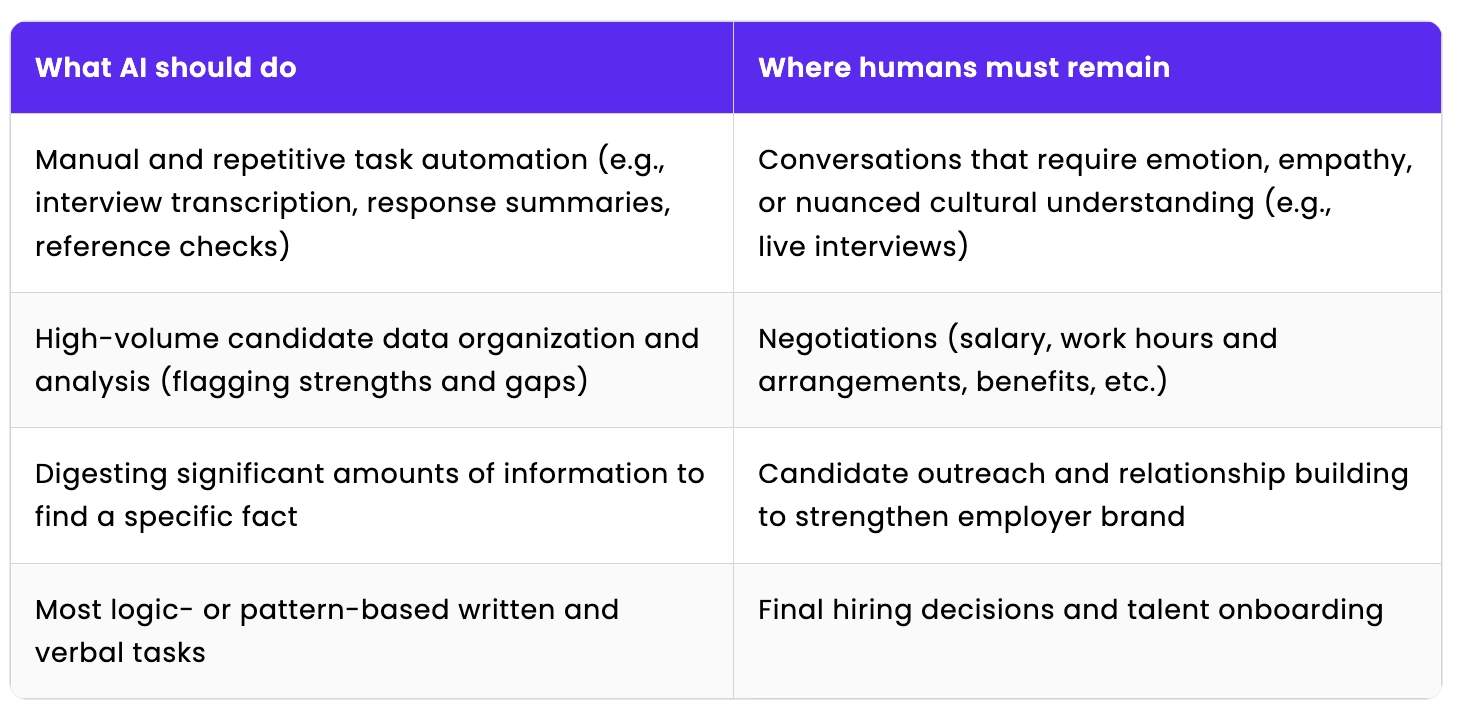
But human review doesn't necessarily slow hiring. By automating repetitive administrative work, AI gives recruiters more time to evaluate evidence rather than spend hours collecting or searching for it. It only increases time-to-hire if processes are disorganized.
According to Alyssa-Marie Lefebre, Senior TA Specialist at Clio, recruiters with 15 to 20 requisitions on their plate are pressed for time and looking for ways to hire leaner and faster. AI-assisted human-centric hiring at scale is the answer, and if you want to learn more about it, check out our guide to responsible AI hiring.

Every Candidate Sounds Great on Paper. Now What?
Get 20+ AI-proof interview questions - with follow-ups that spot the difference between real experience and a rehearsed answer.
3. Screen for Potential Job Performance Beyond Pedigree or Intuition
Resumes and intuition are weak predictors compared with verifiable evidence. This explains why 40% of hiring teams are moving away from resume-first screening, with many exploring more objective alternatives such as async interviews and skill tests.
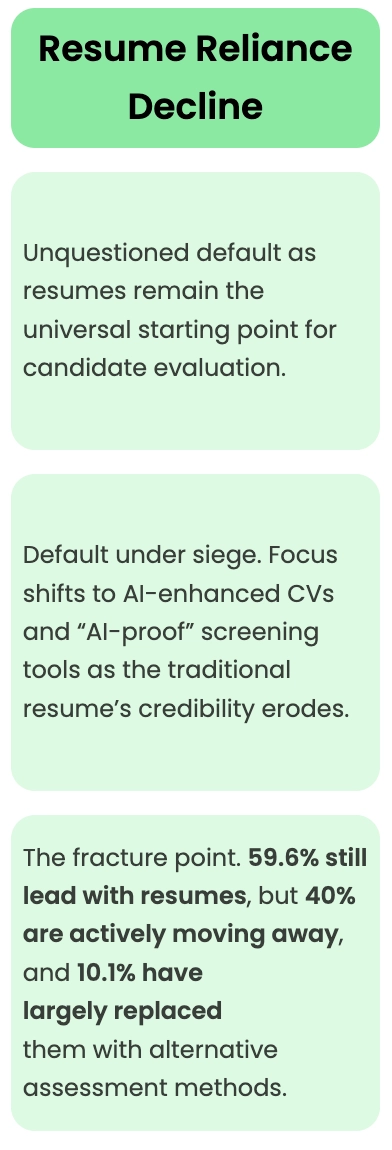
Pedigree, previous employers, and gut feeling often reinforce existing bias. But hiring workflows that strip those factors reduce it by focusing instead on behavioral questions, work samples, and job-relevant scenario testing.
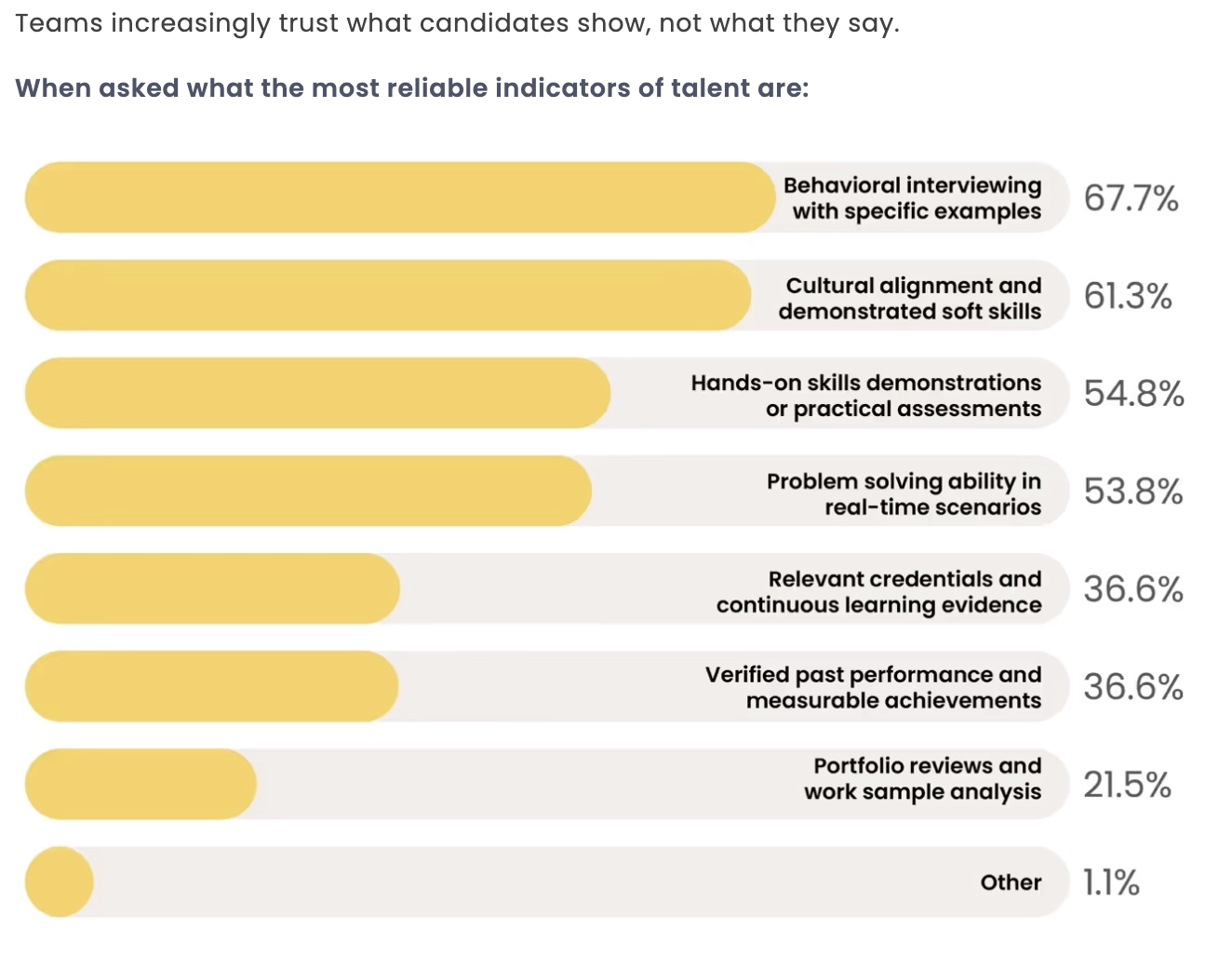
While recruiters increasingly value behavioral interviews and skills demonstrations over credentials alone, multiple assessment formats are also key to creating richer candidate profiles and surfacing more relevant hiring signals. These formats can include async video/audio interview responses, multiple-choice Q&As, file uploads for resumes or cover letters, and more.
With this approach, you can identify candidates with a stronger fit more accurately. Some might have impressive resumes with weak evidence, while others with less traditional backgrounds but consistently strong responses are better matches.
David Hiford, a Talent Acquisition professional at Hitachi Rail, shares a similar view: Career switchers and non-linear candidates represent an under-tapped talent pool that companies should consider and invest in early training for, rather than overlooking them entirely because of light resumes.
4. Reduce Bias-Prone Identity Signals Wherever Possible
The less irrelevant information reviewers see, the easier it is to focus on job-related evidence.
Visual and affinity bias in relation to race, gender, facial expressions, higher institution, certain pedigrees, and more are some of the biggest objectivity issues human recruiters inadvertently reinforce.
The fix? Introduce blind evaluation where appropriate. For instance, some teams collect async video interviews but only review the transcript. Meanwhile, others ask for audio-only responses and focus on assessing communication skills without introducing appearance bias.
Toyota GB is a real-life example worth emulating. In order to improve hiring equity, the company adopted skill-based hiring, leveraging one-way video interviews to “bring CVs to life”.

Despite collecting audio/video interview responses along with CVs, the automotive company uses an AI screening tool that focuses only on transcripts, effectively gaining relevant candidate insights without considering bias-inducing signals.
Remember, reducing identity signals is not about having less humanity in the hiring process; it’s about removing irrelevant influences so you can focus on the ones that truly matter. Toyota GB understands this and continues to work towards fairness in its hiring practices.
5. Evaluate Candidates Independently Before Comparing Notes
Independent scoring before interview panel discussion is important because even experienced recruiters and hiring managers can unintentionally influence each other's judgment. Three common challenges tend to emerge when opinions are shared too early:
- Anchoring bias: The first voiced opinion can become the reference point for everyone else, making later evaluations less objective.
- Halo effects: One particularly strong quality—such as confidence, charisma, or a prestigious employer—collectively identified in one candidate may overshadow weaknesses in other areas that matter for the role. Or a charismatic panelist may subconsciously or intentionally sway others toward their perspective.
- Groupthink: Panel members could unconsciously align with the majority view to avoid disagreement, even if their initial assessments differed.
This is where blind scorecards become valuable. By requiring each interviewer to evaluate candidates independently before discussing them as a group, they preserve independent judgment, create a clear record of each evaluator's reasoning, and make it easier to identify where opinions genuinely differ.
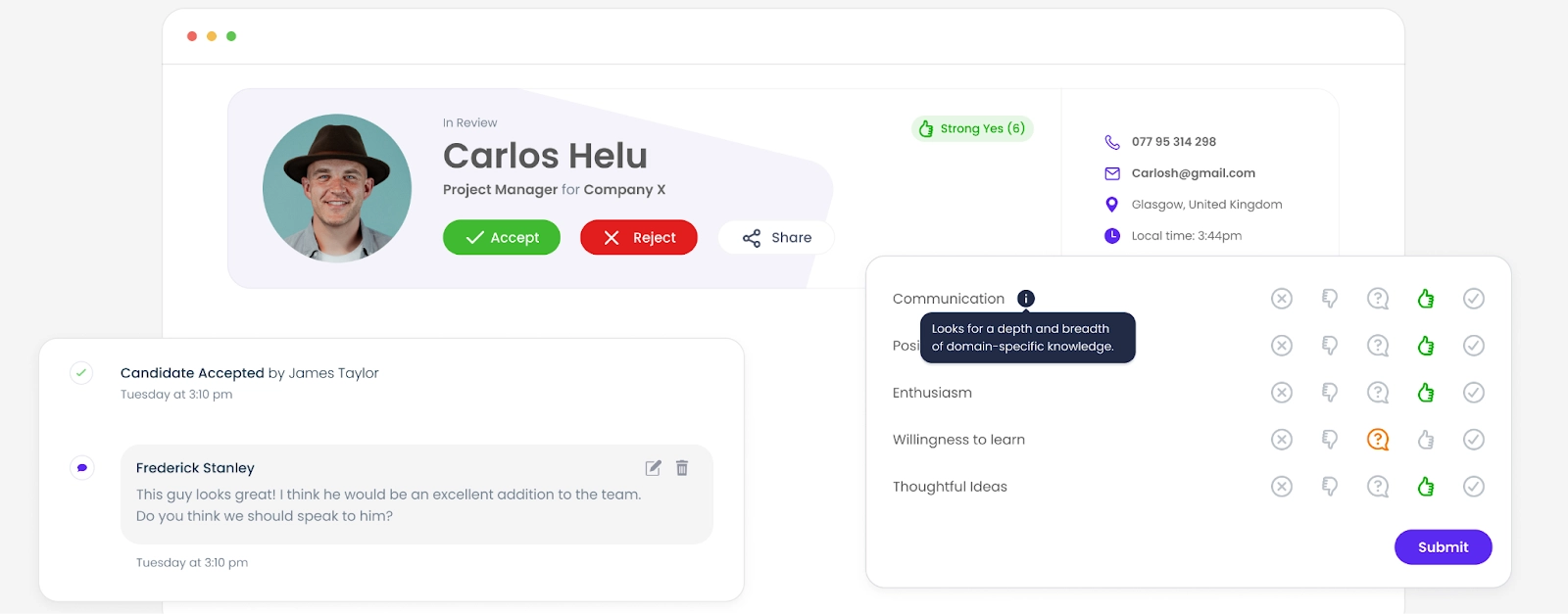
They also reduce the influence of dominant personalities, encourage evidence-based discussions, and produce more consistent, transparent, and defensible hiring decisions.
Say four interviewers are assessing the same candidate and one of them immediately says, "I think so and so is an obvious hire," before anyone has shared their scores. Without realizing it, the other panelists may start seeking evidence to support that belief instead of weighing the candidate against the predefined criteria.
But if each interviewer had submitted an independent scorecard first, the panel discussion would begin with multiple evidence-based perspectives rather than a single opinion shaping the conversation.
Learn more about creating and using candidate interview scorecards more effectively in our expert guide or explore these top templates for objective evaluation.
6. Build Accessibility Into the Interview Process
A fair process isn't just unbiased. It's accessible. To achieve this accessibility, remove unnecessary barriers that affect candidate comfort or unfairly disadvantage neurodivergent job seekers.
Keep in mind, this is not about lowering standards to accommodate everyone. It’s about ensuring solid candidates don’t get overlooked due to circumstances beyond their control.
During high-volume hiring cycles, accessibility often comes down to a handful of simple design choices:
- Technical accessibility: Use interview platforms that work across devices and require minimal setup.
- Language support: Write questions in clear language and provide translations where needed.
- Flexible interview timing: Let candidates complete interviews at times that work best for them.
- Multiple response formats: Offer video, audio, text, and file uploads to help candidates demonstrate their strengths in different ways.
- Practice opportunities: Let candidates complete practice questions or test recordings so unfamiliar technology doesn’t disorient them
Remember the Toyota GB example from earlier? Well, accessibility is also a standard the automobile giant upholds. So while Toyota GB uses one-way video interviews with transcript-based evaluation to avoid bias-prone signals, its goal is also to give otherwise disadvantaged candidates a fighting chance.
Think parents and caregivers with tight schedules. Neurodivergent individuals who need to respond at their own pace. Early-career talent with light CVs but relevant skills. And people with valid career breaks or employment gaps.
The outcome? Not only did Toyota GB achieve more equitable hiring, but it also saved 161 hours of recruiter time, proving that scale and fairness can reinforce each other rather than counteract.
7. Audit Both Your Hiring Workflows and AI Automation Tools
Bias is rarely caused by one algorithm. More often, it's introduced by the overall hiring process. If you want to keep your hiring as bias-free as possible, regularly review your workflows.
From job descriptions and hiring requirements to screening questions, scorecards, and AI systems. Periodic audits keep hiring systematic and compliant, even as roles, candidate pools, and regulations evolve.
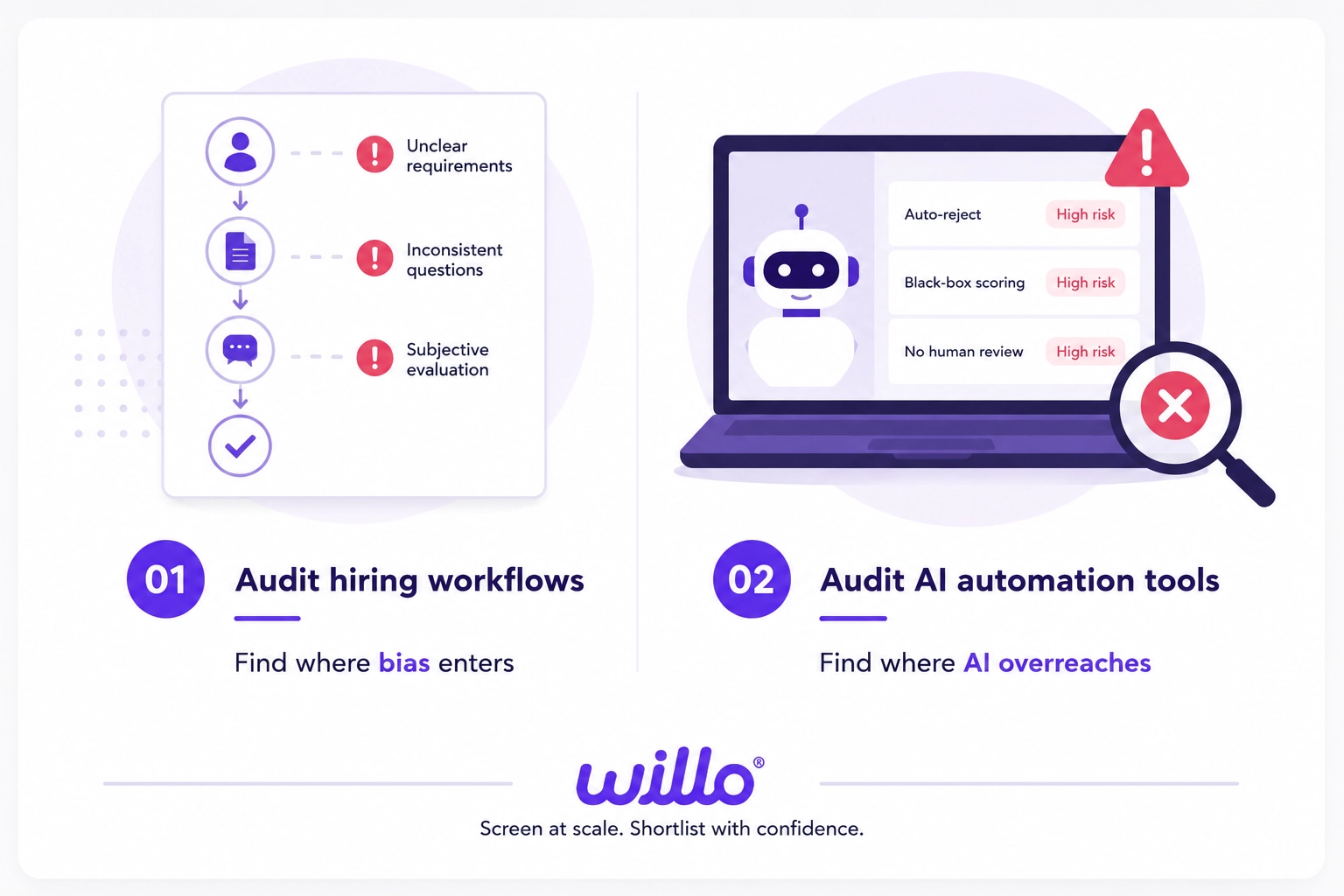
First, map out the candidate journey and your internal processes, including all recruitment sources and channels.
Next, look for patterns vs isolated incidents. Are certain groups consistently dropping out after a specific screening stage? Is AI automatically rejecting candidates and creating shortlists without recruiter input? Are interview questions still aligned with what success in the role actually looks like?
Your answers to these questions will then inform the changes you need to make. Want a more detailed step-by-step breakdown? Our guide to performing an effective recruitment audit can help.
8. Reject Based on Poor Fit Rather than Suspicion of AI Use
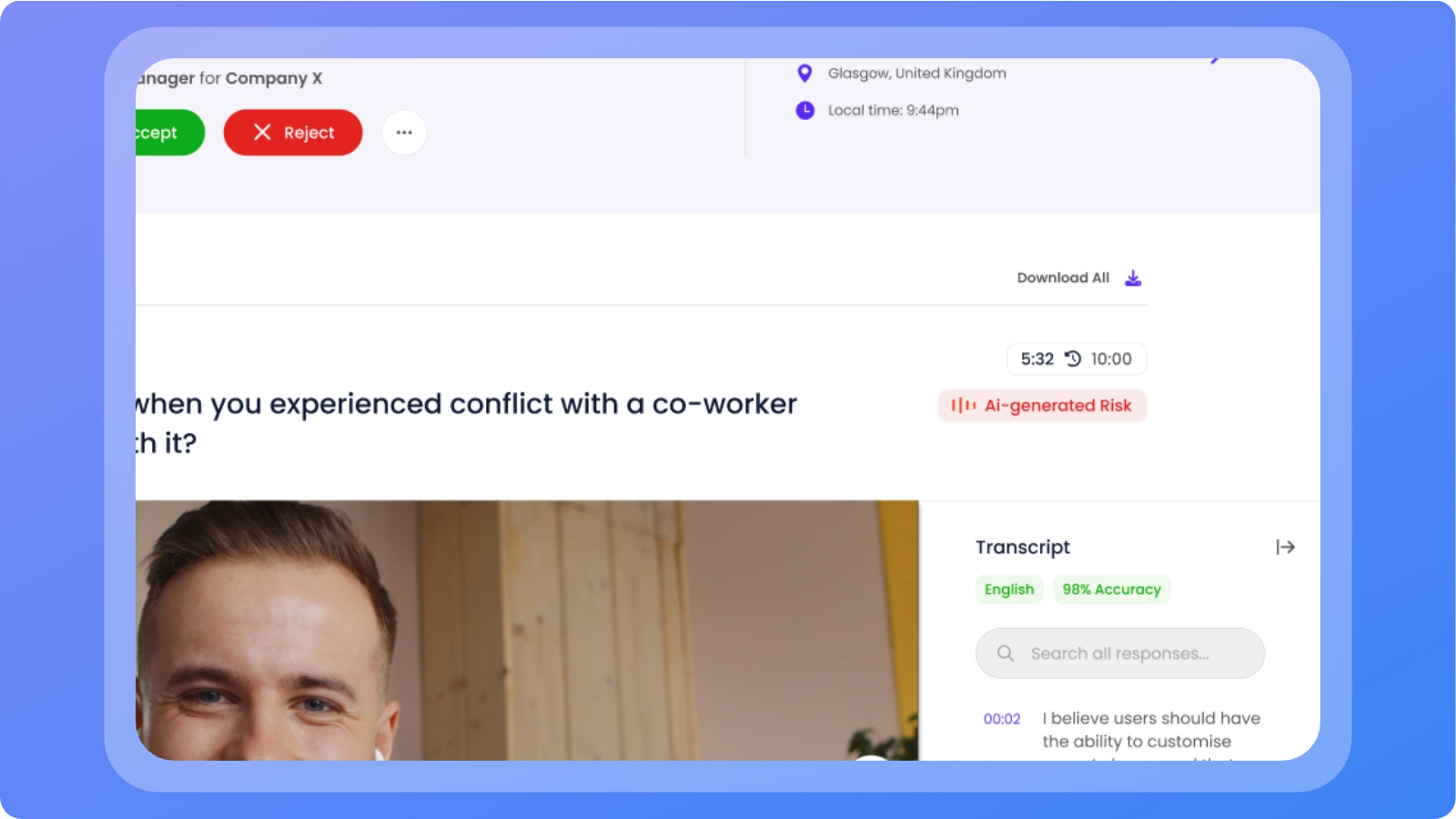
AI use isn't misconduct. Poor evidence of job capability is. So while more and more job seekers are relying on AI to polish their profiles, it shouldn’t be reason enough to automatically reject them when they might actually be qualified.
If a candidate shows significant authenticity signals or seems too good to be true, that should prompt human review, not automated exclusion. Look for authentic examples, probe during interviews, verify claims, and investigate unusual responses.
On a different note, Artimese Braddy Lawrence, HR Coordinator at Tyler ISD, and Julia Fulton, Talent Manager at Float, echo a surprisingly simple pre-screening solution:
Redesigned, more specific application questions, and async interviews that tell more than resumes or work samples ever could. AI can then assess candidate responses against job requirements.
Because fairer hiring isn’t about catching candidates using AI or hiring teams using less AI while screening them. It's about making confident decisions based on evidence that's genuinely relevant to the role.
Achieving “Unbiased” AI Candidate Screening is Possible With the Right AI Hiring Tools
No hiring process, whether manual or AI-assisted, will ever be completely free from bias. That's an unrealistic standard to hold people or technology to.
But making candidate screening fairer? That's entirely achievable, and it starts with a hiring process that consistently reduces opportunities for bias while producing decisions recruiters can explain, defend, and improve over time.
So, rather than judging AI candidate screening platforms by how much work they automate or whether they claim to eliminate bias, evaluate them by how well they support structured, transparent, and human-led hiring at scale.
Look for features like:
- Structured interviews,
- Independent scorecards,
- AI-generated summaries instead of automated scoring, and
- People-first review.
These functionalities support high-volume hiring without sacrificing fairness.


.webp)