If you're looking for hiring platforms with AI candidate scoring, you're likely seeking an automated solution to filter candidates at the top of the funnel, so you can save time and focus on the most promising applicants.
Most AI candidate scoring systems you'd find won't deliver accurate scores that reduce time-to-hire without introducing bias. Primarily because their top-of-funnel filtering process passes or fails candidates based on signals that aren't reliable enough to measure authentic performance.
For instance, AI resume scoring systems; the most popular type, often produces shortlists based on information that, in many cases, doesn’t fully represent the candidate. 75% of people lie or significantly embellish on their CVs, and 76% of hiring teams now regularly encounter AI-assisted or AI-generated applications. Most CVs now represent what an AI thought would get a candidate screened in.
If AI-polished applications are part of the problem you’re trying to solve, start with the limits of spotting AI-generated resumes before comparing scoring systems.
If you are specifically comparing tools that evaluate CVs, read our AI resume screening software comparison before choosing a scoring approach.
Other options, like psychometric and game-based assessments, can profile how a candidate thinks, makes decisions under pressure, and is likely to behave in the role. But they perform poorly at the pre-screening stage because of the time required to complete them.
The only way to trust AI scoring is to use a platform that evaluates applicants based on a combination of asynchronous video and audio responses to skills-based prompts, cross-referenced against behavioural markers — not resume keywords alone.
In Willo, for instance, you can:
- Send one invitation link that collects up to 20,000 applicants' responses through video, audio, document uploads, and multiple-choice answers to objective knockout questions, in minutes. No downloads or login required.
- Use Willo Intelligence to automatically transcribe every response, generate a qualitative summary of each candidate, and flag proficiency areas — communication style, knowledge gaps, examples given — so your reviewers know exactly where to focus before they score.
- Review the shortlist and share it with hiring managers alongside AI-generated follow-up questions specific to each candidate, so the next conversation starts exactly where the screening left off.
That way, you get a full picture of each applicant's skills through an assessment they can complete in minutes, at their own convenience. And you get a shortlist you can defend to leadership — backed by documented responses, not a black-box score.
Want to see how it works? Willo's 7-day free trial lets you score up to 100 candidates. Get started today. Or keep reading to learn more about how Willo and 6 other candidate scoring software can help.
Want to learn more about AI candidate scoring, how it works, the different types, and how to choose? Read our best practices for AI candidate scoring.
The top 7 AI candidate scoring software & how they work:
- Willo: Best for AI video interview assessment with full human control.
- HireVue: Best for multi-stage candidate scoring [games, psychometrics, one-way video, etc]
- Eightfold: Best for pre-screening resume & job match
- SeekOut: Best for scoring complex technical roles
- Turbohire: Best for automated assessment & AI scoring in one place
- Vervoe: Best for scoring candidate performance based on a job simulation
- Manatal: Best for scoring candidates against your existing database
1. Willo
Willo is a human-first candidate screening platform powering high-volume hiring for thousands of organizations worldwide. It provides flexible, AI-supported tools that help teams evaluate talent efficiently while maintaining authenticity, fairness, and an exceptional candidate experience.
For AI candidate scoring, Willo Intelligence takes a hybrid approach. It doesn’t assign any predictive numerical score to candidate quality. Instead, it focuses on being an assistive tool that helps you deeply understand a candidate's skills, while leaving every meaningful judgment to you.
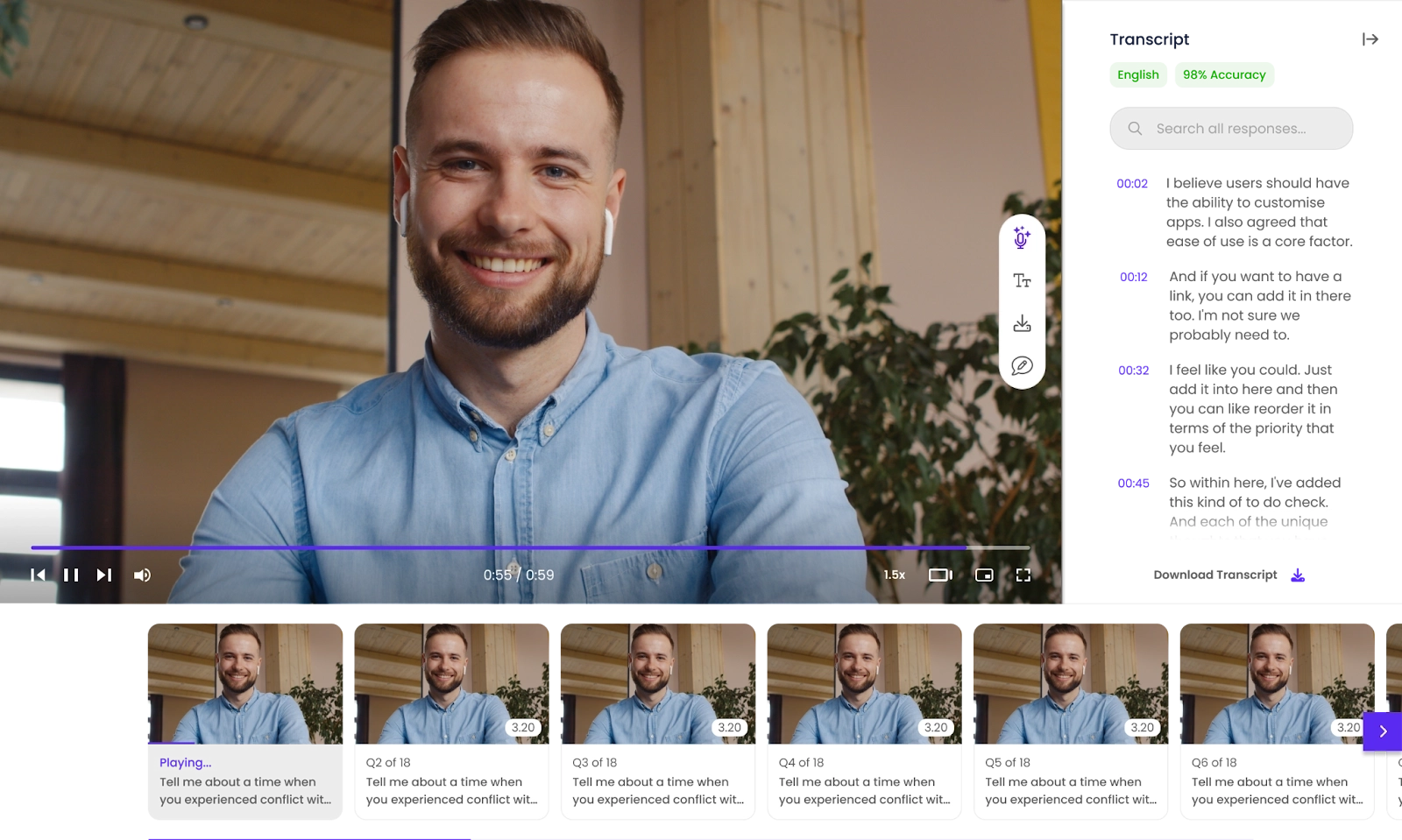
When candidates record video responses, Willo Intelligence transcribes everything and generates structured qualitative summaries covering:
- Skill proficiency,
- Knowledge areas demonstrated,
- Specific examples and evidence they provided,
- Communication style,
- Gaps in answers and precise follow-up questions you can use in live interviews.
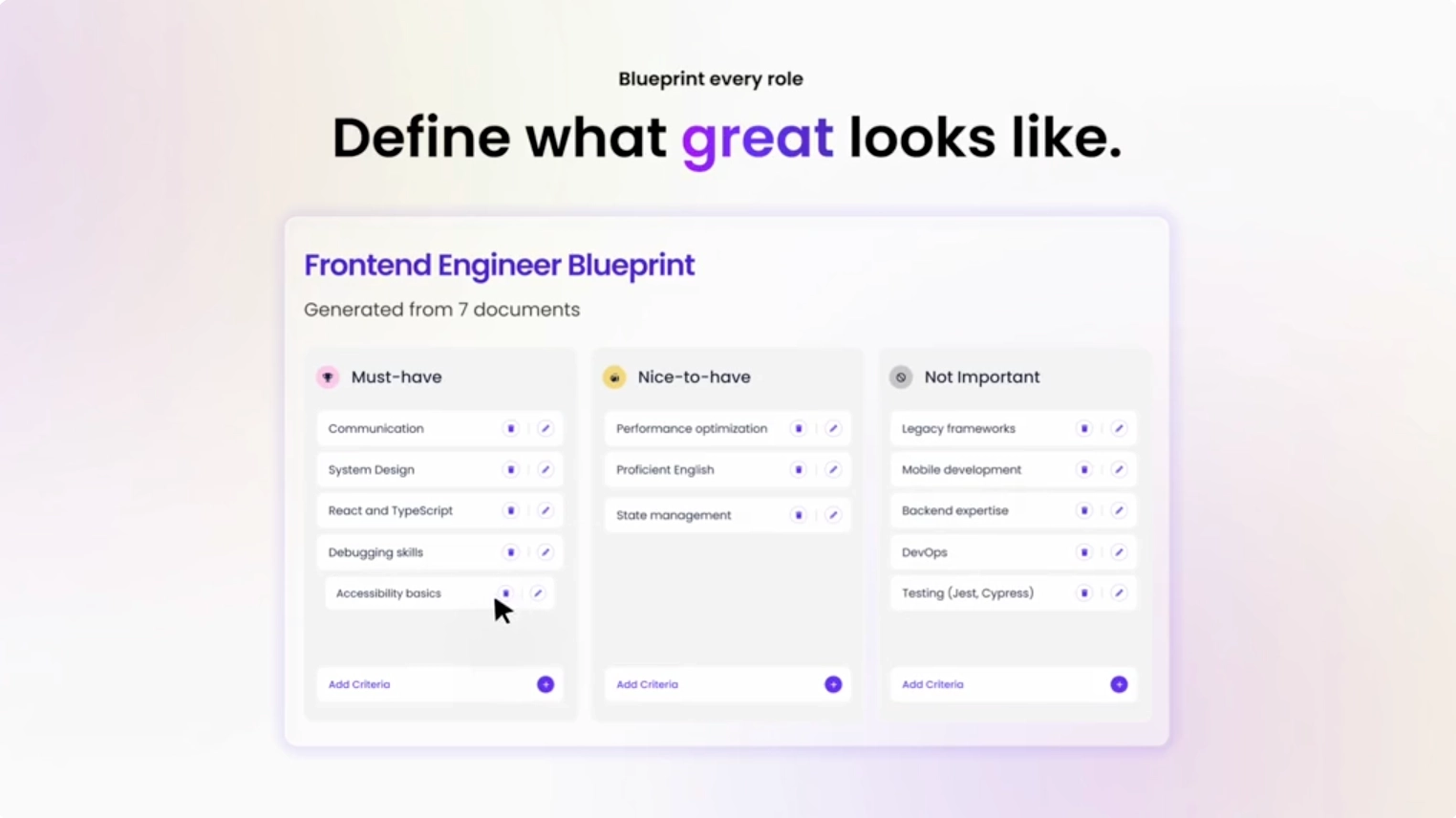
Willo Insights then evaluates each response against your Blueprint, the criteria you define for the role, and surfaces the strongest candidates with the evidence behind each match: the summary, the criteria met, and the moment in the answer that shows it. You shortlist from that evidence, and the decision to move anyone forward stays with you.
During the video assessment, Willo’s RealTalk runs separately to check whether the applicant is answering your questions themselves or with the use of AI.

And if you need to filter our poor-fit candidates faster, at scale, Willo offers automated scoring through Benchmark. It allows you to set a pass percentage (e.g., 80%) based on multiple-choice checkbox questions only.
This ensures candidates are only auto-rejected based on factual, binary criteria defined by you, not by an AI’s interpretation of their personality or video background. That way, final fit evaluation is faster through your team's hiring scorecards, where you rate on a 5-point scale against custom criteria, with optional blind mode to prevent groupthink.
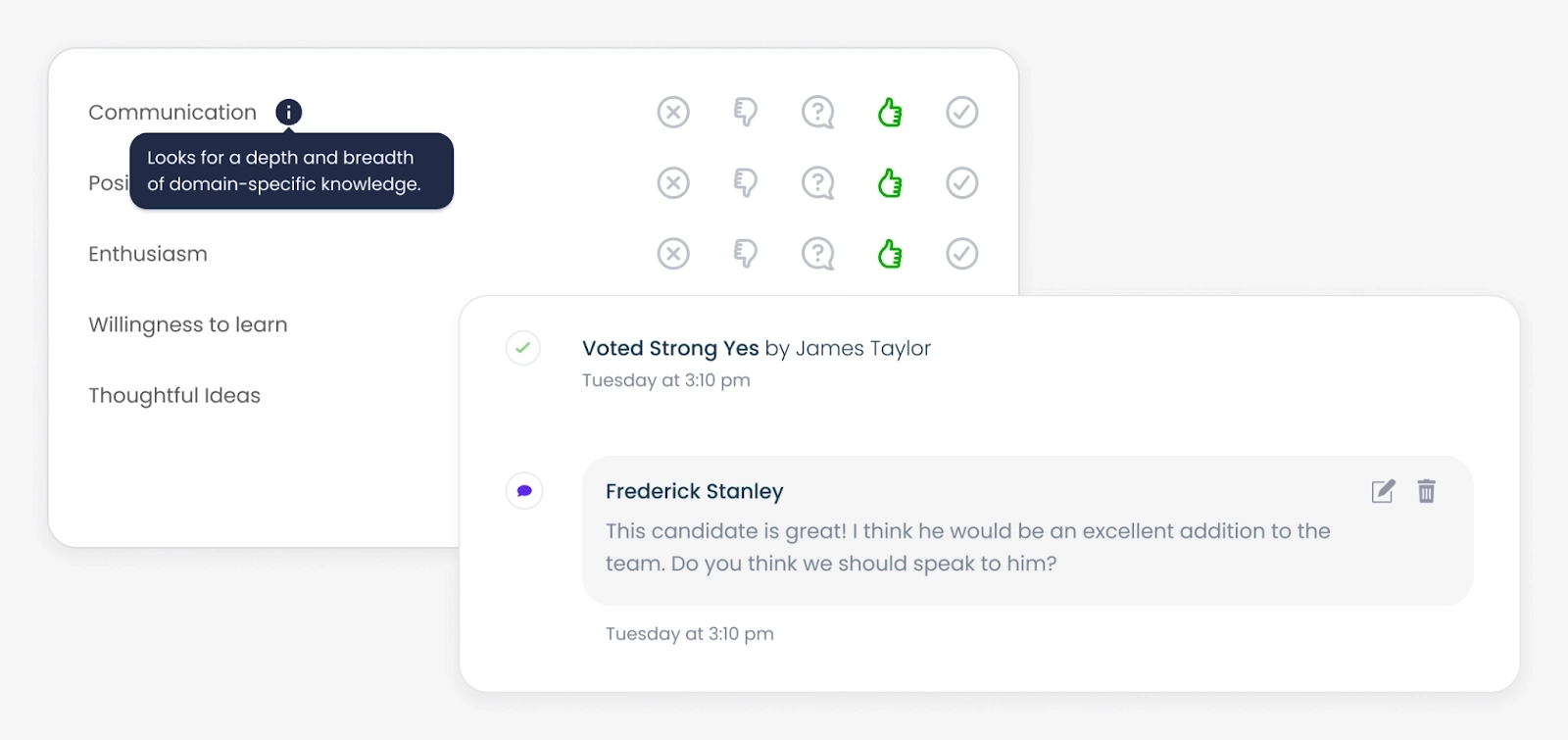
As a result, Willo is the best fit for high-volume, values-driven teams handling graduate programs, seasonal roles, or distributed hiring where fairness, confidence, and human oversight matter as much as speed.
Key Strengths
Willo’s AI scoring system protects human judgment by giving you concise, contextual insights that surface candidate qualities beyond what you’d normally get from CV scoring. That way, your team reduces time to hire while maintaining full transparency.
Limitations
Willo does not offer automated scoring and decision-making for your hiring team. This approach ensures you stay actively involved in decisions for transparency and bias-free hiring.
Pricing
- Growth: $310/month
- Scale: $399/month
- Custom pricing for enterprise
Ready to see how our human-first AI supports confident, human-first decisions? Book a Willo demo today.
2. HireVue
HireVue is an AI candidate assessment software for large organizations who need to manage the screening, assessment, and interview process in one place, while following strict hiring compliance policies.
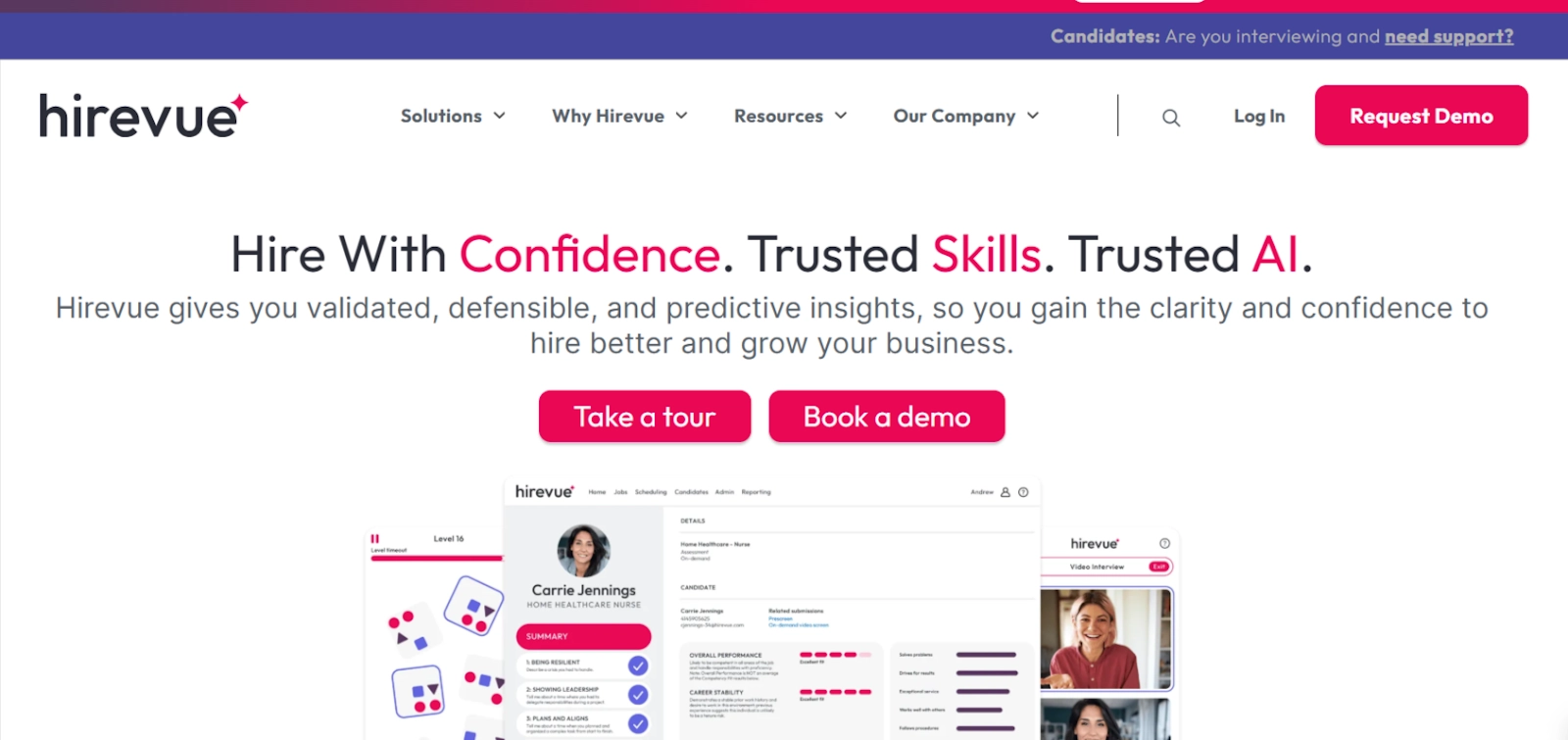
When you set up a HireVue assessment, candidates complete video interviews or game-based tasks, and the platform's AI immediately starts analysing everything they say and how they say it to predict their potential on the job.
The system transcribes candidates’ spoken answers and uses natural language processing to analyse how they describe past experiences tied to competencies like team orientation, adaptability, or problem-solving.
It also measures behavioural indicators such as verbal fluency, how quickly applicants respond, the sophistication of their vocabulary, and the clarity of their concepts.
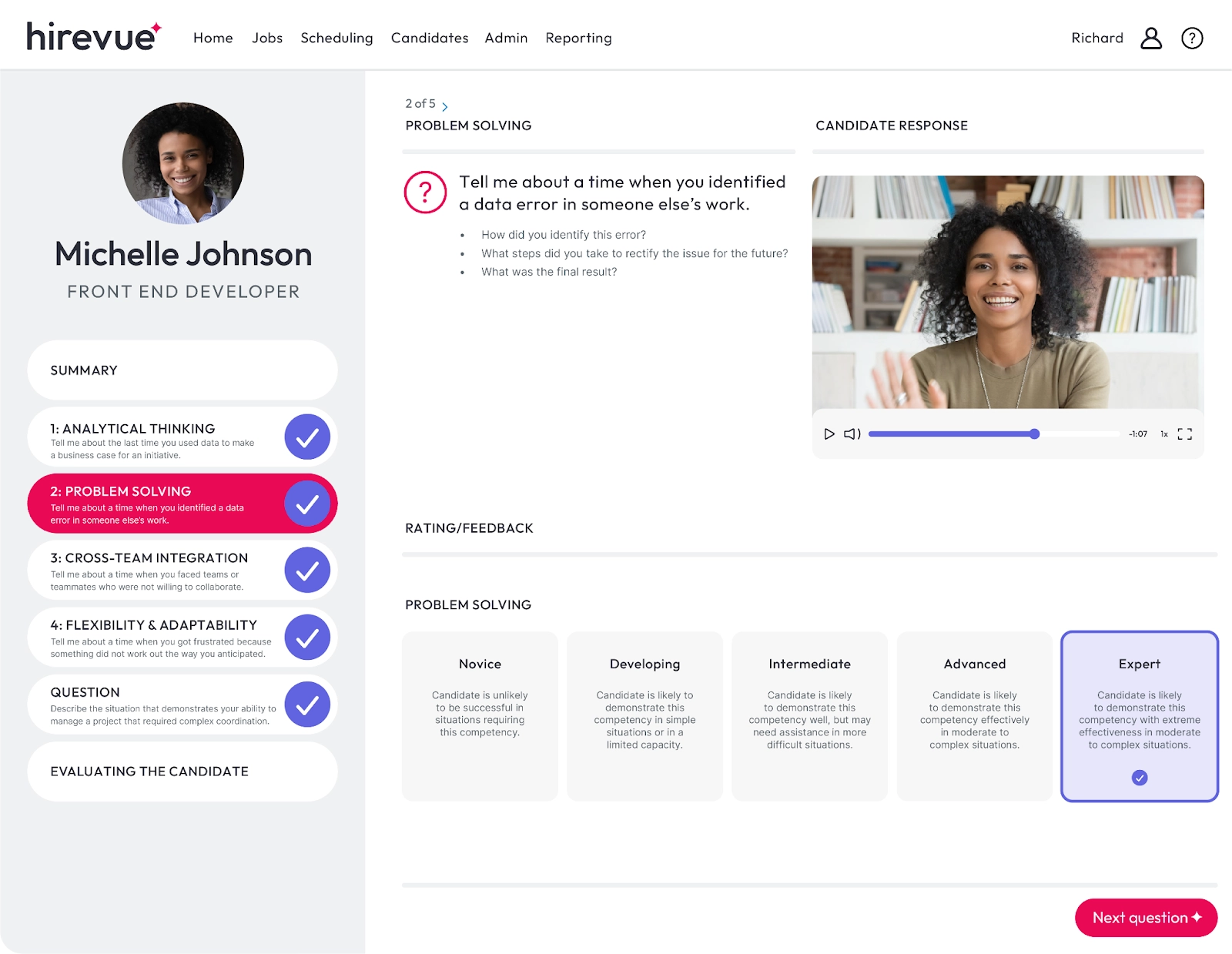
In some setups, candidates play short cognitive games that reveal traits like conscientiousness or problem-solving ability. All of this gets compared against a custom model built from data on your organisation's top performers in that exact role.
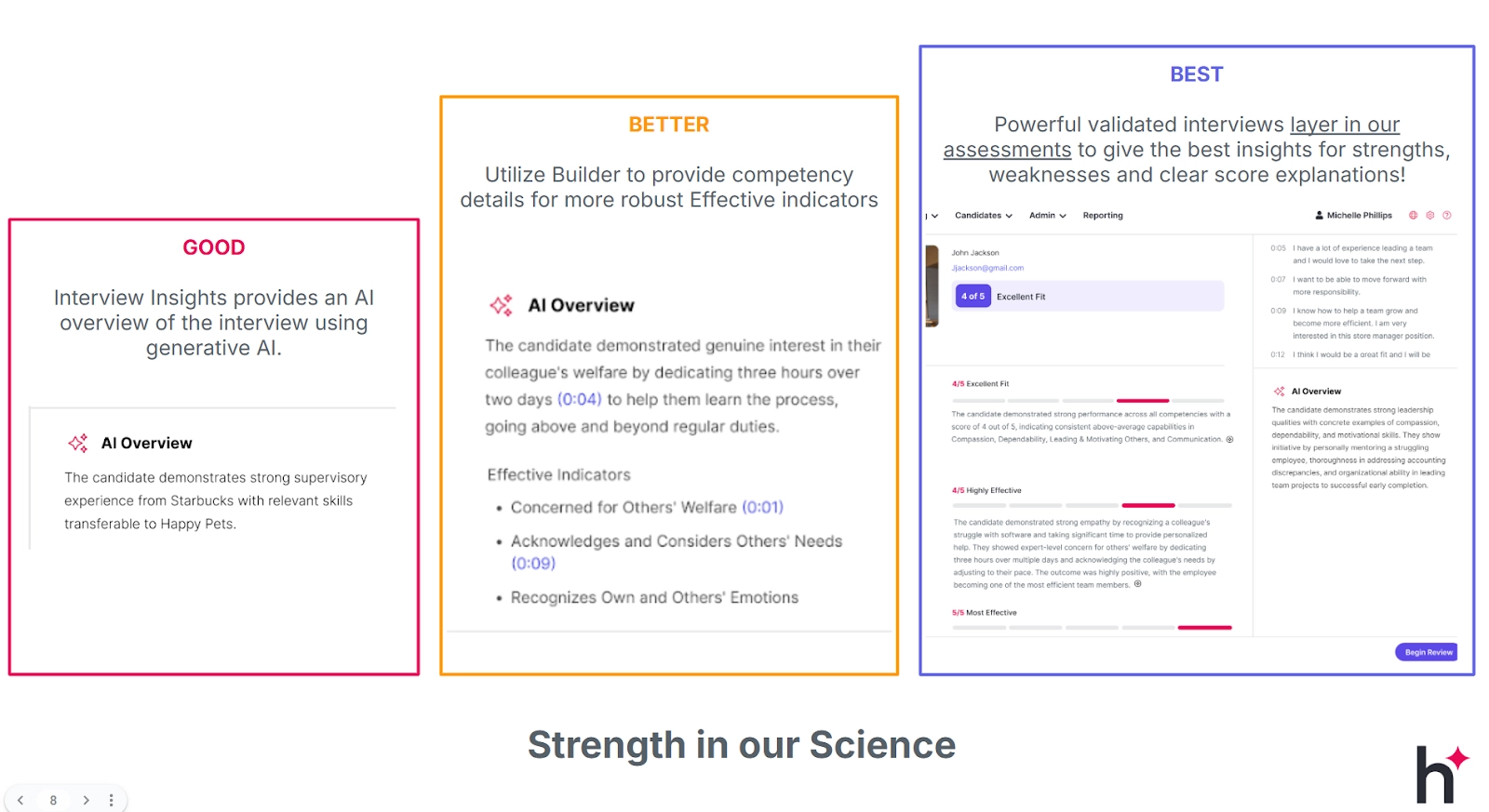
Once complete, you receive an employability score that sorts candidates into tiers: the top tier often moves forward automatically, while the middle or Bottom usually triggers manual review.
Key Strengths
Mature algorithms refined over the years deliver consistent predictions at a massive scale. Large enterprises in regulated industries rely on it for defensible, high-velocity screening.
Limitations
Potential subtle biases remain in language patterns, and tier placement can feel opaque without deep dives into the model. Historical concerns around facial analysis, though addressed, still linger in some discussions.
Pricing
- HireVue’s pricing starts around $35,000 per year for the "Essential" package, while a more comprehensive "Premium" package starts at $75,000 per year.
Further reading: Best HireVue Alternatives Ranked | HireVue Candidate Experience Review | HireVue Review
3. Eightfold
Eightfold generates a semantic Match Score using deep learning to assess alignment between a candidate’s profile and job requirements.
.webp)
The way it works is that Eightfold takes your job description and candidate profiles—mostly from resumes—and runs them through deep learning models to calculate a Match Score that predicts success in the role.
It goes beyond simple keywords by using semantic embeddings to understand context: it knows "Pandas" relates to Python programming, not the animal, so it surfaces candidates with relevant experience even if phrasing differs.
The system prioritises recent skill usage, de-emphasising old experience, and even predicts how quickly someone might pick up new competencies based on their career patterns. The candidate’s performance is assessed against historical data on successful hires and retention.
Key Strengths
The explainability stands out. You can see the top criteria pulled from the job and tweak them, plus it deliberately avoids demographic signals to keep focus on qualifications.
Limitations
Scores can shift noticeably between jobs, and the emphasis on certain trajectories sometimes favours traditional paths over diverse or non-linear ones. As a result, it is best used by organisations emphasising internal mobility and skill-based matching across large talent pools, especially when resurfacing past applicants for new roles. For roles where seeing communication style matters more than resume semantics, video-focused tools offer different signals.
Pricing
- Contact Eightfold for pricing
4. SeekOut
SeekOut functions primarily as a talent intelligence platform that aggregates data from public sources like GitHub, publications, and patents, then uses AI to match and score candidates against your role requirements.
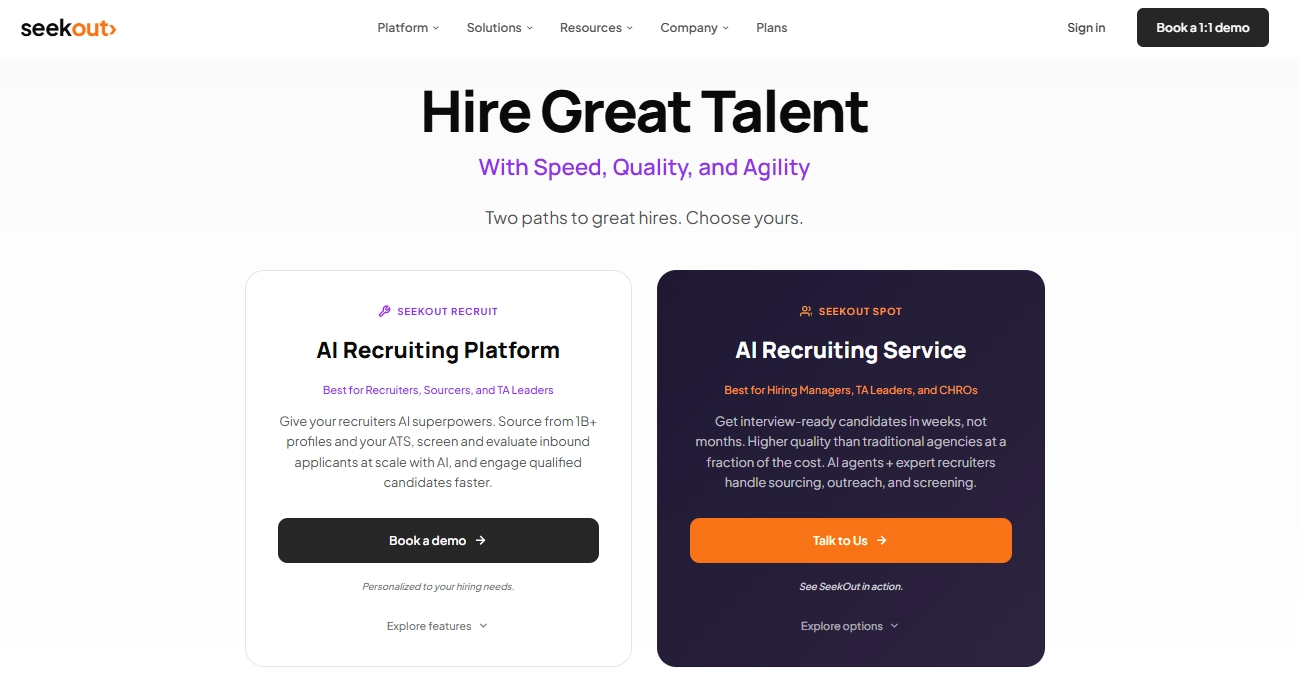
When you input a job description or criteria, the AI scans its database of over 800 million profiles and applies smart matching to rank results.
For technical roles, it dives into GitHub contributions—analysing code acceptance, influence, and quality to generate a specialized Coder Score. General profiles receive numerical match scores indicating strength against your specified skills, experience, and other filters.
Outputs appear as ranked lists with clear numerical indicators of fit, often highlighting the top reasons for each match.
Key Strengths
Excels at deep sourcing for hard-to-fill roles, especially in tech, where public contributions provide strong signals, and it effectively rediscovers talent already in your ATS or CRM.
Limitations
Heavy dependence on public data means candidates with minimal online presence or from non-technical fields can be harder to surface accurately. For that reason, SeekOut works best for tech-heavy recruiting teams needing to surface engineering talent quickly from GitHub and other public sources.
If your hiring spans non-technical or high-volume hourly roles, platforms built around structured video interviews may provide more consistent signals.
Pricing
- SeekOut Recruit software plans are billed on an annual basis. SeekOut Spot, our agentic-AI recruiting service, is sold in packs of candidate slates with no annual commitment. Book a demo to get full pricing information.
5. Turbohire
Turbohire processes resumes through its TurboScore engine, which reads the document structure and context to assign a precise fit score out of 100.
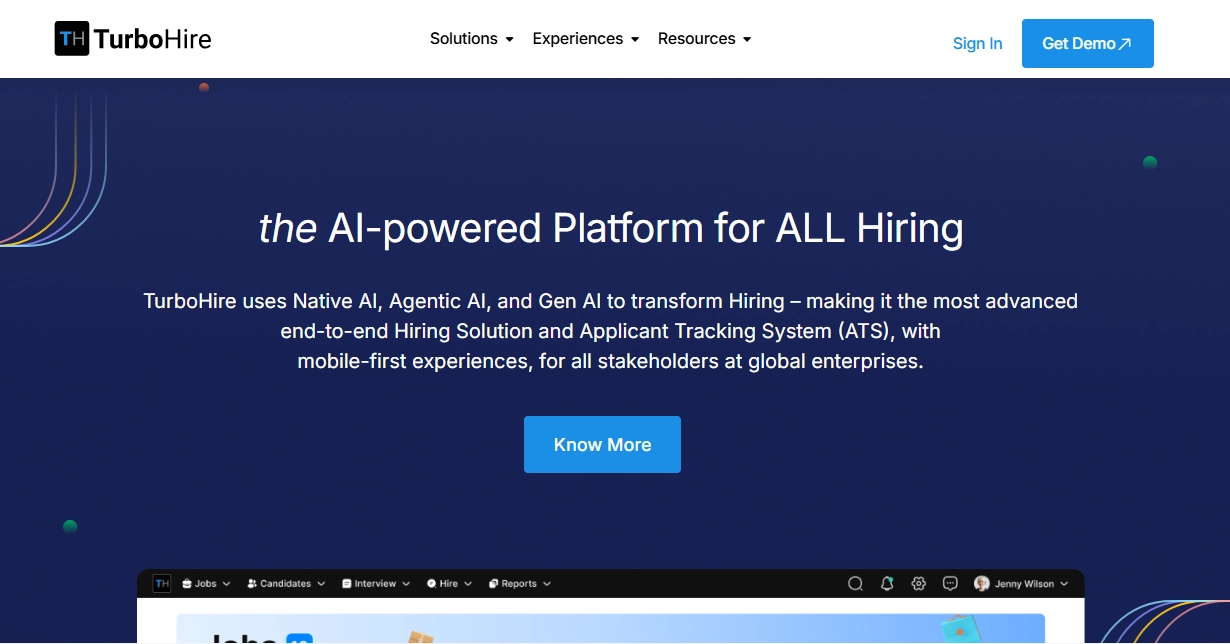
how skills were applied, how long someone used them, and whether that usage matches the seniority you need.
The scoring breaks into three main pillars—skills alignment, experience duration and relevance, and education/certifications—with weights you control. For instance, you can make a master's degree a heavy factor if it's required.
Once calculated, candidates rank from top to bottom, and you can set thresholds to auto-move high scorers forward. You get visual breakdowns showing exactly which required skills match and which preferred ones are missing, plus support for candidates from any source, like LinkedIn or referrals.
Key Strengths
The transparency of pillar breakdowns and customizable weights gives you direct control, and the standardised approach aims to reduce early human bias while cutting screening time dramatically.
Limitations
Being resume-only means it struggles when documents are non-standard or inflated with AI-generated content, potentially missing strong fits from unconventional backgrounds. It is best for high-volume roles where resumes follow relatively standard structures, and you need quick numerical rankings from document data alone.
When resumes alone no longer feel reliable due to AI inflation, video-based screening offers a stronger authenticity layer.
Pricing
- Contact Turbohire for pricing.
6. Vervoe
Vervoe shifts focus from credentials to actual performance by having candidates complete customised skills assessments—simulations, coding challenges, or written tasks—and scoring them through a three-layer machine learning model.
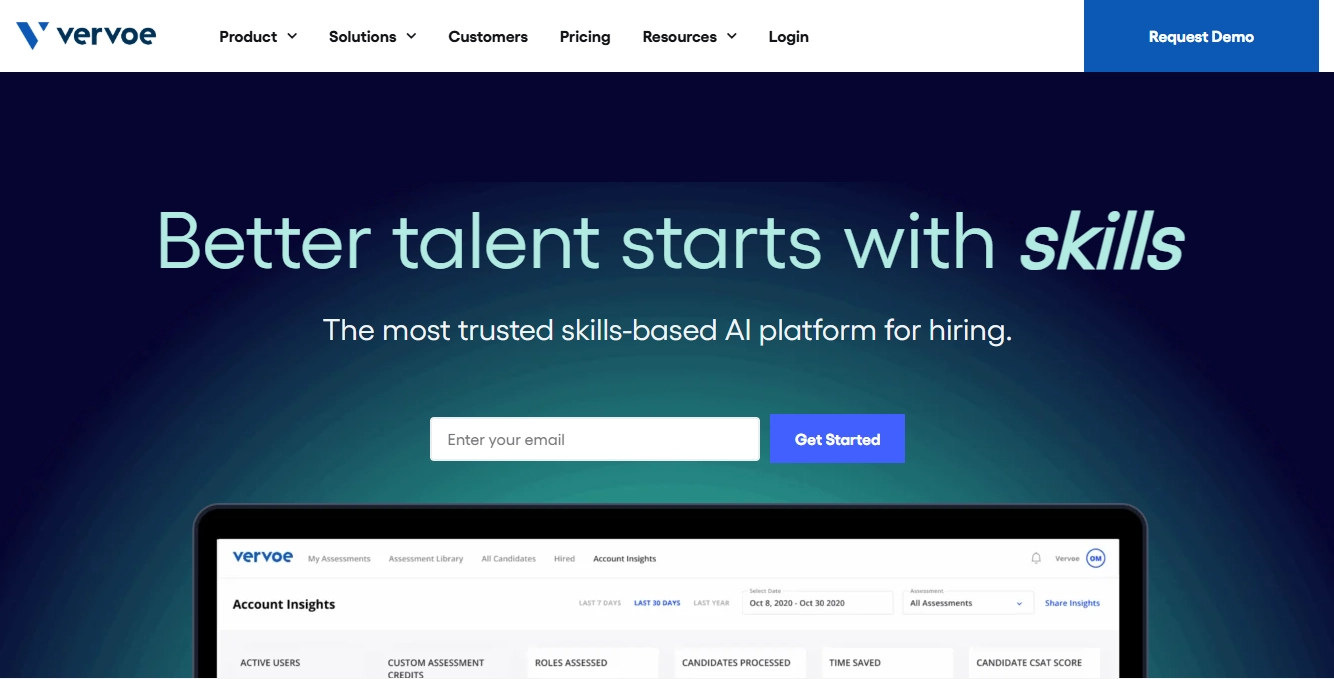
- The "What" model analyses response content against benchmarks from millions of past answers and your own correct samples, using transcribed text for any video or audio while ignoring tone or accent.
- The "How" model tracks interaction patterns like time spent, editing consistency, or scrolling to find correlations with success in your roles.
- The "Preference" model adapts by learning from about 20 blind-graded samples you provide, aligning predictions to your team's exact style. Higher-effort tasks carry more weight in the final calculation.
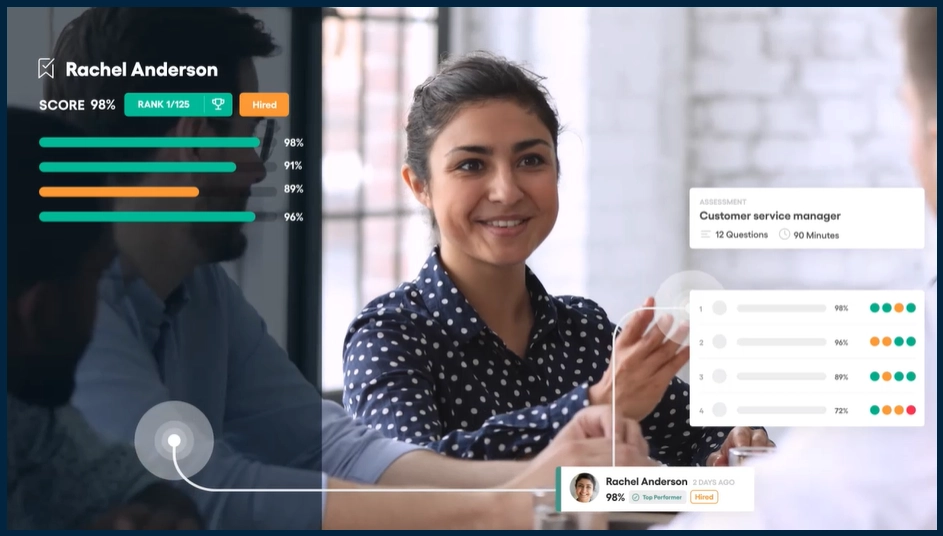
This analysis provides a result showing colored performance bars—green for strong, orange for moderate, red for weak—plus an automatic ranking where your manual overrides take priority.
Key Strengths
The skills-first design measures real ability through practical tasks, and the human-in-the-loop training makes it highly tailored to your organisation's standards over time.
Limitations
Achieving accuracy requires an initial investment in grading samples, and without enough diverse training data, early predictions can drift from your preferences. As a result, Vervoe might be best used for roles where practical demonstrations—like coding challenges or work simulations—are more predictive than resumes or interviews.
If you want similar depth without the calibration burden, some platforms provide structured insights out of the box.
Pricing
- Free trial: 7 days at $0
- Pay & Go plan: One-time $1,100 payment for unlimited assessments (up to 100 candidates)
7. Manatal
Manatal uses an AI Recommendation Engine to extract requirements from your saved job description, categorising skills, experience levels, and education into required versus preferred.
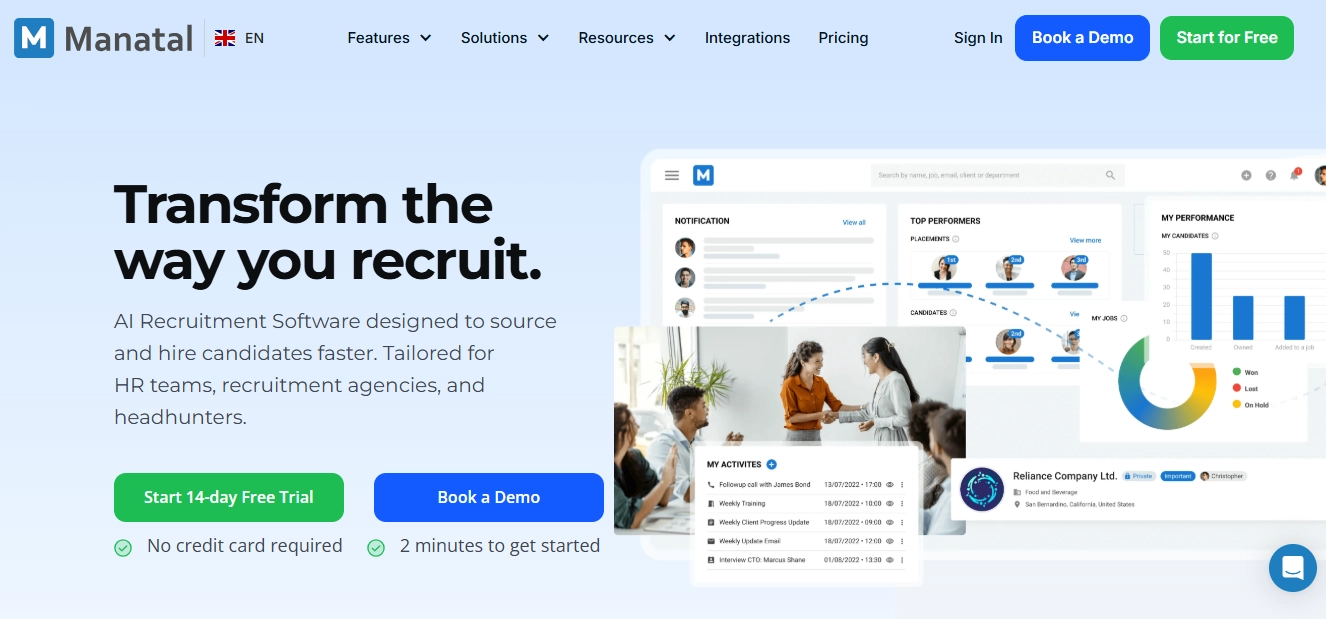
It then applies semantic matching across new applicants and your existing database, understanding context so "SaaS Sales" counts toward "B2B Software Sales" even without exact wording.
You assign importance weights to fine-tune priority, and the system enforces thresholds—like needing at least three matching skills plus two primary criteria—before recommending anyone. It also enriches profiles with LinkedIn data and continuously scans past applicants for new fits.
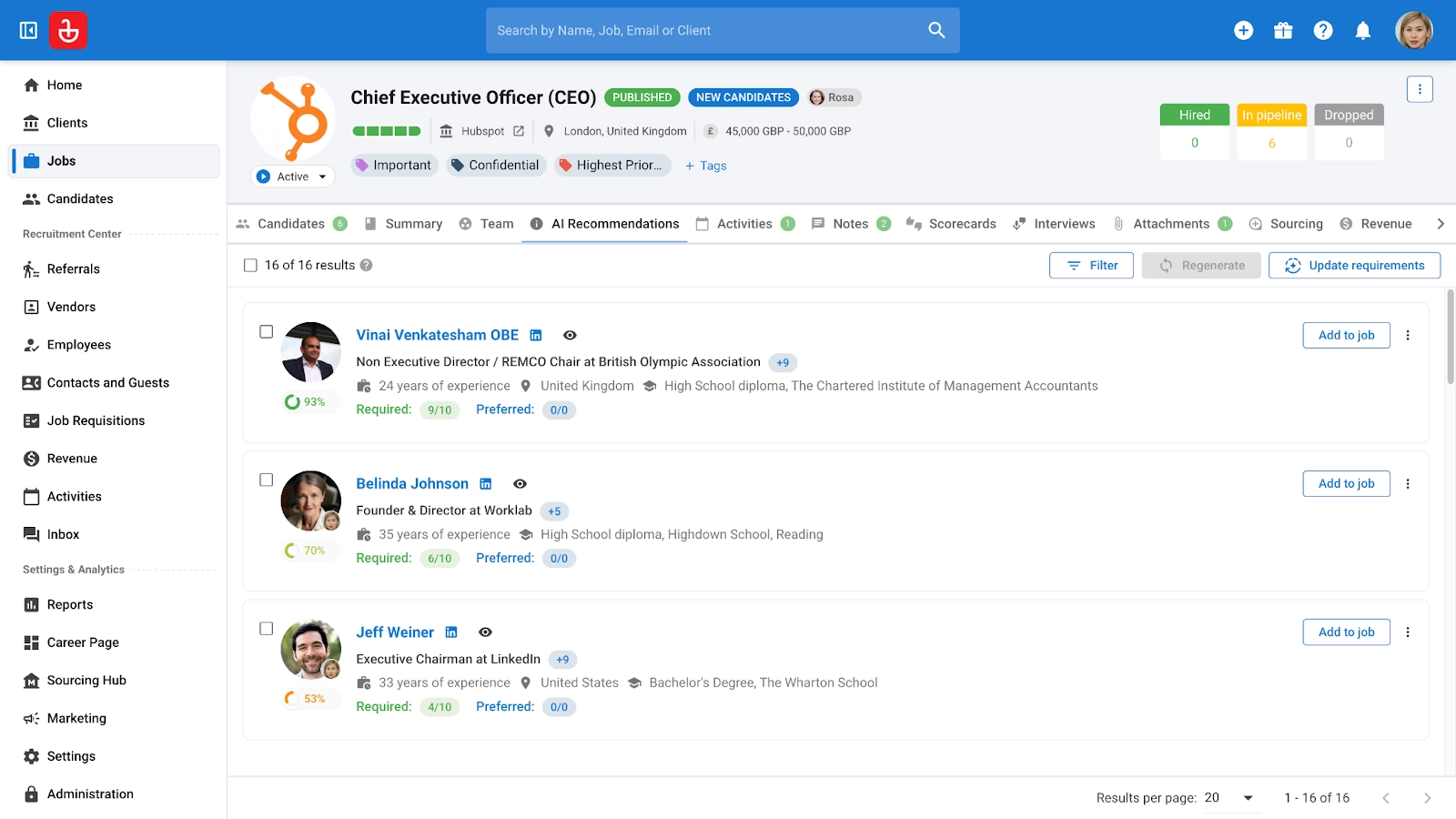
Each recommended candidate shows a clear percentage match out of 100, with explainable summaries justifying matches line-by-line, gap analysis for missing elements, and colour-coded highlights for quick scanning.
Key Strengths
The combination of profile enrichment, customizable weighting, and strong rediscovery of silver-medalist candidates helps maximise your existing talent pool efficiently.
Limitations
Thresholds can feel rigid for borderline cases, sometimes rejecting nuanced fits without extra manual review. Growing teams managing large internal databases and needing to resurface silver-medalist candidates quickly would benefit more from Manatal’s approach to AI candidate scoring.
Pricing:
- Manatal is priced between $15 to $55 per user per month.
Final Verdict: Which Platform Is Right for You?
If maximum automation and predictive ranking are your priorities—and you have resources to audit and mitigate bias—tools like HireVue, Eightfold, or SeekOut can deliver speed at massive scale.
If you want efficiency without surrendering control, especially in high-volume or regulated environments where fairness and transparency are non-negotiable, Willo gives you powerful assistive AI that compresses review time while keeping every meaningful decision in human hands.
Ready to see assistive AI that supports confident, human-first decisions? Book a Willo demo today.
Frequently asked questions
What Is AI Candidate Scoring in Recruitment?
AI candidate scoring refers to the use of algorithmic systems that evaluate or rank job applicants by assessing their suitability for a role. These systems analyse structured or unstructured data—such as resumes, async video assessments, or interview responses—and produce an overview, score or ranking that informs selection decisions.
With the increasing adoption of AI in recruitment [at least with 76.6% of teams now using AI in their processes], AI scoring is increasingly adopted across the hiring funnel, particularly in high-volume recruitment:
- Pre-screening: For predictive ranking or matching based on past hires
- Asynchronous assessments: For scoring cognitive, behavioural, or situational responses
- Video interviews: Automated scoring of video or text-based answers
Simple automation or rule-based filtering (e.g., knockout filters or eligibility rules) is not considered AI candidate scoring, although some vendors group them as one. AI scoring models learn patterns from historical hiring, assessment, or job performance data to make predictions or generate evaluations.
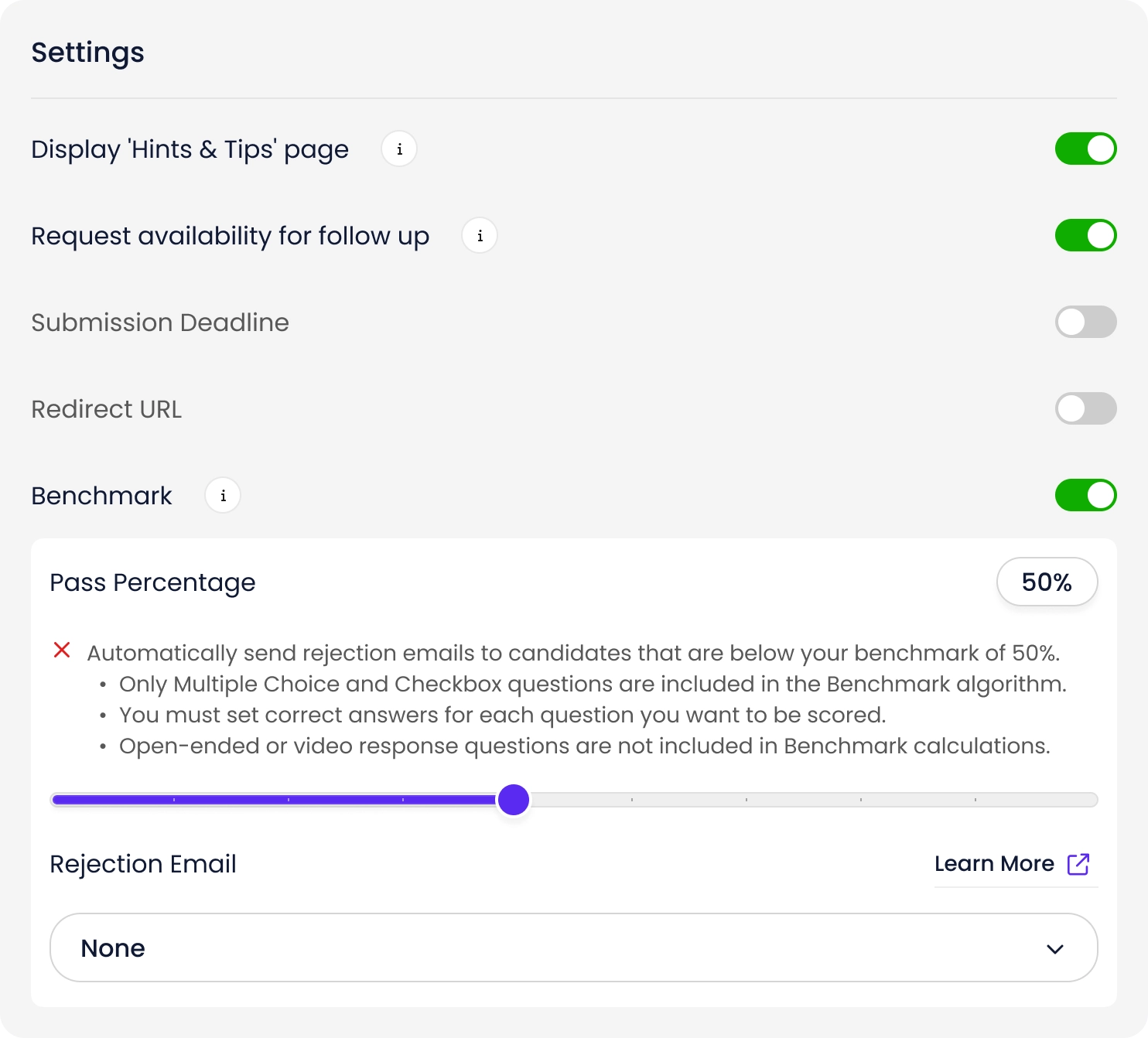
For instance, you can set a pass percentage on knockout questions with Willo's Benchmark. Candidates who score below this threshold will be automatically rejected and will receive the rejection email you have chosen.
This type of rule-based scoring (e.g., knockout filters or eligibility rules) is often implemented alongside AI systems in hiring workflows.
What are the types of AI Scoring Systems?
AI candidate scoring tools are typically categorised by the form of assessment they score, which determines where in the hiring process they sit and what kind of signal they produce. The main types are
- Resume and application scoring tools, which filter candidates at the top of the funnel based on CV text and application responses
- Video interview scoring tools, which analyse recorded candidate responses for content, communication quality, and authenticity;
- Written response scoring tools, which evaluate how well a candidate reasons and communicates in writing;
- Psychometric and game-based scoring tools, which measure cognitive ability and personality traits through structured tests or gameplay, and
- Coding and technical scoring tools assess whether a candidate can actually do the work through live or submitted code challenges.
How to choose the right AI candidate scoring tool
When evaluating recruitment platforms with AI scoring, answer these questions to align your decision to your hiring needs:
- What stage of the funnel needs scoring? Some tools only do resume ranking, while others support scoring throughout.
- What kind of inputs do you already have? If you’re not using assessments or collecting structured data, LLM-based resume scoring might be more practical than psychometrics.
- Is explainability a priority? For regulated industries or public-sector hiring, being able to justify decisions matters.
- Will it integrate easily with your ATS or CRM? A powerful system that sits in a silo won’t help much.
- How much control do you want? Some platforms are more black-box, while others allow you to adjust scoring weights or thresholds.
This framework helps narrow down the selection to the best product for your workflow.


.webp)