Time to hire, the days between a candidate applying and accepting your offer, is one of the most watched recruiting KPIs, and “how do we shrink it” is usually the wrong first question.
Ask most hiring teams why a role is taking too long to close, and they’ll point to the calendar: too many interview rounds, slow scheduling, a sign-off stuck in someone’s inbox. We’ve talked to 100s of talent leaders to know that those factors are rarely the only reason a good hire slips to next quarter.
In this article, I’ll walk through what the evidence says actually moves time to hire, drawing on the research and the practitioners who’ve done it. Then, you’ll learn how to calculate time-to-hire, the benchmarks worth trusting, and how it differs from time to fill.
Why a long time to hire isn’t always a speed problem
When a role drags, the instinct is to compress the visible steps. But evidence shows that the largest block of time sits in the selection period. In fact, this study of employer vacancy data found that employers spent about 18 days gathering applications for a vacancy and roughly 45 days selecting among them.
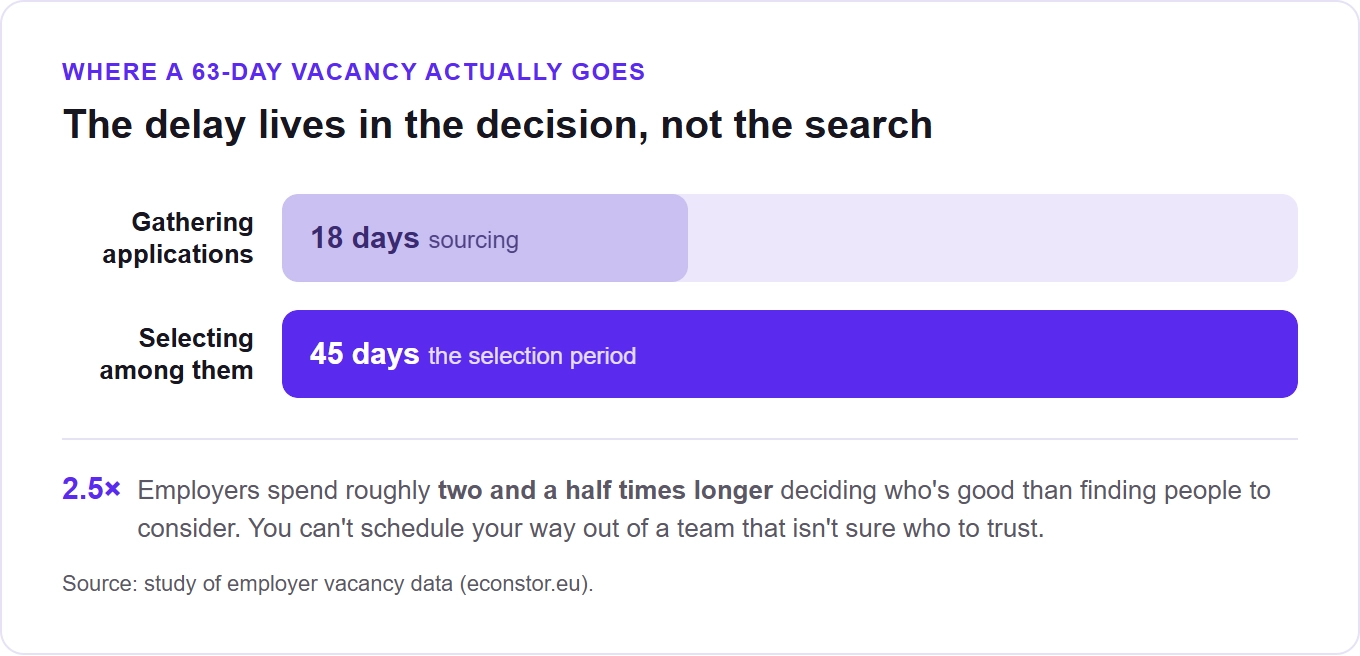
The report references a 2020 problem that’s still true today. Deciding which applicant should go to the live interview stage has only gotten harder and slower. In Willo's 2026 Hiring Trends Report, 76.6% of hiring teams said they now field AI-generated applications.
The stack looks as strong as ever while more of it is polished noise. When you can't fully trust what's in front of you, and you can’t schedule your way out of a team that isn’t sure who’s good yet, the confident call is the one that takes time.
Therefore, the part that actually stretches time to hire is how long it takes to decide who’s good, and to feel confident enough in that call to send the offer. Simran Sandhu, TA lead at Shopify, named the usual cause on the Looks Good on Paper podcast: “hiring managers aren’t often calibrated on what great looks like before they kick off” (Why Shopify Asks Every Candidate to Tell Their Life Story).
A hiring manager who hasn’t decided what a strong answer looks like will re-read the same resume three times, ask a colleague for a second opinion, and push the call to next week. It reads as indecision. It’s actually a missing standard. Every extra day of “let me think about it” is a symptom of calibration that never happened, and no amount of scheduling pressure fixes it.
How to calculate time to hire: The standard way & an alternative approach
The standard time-to-hire formula is a single subtraction:
Time to Hire = Offer Acceptance Date − Application Date
The clock starts when someone applies and stops the moment they accept. Everything in between, screening, interviews, references, and offer negotiation, counts toward the total. Track it per hire, then average across a role, a team, or a quarter.
Here’s what that looks like with real dates.
Say a candidate applies for a customer success role on March 3, completes a structured screening assessment on March 5, interviews with the hiring manager on March 12, clears a final panel on March 19, and accepts an offer on March 21.
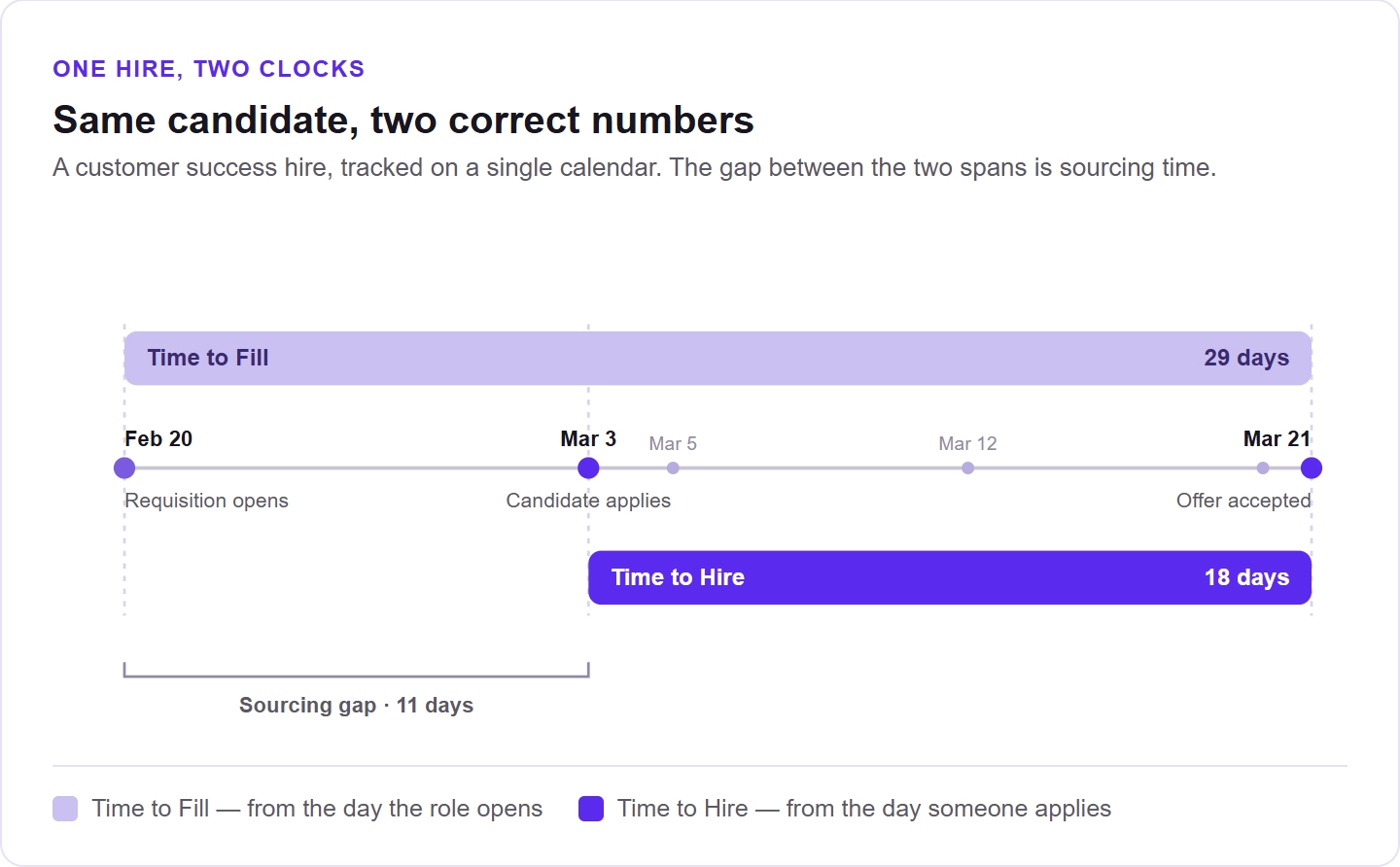
That way, the applicant’s time to hire is 18 days, the span from March 3 to March 21. If the requisition itself opened on February 20 while the team ran sourcing outreach, time to fill runs from February 20 to March 21, or 29 days. Same hire, two numbers, both correct, each answering a different question.
The alternative approach: calculate your screening efficiency
The formula above gives you a clean calendar span, and that span is worth tracking. But it blends two very different things: the work your team controls and the waiting it doesn't. A candidate's notice period, a holiday week, a reference who takes five days to reply, none of that moves because you ran a tighter process. How long your team spends screening a pool and reaching a shortlist it trusts does move, and that is the part worth measuring on its own.
That is what screening efficiency captures. Where the standard calculation counts calendar days, screening efficiency measures recruiter productivity: how much of your team's capacity a hiring round actually consumes to produce a confident shortlist.
- Standard time to hire: calendar days from application to accepted offer, shaped in part by external factors you can't control.
- Screening efficiency: the recruiter time and capacity your process spends to reach a confident shortlist, which is the part you can actually improve.
Most time-to-hire calculators stop at the first line. Willo's time to hire calculator works from the second, so you can size the efficiency your own process has on the table before you get to how to improve it.
What’s a good time to hire? Benchmarks by industry and stage
Time to hire varies enormously by role, seniority, and industry, so a single target number is close to useless on its own. Sourced ranges give you a starting point:
The spread is itself the finding, and so is the fine print: SHRM’s figure measures time to fill (requisition opened to offer accepted), which runs longer than time to hire by definition, and a widely repeated “SHRM says 24 days” figure circulating on competing pages appears to be an example calculation misread as a benchmark. Methodology and sample differ across every source in this table, so treat any single figure as directional rather than a pass/fail line.
The more useful benchmark is almost never the company-wide average. Time to hire for a senior engineering role behaves nothing like a high-volume support role, and the average of the two describes neither.
And the same is true stage by stage: a pipeline that looks healthy in aggregate can hide a selection period that runs twice as long as sourcing, which is exactly the pattern the evidence from the study of employer vacancy data data surfaced above.
Benchmark by industry to know whether you’re competitive, and benchmark by stage to know where your own delay actually lives. Then track your own trend against your own roles before you benchmark against anyone else’s.
How to reduce time to hire without lowering the bar
Most advice on how to reduce time to hire converges on three moves: use an ATS to kill administrative drag, cut interview rounds that don’t earn their place, and tighten employer branding so candidates self-select earlier. All three help. But we often advise teams to consider tips to reduce decision fatigue. Consider how to eliminate the moment where a hiring manager stares at two similar candidates and can’t decide.
Here are our additional tips to reduce time to hire:
- Calibrate what “good” looks like before the role opens
- Standardize the evidence so every reviewer sees the same candidate
- Set a decision SLA — a 24-hour answer stops losing candidates
- Close the loop fast with the people you don’t hire
Calibrate what “good” looks like before the role opens
This is the fix for the slow decisions diagnosed above, moved to the front of the process where it belongs. Sandhu’s version is upfront work rather than downstream urgency: “Do the work up front to think through what great really looks like… so when you see it, you recognize it and you can move quickly” (Why Shopify Asks Every Candidate to Tell Their Life Story).
In practice that means the hiring manager and recruiter agree, before the requisition opens, on what a strong answer to each question actually sounds like, and write it down as the criteria for the role. Not a vague “culture fit” gut sense. A stated bar that a second reviewer could apply and reach the same call.
What changes is the tempo of the decision. When the standard exists before the first candidate lands, reviewers recognize a strong answer on sight instead of re-litigating it, and the “let me think about it” days stop accumulating. The causal order only runs one way. Teams that skip calibration and jump straight to “move faster” get the same indecision, now compressed into a more stressful timeline.
Standardize the evidence so every reviewer sees the same candidate
Knowing what a “good” candidate looks like sets the standard. Standardizing the evidence is how you apply it across a whole pipeline without the comparison itself becoming the bottleneck. The move is structured, async screening: every candidate answers the same questions, evaluated against the same criteria, so the comparison is apples to apples before anyone starts deliberating.
The mechanics are where the time comes back. A 45-minute unstructured phone screen for every applicant doesn’t scale. A structured assessment that every candidate completes on their own time, scored by a reviewer against one rubric, does. The reviewer compares standardized evidence that’s already been collected instead of running each conversation live and taking notes on the fly. The candidate slate stays intact. The clock moves because the bottleneck, which is recruiter and hiring-manager calendar time, stops gating every comparison.
HelloFresh’s TA team saw this play out directly. After moving to structured async screening with Willo, Marley Andrews, TA Manager, reported improved monthly screening volume and reduced time to hire, and said the process “added a level of fairness and equality to the process.” The fairness result and the speed result came from the same change: standardized criteria applied consistently across a large candidate pool. They didn’t come from two separate initiatives. See our candidate screening guide to learn more
Set a decision SLA — a 24-hour answer stops losing candidates
Calibration and standardized evidence get you to a defensible call quickly. A decision SLA makes sure the call actually gets made before the candidate is gone. Taylor Genry, Director of Recruiting at BMAC Logistics, built her sales team’s process around giving every candidate a final answer within 24 hours of their last interview. Her reasoning is blunt: “We’ve lost great talent for taking 3 days to make a decision” [caption] (She Gives Every Sales Candidate a Final Answer in 24 Hours).
The 24-hour promise is a hiring-manager feedback SLA, not recruiter heroics. Nobody is grinding through candidate files at midnight to hit the number. Managers commit to a same-day decision window, and the rest of the organization aligns around that commitment ahead of time, so the deadline doesn’t depend on any one person’s calendar clearing up.
What changes is who’s still available to say yes. A candidate who hears back the same day is deciding about your offer while it’s the live one in front of them, not weighing it against a competing offer that closed the window while your panel was still debating.
Close the loop fast with the people you don’t hire
A fast process isn’t only about the candidate you hire. Researchers surveyed 344 IT-sector candidates and found that time to hire shapes the candidate experience, and that the experience in turn drives employer-brand outcomes.
A slow process doesn’t just lose you the one candidate. It costs you the reputation that brings you the next hundred. Our own 2026 Hiring Trends Report surfaced the same connection from the employer side: teams described candidate experience as an efficiency problem, not just a courtesy, because slow, unstructured processes are where their strongest candidates dropped out.
The people you turn down carry that experience too, and how you handle them feeds back into the next req. Barattucci and colleagues (2025) found that timely, clearly communicated rejection improves candidates’ fairness perceptions and their willingness to reapply and refer others. How you close the loop with the people you don’t hire is part of how fast you can hire the next time.
The mechanism is the same one running through the whole section. When the evidence is already standardized and scored, a clear, timely “not this time” is cheap to send, because the reason for the call is sitting right there in the rubric. The same structure that compresses your time to hire is what lets you close the loop fast with everyone it didn’t work out for.