If you’re evaluating Spark Hire, the biggest questions you probably have are “what is Spark Hire?", “how does it work”, “how much does Spark Hire cost?”
The answer depends on the kind of hiring you need the tool for, which Spark Hire product you’re considering, whether you need month-to-month billing, your company size, and other factors.
Here’s a quick summary of what you need to know about Spark Hire:
Exploring multiple options? See our complete guide to Spark Hire alternatives to compare platforms based on pricing, integration, AI approach, and candidate experience
Why You Can Trust This Review
At Willo, we live in the candidate screening space every day. This review is grounded in real implementation patterns, verified user feedback, and direct platform comparison.
Here's what we did:
- Analyzed verified user reviews: Scanned recent G2, Capterra, and TrustRadius reviews for recurring patterns—specifically looking for themes mentioned by multiple users across different organizations
- Fact-checked against Spark Hire’s latest pricing page and demos. We reviewed pricing and add-ons, feature availability by tier, and compliance claims verified against Spark Hire’s public materials and G2 data
- Compared against agency and mid-market needs: Scored against hiring team priorities, recruiter capacity, speed to hire, team collaboration, and total cost of ownership.
This guide should give you a clear view of where Spark Hire adds value, where it might not, and how it affects your team’s approach to hiring.
Spark Hire Features & What Users Say About Them
Spark Hire features at a glance
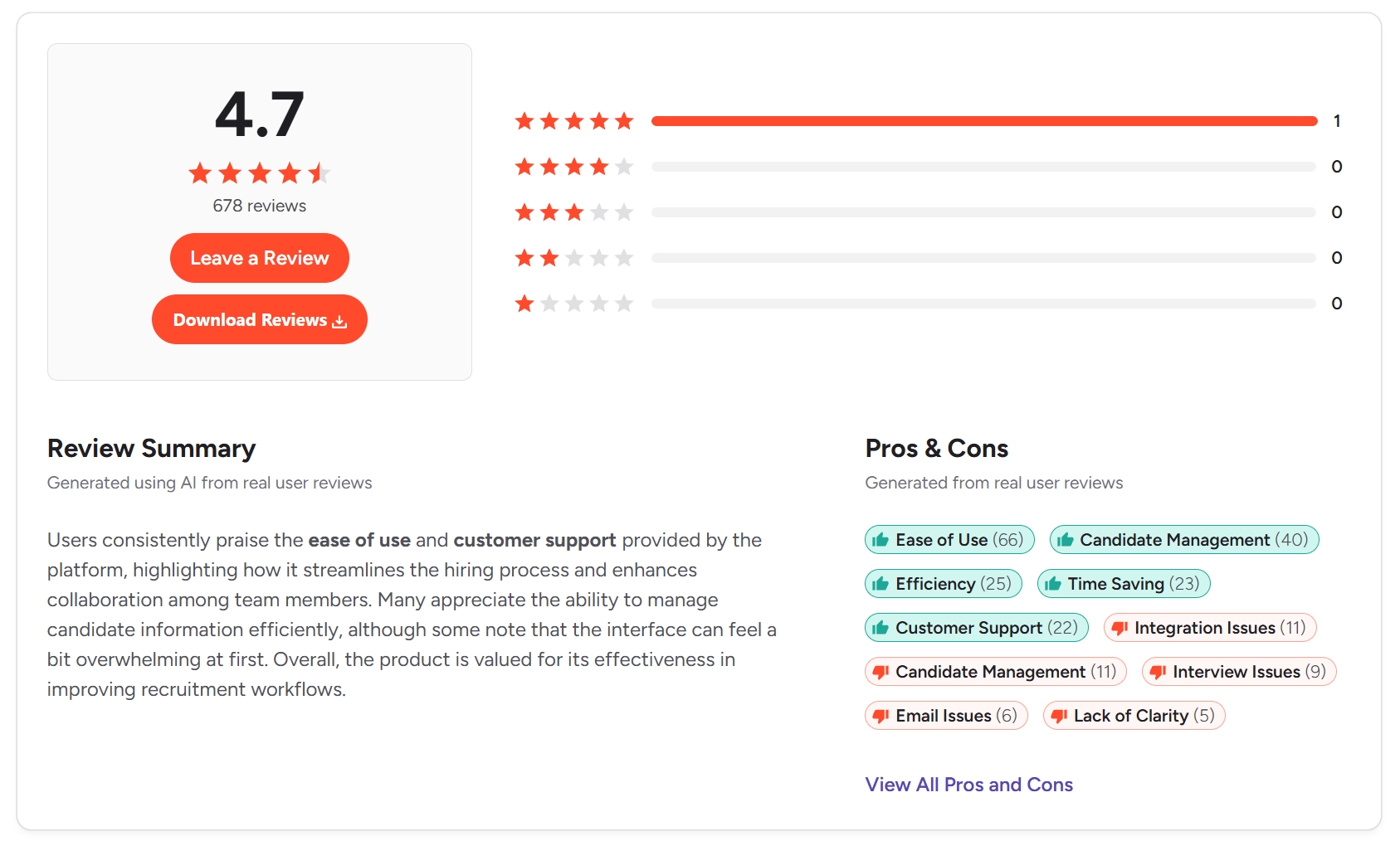
- Overall G2 Spark Hire Rating: 4.7/5 ⭐
- Overall Capterra Spark Hire Rating: 4.7/5 ⭐
What Users Love About Spark Hire Features
1. You can get started in minutes without a tutorial
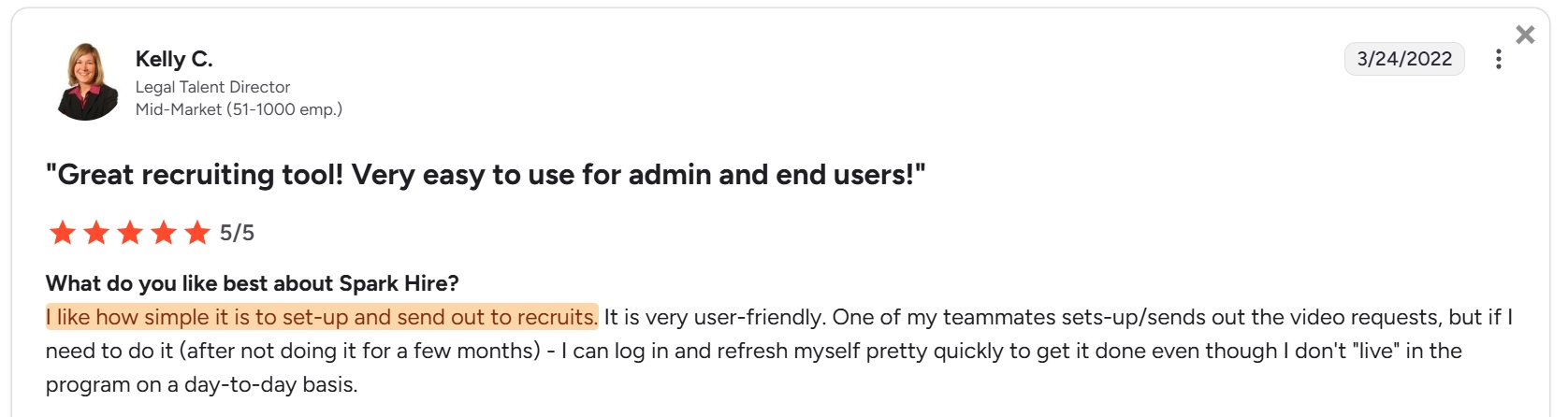
Spark Hire's interface is designed so you don't need to sit through training videos or read documentation before sending your first interview. You build question sets, customize settings, and send invites within the same session you sign up. G2 reviewers consistently describe the setup as "seamless" and "intuitive." Kelly C, Legal Talent Director, describes how simple it is to use, plainly:
2. The time savings are real — phone screens disappear
Teams report cutting their hiring timelines in half after adopting Spark Hire. One user described how Spark Hire sped up their hiring process.
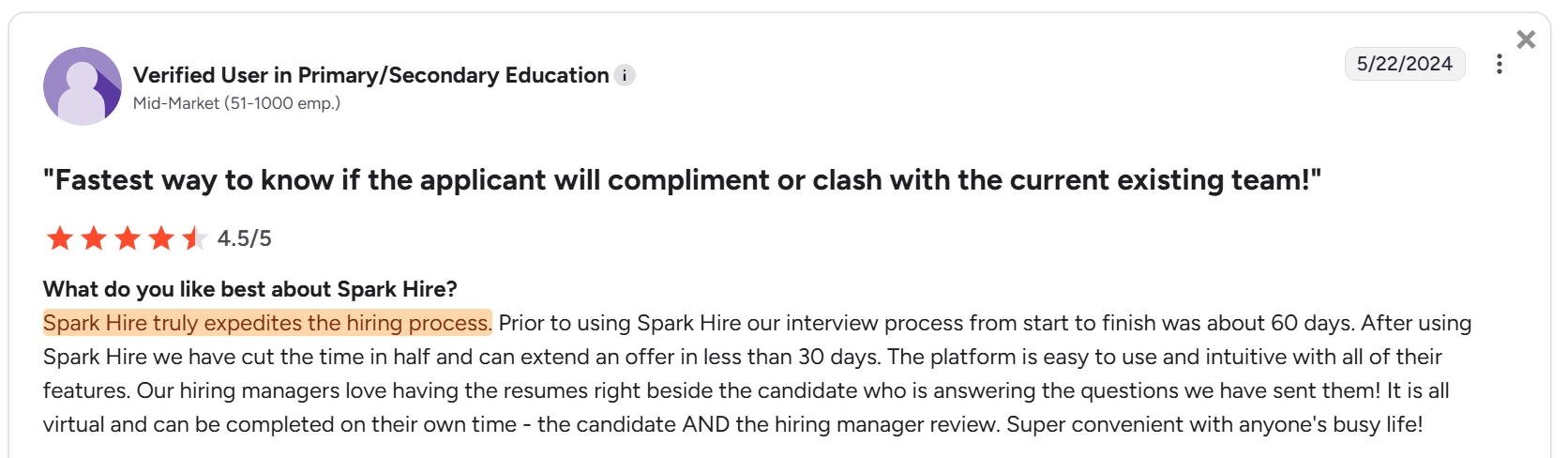
For high-volume hiring, that time savings compounds quickly. Another reviewer described the shift from chaos to efficiency:
"Before Spark Hire, we spent hours every week conducting phone screenings, which slowed down our hiring process in a very crippling way. Spark Hire has given us hours every week and sped up the hiring process tremendously."
3. The Chrome extension makes high-volume sending effortless
When you're inviting 50+ candidates to interview in a single week, the Chrome extension becomes the tool you didn't know you needed. It lets you send interview invites directly from your ATS or job board without switching tabs or copying candidate information manually. See how one Talent Acquisition Manager described the ease of use below.
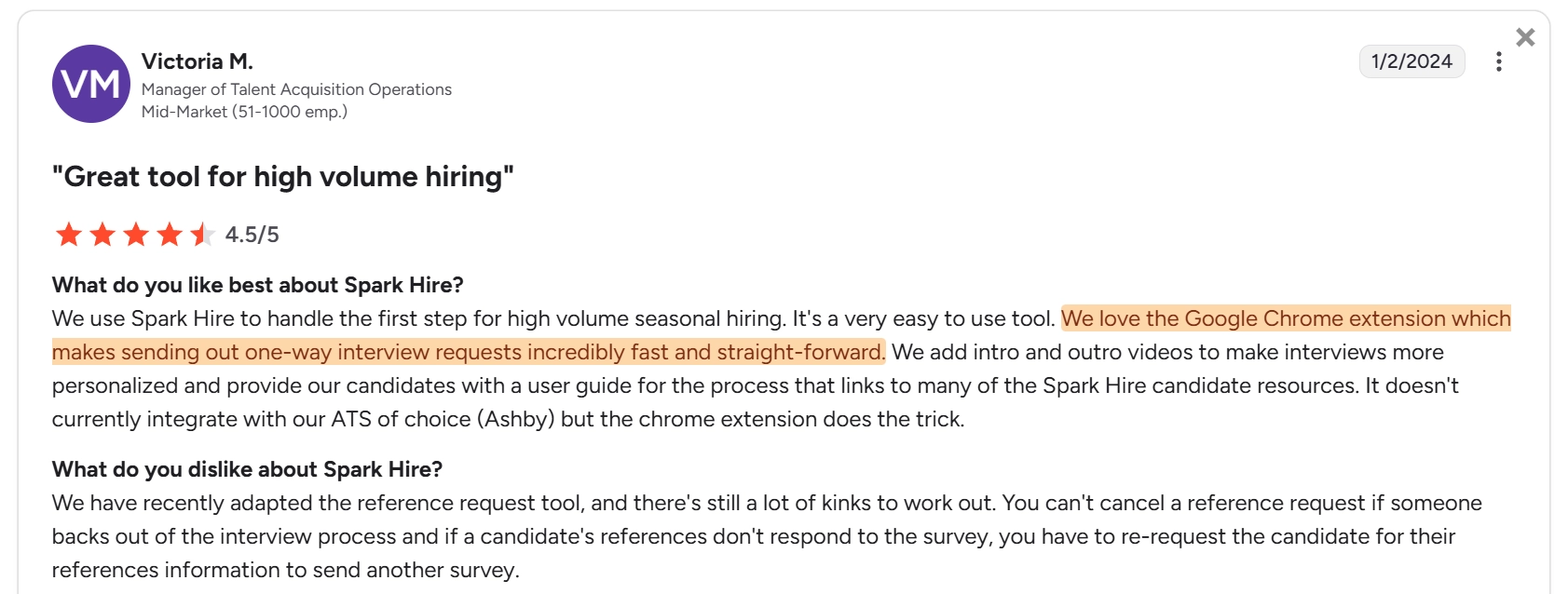
4. Customer support actually responds — and quickly
Spark Hire's support team shows up repeatedly in positive reviews, not just as a checkbox feature but as a genuine differentiator. One user noted: "The support line is the best. They are so responsive and helpful. I've never been disappointed by their assistance." Another highlighted the speed:
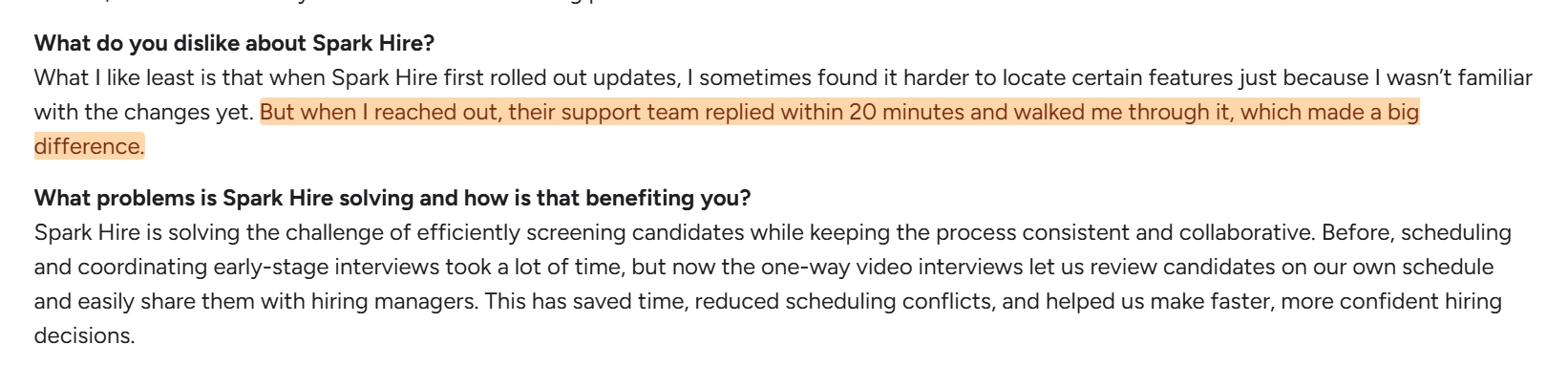
That level of responsiveness matters when you're in the middle of a hiring sprint and something breaks.
What Users Dislike About Spark Hire Features
1. ATS integrations sync status only; not the data you actually need
The 40+ ATS integrations Spark Hire advertises don't work the way most teams expect them to. Multiple G2 reviewers describe the same limitation: the integration tells your ATS that a candidate has completed an interview, but it doesn't flow ratings, scorecards, or detailed feedback back into your system.

You may find that you're still switching between systems and copy-pasting candidate information to keep your hiring team aligned. We discuss how this pain point affects Spark Hire pricing in more detail in the next section.
2. Video glitches create candidate drop-off and rework
Technical issues on the candidate side show up frequently enough in reviews that it's worth flagging before you commit. Users report that videos occasionally fail to upload properly, audio doesn't sync, or playback issues force candidates to re-record their interviews. One reviewer noted how video glitches limited candidate engagement.
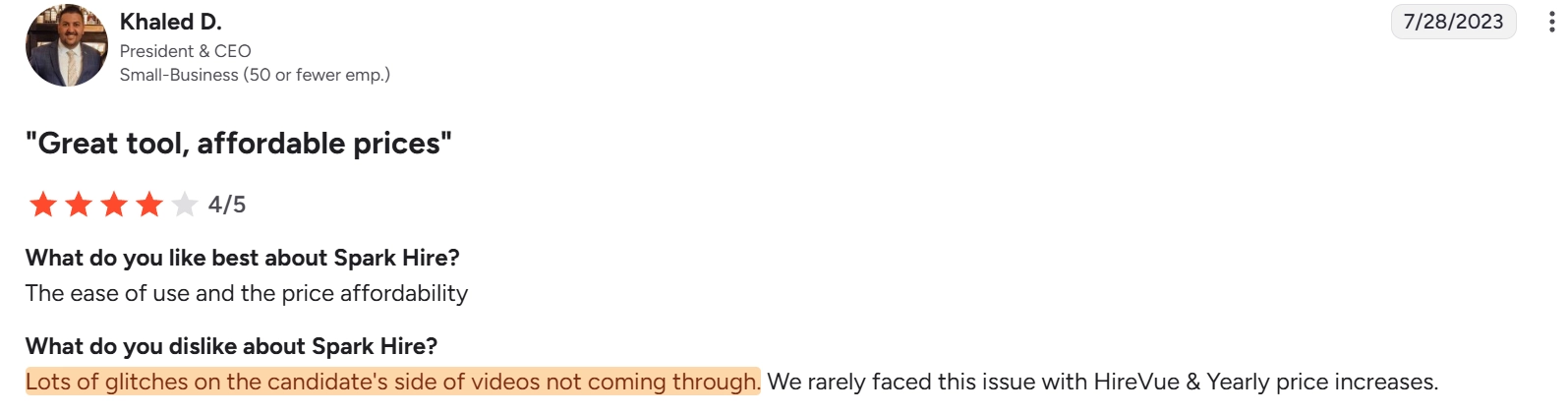
Another described the operational impact:
"Only downside to Sparkhire is that every so often the video interviews do not populate correctly and there could be either audio or video issues. I would suggest looking into this issue as it will prevent an applicant from having to interview twice."
When you're managing high-volume hiring, asking candidates to redo interviews because of platform issues damages your employer brand.
3. Question set creation is more complicated than the rest of the platform
While Spark Hire's overall interface is praised for being intuitive, the question set module is the exception. Multiple reviewers flag that creating and managing question sets takes longer than expected and has a steeper learning curve than the rest of the platform. One user described it clearly:


4. Limited customization for branding and candidate communication
You can upload your logo and apply a color scheme, but deeper customization can be limiting quickly. One reviewer highlighted specific gaps in customization.

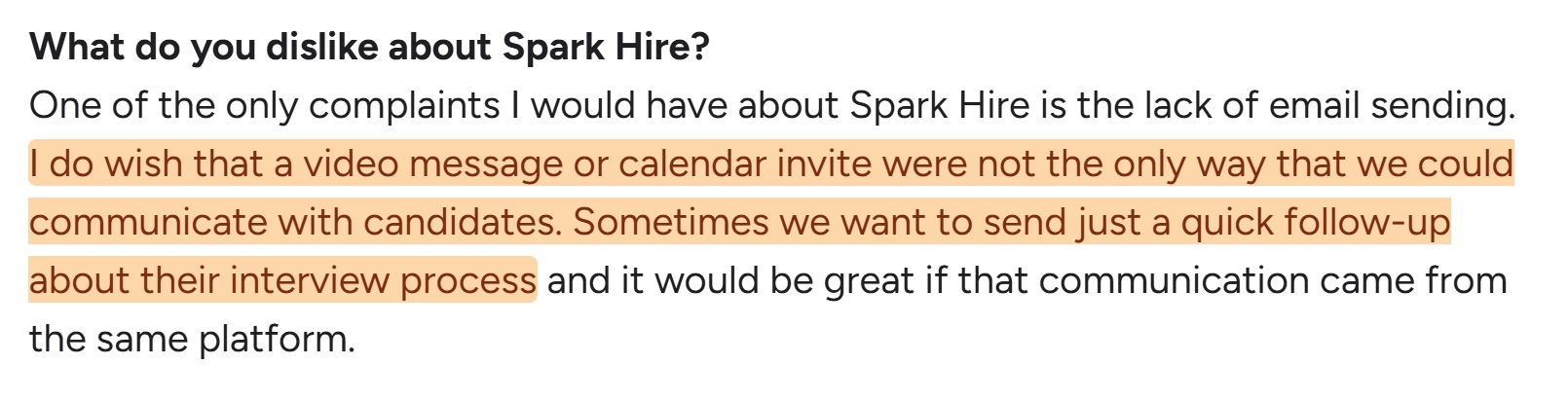
Another flagged a communication constraint:
Spark Hire Pricing Analysis: 5 Pros & Cons You Should Know
If you've already visited Spark Hire's pricing page and have an idea of how much it costs. But to understand how Spark Hire's pricing model fits the way your team hires, here are the 5 key factors you should consider:
- Spark Hire’s annual plan pays off when you’re hiring non-stop
- The all-in-one bundle makes a strong case if you're replacing a broken ATS
- The annual ATS subscription can be challenging if your hiring is seasonal
- Employee-count pricing limits growth even when hiring volume stays flat
- Video and behavioral assessments are separate products, and that cost adds up
Here’s the full Spark Hire pricing at a glance:
1. Spark Hire’s Annual plan pays off when you're hiring non-stop
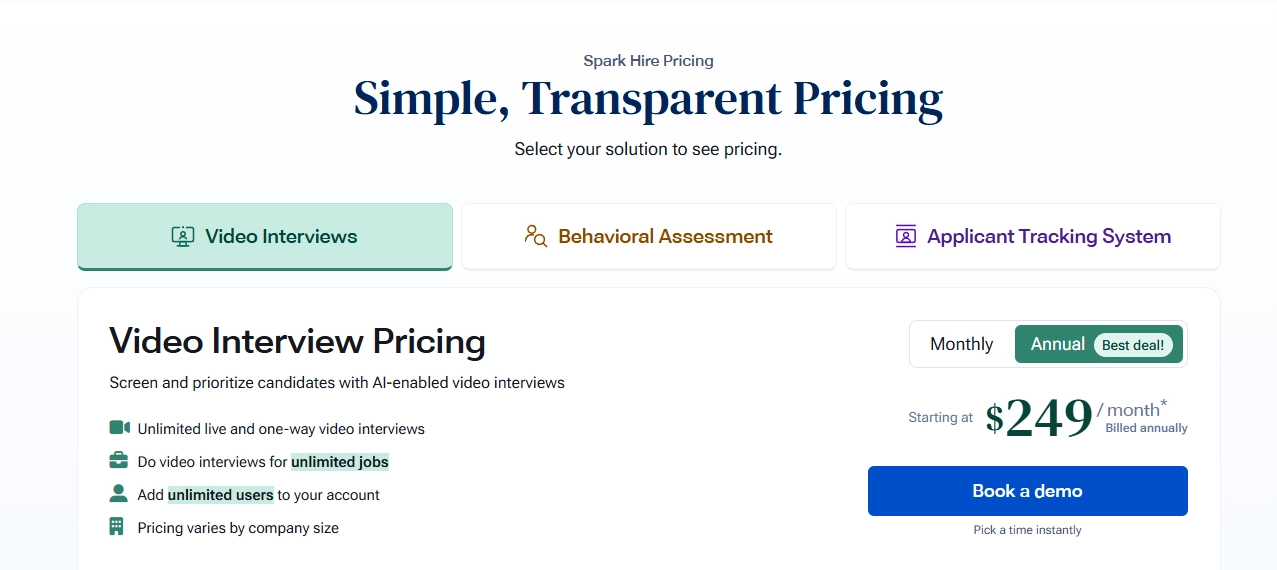
When you're hiring continuously, say you have 50+ hires per year across multiple roles and 5–15 open positions running, Spark Hire's pricing gives you the freedom to run a high-throughput hiring operation without paying per role or per seat.
That's because:
- Annual commitment is a non-issue: You hire year-round, so locking in 12 months isn't a risk — it's just how you operate. The 'what if we don't need this in 6 months?' anxiety doesn't apply when continuous recruiting is the job.
- Unlimited jobs means no per-role friction: Post 5, 10, or 20 roles simultaneously without a per-job fee ticking up in the background. When volume is constant, that adds up.
- Unlimited users means your whole hiring team can work together at no extra cost: Recruiters, hiring managers, department heads — everyone can access and review candidates across every open position without triggering a seat-based cost increase.
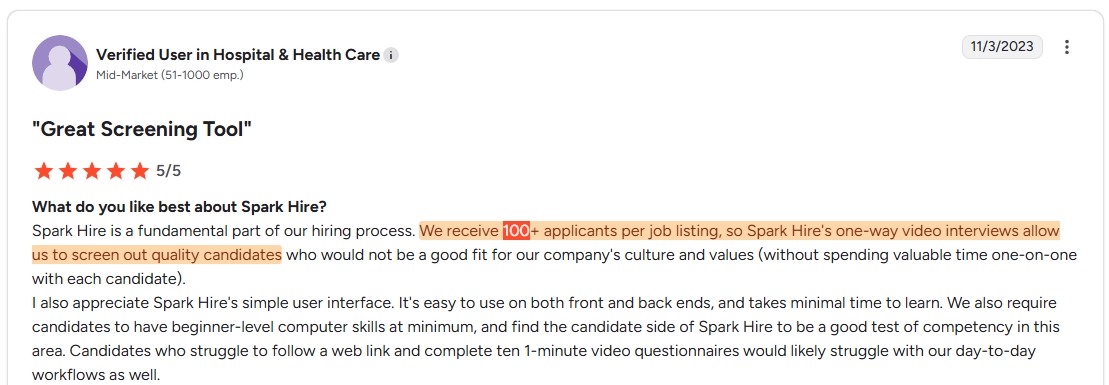
G2 user reviews reflect this kind of scale, with users doing in excess of 100+ completed per job listing, year over year.
However, there’s one concern:
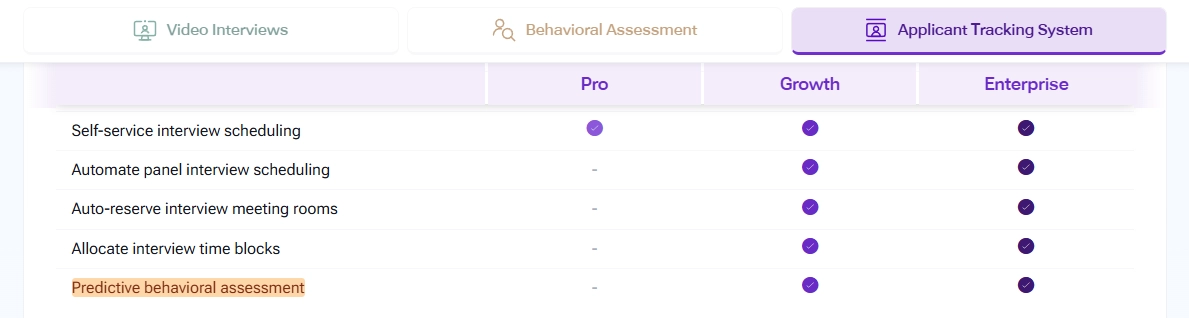
Spark Hire’s annual plan doesn't automatically give you a behavioral assessment
The Growth tier ($499/month) includes it. The Pro tier ($299/month) doesn't, despite being a full annual commitment with video interviews and ATS included.
That means, if you start on Pro and later decide behavioral screening matters for quality filtering (and at 50+ hires a year, it usually does), you're looking at an upgrade mid-contract.
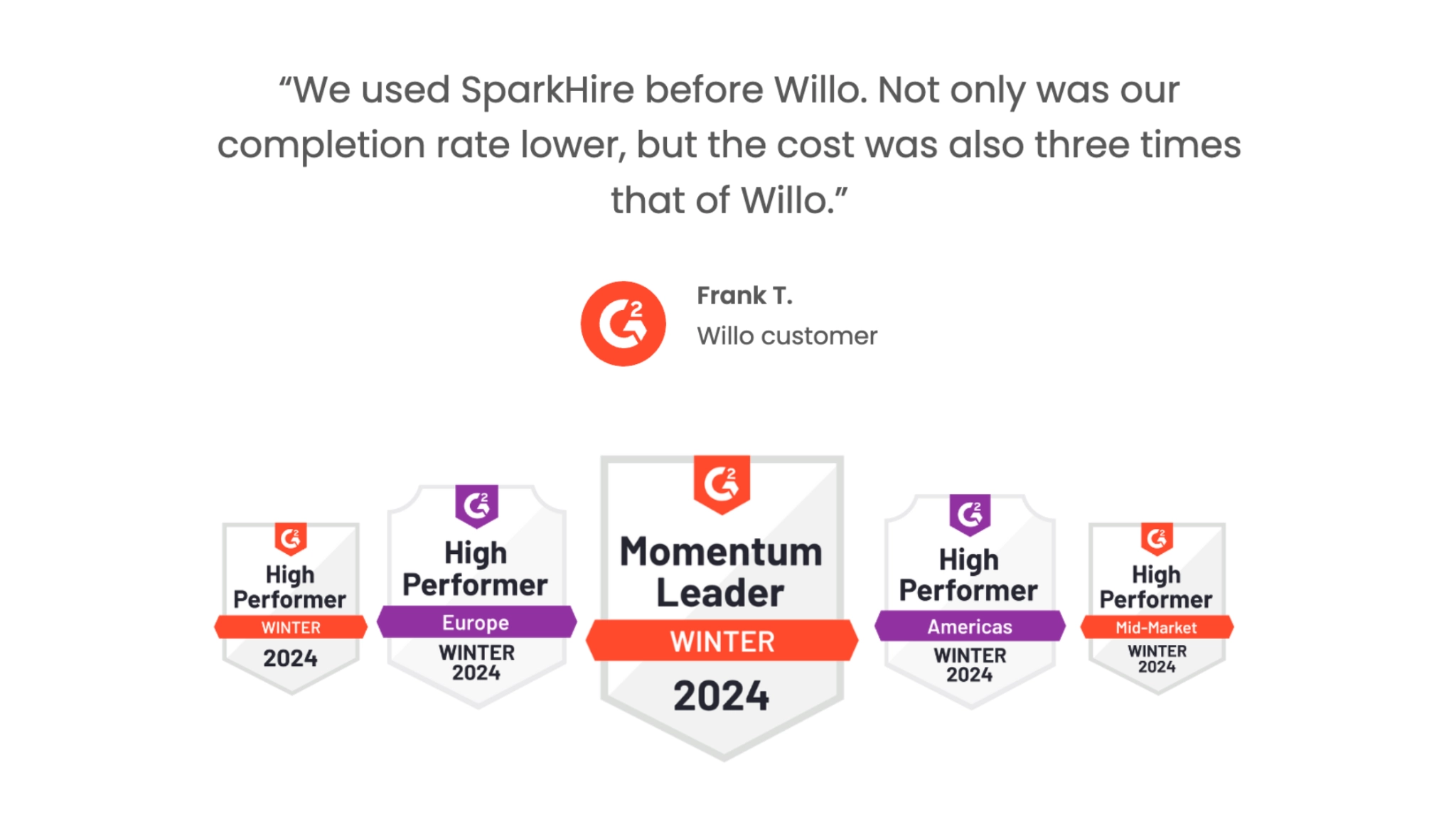
If you're hiring between 5 and 10 roles at a time and need comprehensive screening and assessment included from day one Willo's Scale plan ($389/month annually, $409/month monthly) bundles video, audio, multiple-choice assessment, and file upload in one assessment. Making it easy for you to evaluate candidates across multiple dimensions without buying separate products or managing tier upgrades.
Want to see how Willo works? Watch the demo video below:
2. The all-in-one bundle makes a strong case if you're replacing a broken ATS
If your current setup is spreadsheets, disconnected email threads, or an ATS your team actively works around, Spark Hire's bundled approach removes a category of problem.
The full ATS bundle (Recruit Pro or Growth) gives you everything in one place:
- Applicant tracking and pipeline management
- Video interviews (one-way + live)
- Behavioral assessment (Growth tier)
- AI resume review
- Collaboration and rating tools
Although Spark Hire’s native ATS provides a smoother hiring workflow, you may rethink the offer when you have an ATS you’d rather keep using. That’s because, even though Spark Hire integrates with 40+ ATS, G2 reviewers say the integration causes them more manual work. For most users, here’s what the typical day looks like:
- ✅ Status updates sync (Sent, In Progress, Complete)
- ✅ Link to view interview in Spark Hire
- ❌ Ratings/scorecards don't flow back to your ATS
- ❌ Video player doesn't embed in ATS interface
- ❌ You still switch systems to review and rate candidates

.webp)
As a result, some users report copy-pasting and manually moving candidate details from Spark Hire into their ATS.
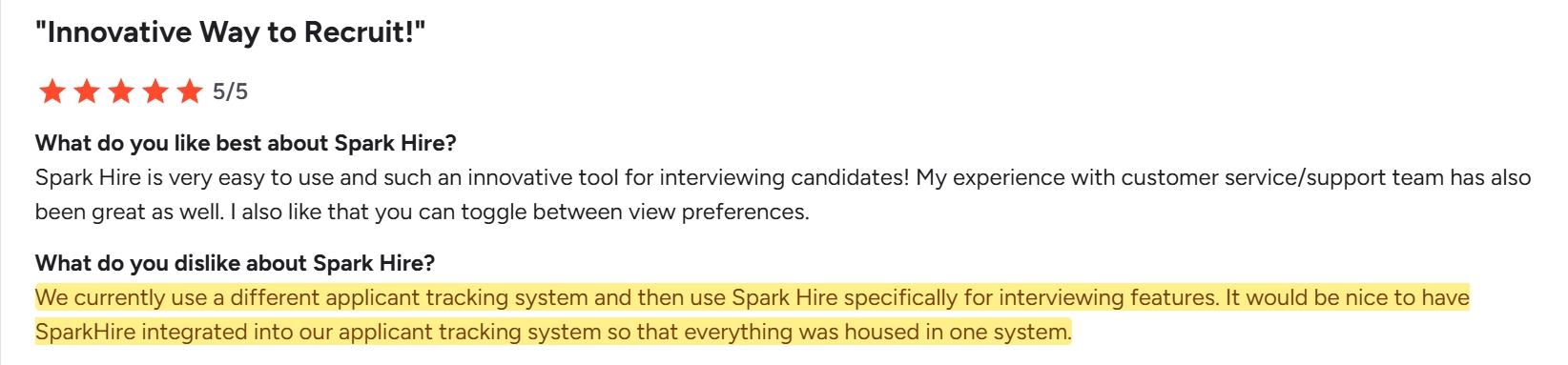
This is where Willo's integration approach gives you an advantage. It is built to work synchronously inside any of the popular ATS you might have:
- Create an assessment as a stage directly in Greenhouse or Lever
- Candidates complete it, and
- Results sync back automatically. That includes ratings, scorecards, video responses, all of it.
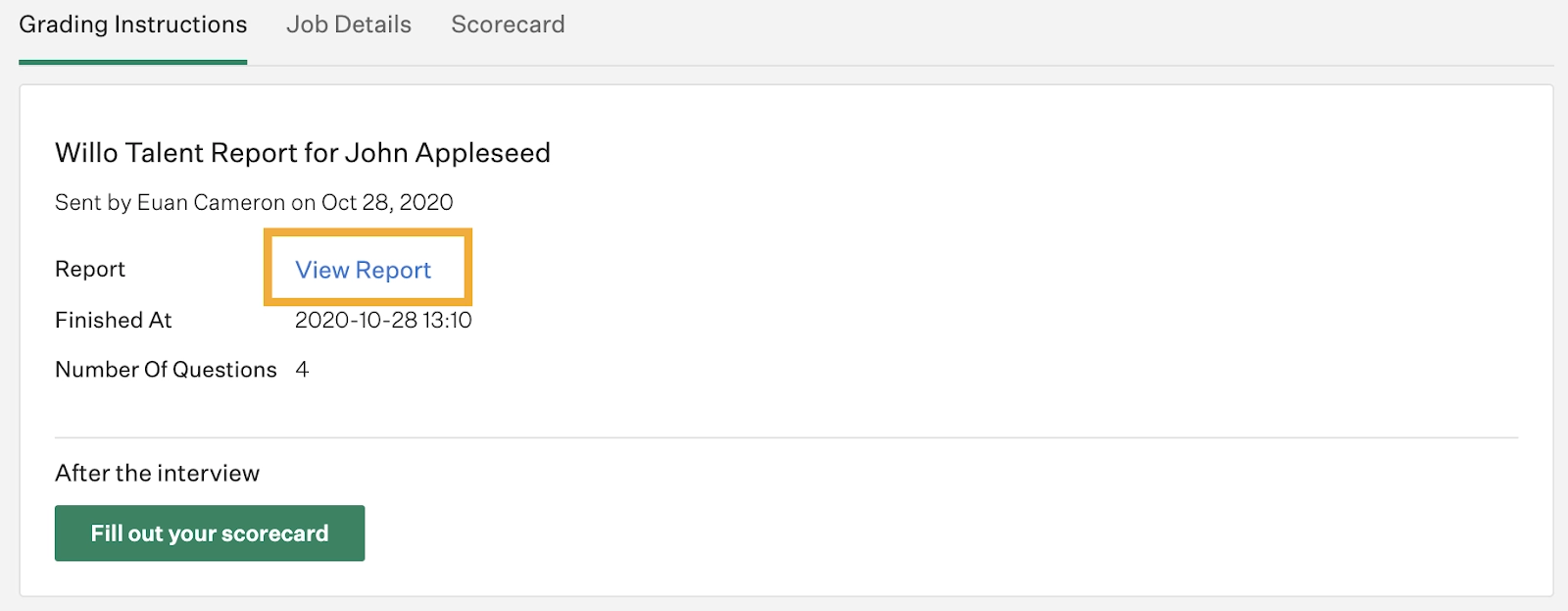
In fact, 97 hiring managers at Madison Reed reviewed candidates entirely within their existing Greenhouse workflow, with no per-seat fees and no system-switching for a lean HR team managing 95+ locations.
Candidate response rates doubled, time to fill dropped from 30+ days to approximately 15 days, and recruiters saved roughly 66% of the time previously spent on phone screens. The integration was the point.
3. The annual ATS lock-in is a real challenge if your hiring is seasonal
If your hiring is concentrated in specific months, the annual-only ATS requirement means you're paying 12 months for 3 or 4 months of active use. There is no monthly ATS option.
Sharon, an HR director, described the pain of paying for a full year when your team only uses Spark Hire for a few months.
"It would be helpful if the per-employee billing were more reasonable. Over half of our hiring managers only use the product 3 months out of the year, but we need to pay for a license year-round."
To be fair, Spark Hire does offer monthly plans for both Video Interviews and Behavioral Assessment as standalone products — so you're not forced into an annual commitment just to get started. A genuine entry point for teams that want to test async hiring before going all in.
However, monthly plans cap the number of jobs and users you can run simultaneously (exact thresholds aren't published), and interview downloads aren't available. It’s enough to get a real feel for the platform. Not enough to run a peak-season operation across six concurrent roles with twelve people reviewing candidates.
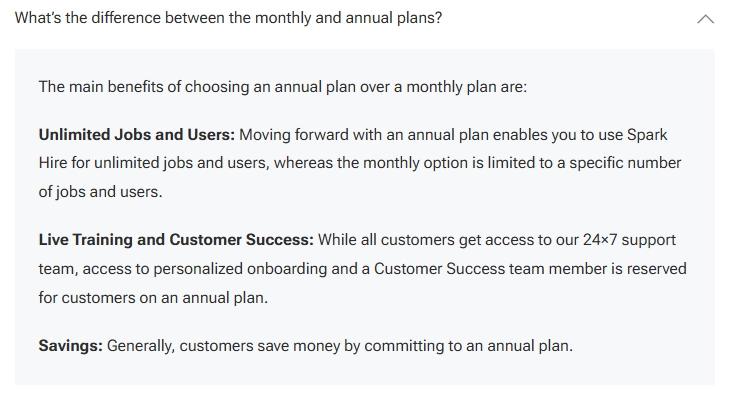
Willo's monthly plans carry the same features as the annual. The Scale plan ($409/month billed monthly) gives you 10 open assessments, up to 20 users, and full Willo Intelligence (AI transcription, summarization, benchmarking) — with no feature limitations. The only difference is price: annual billing saves you roughly 5%. No job caps, no penalty for pausing between seasons.
This approach helped EDF UK run graduate recruiting seasons with over 17,000 applications in a single cycle. Their previous platform was "cost-prohibitive for the value it offered". After switching to Willo, they cut recruiter admin time by 50% during peak season.
4. Employee-count pricing limits growth even when hiring volume stays flat
Spark Hire's ATS tiers are based on company size, not how much you use the platform:
- Recruit Pro: up to 200 employees — $299/month
- Recruit Growth: up to 500 employees — $499/month
- Recruit Enterprise: 500+ employees — custom
Additionally, the total cost for the video interview and behavioural assessment tiers varies by your company’s size.
.webp)
For stable, mature companies with predictable headcount, this is a non-issue. You know which tier you're in, you're not approaching the boundary, and the pricing is easy to budget.
But for companies in growth mode — say, 75 to 150 to 220 employees over 24 months — you're crossing tier thresholds and absorbing cost increases that have nothing to do with how much you're hiring. The billing grows independently of the value you're extracting.
Joel, a G2 reviewer, describes how the ATS pricing [formerly Comeet] can prohibit growth at a small to mid-market organization.
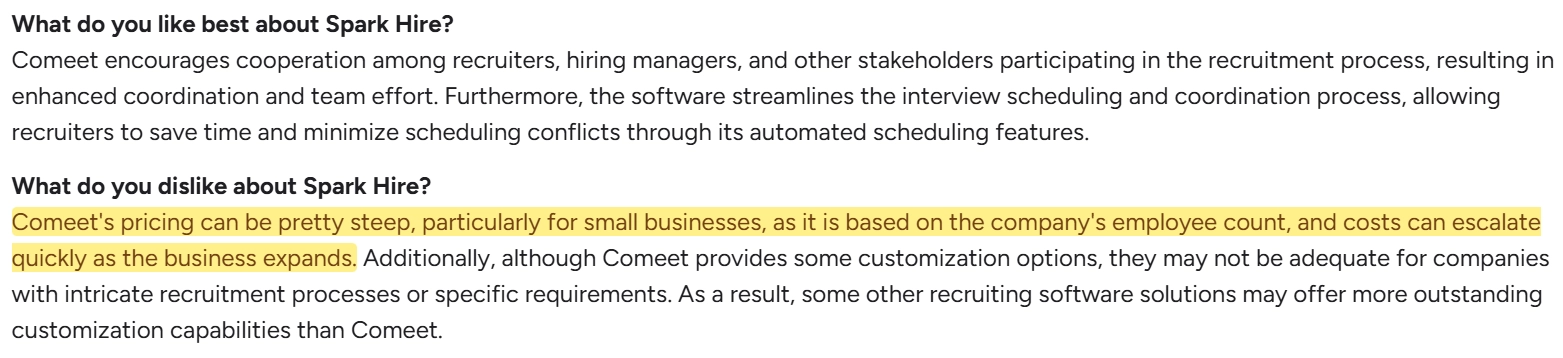
The headcount threshold creates a pricing transition point that’s worth planning for as your organization grows. A G2 reviewer noted:
.webp)
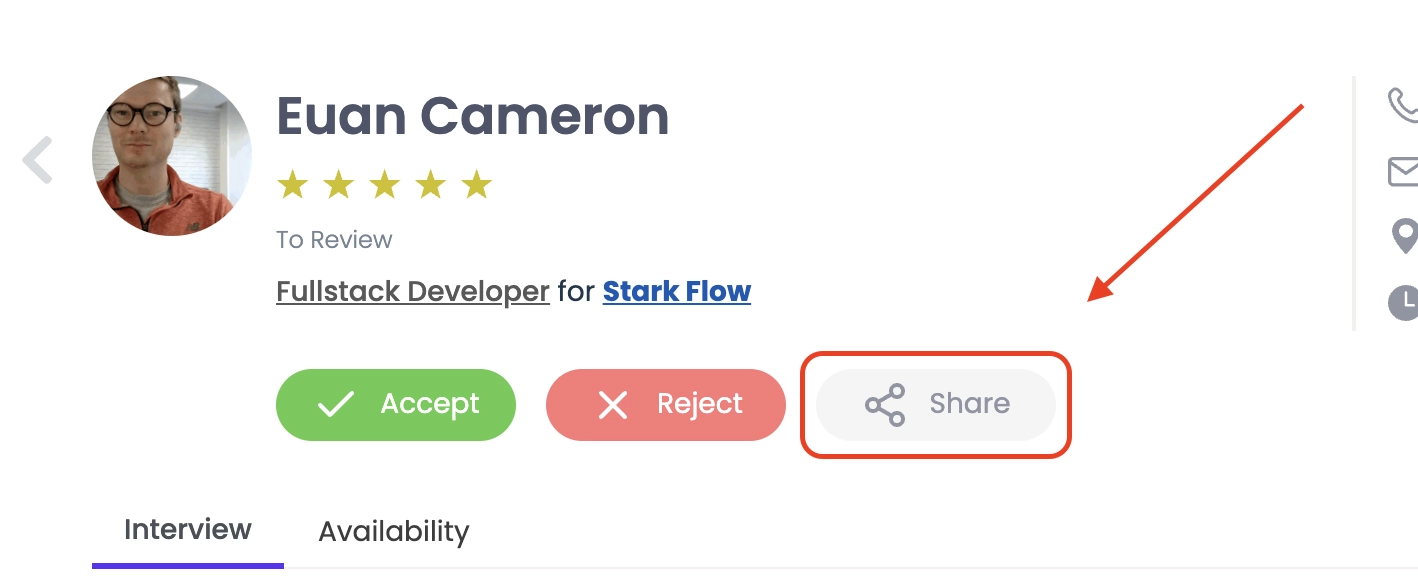
There's also a collaboration constraint that the employee-count model creates. Hiring a VP of Sales or a C-suite leader? You want the CEO involved, a board member or two, and three department heads weighing in on culture fit.
Adding those temporary reviewers can push against tier limits. That means you're either sharing credentials, manually emailing shareable links, or absorbing a tier upgrade for a one-off collaboration need.
With Willo, you don’t have to choose between growth and cost-efficiency. We price on open positions, not headcount.
- Growth: $209/month — 2 open assessments, up to 4 users
- Scale: $389/month — 10 open assessments, up to 20 users
- Enterprise: Custom — Unlimited assessments, unlimited users
Growing companies still get access to comprehensive candidate screening [video, audio, multi-choice, file uploads, etc], don't get penalized for headcount increases, and stakeholder collaboration doesn't require a billing conversation first. In fact, hiring managers and any other stakeholder can access candidate shortlists without an ATS login.
When Lunio needed to build an entire outbound sales function in 1.5 months, a post-Series-A sprint where budget predictability and speed both mattered, they turned to Willo. They successfully found the best-fit talent with:
- No annual commitment.
- Month-to-month flexibility.
- Teamtailor integration that eliminated manual work.
- Over £50,000 saved versus agency fees, and
- 30 minutes of recruiter time cut per candidate.
→ Read the full Lunio case study
5. Video and behavioral assessments are separate products, and that cost adds up
Spark Hire sells video interviews and behavioral assessments as separate products, each starting at $249/month on an annual billing plan. If you need both — which most hiring teams do across a mix of roles — you're looking at $498/month for two standalone products, or $499/month on the Growth ATS bundle.
Yet, there's also a question of what Spark Hire's behavioral assessment actually measures.
What Spark Hire's behavioral assessment actually measures
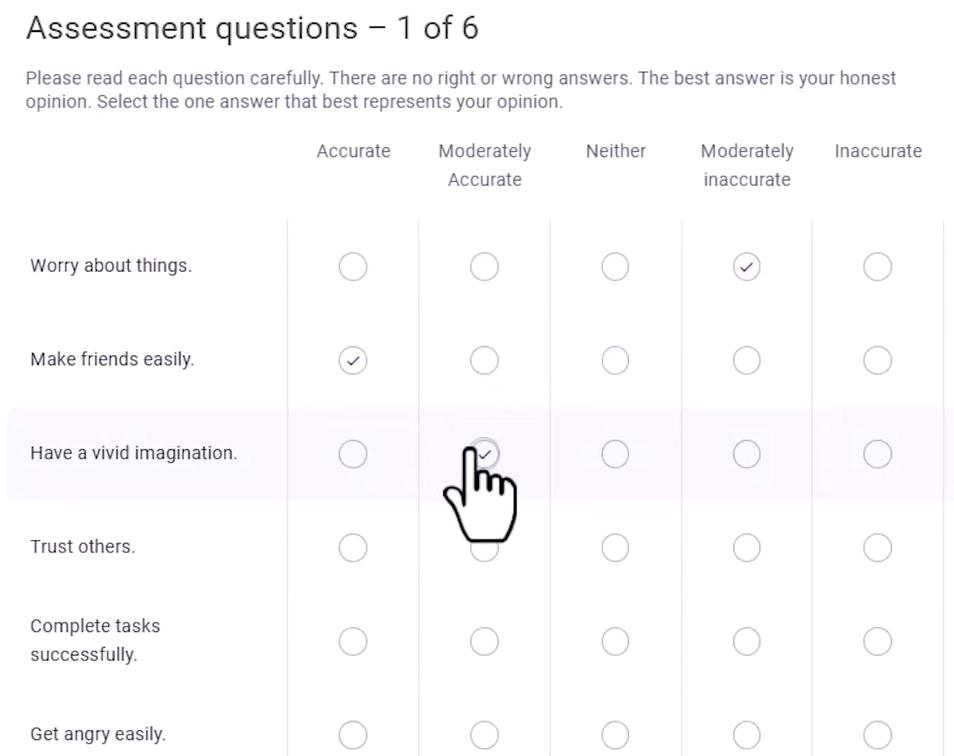
Spark Hire’s Predictive Behavioral Assessment uses a standardized format: 118 multiple-choice questions completed in approximately 20 minutes. The assessment generates fit scores against 50+ predefined profiles or custom configurations.
.webp)
The assessment format focuses on multiple-choice questions, which means:
- No open-ended responses where candidates explain reasoning or demonstrate communication style
- No video or audio components capturing presence, tone, or interpersonal dynamics
- No custom question creation for role-specific scenarios that your team designs
Behavioral assessment is only as good as the format it uses
Behavioral assessments can predict job success — but multiple-choice formats are only moderately reliable on their own, and work best when combined with other evaluation methods.
Part of the reason is transparency. Multiple-choice behavioral tests are easy to game. Not because candidates are being dishonest, but because the right answer is usually obvious. When a collaboration-heavy role asks whether someone prefers working alone or in teams, most people know what to say.
The problem compounds when you factor in how candidates prepare today. Talent leaders increasingly recognise that effective assessment requires authenticity checkpoints that distinguish genuine human capability from prepared or AI-assisted responses.
And with 76.6% of hiring teams now encountering AI-assisted applications, self-reported multiple-choice answers are an even thinner signal than they used to be. They measure what someone knows to say, not how they actually communicate, solve problems, or perform under pressure.
The only way to get both video and behavioral screening inside Spark Hire without buying two standalone products is the Growth ATS bundle at $499/month. Numerically, that's the better deal. But it comes with two conditions attached:
- You're taking on a full ATS; you may not need
- You're committing annually when you might need monthly flexibility
If you need to screen candidates more authentically — combining skill testing, behavioral assessment, and video without paying for three separate products — Willo's approach is worth understanding.
Willo doesn't separate video and behavioral into different products. You configure question types within a single assessment — video, audio, multiple-choice, file upload, text response — and adjust the mix by role.
A sales hire might get two video questions, three multiple-choice behavioral questions, and a sample proposal upload. An ops hire gets one video and five multiple-choice. Same plan, same price, configured to the role — and Willo Intelligence adds AI-powered transcription and analysis across all response types.
You're not buying three products to do one job.
Pricing Difference: Willo vs Spark Hire
We’ve examined how Spark Hire’s pricing aligns with different hiring conditions. Here’s how Willo’s pricing plan differs and what makes each approach unique.
Spark Hire’s pricing page shows how these elements combine across their product lineup. The modular approach means teams purchase exactly what they need, but it also means managing multiple products as hiring requirements expand.
Key takeaway: Neither tool’s pricing philosophy is inherently superior. The better fit depends on your hiring patterns, existing stack, and how much flexibility you need in your billing cycle.
Final Thoughts: Does Spark Hire’s Pricing & Features Fit Your Hiring Conditions?
Spark Hire’s pricing structure prioritizes annual commitment, employee headcount tiers, and modular product separation. These choices optimize for specific hiring scenarios while creating friction in others.
Spark Hire pricing works best when:
- You're replacing an ineffective ATS with an all-in-one system
- You hire year-round at high volume, and annual commitment is planning, not risk
- Your headcount is stable, and tier-crossing is unlikely
- A small, dedicated recruiting team handles all access needs
A Spark Hire alternative like Willo makes sense when:
- Hiring is seasonal, and paying 12 months for 3–4 months of use doesn't pencil out
- Stakeholder collaboration is distributed, and unlimited users matter
- You have an ATS you like and need complementary screening, not a replacement
- You want to mix assessment types by role without buying separate products
- You're testing before committing and need a monthly plan that isn't stripped down
If your hiring conditions match the pricing plans, the investment makes sense. If friction occurs in multiple areas, choose an alternative tool, such as Willo, that fits several organizations’ size and hiring needs.