- Six hiring stages make up a complete recruiting stack, and no single platform covers them all well, though some tools overlap.
- Willo enables candidate screening, Recruitee is a top ATS, Recruiterflow covers CRM and outreach, SeekOut aids sourcing, Criteria prioritizes skill assessments, and GoodTime handles scheduling.
- Add Willo to your hiring workflow if you need evidence beyond a CV before deciding who's worth a live interview.
If hiring quality candidates without sacrificing fairness or speed currently feels (near) impossible, check your recruiting tools. Most likely, you just need to re-evaluate your stack and add or replace some apps.
While there's no shortage of TA tools to invest in, not all of them reach their full potential. This explains why only 43% of 225 HR professionals in an HR.com survey rated their hiring stack as good or excellent.
In my experience, the tools themselves work fine: most teams that switch to Willo, or add it alongside what they already have, have used some of the most popular, feature-rich platforms on the market. The real gap is usually in the TA workflow itself — sourcing, screening, interview coordination, applicant tracking — not in the software meant to support it.
This guide splits the ideal recruiting stack into six hiring stages, highlights top tools for each, and shows where they overlap so you can avoid paying for software you don't need.
For a narrower shortlist, compare video screening tools for high-volume recruitment or recruiting software for small businesses.
What you’ll learn: The 6 key hiring jobs recruiting tech stacks support. Some of the best recruiting tools to help fill each of the gaps in your TA workflow, starting with Willo. Areas where various recruiting tasks and tools overlap, and how to navigate them.
A quick overview of the key hiring stages and top recruiting tools that support them
- Candidate screening: Willo, HireVue, Spark Hire
- ATS and pipeline management: Recruitee, Greenhouse, Lever, Ashby
- CRM and outreach: Recruiterflow, Bullhorn, Manatal
- Talent sourcing and discovery: SeekOut, Juicebox, LinkedIn Recruiter
- Skill assessment: Criteria, CodeSignal, HackerRank, TestGorilla
- Interview scheduling and coordination: GoodTime, Modernloop, Cronofy
Which factors determine the right recruiting tools for your team?
Figure out which parts of your process need dedicated support and which you can blend into one or two tools, then choose accordingly. An ATS could handle handling basic scheduling. A recruiting CRM may also cover outreach and pipeline management.
Each of these eight factors changes what “right” means for your exact context, so consider them before touching your existing systems:
- Goal or bottleneck: Which of the six hiring stages are you struggling with right now; is it talent sourcing, candidate screening, or something else?
- Existing software and assessments: What system would you be replacing or adding alongside?
- Roles and evidence needed: Do the open roles need highly structured evidence (screening, assessment), faster time-to-hire, or a balance of both?
- Hiring frequency and applicant load: Occasional, low-volume hiring needs a different setup than always-on, high-volume recruitment; are you doing one or both?
- Team and reviewer capacity: Who actually reviews candidates, and how much time do they realistically have?
- Candidate requirements: Do you need multi-language support, accessibility, or regulated-industry documentation features to reach your target candidates?
- Stance on AI: Do you want AI to suggest and summarize with a human deciding, or are you comfortable with more automated scoring?
- Budget and implementation capacity: Which works better for you, monthly, pausable plans or annual contracts, and how fast do you need to go live?
If you’re a lean team moving off Google Sheets and Forms or hiring a new internship cohort, a mix of an ATS and screening tool may serve you better than a full-scale enterprise setup. Review the conditions above and make a list of the realistic hiring stack that fits your needs.
The 6 best recruiting tools by hiring job
A tool stack built around feature or star ratings tends to duplicate coverage in some places and leave real gaps in others. Build around the actual jobs your hiring process demands, from sourcing and discovery to interview scheduling.
1. Willo
Best for: Candidate screening
Manual phone screens are expensive at scale, and resume-only reviews miss qualified candidates who don’t present well on paper. Willo is an AI-assisted candidate screening tool that lets you run structured one-way interviews, set your own hiring criteria, collect rich candidate context, and decide who to progress with confidence.
Key features
Structured questions
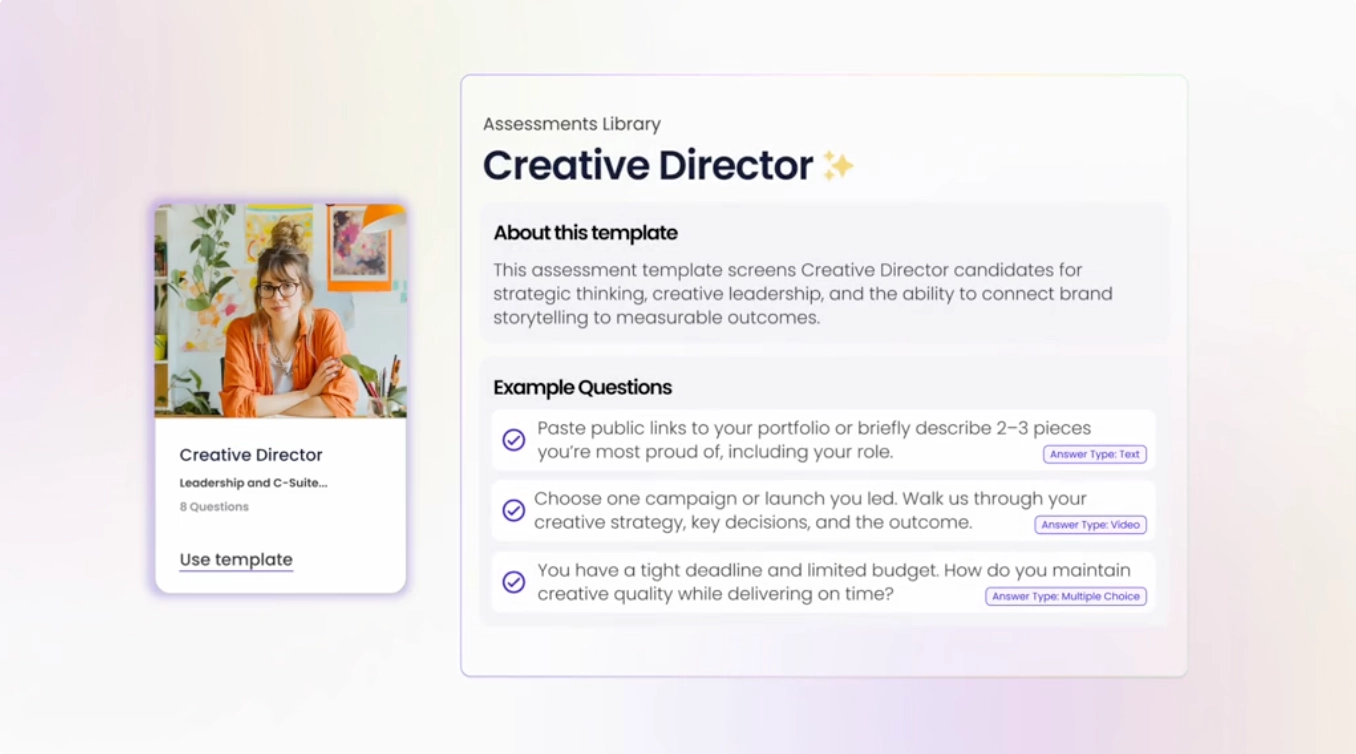
Willo’s interview question generator helps you draft screening questions around role-relevant skills and job requirements. You can also explore questions suggested within the app or templates from Willo’s assessment library and tweak them as needed for high-volume hiring.
Rich candidate insights
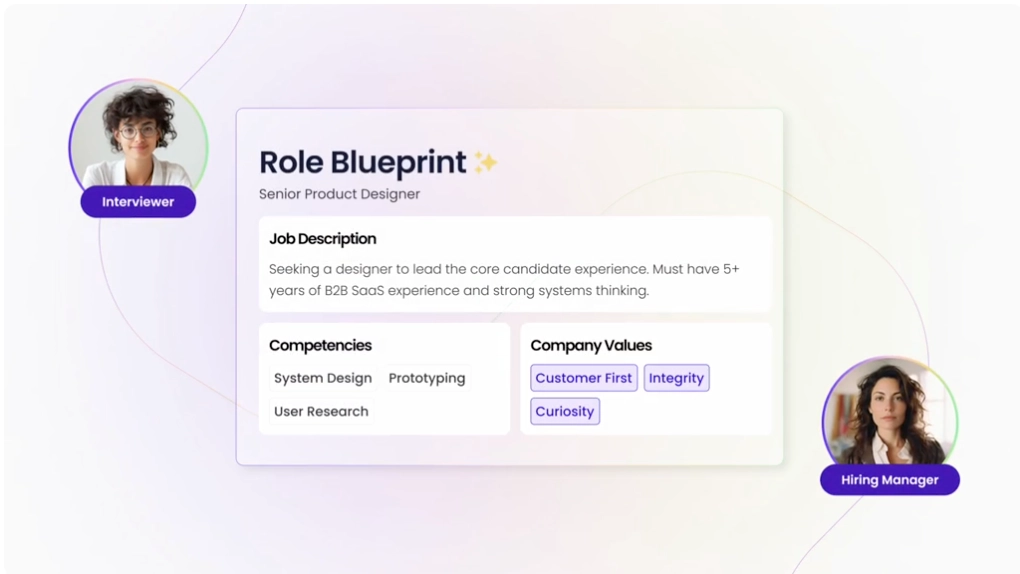
Willo’s AI turns candidate responses into transcripts, summaries, and key insights, so you can review the evidence without watching every interview from start to finish. It also scores responses against your predefined hiring Blueprint so you can create a trustworthy shortlist and make the final call on who to advance.
Accessible candidate experience
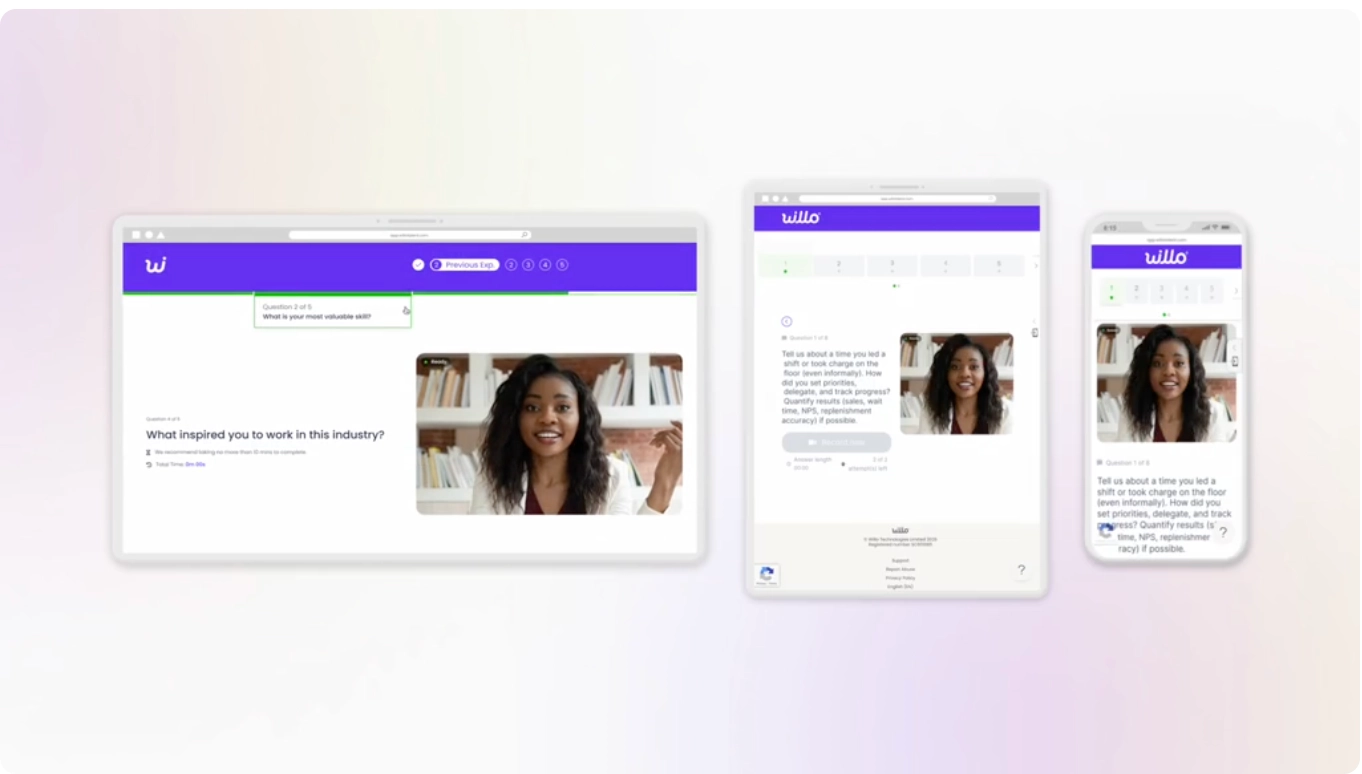
Once you send out interview links, candidates can respond on their own time, via whatever format you choose - video, audio, text, file uploads, or a mix. For accessibility, Willo works across mobile and desktop devices and supports 18+ languages.
With Willo’s inclusive, candidate-first approach, EDF successfully personalized their graduate hiring experience, cutting recruiter admin time by 50% while enabling neurodiverse applicants to respond under less pressure.
Enterprise-grade security and compliance
Willo uses enterprise-grade security measures and is ISO 27001 certified and GDPR compliant. It also encrypts and protects candidate data throughout the process.

Native integrations and API/third-party connections
Willo connects natively with popular ATS and recruiting platforms, so candidate data can flow to and from the systems your team already uses. It also offers API and Zapier integrations for more customized workflows.


Pros
- Cuts down screening time: Recruiters can review candidate responses and insights without sitting through every interview.
- Provides richer candidate context beyond resumes: Video, audio, and text responses give you a better sense of candidates than a CV alone.
- Flexible, customizable screening workflows: Build assessments and interviews around each role's skills and requirements.
- Fits into your existing stack: Native ATS integrations, API access, and Zapier let you easily connect Willo to your existing recruiting systems.
- Final decisions stay human: Willo’s AI can surface relevant evidence, but the hiring team still decides who to hire.
Cons
- Not a live interview tool: Willo is built for asynchronous screening, so you might still need another tool for live interviews.
- AI insights aren’t a substitute for judgment: Willo helps organize and assess responses, but you still need to review the evidence before deciding.
Pricing
Willo offers two main pricing tiers:
- Willo Lite: $59/live role, ideal for occasional recruiting cycles
- Willo Enterprise: Starts at $3,799/year, perfect for teams that are always recruiting
Willo also gives a 50% discount to verified non-profits and a 14-day free trial if you’d like to test the platform before committing.
Why teams choose it: Willo lets hiring teams screen candidates faster and more confidently, with AI handling transcripts, summaries, and insights, while human recruiters make final calls.
Willo alternatives for candidate screening
- HireVue: For enterprise teams with large budgets and high-volume hiring needs.
- Spark Hire: For lean teams who want a video interviewing tool with a built-in ATS.
- Hireflix: For one-way video interviews only.
2. Recruitee
Best for: ATS and pipeline management
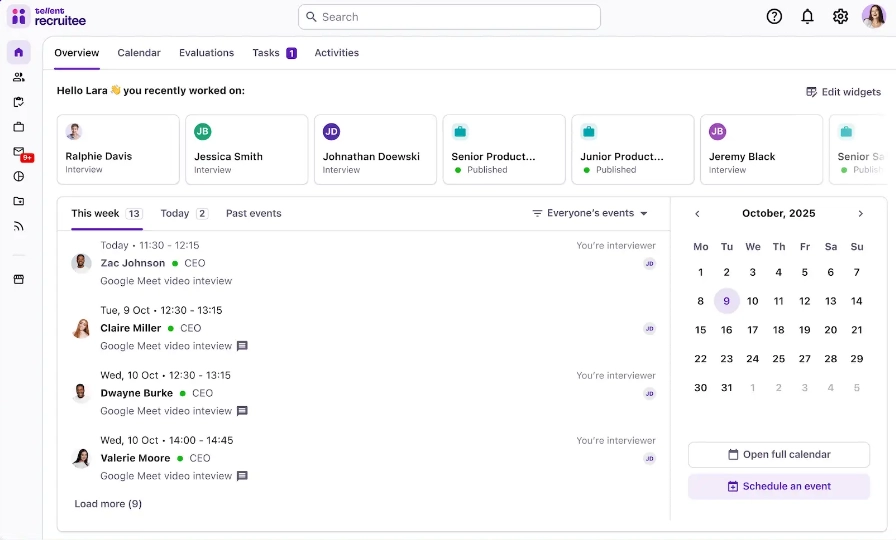
Recruitee, now known as Tellent Recruitee, is an AI-powered, customizable ATS that lets your team work together in one space so every candidate moves through the hiring pipeline seamlessly. It also supports other recruiting tasks like talent sourcing, onboarding, and reporting.
If your applicants live in a spreadsheet, email inbox, or applicant tracking module with weak integrations, an ATS like Recruitee is just what you need. It keeps strong candidates from getting lost between stages, while recruiters and hiring managers get a single source of truth for who's in the pipeline.
Key features
- Customizable hiring pipelines let you set up stages around the way your team hires.
- Collaborative hiring keeps recruiters and hiring managers working from the same candidate information.
- Candidate sourcing brings applicants in from different channels, all within the same system.
- Automated workflows for routine tasks like candidate communication and interview scheduling.
- Reporting and analytics give you a clearer view of pipeline activity, candidate drop-off, and hiring progress.
User reviews
Pros
- Good for growing teams because it adds structure without the complexity of a heavyweight ATS.
- Flexible enough to support different hiring processes for different roles.
- Works as a central hub for your recruiting workflow.
Cons
- Sourcing isn’t its strongest suit for teams doing heavy outbound recruiting.
- Some workflows may require third-party integrations.
- It can be too much for small teams with simple hiring needs.
Pricing
Recruitee doesn’t publicly disclose its pricing. Plans are based on your company size and billing period, with Start, Advance, and Optimize currently available.
Why teams choose it: It’s a central place for recruiting, collaboration, and pipeline management without the complexity of a heavyweight ATS.
Recruitee alternatives for ATS and pipeline management
The ATS you already use, or any of our top picks:
- Greenhouse, Lever, or Ashby: For in-house teams
- Zoho Recruit: For staffing agencies
3. Recruiterflow
Best for: CRM and outreach
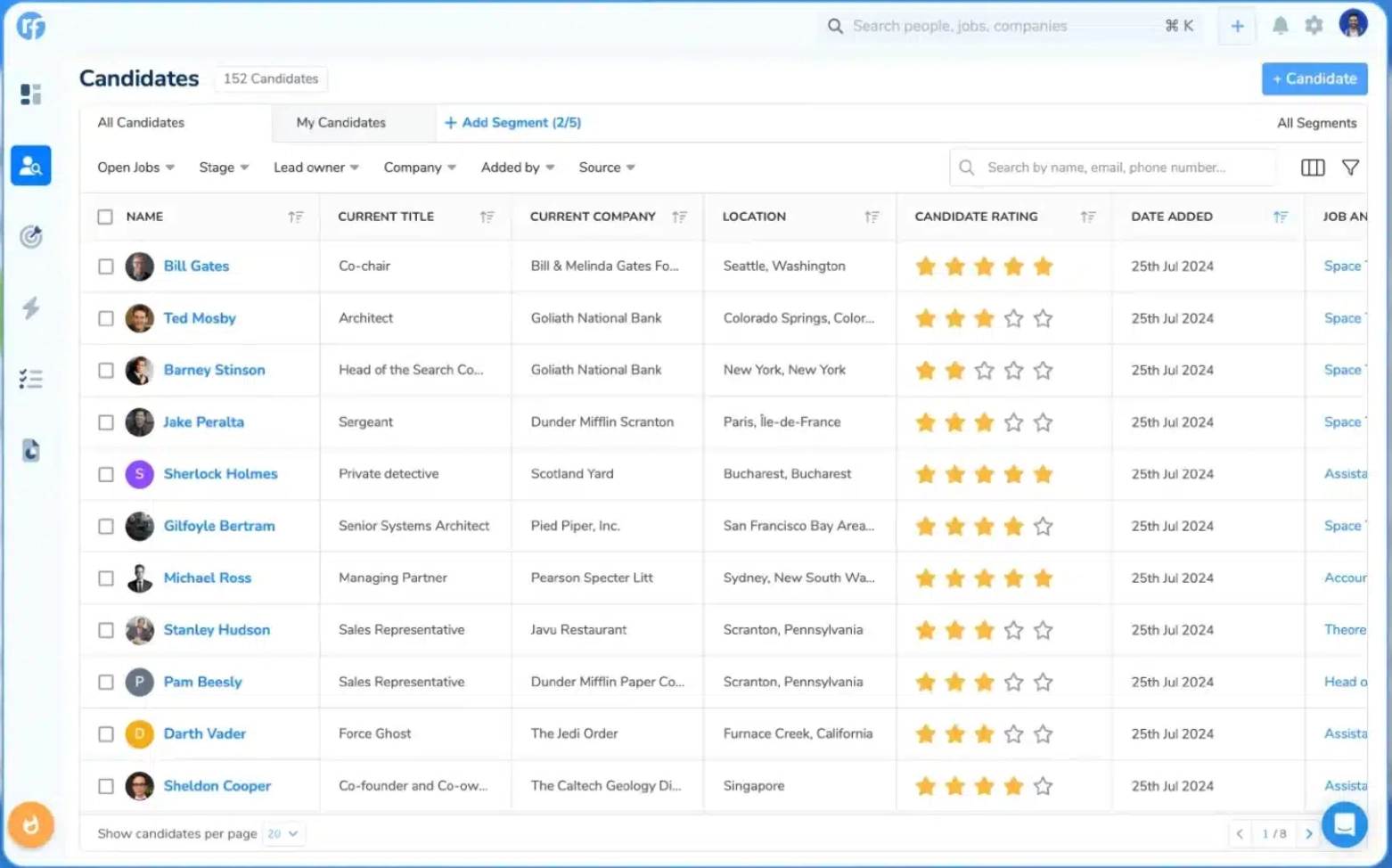
Recruiterflow is an AI-native CRM built for executive search firms, recruiting agencies, and staffing companies. It also doubles as an ATS tool, with an AI recruiting agent that sources candidates from internal databases and external talent networks, then runs multi-channel outreach sequences.
Tools like Recruiterflow ensure every search doesn’t start from zero. Candidates who were a near-miss for one role, or who weren't ready to move, don’t just disappear. Instead, they stay warm ahead of the next relevant opening.
Key features
- Searches your existing database and external talent networks for potential candidates.
- Outreach can run across multiple channels, with automatic follow-ups.
- Past candidates remain searchable and can resurface when a new role makes sense.
- The CRM and ATS sit together, keeping candidate records and hiring activity in one place.
- Recruiting analytics give you a clearer view of search performance, outreach, and candidate drop-off.
User reviews
Pros
- Built for agencies juggling multiple searches, candidates, and clients.
- Keeps your existing candidate pool useful for future searches.
- Combines CRM and ATS functions in one system.
Cons
- Its agency-first design doesn’t suit in-house teams.
- Teams filling only a few roles a year may not need its broader features.
- You’ll likely need another tool for advanced candidate assessments.
Pricing
Recruiterflow’s Platform plan costs $149 per user/month when billed monthly, or $119 per user/month with annual billing. The AIRA plan uses custom pricing and adds Recruiterflow’s suite of AI agents.
Why teams choose it: It keeps candidate relationships and search management in one place, especially for agencies juggling multiple roles.
Recruiterflow alternatives for CRM and outreach
The CRM you already use, or any of our top picks:
- Bullhorn or Manatal: For staffing agencies
- SmartRecruiters or Workable: For in-house teams
4. SeekOut
Best for: Talent sourcing and discovery
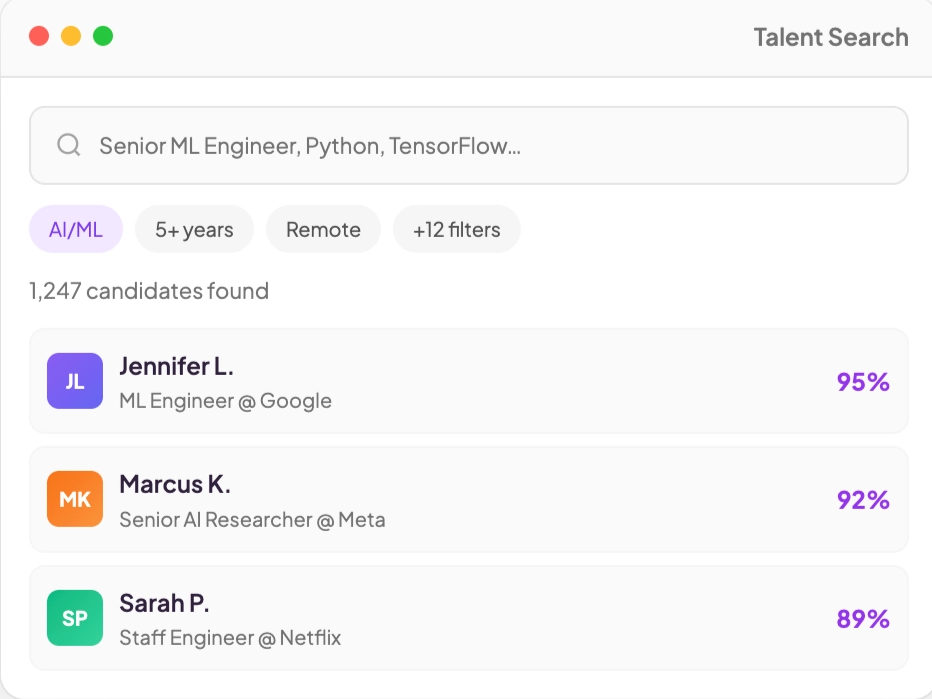
SeekOut is an agentic AI recruiting platform that sources candidates from a pool of over 1 billion candidate profiles. The tool is especially useful when you’re filling roles with generally passive or hard-to-find candidates (e.g., people with specialized technical skills, senior hires, thin local talent pools).
With SeekOut, your hiring pipeline doesn’t depend entirely on who happens to apply, so if attracting the right talent is bottlenecking your time-to-hire, it’s worth exploring.
Key features
- Natural-language search makes it easier to find the right candidates without relying on complicated Boolean strings.
- Candidate profiles offer more context on a person’s experience and background than a standard resume search.
- Past candidates remain searchable alongside new prospects, making it easier to revisit people who weren’t right the first time.
- For teams handling several roles, separate projects keep each search organized.
- Recruiters can handle sourcing and outreach in the same platform instead of jumping between tools.
User reviews
Pros
- Strong for passive candidates, especially in senior and specialized searches.
- Useful when the local or industry talent pool is limited.
- The project setup keeps multiple searches organized.
Cons
- You’ll still need an ATS and other tools for later hiring stages.
- Smaller teams hiring for common roles may not need such a large talent pool.
- Finding candidates is only half the job; recruiters still need to engage them.
Pricing
SeekOut’s Recruit Core plan starts at $179/month when billed monthly, or $149/month with annual billing. Larger teams can choose custom-priced plans with additional sourcing, ATS integration, analytics, and support features.
Why teams choose it: It gives recruiters access to a deep talent pool and powerful search for hard-to-find and passive candidates.
SeekOut alternatives for talent sourcing and discovery
- Juicebox: For 24/7, high-quality AI talent sourcing
- LinkedIn Recruiter: For sourcing directly from the LinkedIn social network
5. Criteria Corp
Best for: Skill assessment
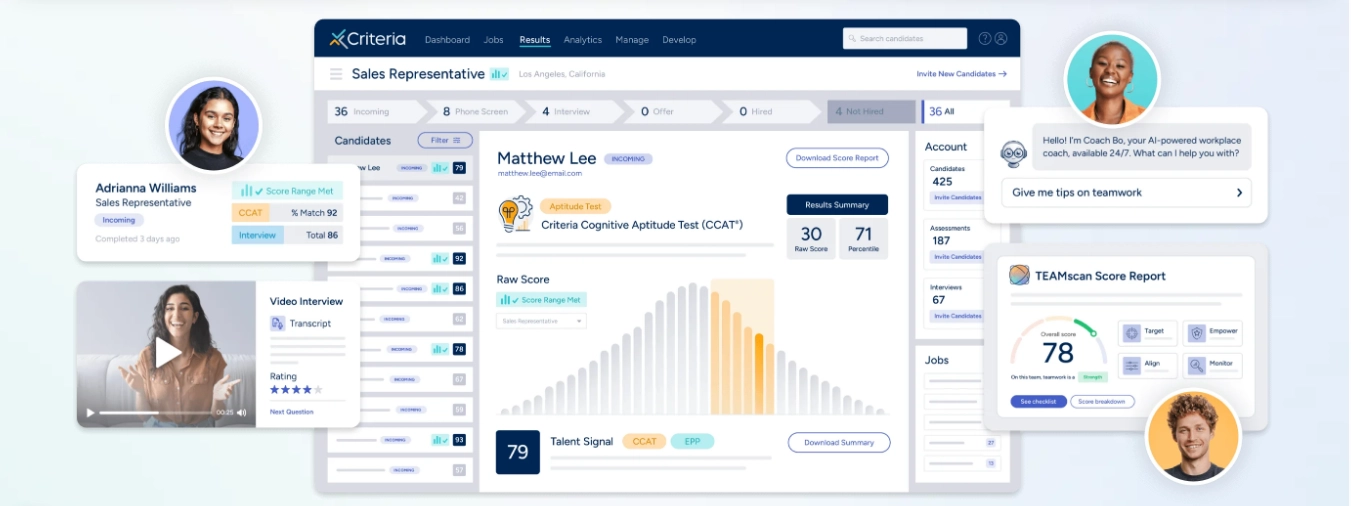
Criteria Corp is a talent signal platform for conducting skill assessments, from cognitive aptitude tests to personality and game-based evaluation.
While interviews are hard to standardize and easy to challenge if a hire doesn't work out, combining them with science-backed tests on Criteria Corp produces richer candidate context and stronger shortlists. This way, your hiring decisions don't rely on interview impressions alone.
Key features
- Cognitive assessments cover problem-solving, critical thinking, learning ability, and more.
- Personality tests add context around how candidates work, communicate, and approach different situations.
- Role-specific tests cover customer service, sales, technical, and other professional skills.
- Game-based assessments offer a more interactive way to measure cognitive and behavioral traits.
- Assessment results give hiring teams structured data to consider alongside resumes and interviews.
User reviews
Pros
- Gives hiring teams more evidence to consider alongside resumes and interviews.
- Covers cognitive, behavioral, and job-specific skills across different roles.
- Game-based assessments provide an interactive way to evaluate candidates.
Cons
- A portfolio or work sample may be more useful for some roles.
- Assessments add another step to the hiring process.
- The wrong test can produce data without answering the hiring question.
Pricing
Criteria Corp doesn’t publish fixed prices. You’ll need to request a quote for exact pricing.
Why teams choose it: It gives hiring teams standardized, science-backed assessments to support better-informed hiring decisions.
Criteria Corp alternatives for skill assessment
- CodeSignal or HackerRank: For coding assessments and technical hiring
- TestGorilla: For both standard and technical role assessments
- Willo: For flexible, untemplated assessments
6. GoodTime
Best for: Interview scheduling and coordination
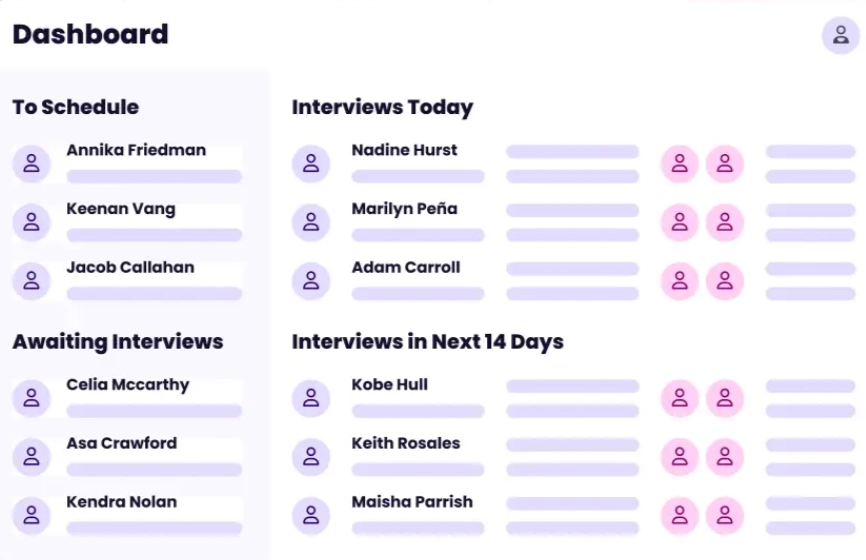
GoodTime is enterprise hiring software that solves tough interview-coordination problems and gives recruiters and candidates a smoother experience. Interviewers save hours each week on calendar back-and-forth, and strong candidates don’t drop off waiting to hear back about interview timing.
The app also delivers AI-powered insights and recommendations after each completed interview, helping hiring teams identify and advance top applicants.
Key features
- Automates the back-and-forth involved in finding interview times.
- Provides a single platform for managing multiple interviewers, stages, and calendars.
- Smart matching helps pair candidates with the right interviewers based on availability and hiring needs.
- Candidates can pick an available time themselves instead of exchanging emails with recruiters.
- AI-powered insights and recommendations give hiring teams more structured candidate context.
User review
Pros
- Good for complex interview loops involving multiple interviewers and stages.
- Lets candidates choose available slots, reducing scheduling back-and-forth.
- Helps teams coordinate interviewer availability without endless calendar juggling.
Cons
- Teams with simple interviews may not need its deeper scheduling features.
- You’ll still need other tools for sourcing, screening, and assessments.
- Smaller teams may not get much value from its advanced features.
Pricing
GoodTime doesn’t publish fixed pricing. Its pricing is based on the number of candidates you hire annually. You’ll need to request a custom quote.
Why teams choose it: It makes interview scheduling faster and cuts down on calendar back-and-forth, especially for high-volume hiring.
GoodTime alternatives for interview scheduling and coordination
- Modernloop: For small, high-volume recruiting teams
- Cronofy: For teams already using Cronofy for other use cases like medical scheduling or client engagement
Build your recruiting stack around workflow gaps
The trick to building an effective recruiting stack is matching software to the job your current process doesn't yet cover. Start with the gap.
For example, struggling to find candidates points to sourcing. Applications piling up faster than your team can review them points to screening. And good candidates getting lost between stages points to your ATS pipeline.
Once you know the gap, matching it to a tool comes down to the scenario you're actually solving for:
- If your team or budget is limited but hiring volume isn’t, start lean. An ATS alone covers most of what a small team needs for a pipeline, and depending on which you prefer, Recruitee or any of its alternatives work. Add anything else, like dedicated candidate sourcing or interview scheduling, once it becomes a real blocker, not before.
- If you can't find enough of the right candidates in the first place — passive talent, niche technical skills, thin local pools — that's a sourcing problem your ATS can't solve on its own. SeekOut, Juicebox, and LinkedIn Recruiter are all built specifically to reach candidates before they apply, so they’re worth exploring to layer on.
- If your screening needs are simple and low-volume, you may not need a dedicated screening platform. A simple, low-volume screening tool like Hireflix or even manual phone screens can work. Step up to something more robust once volume grows or you need evidence-backed, structured decisions rather than a quick pass.
- If you're handling frontline, high-volume, or cohort-based hiring (internships, campus recruiting, seasonal roles), pair an ATS or CRM with AI-assisted screening via Willo or Spark Hire. Manual phone screens don't scale, but async interviewing keeps review manageable without losing evidence quality. For cohorts specifically, getting both your ATS/CRM and screening layer live before applicants start arriving keeps things more organized.
- If you already have a working ATS and CRM but screening is still largely manual, don't replace your system of record. Add a screening tool (like Willo or HireVue) with native integrations to the tool you already use. The gap is evidence before the live interview, not a new pipeline tool.
- If interview coordination itself is the bottleneck, say due to multi-stakeholder panels, high interview volume, or constant calendar back-and-forth, that's a dedicated scheduling job an ATS usually doesn't cover well at scale. GoodTime, Modernloop, and Cronofy are built for exactly that.
- If your team already runs internal assessments that work well, keep them. You can bring in Criteria, coding-first tools like CodeSignal or HackerRank, or TestGorilla for a mix of both standard and technical hires, but that should only be for roles your current assessment wasn't built for, so you don’t end up running two overlapping tools.
- If you want AI-assisted screening but need a human to make the final call, Willo does exactly that. It lets your team set the hiring Blueprint, scorecard, and questions, collects candidate responses, then transcribes and summarizes them while you make the final call.