
At a high level, the full process involves:
- Identifying gaps in your current screening workflow
- Highlighting the steps AI screening tools can automate (and those they shouldn’t)
- Selecting the right automated candidate screening tool/method
- Customizing your screening workflow for consistency and candidate experience
- Monitoring, optimizing, and maintaining compliance over time
In our conversations with talent teams, we’ve found that candidate screening automation breaks down when organizations attempt to automate their traditional screening process. Why? Because, in most cases, the workflow itself is often structurally flawed.
- The inputs to the workflow are unreliable: Resumes rarely reflect real skills or job performance, job descriptions don’t match the actual work, and AI-generated job ads attract AI-generated applications. If the raw material is poor, automation just accelerates processing bad inputs.
- Evaluation criteria aren’t documented or consistent: Most expectations exist as tacit knowledge held in people’s heads, not in structured scorecards. Automation cannot operate reliably on undefined or inconsistent criteria.
- The workflow prioritizes sequence, not signal: Most teams follow a resume → call → assignment → interview sequence, even though the earliest steps provide the least insight. Automation simply speeds up a low-signal sequence.
The process highlighted above ensures your hiring team can automate screening faster and more fairly, without reverting to the manual screening you were trying to escape.
We discuss each step in detail below:
Step 1: Identify gaps in your current screening workflow
When the candidate screening process breaks, the root causes are always buried in the manual workflow, and they almost always fall into three buckets:
- Bottlenecks that create delays,
- Inconsistencies that introduce bias, and
- Synchronous dependencies that limit scalability.
Before you even think about buying a new tool, you need to conduct a thorough recruitment audit of those three areas.
Identify your bottlenecks
A bottleneck is any point in your process where manual, high-touch work can’t keep up with application volume. These choke points create delays, delay momentum, and cost you candidates.
Look at the case of Packaly, a delivery company that was scaling rapidly. Their initial recruitment process for a single gig-worker took 7-8 days and involved 15 different human touchpoints.
In a high-volume, candidate-driven market, where job seekers are looking for immediate income, this process bottleneck directly costs them qualified candidates who accepted offers from faster-moving competitors.
As co-founder Justin Plagis noted, for these workers, "the first one that's going to actually be putting money into their account is the first kind of job that they want to get."

Root out inconsistencies that skew the evaluation.
When a screening process is unstructured, the resulting subjective evaluation introduces inconsistencies and biases that recruiting teams must address before automating it.
As Alyssa Lefebre from Clio explains, this creates "ambiguity bias" — where evaluation is based on gut feel and personal chemistry, not objective criteria. These inconsistencies often center on measuring attributes like experience and cultural alignment in ways that are not fair, objective, or predictive of future success.
Here are some questions experts recommend asking to identify inconsistencies that might break candidate screening automation if left unaddressed:
- Is your screening process fixated on metrics that are easily automated but fail to predict competence? Arbitrary time requirements, such as requiring 10 years of experience or specific tenure, discount high-potential candidates who may have achieved impressive accomplishments in a shorter period (e.g., four years).
- Do you have ambiguous interview processes that encourage subjective evaluations? Consider instances where multiple interviewers assess a candidate by assessing the same surface-level items, rather than specific technical must-haves, people competencies, or values.
- Are there hiring policies that encourage seeking candidates who mirror the existing staff? Leaders often unknowingly introduce bias by seeking to clone the CV and qualifications of a current top performer on the team, assuming that identical past experience will yield the same future success.
Remove synchronous steps that don't need to be
Synchronous screening activities are the primary cause of scheduling delays. They are profoundly inefficient at the initial stages of the hiring process, especially for global or high-volume teams. 42% of candidates have dropped out of a hiring process because scheduling interviews took too long.
The process looks different for each team. In Packaly’s case, their initial reliance on scheduling live calls via Calendly meant their entire hiring capacity was limited to a single person's calendar. The process was so unscalable that they reluctantly hired a second person whose sole job would be to conduct these initial screening calls—a massive resource drain that still didn’t meet candidate demand.
While automation can prevent such resource drain, consider eliminating or replacing the following synchronous activities with asynchronous, automated tools:
- Traditional phone interviews/live calls at the initial stages. Replacing these calls with pre-recorded, one-way video interviews allows candidates to submit their responses outside of standard office hours, enabling recruiters to review 100% of applicants efficiently.
- Manual identity and certification verification: Asynchronous applicant identity verification tools can replace this for roles requiring specific technical or legal checks (like the legal right to work in a country). You can also enable candidates to submit paperwork like assignments, credentials, and portfolios alongside their video assessment, in a tool like Willo, saving time and money.
Our 2026 hiring research data suggests most teams know their current approach isn’t perfect, even if they feel directionally good about it. 72.8% say they’re at least somewhat confident their hiring process is fair and inclusive, but the largest group admits there is clear room for improvement.
Once you've identified these structural flaws, the next question becomes: what should automation actually handle? Most teams automate the wrong things because they haven't defined where human judgment ends and structure begins.
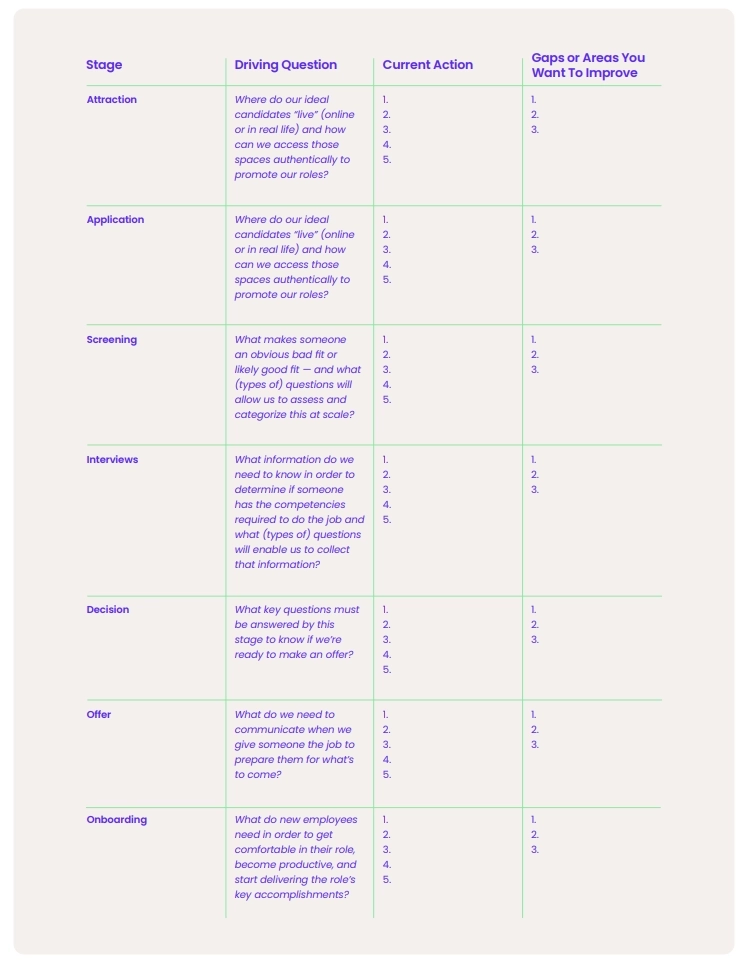
Step 2: Decide What AI Can and Should Automate
Leaders often get so excited about the promise of automation that they attempt to automate the one thing they shouldn't: human judgment. I've seen it happen a dozen times. This is where Jim Miller’s concept of "intentionality" becomes critical.
Miller argues that many companies fail to see the expected ROI from AI because they lack intentionality in how the technology is applied. Intentionality requires businesses to move beyond simply adopting the latest AI trend and instead focus on deploying it with a clear expectation of return.
This distinction becomes especially relevant in high-stakes processes like hiring, where AI is often misunderstood. In 2024, our hiring research showed that most hiring teams still don’t trust AI to make hiring decisions.

Today, AI is being positioned exactly as an assistive layer, not an automated decision-maker. 64.9% of teams have increased AI usage in hiring, but mainly for tasks like summarising long responses, handling volume, and standardising early-stage screening—not for making final calls.
When asked which stages must stay human-led, hiring teams were unequivocal:
- 78.7% say final hiring decisions should remain in human hands,
- 72.3% say the same about salary and offer discussions, and
- 69.1% insist that onboarding and culture integration must be human-driven.
Here’s a clear breakdown of what to automate and what must remain human.
The core principle is simple: use automation to create structure and gather objective evidence. This frees up your team to do what they do best—connect with people and make wise judgments.
Step 3: Select the Right Automation Tools
Tool selection is a search for solutions to the specific problems you diagnosed in Step 1. Here are four common problems I see teams face and the criteria to look for in a tool that can solve them.
Problem 1: You're drowning in volume with no signal
As Anuj Rastogi of Backstretch points out, receiving thousands of applications for a single role might be a sign of a broken process, not a successful one. It creates an overwhelming administrative burden and makes it nearly impossible to find the best candidates.
I've watched too many great recruiting teams burn out because they spend 90% of their time on low-value sorting, while quality candidates are either screened out by simplistic keyword filters or never even reviewed.
If that’s the case for your team, look for candidate screening automation tools that:
- Allow for skills-based or asynchronous screening before a human ever reviews a resume.
- Can be customized with your company's unique values and role competencies.
- Help you review 100% of your applicant pool in a structured way, as Ashby's model of posting with closing dates enables.
Problem 2: Your process creates candidate friction
Long, complex, or demanding application processes create a poor candidate experience and lead to high drop-off rates. As Julia Fulton of Float notes, asking candidates to create a video without any assurance that it will be viewed is a recipe for abandonment.
The best candidates, who have other options, will leave your process, leaving you with a less qualified pool. If you need screening automation to reduce candidate friction, look for tools that:
- Are asynchronous, respecting that many candidates apply outside of standard work hours.
- Integrate smoothly into a single workflow to avoid making candidates log into multiple systems.
- Are demonstrably efficient. For example, Packaly found that adopting short video interview questions with Willo increased completion rates by 30-40%.
Problem 3: You can't assess authenticity
The rise of AI-generated resumes and application answers has made it nearly impossible to gauge a candidate's true personality. This isn’t a niche problem anymore. In our 2026 survey, 76.6% of hiring teams reported encountering obviously AI-assisted applications, and almost a third say they see them “in many” or “most” applications.
As Derek Polowyj of Eden Scott notes, this makes everything sound bland and generic, erasing the candidate's unique voice. You risk hiring someone based on a fabricated persona who lacks the actual communication skills or personality required for the role. In that case, look for tools that:
- Go beyond text to capture personality, voice, and communication style.
- Allow for memorable, human moments. Caitlin from Lunio's shared example of a candidate who gave a quirky, unforgettable answer about a "sliver of cake."
Further reading: Discover applicant AI tactics & optimize your screening process with 11 proven tips to identify AI-generated resumes.
Problem 4: You have "black box" scoring and bias
Many automated tools use opaque algorithms that can perpetuate bias. A score is given to a candidate without clear, auditable reasoning, creating a black box that you can't see inside.
This compounds the 'undocumented criteria' flaw. If evaluation standards only exist in people's heads, automation can't apply them consistently. You may be unknowingly and systematically filtering out diverse candidates, undermining your DEI goals and reducing the quality of your talent pool.
Look for tools that:
- Provide transparent scoring rubrics and allow for human review and override.
- Focus on assessing competencies and values that you define.
- Enable a fair and consistent process, such as Willo’s collaborative scorecards with Blind Scoring, to prevent groupthink.
Step 4: Customize Your Screening Workflows
The difference between automation that feels human and automation that feels robotic lies in thoughtful customization.
Take Madison Reed, the Beauty Brand tested a video screening platform for nine months; time-to-hire didn't budge. Rigid formats, a lack of ATS integration, and generic templates meant the workflow never came together.
After redesigning the whole process to adopt flexible formats, seamless integrations, and value-aligned questions, candidate response rates doubled and time-to-hire dropped by half.
If a candidate screening automation tool is only as good as the process and content you build into it, here is a list of customized content you should implement to ensure efficiency:
Custom skill test questions:
Move beyond generic candidate screening questions like "Tell me about your experience." Use unique prompts to elicit authentic responses. Caitlin from Lunio’s "sliver of cake" example shows how a creative question can reveal a candidate's personality and memorability—something crucial for roles like sales and customer success, that a resume can never capture.
Our research confirms that teams increasingly trust what candidates can show in context over what’s written on a CV. When asked which signals are most reliable:
- 67.7% chose behavioural interviewing with specific examples,
- 54.8% chose hands-on skills demonstrations, and
- 53.8% chose real-time problem solving or practical exercises.
Portfolios and static work samples ranked lowest at just 21.5%.
In other words, structured questions and scenario-based tasks aren’t “nice to have” extras; they’re now the primary way high-performing teams separate genuine capability from well-written, AI-assisted applications. Bake these into your automated custom questions for the best result.
Standardized scorecards:
Remember the "ambiguity bias" Alyssa warned about in the "casual chat"? A standardized scorecard is the single most powerful antidote. As Daneal Charney advises, building a consistent scorecard directly into your screening tool forces every reviewer to evaluate against the same objective criteria. This is one of the most effective ways to reduce affinity bias—the tendency to favor people we'd "have a pint with."
However, most interview scorecards adopt the classic Likert scale (ratings on a scale of 1 to 5), which is difficult to standardize because it leaves a lot of room for interpretation. For example, what does a perfect 5 out of 5 score for B2B sales experience actually look like?
At Willo, we’ve come up with a solution. Our Scorecards ask interview reviewers to rate candidates on a clearly defined scale for each attribute [with contextual comments]:
.webp)
- Strong Yes: Absolutely endorse this hire
- Yes: Good fit, worth considering
- Maybe: Need more information
- No: Likely not a fit
- Strong No: Oppose this hire
Rather than thinking in abstract terms (“Is this candidate’s CRM knowledge a 3 or a 4?”), you’re thinking in concrete terms (“Would I advocate hiring this person based on their CRM knowledge?”).
See how Willo scorecards improve hiring confidence, or read our review of 16 interview scorecards. We'll walk you through different scorecard templates to help you assess candidates fairly (and even show you how to create your own).
AI rubrics and training:
Customize your tools to reflect what your organization uniquely values. Follow the lead of companies like Zapier, which builds AI aptitude rubrics into its process, or Remote, which trains its AI screening agent on its specific company values. This ensures the automation is aligned with your culture, not some generic industry standard.
Communication templates:
Set up automated but highly personalized communication templates for each stage that excite candidates and clearly explain what to expect.
Here are examples of custom communication materials you can automate in Willo:
- Asyn invitation email templates that explain the next step is ("a 15-minute asynchronous video interview"), what is being assessed ("We'll ask three questions related to our values of curiosity and ownership"), and how to prepare.
- Over 1000 pre-made skill testing templates you can customize to your role and send to applicants in minutes.
- A warm 60-second intro video that puts a face to the brand and explains the role in detail, transforming a faceless process into a human one.
- Reminder sequences that nudge over a week keep candidates moving without recruiter follow-up.
- Automated rejection responses. A short message thanking them and letting them know they won't be moving forward acknowledges that effort.
Take a page from Clio's book and link to resources like blog posts from interviewers to give candidates the best possible chance to succeed.
Here’s an in-depth guide to acing a one-way video interview [with practice exercises] you can share with applicants.
Step 5: Monitor, Optimize, and Maintain Compliance
You have to treat your screening process like a product that requires constant monitoring and iteration. As Justin Plagis of Packaly shared, his team is on "version four or five" of their process and is "constantly looking for... the next little tweak."
Here are the areas to watch closely:
- Audit trail and compliance: Remember Jim Miller's point that resumes and applications are legal documents of record. Your automated system must maintain a clear, accessible audit trail for every candidate decision to support compliance requirements.
- Accessibility: As accessibility advocate Theo Smith advises, you must support neurodiverse candidates by providing multi-format options. Audit your entire automated process for accessibility and ensure that candidates have a clear and simple way to request accommodations.
- Bias audits: Periodically audit your system's outcomes for bias and be prepared to evolve your process based on data. Clio did the same when they identified that their "recharge your way" value was being interpreted in a non-inclusive way and changed it. We’ve created an easy-to-follow framework for you to reduce bias in your hiring process.
Six Risks Both Manual and Automated Screening Share (And How to Fix Them)
Let's be clear: the risks below aren't unique to automation. Manual screening suffers from the same structural flaws—affinity bias, pedigree fixation, and inhumane processes.
The difference is that manual bias is invisible and untrackable, while automated systems make patterns measurable and fixable.
Here's what to watch for:
- Amplifying affinity bias: The risk is that your keywords and criteria will simply codify hiring people who look and sound like you on a massive scale. The solution, as Derek Polowyj and Caitlin from Lunio advise, build your process around objective, skills-based criteria and a "culture add" framework, not subjective preferences. Use structured, independent review panels to ensure multiple, unbiased perspectives.
- Over-indexing on pedigree: Your automated system might favor candidates from specific companies or schools, falling into the "pedigree trap" described by Marianne Bulger, Global Recruitment Leader at True Search. Instead, focus the screening on aptitude and capability through skills-based assessments that evaluate how a candidate thinks, not just their resume history.
- Losing high-potential candidates: Automation, particularly those based on resumes, poses the risk of hiring for perfection today and screening out candidates who have high growth potential but don't tick every single box. To avoid this, intentionally screen for "resourcefulness" and "aptitude" (what Kree from Microsoft calls The Three A's), leaving room for promising candidates to grow into the role.
- Creating an inhumane experience: The risk is a robotic, impersonal process that alienates your best candidates and damages your brand. Use automation to handle repetitive tasks like scheduling and data collection to free up human time for high-value engagement, relationship-building, and providing meaningful feedback.
- Failing to capture authenticity: When AI-generated applications pass through AI-powered screeners, the process becomes a completely fabricated and meaningless process. Instead, use screening methods like asynchronous video that require candidates to present themselves authentically, making it much harder to rely on generic AI scripts.
Measuring Success: The Candidate Screening Automation KPIs That Actually Matter
The true measure of a great automated screening process isn't volume; it's the quality of your signal and the efficiency of your funnel.
Here are the four KPIs that actually matter.
- Time-to-hire: A good time to hire is 25 to 30 days. If this metric is poor, audit for synchronous bottlenecks and manual handoffs, such as waiting for the hiring manager to review. Use our time-to-hire calculator [with cost saving analysis] to discover exactly how much time your current screening process is costing you and how much you could save with asynchronous candidate screening.
- Candidate completion & drop-off rate: If more than 20-25% of candidates abandon the process at a specific stage, it's a sign of excessive friction. Review your async questions—are they too long or unclear? Maddison increased completion by 30-40% simply by shortening questions and clarifying expectations.
- Acceptance rate: If your offer acceptance rate falls below 80-85%, it may indicate a disconnect in expectations or a poor candidate experience.
- Quality of Hire (QoH) from automated funnel: Track Quality of Hire by source. As Jim Miller notes, if hires from the automated inbound funnel have a lower performance score than sourced or referred candidates, your screening criteria are likely flawed. Compare responses from high vs. low performers—the gap reveals what your questions should actually test for.
- Diversity at final stages: If the diversity of your candidate pool decreases significantly after the automated screening stage, your tool or criteria may be introducing systemic bias.
- Candidate feedback and NPS: Actively survey candidates (even rejected ones) about their experience. A pattern of feedback describing the process as "robotic," "impersonal," or "unfair" is a major red flag that requires immediate attention.
If Quality of Hire is low, review your screening criteria for biases like pedigree or affinity. If the completion rate is low, simplify your questions and reduce the number of steps in your process.
👉 See how TravelXp reduced time-to-hire by 50% with Willo’s candidate screening.
Scale Your Hiring Process with Willo: The Human-led Candidate Screening Platform
Fair, fast, and effective automation requires you to do the hard work first: diagnose your manual process, choose the best system to fix it, and only then, scale with intention. It's about designing a fundamentally better system, not just bolting on a piece of software.
As Allison from Golden Ventures puts it, "There's really no replacement for human judgment, especially when it comes to talent." Your goal with automation is to clear away the noise so your team can exercise that judgment more effectively than ever before.
That’s where Willo comes in:
Unlike platforms that use AI to score video responses (communication style, cultural fit), Willo limits algorithmic scoring to multiple-choice questions with factual right/wrong answers. Set a pass percentage (e.g., 75%), and candidates who don't meet it are filtered out automatically.
For video responses where personality, presentation, and authentic communication matter, you maintain complete control while AI-generated transcripts and summaries speed up your review.
Want to meet more top talents faster? Book a demo today, see how Willo’s human-led hiring accelerates your process.