The hiring challenges recruiters face today are very different from those they faced in the past. Previously, talent acquisition relied heavily on printed job postings, employee referrals, and recruitment fairs. During this time, the biggest worries hiring teams had were expensive outbound motions and manual applicant tracking.
But now that recruiting is more automated than ever, organizations looking to build sustainable recruitment workflows must overcome a new set of challenges to stay ahead.
To help, we’ve broken down the most common issues hiring teams are facing today (as highlighted in our 2026 Hiring Trends Report and in interviews with HR experts on our Looks Good on Paper podcast).
Here are the top challenges:
- AI-generated applications make it difficult to verify authenticity: 76.6% of employers now encounter AI-assisted applications, making candidate authenticity and fit harder to assess.
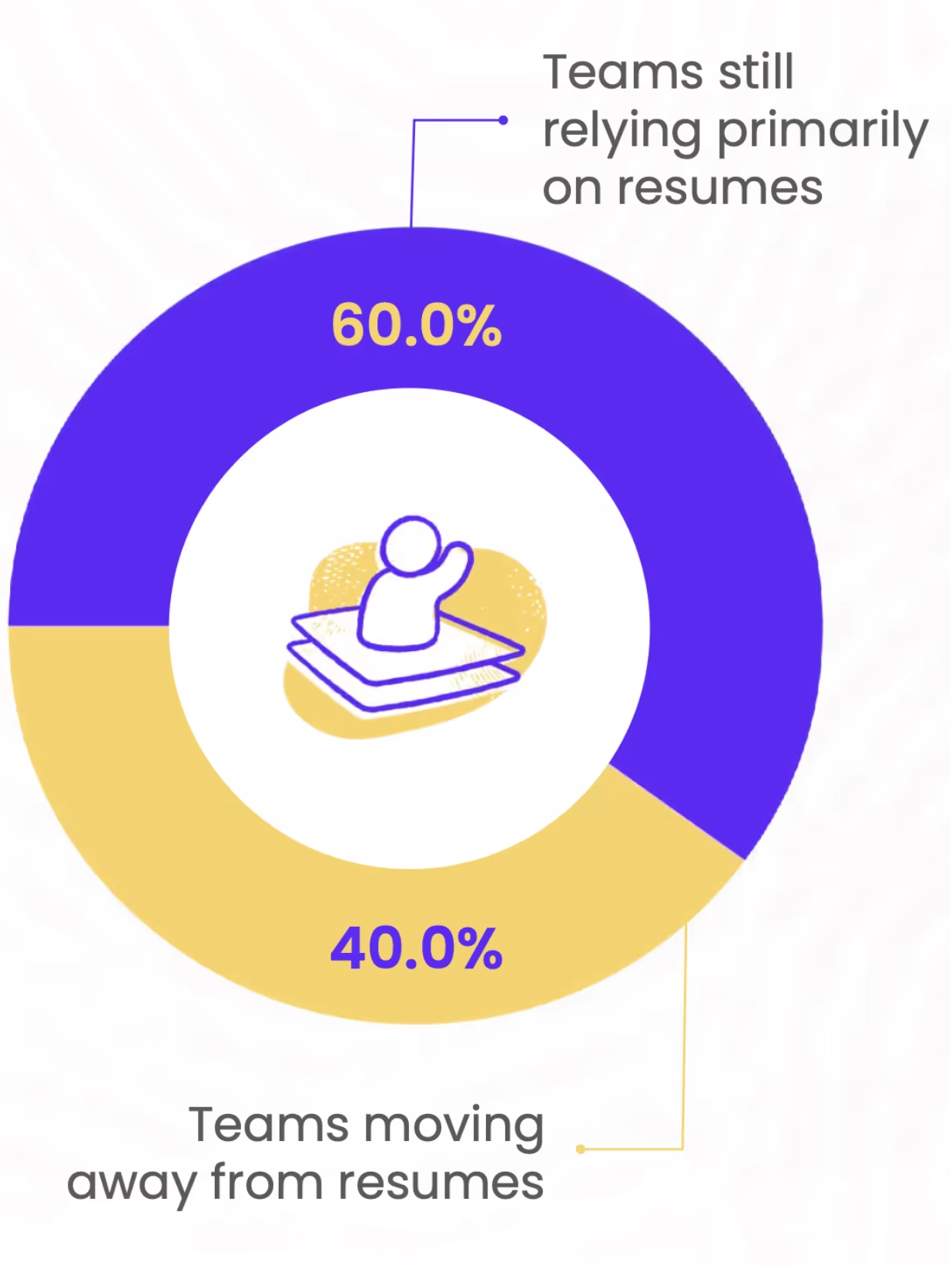
- Resumes no longer reliably signal candidate fit: 59.6% of hiring teams are still relying primarily on resumes. Most of them say they are no longer reliable as standalone indicators of role fit.
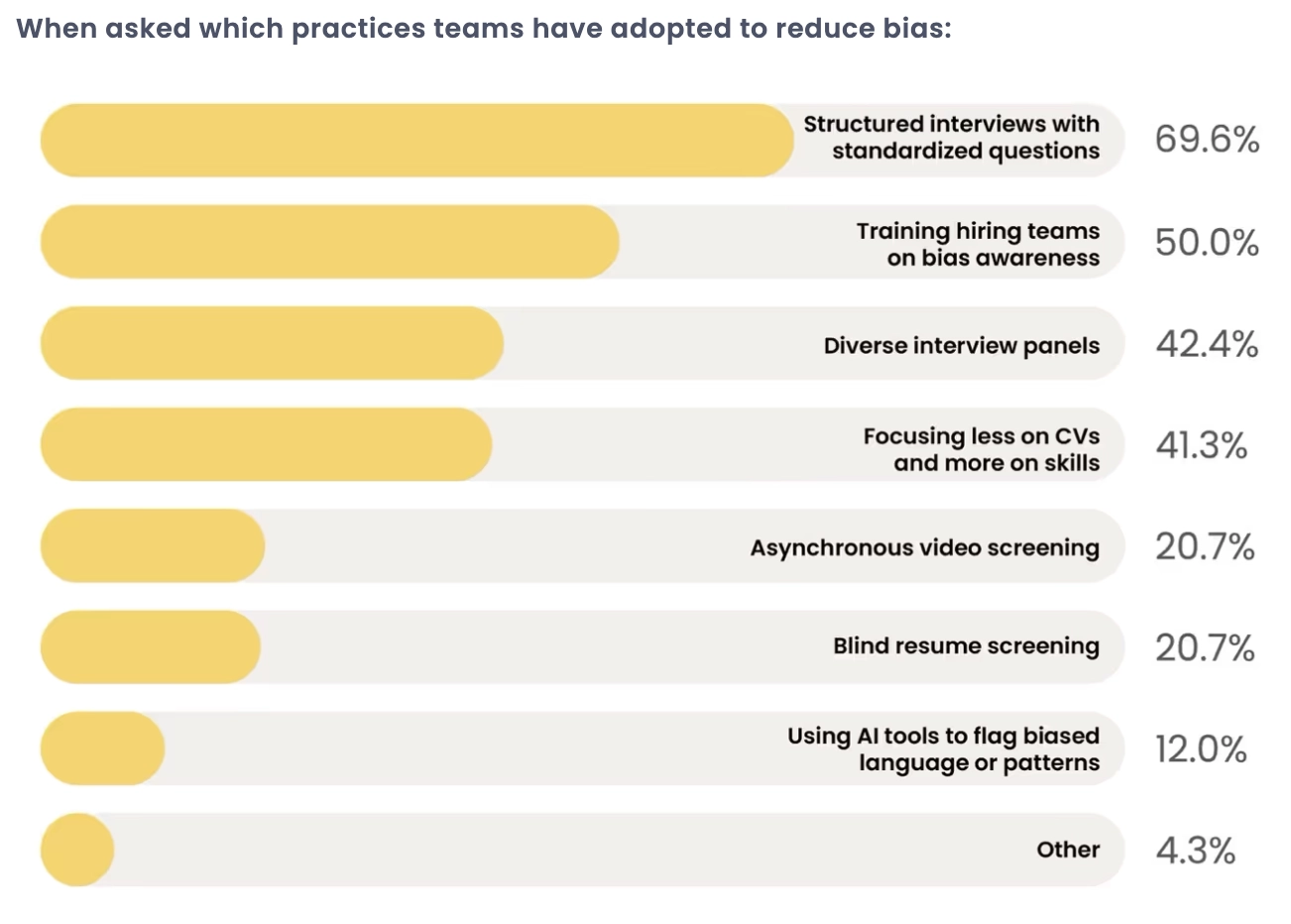
- Hiring bias still limit hiring quality even with structured processes. To avoid biased hiring decisions, 69.6% of teams use structured interviews, 50% conduct bias-awareness training, and 42.4% employ diverse interview panels.
- Recruiters lack confidence in AI automated hiring processes despite increased usage: 78.7% of recruiters prefer keeping final hiring decisions human-led despite AI adoption (and team size).
- The inability to validate portfolios and work samples slows down time to hire: Portfolios and work samples show projects completed under unknown conditions, so only 21.5% of hiring teams consider them reliable talent signals.
1. AI-generated applications make it difficult to verify authenticity
AI in the recruitment industry is a two-edged sword. On the one hand, it helps recruiters streamline candidate sourcing and screening. But on the other hand, it’s led to a rapid influx of AI-generated applications, from resumes and cover letters to form responses.
Back in 2024, our survey of 86 HR professionals revealed that 79.4% of hiring teams expected to add AI to their workflows. Today? Regular AI use is the norm, with 76.9% of the 100+ respondents in our 2026 study stating that they use it in parts of their recruitment process.
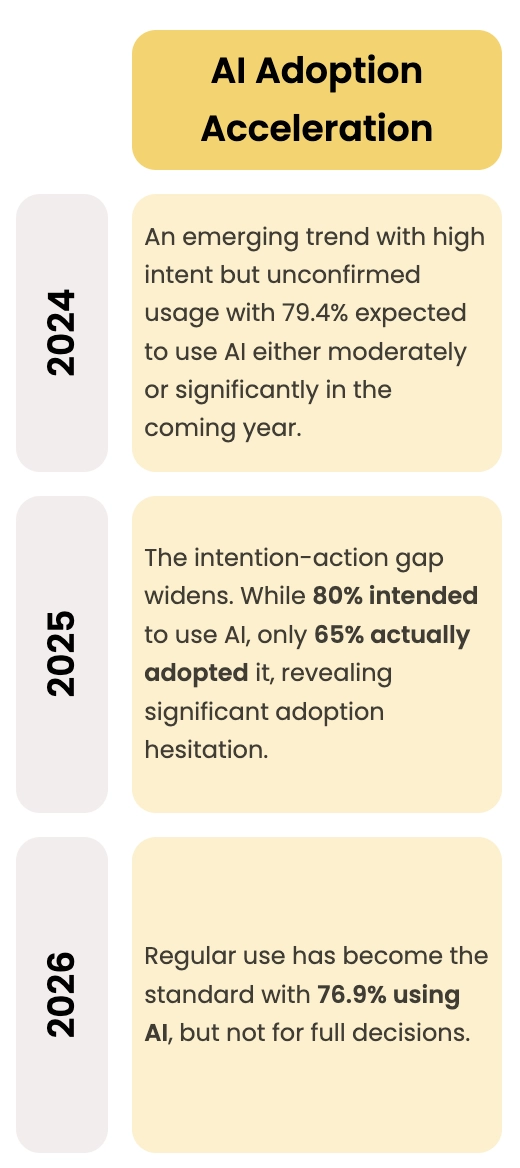
At the same time, applicants followed a similar trajectory. AI-assisted applications have hit an all-time high (76.6% of employers now encounter them), and candidate authenticity and fit have become harder to assess.
Artimese Braddy Lawrence, Coordinator of Human Resources at Tyler ISD, highlights async video interviews as a huge game-changer for navigating AI applications. She said: "With AI, a lot of resumes and cover letters are automatically generated. So how do we really tell if, on paper, this person is who they are? Live interview recording has helped us tremendously to determine who we would like to invite for a further interview."
Below is a breakdown of the top mitigation strategies we’ve seen work recently:
- Update interview techniques to probe more deeply. E.g., revise application questions to be more personal or role-specific, forcing candidates to think critically about their answers and limit AI use.
- Implement AI-detection tools and train teams to recognize AI-generated content via tells like vague, generic, or redundant answers.
- Explore async video interviews for early-stage screening so you don’t need to move all candidates whose resumes and applications meet the initial qualification criteria straight to the live interview stage. Simply add this pre-human interview step to evaluate them further and shortlist even more accurately.
Want to know more about finding authentic candidates? Read our guide to detecting AI generated applications or checkout Real-Talk, Willo’s cheating detection tool that lets you detect scripted and AI-generated responses.
2. Resumes no longer reliably signal candidate fit
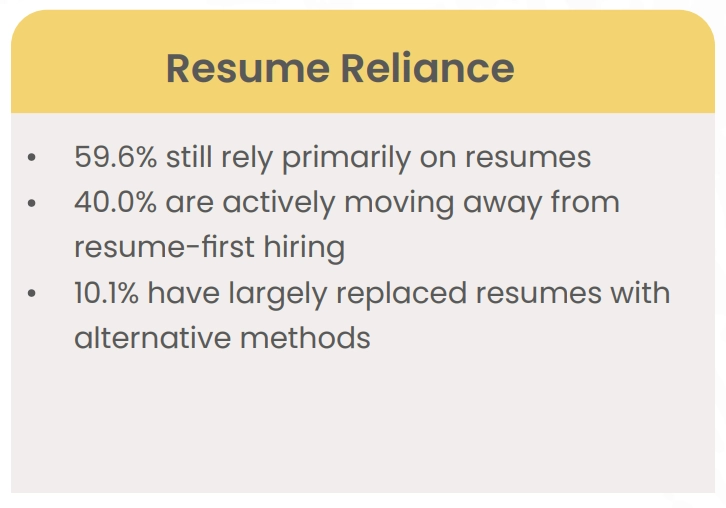
As recently as two years ago, resumes were the default, unquestioned starting point. But this year, only 59.6% of recruiters still lead with them: 40% are actively moving away, and 10.1% have mostly replaced them with alternative evaluation methods.
One reason for this growing distrust is that people sometimes lie on their CVs and applications. And even when candidates are honest, a document can only tell you so much about how someone actually performs under pressure.
In the words of Jeff Waldman, Founder at ScaleHR: "We still look at signals and things that have virtually nothing to do with future outcomes. Resumes tell you where someone's been, but they don't give you any indication whatsoever of how they're going to do in your work environment."
A few solutions to explore in combating the effects of increasing resume distrust include. For example, you can implement skills-based hiring by adding behavioral interviewing with examples, hands-on demonstrations, and real-time problem-solving.
Companies also set up stronger verification methods and authenticity checkpoints such as video assessments and situational questions that require personal context.
3. Hiring bias still limit hiring quality even with structured processes
Adding more interviewers to the process feels like the responsible call. Six perspectives should balance each other out. But as Justin Krucki, Global Talent Acquisition Manager at Miovision (formerly MasterClass), points out, it doesn't work that way:
"A candidate meets with six different interviewers, and you think you've got this amazing, long process that's going to bring you the best decision. But in the end you're not actually focused on enough specific items — and then bias starts to creep in."
Without clear, shared evaluation criteria, more interviewers just means more opportunities for affinity bias, network bias, and confirmation bias to shape the outcome.
Structured interviews and bias-awareness training are good starting points, but they address symptoms rather than causes. The real fix requires knowing which biases are active in your process, where they appear, and who is driving them — before designing any intervention.
We broke this down into a three-step diagnostic framework: identify the specific biases in your organisation, map how and when they manifest, then build targeted solutions around what you find. Read the full guide here.
4. Recruiters are using more AI than ever but still lacking confidence in the outcomes
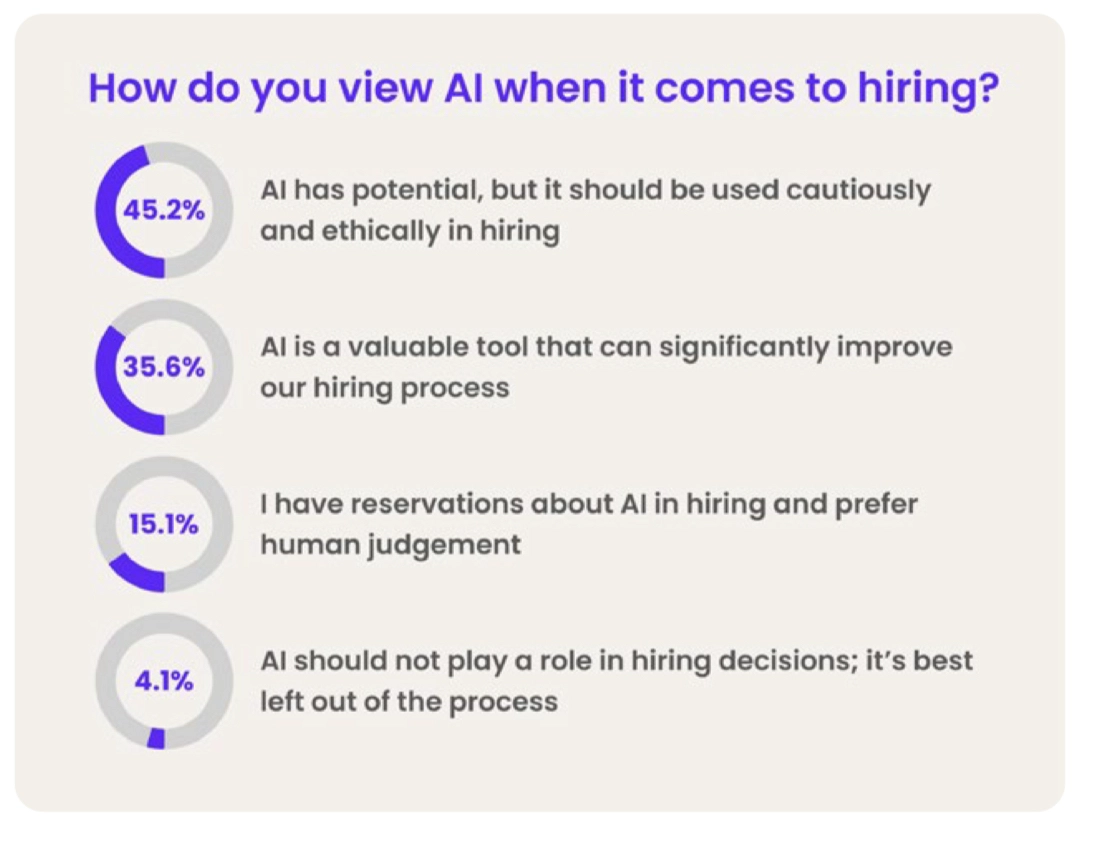
AI use in recruitment is rising fast; 64.9% of employers increased their usage in 2026. But adoption hasn't brought clarity. The same teams embracing AI tools overwhelmingly agree that final hiring decisions should remain human-led (78.7%), and every single respondent in Willo's 2026 research said AI can't handle all recruitment stages.
The regulatory pressure is making the stakes clearer. In New York, for example, companies using AI for hiring decisions are now required to audit their tools for bias and publish the results. Similar legislation is moving through other jurisdictions. The question of where AI ends and human judgment begins is no longer just a philosophical one. And 40% of talent leaders we surveyed agree that AI should be used in recruitment cautiously and moderately.
Getting this balance right requires more than a policy statement. It means mapping where your current screening process actually breaks down, identifying what automation can safely handle, and building in checkpoints to ensure compliance and fairness over time.
We covered the full approach, including where AI-assisted screening fails when teams automate a structurally flawed workflow, in our guide: How to Automate Candidate Screening Without Breaking the Process.
5. The inability to validate portfolios and work samples slows down time to hire
Only 21.5% of hiring teams consider portfolios and work samples reliable talent signals, because they reflect projects completed under unknown or unverifiable conditions.
The key lesson: Hiring teams don't just want allusions to past work; they want to see how candidates think, adapt, and perform now.
If thorough skill validation is a dilemma your team is also working through, Kree Govender, SMB Canada Leader at Microsoft, recommends “moving to holistic, scenario-driven evaluation.”
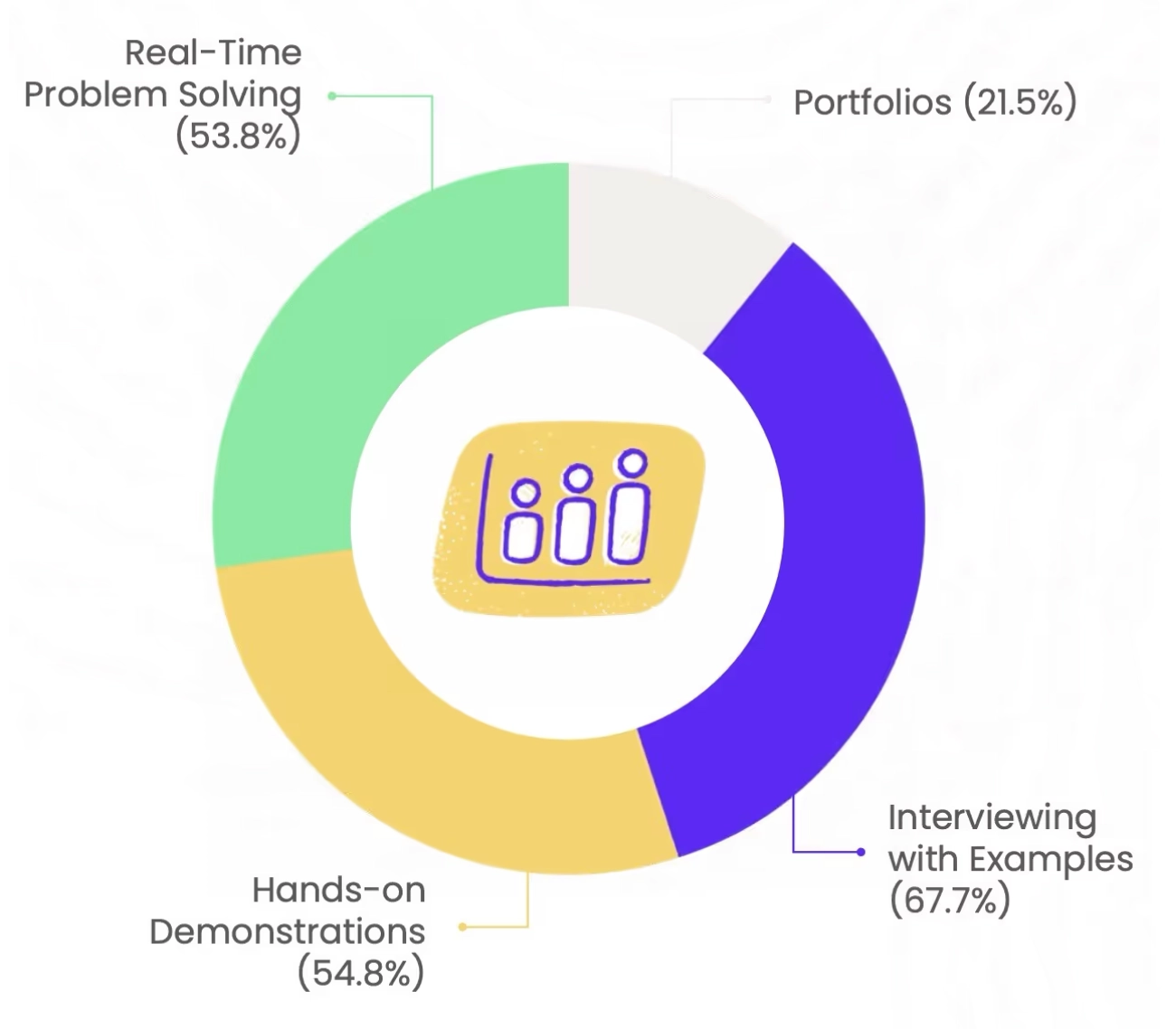
In practice, this approach entails leaning on these three more reliable talent indicators (according to 100+ hiring teams surveyed):
- Real-time problem solving: Live assessments show what someone can do when facing novel challenges in the moment.
- Hands-on demonstration: In today’s era of AI-enhanced work, hands-on demos with robust proctoring guardrails demonstrate true capability while leaving minimal room for external assistance.
- Interviewing with examples: You may not always have the time to administer live demos and challenges to all applicants, especially during initial screening, e.g., async video interviews. Asking candidates to provide specific examples is a powerful way to assess communication skills and validate resume claims before committing to lengthy face-to-face interviews.
6. Ensuring fairness and inclusive hiring processes
Over 70% of hiring teams express confidence in the fairness and inclusivity of their process. But confidence and accuracy aren't the same thing. When roles need to be filled quickly and evaluation criteria live in people's heads rather than structured scorecards, instinct fills the gap. And instinct reproduces patterns.

The problem runs deeper than individual bias.
Theo Smith, Co-author of Neurodiversity at Work, argues that inaccessible hiring processes, not candidate inadequacy, are behind many hiring failures, particularly for neurodiverse candidates who struggle in high-pressure, ambiguous screening scenarios.
His point: before asking whether a candidate is the right fit, organisations need to ask whether the process gives every candidate a fair chance to demonstrate it.
That means rethinking which skills are actually required, how candidates are asked to demonstrate them, and being transparent about roles where certain profiles genuinely won't thrive.
For a more detailed look at how to build this into your recruitment workflow, see our guide: Inclusive Hiring Practices.
7. Interview scheduling is draining recruiter capacity and slowing down hiring
While the interview process is an unavoidable necessity in recruitment, recruiters often struggle with efficient interview scheduling—especially when hiring at scale or connecting with international applicants. Things like email chains, scheduling conflicts, no-shows, and limited capacity drain resources and slow hiring.
HR experts, like Alyssa Lefebre, Senior Talent Acquisition Specialist at Clio (a legal AI software company), agree that scheduling interviews is a major friction point for candidates and recruiters alike. Her exact take:
"Let's say I'm setting up a 60-minute chat with a candidate and a hiring manager, and I describe it as 'oh, it'll be a casual chat, just talking about your experience.' That leaves the candidate trying to figure out, what am I being assessed on? It creates this weird dynamic where candidates are coming in not knowing where to focus and ultimately getting penalized for not being able to storytell."
In essence, this ambiguity poses both a fairness problem and a risk of candidate drop-off.
Here are three ways to reduce scheduling friction:
- Communicate clearly and consistently: From the outset, provide clear information about the recruitment process, including timelines, stages, and what each step entails. Regular updates and transparent communication will keep candidates engaged, reducing uncertainty and frustration.
- Implement a scheduling tool for live interviews: This will help candidates self-select available time slots.
- Use asynchronous interview tools: An app like Willo allows candidates to complete interviews in their own time so scheduling isn't an issue. For example, MyTutor increased its recruiting capacity by 75% using Willo’s async interviews.
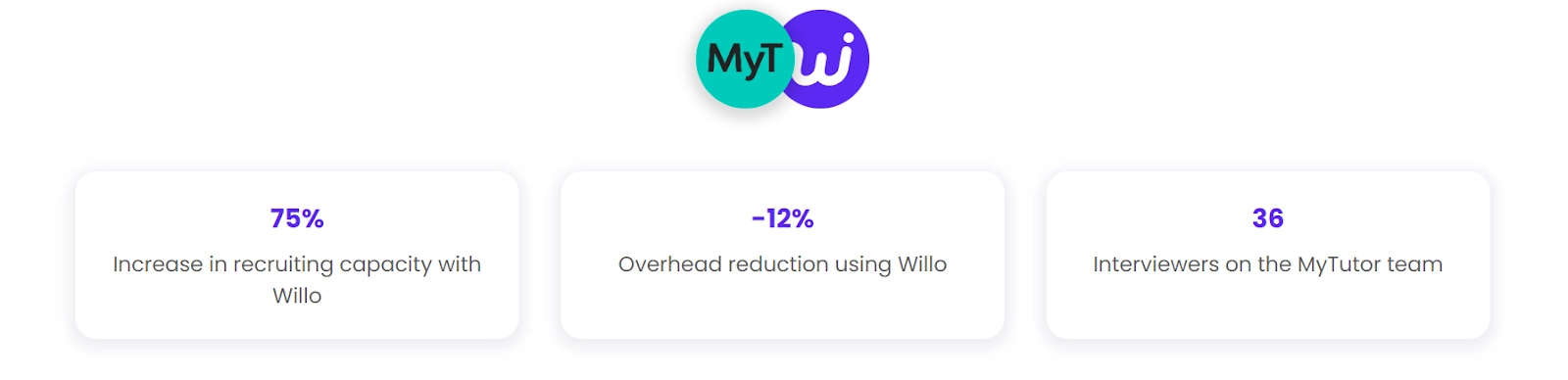
Recruiters could review interview recordings as they were sent in, without worrying about scheduling conflicts. Their hiring process became much more efficient, leading to a 12% reduction in overhead.
8. Candidate drop-off is rising and most recruiters can't tell exactly where it happens
A slow process, unclear communication, or a single unanswered email is often enough for a candidate to disengage and accept an offer elsewhere. The problem is that most of them leave without saying why. Ghosting works both ways — and when candidates do it, recruiters rarely connect the drop-off back to an experience problem.
The reputational damage compounds over time. Julia Fulton, Talent Manager at Float, makes the point directly: “candidates who don't get the role will still talk about how they were treated. A strong experience keeps your pipeline warm. A poor one spreads just as fast.”
Four recruitment tactics move the needle:
- Close every loop, including the rejections. The candidates you don't hire are future referrers, future applicants, and potential customers. A timely, respectful rejection is not a courtesy — it's pipeline management. Where volume makes personalised rejections impossible, automated but specific messaging beats silence every time.
- Reduce friction in the application itself. Mobile-friendly, minimal steps, no unnecessary fields. Every additional requirement is a drop-off point. Audit your application process against the question: would you complete this on a phone in five minutes?
- Design the screening stage around the candidate's schedule, not yours. Async video screening removes the coordination barrier that causes most early-stage drop-off — candidates complete responses when it suits them, with no login required, no app to download, and a practice mode available to reduce anxiety before they record. Willo's completion rates consistently exceed 80% when the process is set up this way.
- Use post-process surveys to find the real friction points. Candidate feedback after each stage — not just at the end — tells you where experience breaks down before the pattern becomes a reputation problem.
9. Lean hiring teams are drowning in high application volume
Recruiter layoffs across the tech sector have led to leaner teams with heavier requisition loads and a ton of applications to process within a limited time.
Julia Arpag, Founder and CEO of Aligned Recruitment, sees this daily in her work with in-house talent teams:
"We work with a lot of in-house talent acquisition managers and specialists, and we just see how overwhelmed they are. Obviously, when they open a job and get hundreds of candidates in a day, how do you sift through? And then typically the company will just go and find someone that they know."
The scale can be disorienting even for well-resourced teams. Noelle Pittock, Senior Director of Onboarding and Business Operations at Remote, describes receiving over 35,000 applications monthly
As you can imagine, with a small recruiting team, even if they are big, for that number, that's a lot to manage. When I first joined the company, I read every single CV. As the company grows and changes, you can't keep up.
The teams handling this well aren't necessarily larger. They've restructured what the first screening stage asks of a recruiter. Alyssa Lefebre at Clio hired over 500 people in 2025. Her team uses AI to handle note-taking and administrative summarisation so recruiters can spend their available time on higher-quality candidate conversations rather than processing. For a deeper look at how to evaluate AI screening tools against this distinction, see our guide: AI Tools for Candidate Screening.
10. Talent shortages limits how quickly recruitment teams can fill critical roles
A recent SHRM report found that three out of four businesses report difficulty recruiting for full-time positions, with the most common reason being a low volume of qualified applicants rather than a lack of interest overall.
The skills shortage is hitting hardest at mid-level (non-managerial) and entry-level roles, especially in fields requiring advanced technical knowledge like medicine, skilled trades, engineering, and architecture.
But not every talent shortage is what it appears to be.
Adam Gellert, founder of Linkus Group and Hipo, makes a useful distinction: many perceived shortages are hiring planning problems in disguise, driven by poor targeting, budget constraints, and teams that only start recruiting when a seat is already empty.
By that point, they are competing on the same timeline as every other company that also waited for the same candidates, with less leverage.
Joshua Sklüt, co-founder of MyStandard, makes a related point: reactive recruitment forces decisions under time pressure, which is precisely when hiring quality drops and bias increases.
What companies still attracting strong candidates in constrained markets are doing differently includes building talent pipelines before roles open, expanding the definition of qualified, and offering attractive compensations.
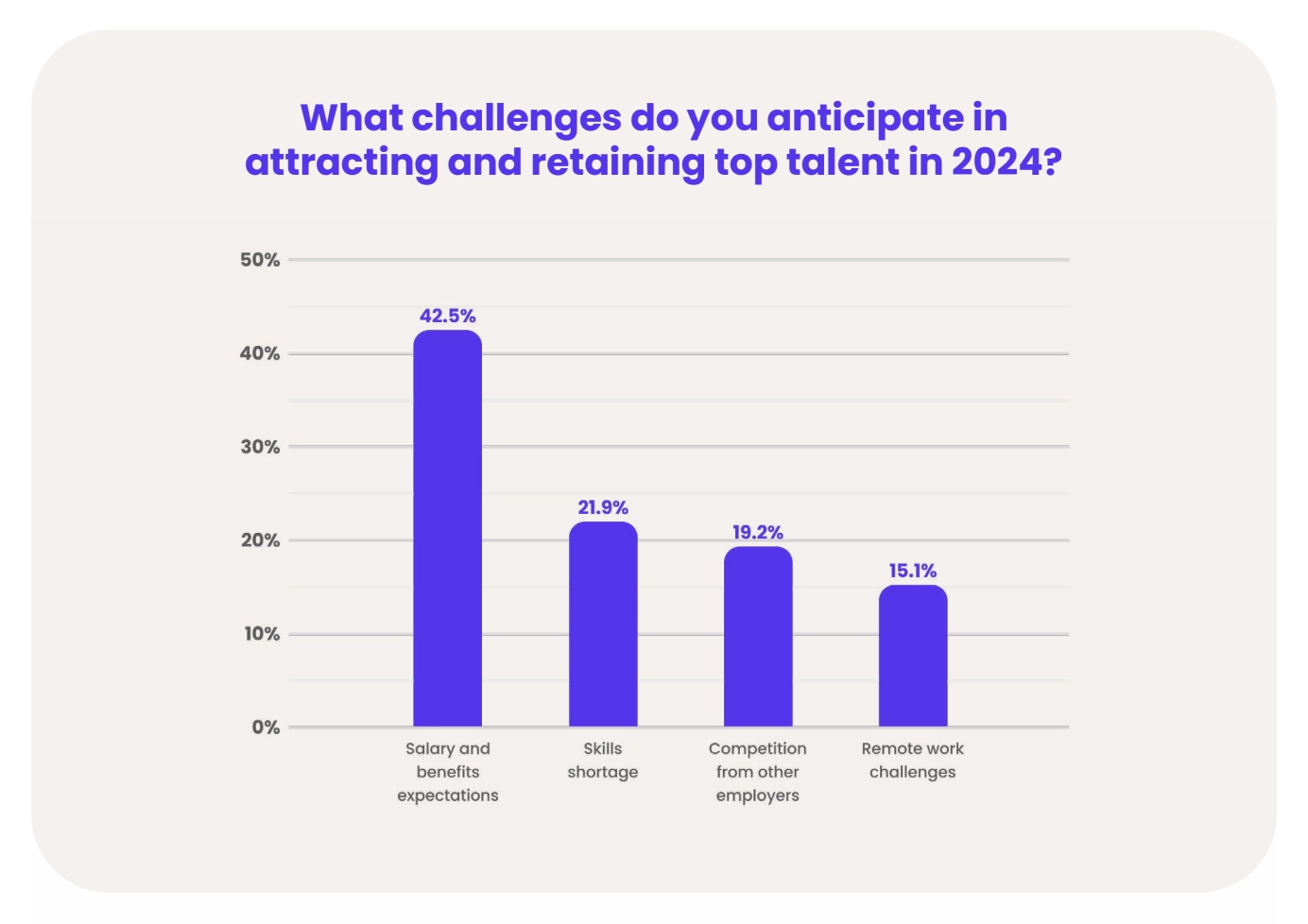
Read our guide on flexible hiring arrangements to learn more about overcoming talent shortage: The Flexible Hiring Guide.
11. RTO mandates are shrinking the candidate pool recruiters have to work with
Return-to-office mandates have introduced a structural tension into recruiting that most teams didn't sign up to manage. The policy debate sits with leadership. The consequences land on hiring.
Research from Robert Half found that 37% of job seekers want fully remote roles and the majority would prefer at least a hybrid arrangement. When organisations enforce full in-office requirements, they are effectively removing themselves from consideration for a significant share of the qualified candidate market before a single application is submitted.
The retention picture compounds the recruiting challenge. A recent Remote study found that nearly three quarters of companies lost talent to competitors offering more flexibility in a six-month window, and a similar proportion reported difficulty finding qualified candidates locally.
Noelle Pittock, Senior Director of Onboarding and Business Operations at Remote, surfaces both figures as connected: the companies winning on talent right now are the ones that have made flexibility a structural feature of how they hire and retain, not a perk offered selectively.
Among other options, teams should audit what in-office requirements are actually necessary versus assumed. Many RTO mandates are applied uniformly across roles where the business case for physical presence is weak.
Identifying which roles genuinely require on-site presence and building flexibility into the rest expands the available candidate pool without changing the culture of the teams that need it.
12. Recruiters still struggle to accurately measure competence beyond job titles and years of experience
Experience doesn’t always equate to competence, but in most hiring situations, it’s a top factor in evaluating candidate proficiency. This dynamic affects not just qualified candidates with minimal experience but also applicants with transferable skills who are pivoting from a non-traditional background.
David Hiford, Talent Acquisition professional at Hitachi Rail, points to the specific pools being overlooked: career returners after parental leave, military veterans, engineers pivoting into project management, and self-taught candidates who pursued a field through self-funded courses because they were genuinely motivated by it.
His observation from a recent data science search — where multiple candidates from entirely different fields had independently upskilled and reached out — illustrates how much employer-ready talent gets filtered before anyone sees it.
The fix isn't to ignore experience entirely. Rather, we should be treating experience as one signal among several, rather than the primary criteria. Add structured competency-based questions to early screening. Behavioural questions with specific real-world examples, role-relevant scenarios, and cultural alignment questions surface capability in ways a CV cannot.
13. Misalignment between recruiters and hiring managers remains a consistent source of bad hires
Misalignment between recruiters and hiring managers often starts before a single application is reviewed. The job description goes live without a skills analysis behind it, written around what the last person in the role did years ago rather than what the business actually needs now.
Derek Polowyj, HR Consultant at Eden Scott, sees this pattern repeatedly: hiring managers arrive with a long list of scraped keywords and a role that has been open for weeks with no suitable candidates. The underlying problem is usually that nobody has conducted a skills analysis or challenged whether the role description reflects what the business needs today.
Daneal Charney, Fractional HR Consultant, offers a direct starting point: ask the hiring manager to articulate what success looks like in the role at 30, 60, and 90 days. That single conversation surfaces misalignment faster than any amount of job description editing.
It is equally important for teams to run skills analysis before writing the job description. Separate must-haves from nice-to-haves explicitly. A role built around the last person who held it will attract the wrong candidates and produce disagreement at the shortlist stage.
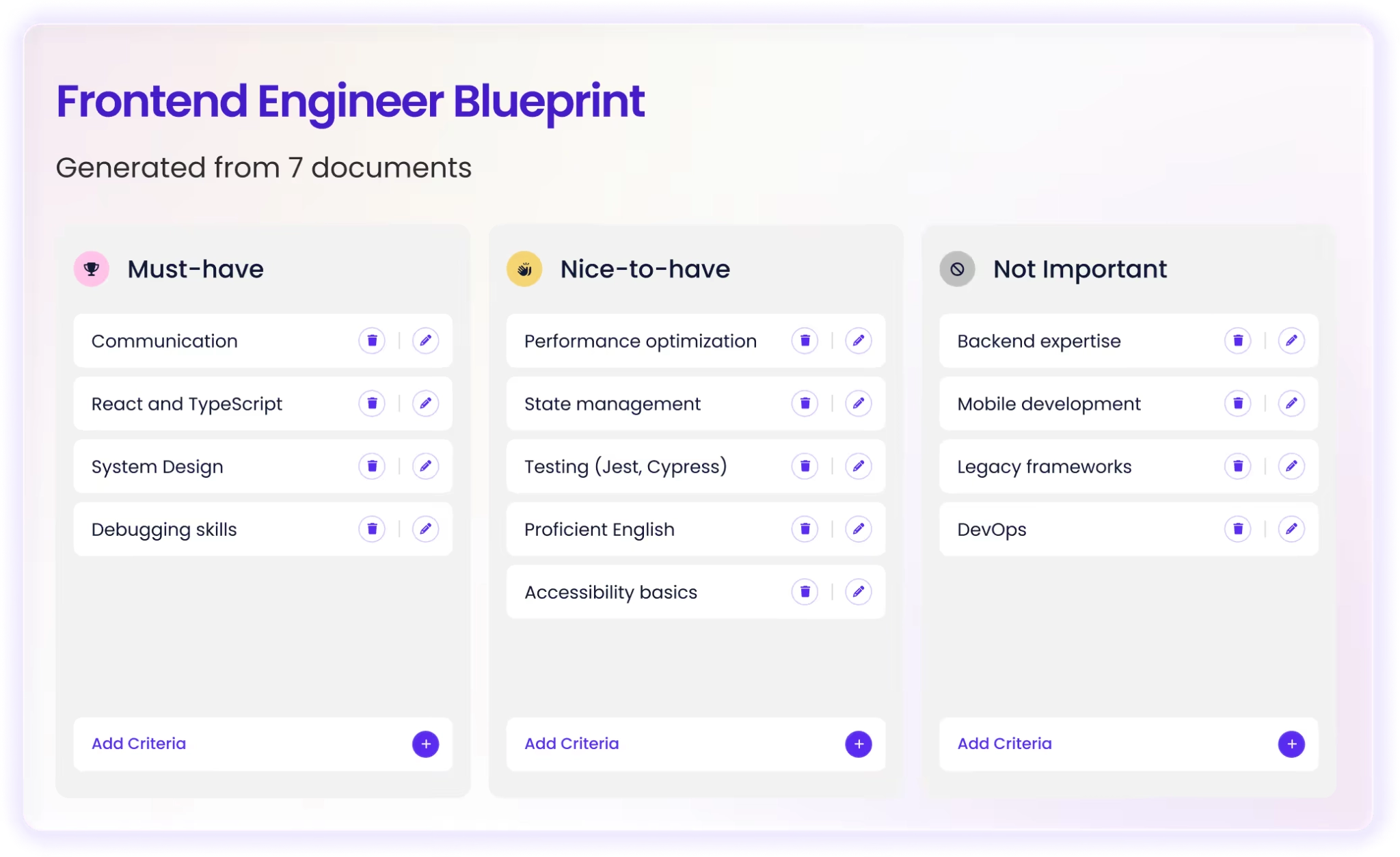
Also, teams should build shared review infrastructure into the process. When recruiters and hiring managers are reviewing the same candidate responses with timestamped comments and structured scorecards, disagreements surface earlier and get resolved on evidence rather than instinct. The cost of a misaligned hire — estimated at up to 40% of the individual's annual salary — makes the investment in structured collaboration straightforward to justify.
The common thread across every recruitment challenge
Thirteen challenges, but one underlying problem: the signals recruiters depend on to make confident hiring decisions are getting harder to read at exactly the moment when the pressure to decide faster is highest.
Application volumes are up. Resume reliability is down. Teams are smaller. Candidate expectations are higher. And AI tools are entering the process before most organisations have decided what role they should actually play.
The teams navigating this well are not necessarily better resourced. They have restructured their screening process around better signal — structured questions, consistent evaluation criteria, human-led assessment supported by tools that organise and surface candidate data without removing judgment from the people who understand the role.
That is the model Willo is built around. Async video screening, AI-powered summaries and transcriptions, structured scorecards, and a candidate experience designed to protect completion rates — not as separate features, but as a connected system for making faster, fairer, more confident hiring decisions at scale.
If the challenges covered in this article reflect what your team is navigating, book a demo to see how Willo handles them in practice.