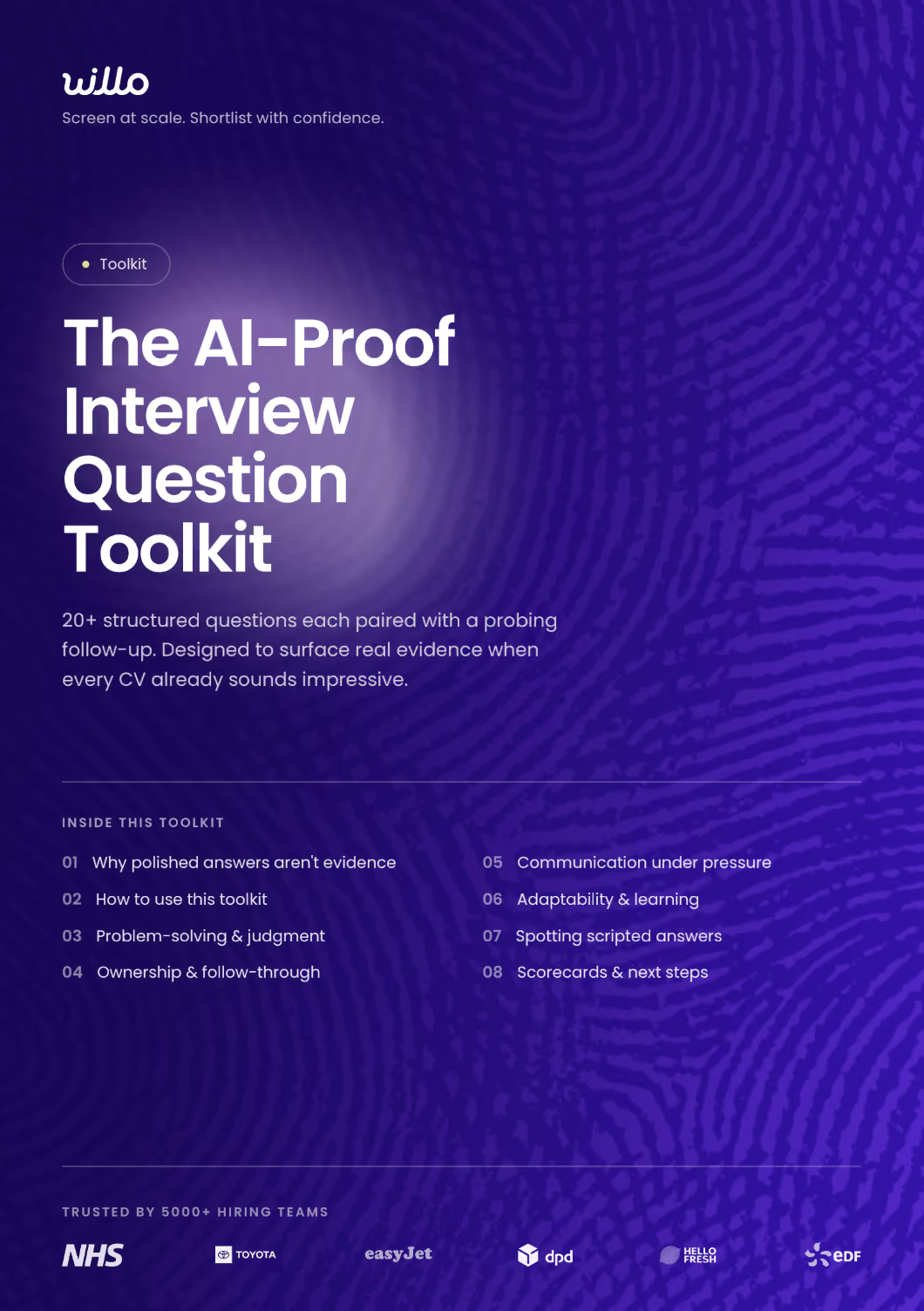
Key insights from the IHR Early Careers Conference on navigating high-volume hiring when applications all look the same.
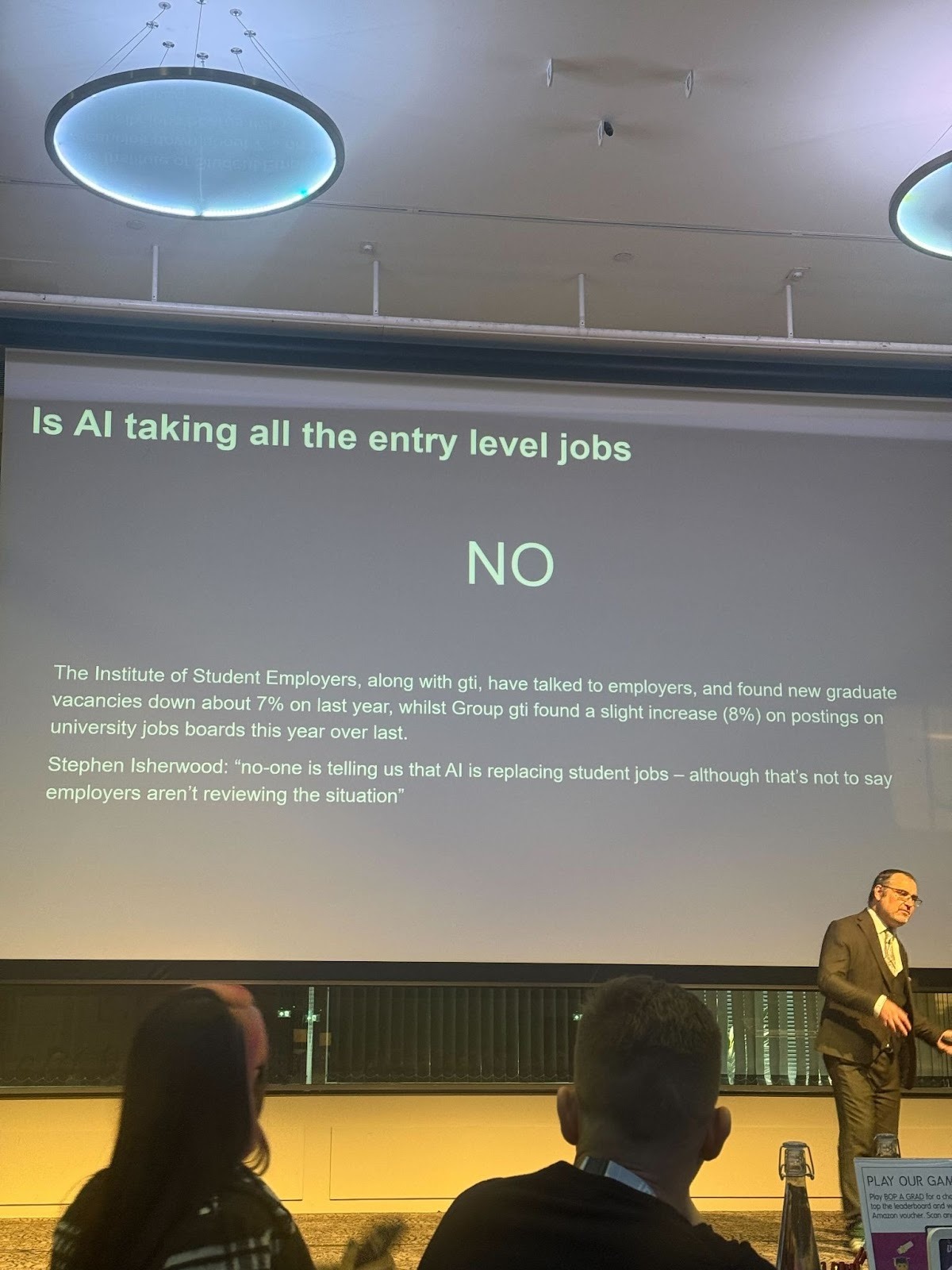
Yesterday in London, early careers and graduate recruitment leaders gathered at the IHR Early Careers Conference in London,a focused, roundtable-driven day designed specifically for teams hiring at scale.
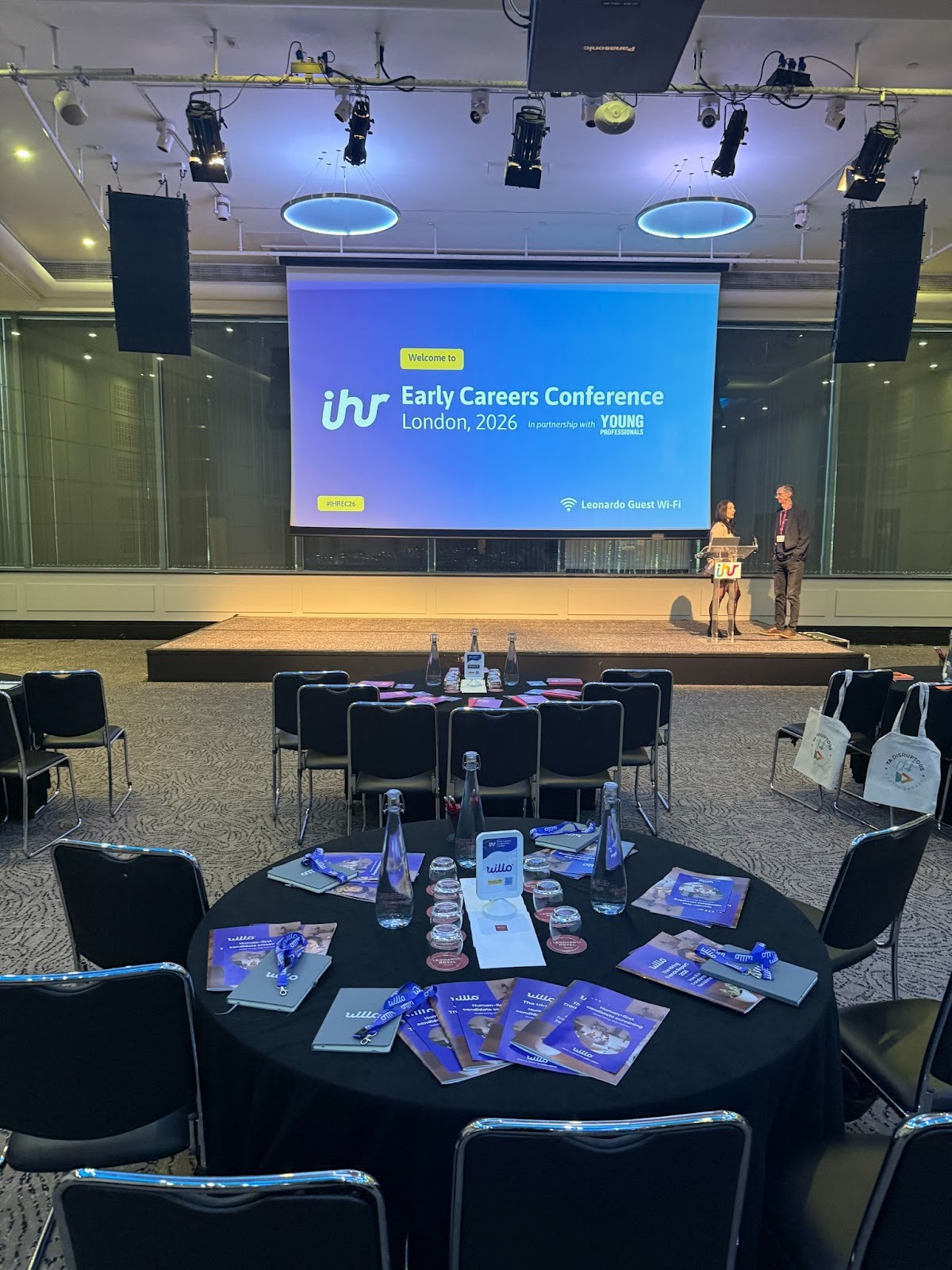
Unlike broader TA events, this one zeroed in on a specific challenge: how do you hire hundreds (or thousands) of graduates and early-career candidates while maintaining fairness, candidate experience, and decision confidence?
Across the roundtables and peer-to-peer discussions, three challenges dominated every conversation:
Too many applicants. Volume is overwhelming, and it's hard to distinguish between candidates when AI has made every application look polished and professional.
Attracting diverse applicants. Teams are struggling with both brand awareness (getting the right talent to apply) and ensuring their processes don't inadvertently filter out diverse candidates.
AI-proof assessments and AI detection. The growing need for assessment methods that can't be gamed by AI, and tools that help identify when AI has been used inappropriately.
These challenges mirror findings from our 2026 Hiring Trends Report, which surveyed over 100 talent leaders and identified the top three hiring trends for 2025 heading into 2026 as: (1) a demand for AI-proof candidate assessments, (2) increase in candidate quantity but decrease in quality, and (3) increased focus on employee upskilling and reskilling.
One early careers leader summed up the consensus: "We're facing massively high volumes, and it's hard to distinguish between candidates using AI."
That observation resonated across every roundtable. Because whether you're hiring 50 grads or 500, the fundamentals have shifted.
The Challenge Facing Early Careers Teams
If you're responsible for graduate or early-careers hiring right now, you're managing competing pressures that feel impossible to balance.
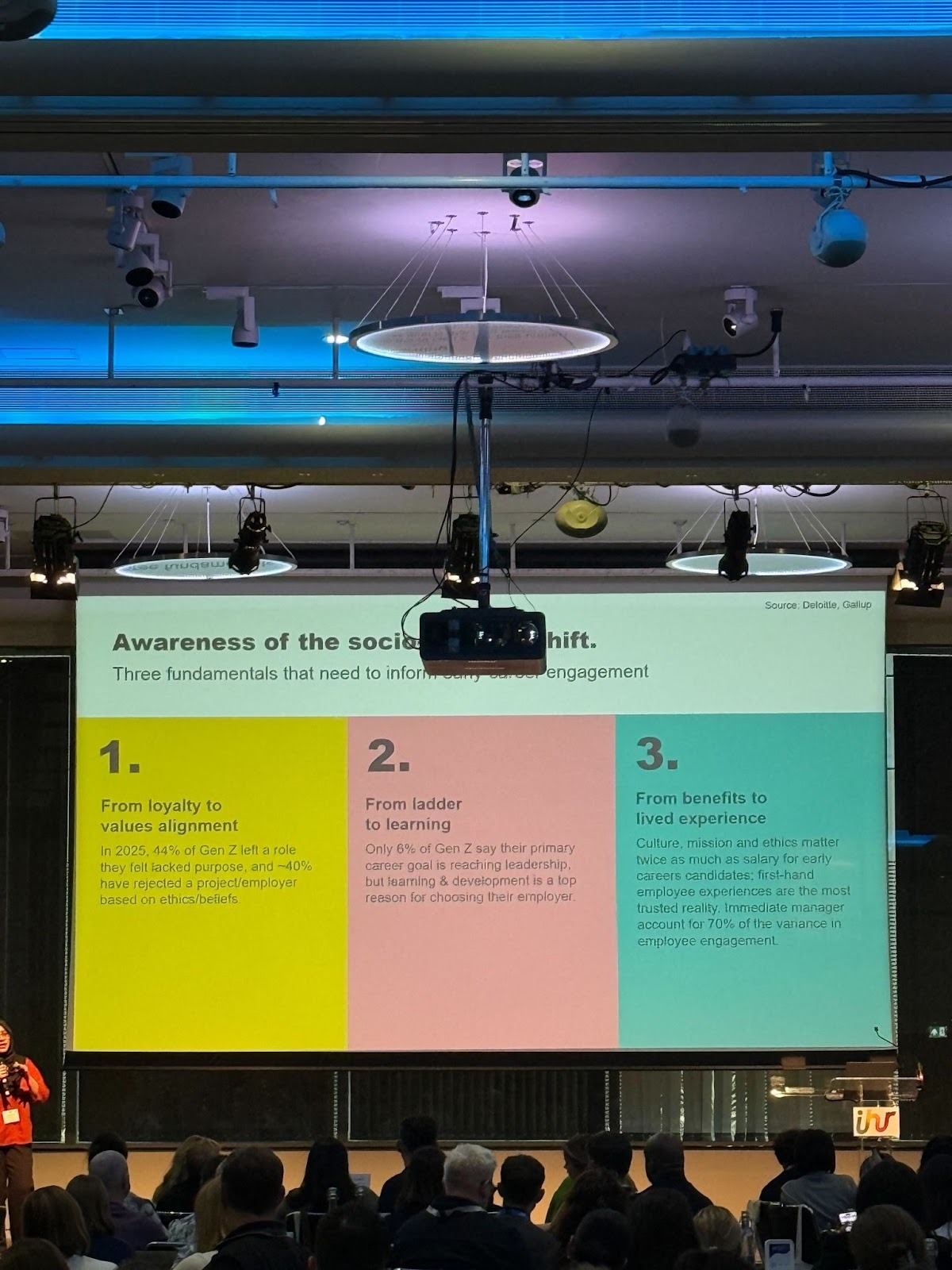
Volume is Higher, Scrutiny is Tighter
Graduate programmes are reputationally sensitive. A bad candidate experience doesn't just cost you one hire,it damages your employer brand with an entire cohort. And with social media, word spreads fast.
Fairness Isn't Optional Anymore
Early careers hiring is under a microscope. DEI commitments, bias concerns, and transparency expectations mean you can't rely on gut feel or inconsistent evaluation. Structure isn't a nice-to-have,it's how you protect your brand and your hiring decisions.
AI Has Changed the Baseline
Candidates are using AI to craft perfect applications. But that doesn't tell you if they can actually do the work. Meanwhile, you're being asked to use AI to screen faster, but without losing the human judgment that builds trust.
Budgets Are Tighter, Expectations Are Higher
You're being asked to hire more with less,fewer recruiters, tighter timelines, smaller budgets. The old playbook of campus events, CV reviews, and multi-stage assessments doesn't scale anymore.
Throughout the day at the IHR Early Careers Conference, these tensions surfaced again and again,from the opening roundtables through to the final networking session.
What High-Volume Hiring Looks Like Now
Let's be specific about what this shift means for early careers teams on the ground.
Your Recruiters Are Drowning in Sameness
The dominant conversation across every roundtable: AI-generated applications have made the baseline problem worse.
Early careers leaders explained that it's become extremely difficult to identify strong candidates and differentiate between them. Early careers applications all look the same, and volumes are overwhelming.
When every candidate can use AI to craft the perfect application, the CV stops being a useful signal. Same polished language. Same keywords. Same structure. Recruiters are spending more time reviewing applications, but they can't confidently tell who's actually qualified versus who just used AI well.
What made this particularly interesting: two of the six people at one roundtable were already hiring entirely without CVs. They'd removed the resume from their process completely and were using structured questions and assessments to surface signal instead.
The result? Fewer applicants who all looked identical. More confidence in who was actually capable. Faster decisions because they weren't second-guessing polished documents that might not reflect reality.
This phenomenon isn't unique to early careers hiring: teams across all sectors are grappling with the increase in candidate quantity but decrease in quality, driven by AI-generated applications.
Candidate Experience Is Make-or-Break
Multiple conversations touched on this: early careers candidates have high expectations. They're comparing your process to the best consumer experiences they have,seamless, transparent, mobile-friendly, fast.
When your application process requires candidates to re-type their entire CV into form fields, or when they wait weeks without communication, or when your assessment feels irrelevant to the actual role,they drop out. And they tell their friends.
Fairness Has Become Non-Negotiable
One of the most active discussions across roundtables was around bias, fairness, and defensibility. Early careers hiring is under scrutiny from leadership, from candidates, and increasingly from regulators.
The challenge is particularly acute in the UK market (where most conference attendees were based): maintaining diversity in your graduate cohort while dealing with thousands of near-identical applications requires structure, not good intentions.
Teams can't afford to make decisions based on "gut feel" anymore. If you advance or reject a candidate, you need to be able to explain why,and that explanation needs to be consistent across all candidates in the cohort.
Assessment Fatigue Is Real (On Both Sides)
Several roundtables raised concerns about over-assessment: asking candidates to complete multiple tests, video interviews, case studies, and live interviews before even meeting the team.
But what was more surprising: at one roundtable, 3 out of 5 companies' hiring teams didn't have a tech stack or any solutions to support their hiring—despite dealing with thousands of applications.
The takeaway was clear: these companies need help, and vendors need to make themselves known to teams who may not even realize solutions exist.
The pattern: Teams add more assessments to compensate for weak signal in the CV. But each extra step increases dropout. And without the right tools to manage volume, recruiters are drowning in manual work,spreadsheets, email chains, inconsistent evaluation.
What Leading Graduate Recruiters Are Doing Differently
The most valuable part of the IHR Early Careers Conference was hearing from teams who've already started solving these problems. Here's what stood out:
1. They've Removed CVs from the Process Entirely
The biggest revelation from the roundtables: some teams have stopped asking for CVs altogether.
Two delegates at one table shared that they're hiring completely CV-free,using structured questions and assessments to surface signal from the start, rather than relying on polished documents that might not reflect reality.
Why this works:
When you remove the CV, you remove the noise. Every candidate answers the same questions. You evaluate based on demonstrated capability, not how well someone can format a document or use AI to polish their experience.
The result: Fewer applications (candidates who aren't serious drop off), but dramatically higher quality in the shortlist. Recruiters report more confidence in their decisions because they're evaluating comparable, structured responses,not trying to decode polished prose.
The shift: These teams accepted that if CVs aren't giving them signal, there's no point collecting them. Instead, they ask role-relevant questions upfront that surface how candidates think, communicate, and approach problems.
For organizations exploring CV-free hiring approaches, structured video assessments can surface authentic capability that resumes simply can't capture.
2. They're Communicating the Human Element
Multiple roundtables discussed the importance of transparency with candidates about where AI is (and isn't) being used in the process.
The key insight that emerged: letting candidates know that a human is reviewing their application immediately puts them at ease and increases response rates.
This isn't about rejecting AI,it's about being clear that humans are making the decisions that matter. When candidates know they're not just being filtered by an algorithm, they engage more, respond faster, and have a better experience.
3. They're Rethinking AI from Strategy, Not Checkbox
The shift from 2024 to 2025 was palpable across discussions. As one delegate put it: "Last year was like an AI tick box—we didn't really know what we needed. But we're taking a step back now and thinking: what do we actually need from AI when it comes to hiring?"
This shift is reflected in broader data. According to Willo's 2026 Hiring Trends Report, while 80% of leaders anticipated using AI in 2024, only 65% actually did, suggesting a gap between AI hype and practical implementation. Looking ahead to 2025, 40% of leaders plan to add new AI tools to their stack, indicating the focus is shifting from "should we use AI?" to "how do we use it strategically?"
Understanding how to implement AI strategically rather than as a checkbox exercise has become critical for teams managing high-volume hiring.
The teams making progress aren't asking "should we use AI?" They're asking "where specifically does AI help us move faster without sacrificing judgment or fairness?"
Where that's landing:
- AI for administrative tasks (scheduling, summarizing, flagging)
- Humans for decisions, context, and relationship-building
- Clear communication to candidates about what's automated and what's human-led
4. They're Investing in AI-Proof Assessments
One of the three dominant themes from every roundtable: the growing need for assessment methods that can't be gamed by AI.
This trend is backed by data. Willo's 2026 Hiring Trends Report found that "AI-proof candidate assessments" was the #1 predicted hiring trend for 2025, cited by 24.5% of talent leaders surveyed. Notably, while 80% of leaders anticipated using AI in 2024, only 65% actually did, suggesting a gap between AI hype and practical implementation. Looking ahead to 2025, 40% of leaders plan to add new AI tools to their stack, indicating the focus is shifting from "should we use AI?" to "how do we use it strategically?"
Teams are looking for ways to verify authenticity earlier in the process, not because they distrust candidates, but because they need confidence that what they're evaluating is real.
This is driving interest in:
- Video assessments that require unscripted responses
- Live exercises that demonstrate thinking in real-time
- Verification tools that detect AI-generated content
- Format flexibility (video, audio, text) that surfaces genuine capability
Three Principles That Stood Out
If you take nothing else from the IHR Early Careers Conference, take these three principles that came up across multiple conversations:
1. Fairness at Scale Requires Structure, Not Just Intent
Better hiring outcomes start with better design. You can't promise fairness,you have to build it into your process through structure, consistency, and transparency.
The teams with the most diverse graduate cohorts aren't the ones with the best DEI statements. They're the ones with structured assessments, standardized evaluation criteria, and clear decision frameworks.
Ask yourself: If we had to defend every hiring decision we made this cycle, could we? What would need to change?
2. Candidate Experience Isn't a Luxury, It's Infrastructure
Trust doesn't come from good intentions or "we care about candidates" messaging. It comes from design.
Fair, transparent, candidate-friendly processes improve both experience and outcomes. When candidates understand the process, get timely communication, and receive meaningful feedback, they become advocates,even if they don't get the offer.
Ask yourself: Have we actually completed our own application process as if we were a candidate? Where does it break down?
3. Speed Without Confidence Creates More Work, Not Better Results
The pressure to "hire faster" is real in early careers. Campus deadlines, offer acceptance timelines, and competition for top talent create urgency.
But speed at the expense of confidence just creates rework,bad hires, higher attrition, wasted training investment, team disruption.
The teams moving fastest aren't cutting corners,they're removing friction. They've built processes they trust, so they can move quickly without second-guessing.
Ask yourself: Are we designing for speed or confidence? What would have to change to get both?
What to Do This Week
Don't wait for your next graduate hiring cycle to start testing changes. Here are three practical plays you can implement immediately:
1. Audit Your Assessment for Predictive Validity
Pull data from your last graduate cohort. For each person, track:
- What stage of the process gave you the strongest signal they'd succeed?
- Which assessments actually predicted performance?
- Where did strong candidates drop out unnecessarily?
Once you know what actually predicts success, build your process around that signal. Stop investing time in inputs that don't matter.
Why this matters: Most graduate hiring processes are built around tradition (this is how we've always done it) rather than evidence (this is what actually works). This exercise reveals where you're wasting effort,and where you're losing great candidates.
Need help conducting this audit? Download our free recruitment process audit template to identify bottlenecks systematically.
2. Complete Your Own Application Process
Go through your entire graduate application process as if you were a candidate:
- How long does it take to complete the application?
- What's unclear or confusing?
- Which steps feel irrelevant or redundant?
- How long do candidates wait between stages with no communication?
- Is it mobile-friendly?
Then fix the three worst friction points. Don't try to overhaul everything at once,just remove the biggest barriers.
Why this matters: The best graduates have multiple offers. Every point of friction in your process is a chance for them to choose someone else. Small improvements in experience can dramatically improve your offer acceptance rate.
3. Run a Fairness Audit on Your Shortlisting
Pull your most recent graduate shortlist. For each candidate who was advanced or rejected, answer:
- What specific criteria led to this decision?
- Was this criteria applied consistently across all candidates?
- Can we explain and defend this decision?
- Would a different recruiter reviewing the same candidate reach the same conclusion?
If you can't answer these questions confidently, you have a fairness gap,and likely a legal risk.
Why this matters: Early careers hiring is high-stakes and high-visibility. Inconsistent decision-making doesn't just create unfair outcomes,it exposes your organization to risk. Structure is what makes fair, defensible decisions possible at scale.
The Opportunity Ahead
Walking through the conference, the energy was clear: early careers teams aren't waiting for permission to evolve. They're redesigning their processes in real time, testing new approaches, and building for scale without sacrificing fairness or experience.
They're moving from CV-first to capability-first hiring. From promises of fairness to infrastructure that embeds it. From speed at all costs to confidence that enables speed.
This is an opportunity to:
- Restore confidence in shortlisting when volume creates noise
- Rebuild trust with candidates through transparent, consistent processes
- Use AI strategically to support human judgment, not replace it
- Embed fairness through structure, not statements
- Turn candidate experience from a nice-to-have into a competitive advantage
The teams pulling ahead aren't panicking about AI-generated applications or campus competition or budget cuts. They've accepted that the old system (post a grad scheme, collect CVs, spend weeks reviewing) is degrading, and they're building for what comes next.
They're asking better questions. Surfacing better signal. Making more confident decisions. And they're not doing more; they're seeing more clearly. In fact, leading teams are moving from resume-first to capability-first screening approaches that work at scale.
Building Graduate Hiring Confidence with Willo
One theme that came up across multiple conversations at the IHR Early Careers Conference: the need for tools that surface authentic signal earlier in high-volume hiring.
That's exactly what Willo was built for.
We help early careers teams move beyond CV-first hiring by introducing structured async interviews earlier in the process,questions that surface capability, not polish. Candidates respond via video, audio, or text, giving you comparable, unscripted responses that reveal how they think, communicate, and approach problems.
What makes Willo different for graduate hiring:
Structured formats that create fairness at scale
Same questions for every candidate. Same evaluation criteria. Consistent, defensible decisions across hundreds of applicants.
Flexible response options that respect candidates
Video, audio, or text responses. Mobile-friendly. Async format that works around class schedules and time zones.
AI-powered tools that help you move faster
Willo Intelligence summarizes responses, surfaces patterns, and helps you identify top candidates faster,while keeping humans in control of final decisions.
Verification capabilities that confirm authenticity
Real Talk technology detects AI-generated content. Identity verification reduces fraud risk. You can trust what you're seeing.
We're not trying to automate graduate hiring. We're trying to restore clarity where volume has created noise.
Less noise in. More truth out. Faster, fairer, confident hiring decisions, at scale.
Want to see how other graduate recruiters have transformed their processes? Read how EDF screens 17,000+ applicants per cycle while cutting admin time by 50%.
Thanks to everyone who joined us at the Willo roundtable at the IHR Early Careers Conference, and to the IHR team for creating such a valuable space for early careers and graduate recruitment leaders to connect and learn.