If you’re looking for a candidate assessment tool today, you’re likely trying to reduce the hours you spend manually reviewing applications. You are struggling to:
- Quickly know who is actually qualified without sitting through a 30 to 45 minutes pre-screening call.
- Get proof they can actually do the work, not just talk about it.
- Provide reliable evidence to back up why you chose the candidate.
Most candidate assessment software won’t help you solve these problems completely because their approach focuses on helping you process more candidates faster, instead of helping you hire better.
For example, many of the options you’d find today focus on using resume filtering to scale down the initial volume, so you can focus on qualified candidates. But this approach falls short today because it assumes that resumes are still a reliable source of hiring signal.
In a world where 76.6% of recruiting teams are encountering AI-assisted applications, and resumes have become almost decorative, it’s difficult to get any reliable result from such an approach.
This is why, in typical cases, high-volume recruiters still spend 6+ hours every week manually cross-referencing LinkedIn profiles against applications because they can't trust what candidates submit anymore.
If your goal is to not only shorten time-to-hire, but also increase quality of hire, you need a tool that allows you to:
- Save time by sending one link, collect every response in a structured format, and share a shortlist with one click, without chasing hiring managers for feedback or asking candidates to create an account they'll never use again.
- Automatically filter out candidates who don't meet requirements based on objective criteria rather than algorithmic selection. That way, you have the confidence that your shortlist is filtered to surface candidates who are most likely to be great hires.
- Confirm that the person behind the application is who they say they are, so you're not progressing a polished AI-generated response while the actual candidate remains a mystery.
- Score every candidate objectively with structured assistive AI insights. That way, your decisions are documented, consistent, and defensible when a hiring manager asks why you passed on someone.
In this article, we review 11 popular candidate screening tools, starting with Willo, the only platform that helps you screen faster and hire with confidence. Book a demo to see how for yourself.
1. Willo
Best for: Recruiting teams managing high application volumes who need to shortlist faster without trading speed for confidence in who they're hiring
Willo is a candidate screening software built for recruiting teams that need to shortlist faster, with confidence, without outsourcing their judgment to an algorithm.
Most candidate assessment tools approach screening the same way:
- Use AI to score initial inputs from resume, psychometric questions, game-based assessment.
- Rank or filter candidates before a human ever sees them.
While this approach gets you a shortlist faster, it creates a bigger problem. By the time a shortlist reaches your desk, you have no idea what you've passed over, or whether the candidates who made it through were the right ones or just the ones who tested well.
Willo takes a different approach. Instead of replacing your judgment with automation and creating more work down the line, Willo gives you the tools to make faster and more reliable decisions yourself.
It is the only option on this list that makes it possible for you to:
- Filter 20,000 applications down to the best 200 without the fear of missing out on top talent who might not meet conventional requirements.
- Verify that those 200 are exactly who and what they say they are before investing your time.
- Assess exactly how every candidate thinks, communicates, and performs in real situations with structured async interviews.
- Score and shortlist the best 50 among those candidates faster and with confidence — with AI informing every step, and your judgment making every call.
That way you’re able to build a shortlist you can move on quickly and actually trust. Below, we break down the three capabilities that make this possible.
Book a Willo demo to see how this works for your specific hiring volume.
Filter down to your best candidates without the fear of excluding top talents
Most teams start screening the same way: run applications through an ATS keyword filter, score resumes against a checklist of requirements, and let the system surface whoever matches on paper.
The problem isn't the intention. It's the assumption that a resume is still a reliable signal of whether someone can do the job. Latest research has proven that resume filtering doesn't surface the best candidates. It surfaces the candidates who are best at writing for keyword filters.
Therefore, that approach often results in a filtered pool that looks clean on paper and tells you almost nothing about actual capability, while burying candidates who might have been your strongest hires because their CV didn't use the right phrasing.
Willo replaces that filter with something more reliable: objective, role-specific criteria you define before a single response comes in.
Using knockout multiple-choice questions, you set the baseline requirements that matter for your role: availability, right-to-work status, specific qualifications, or any non-negotiable criteria.
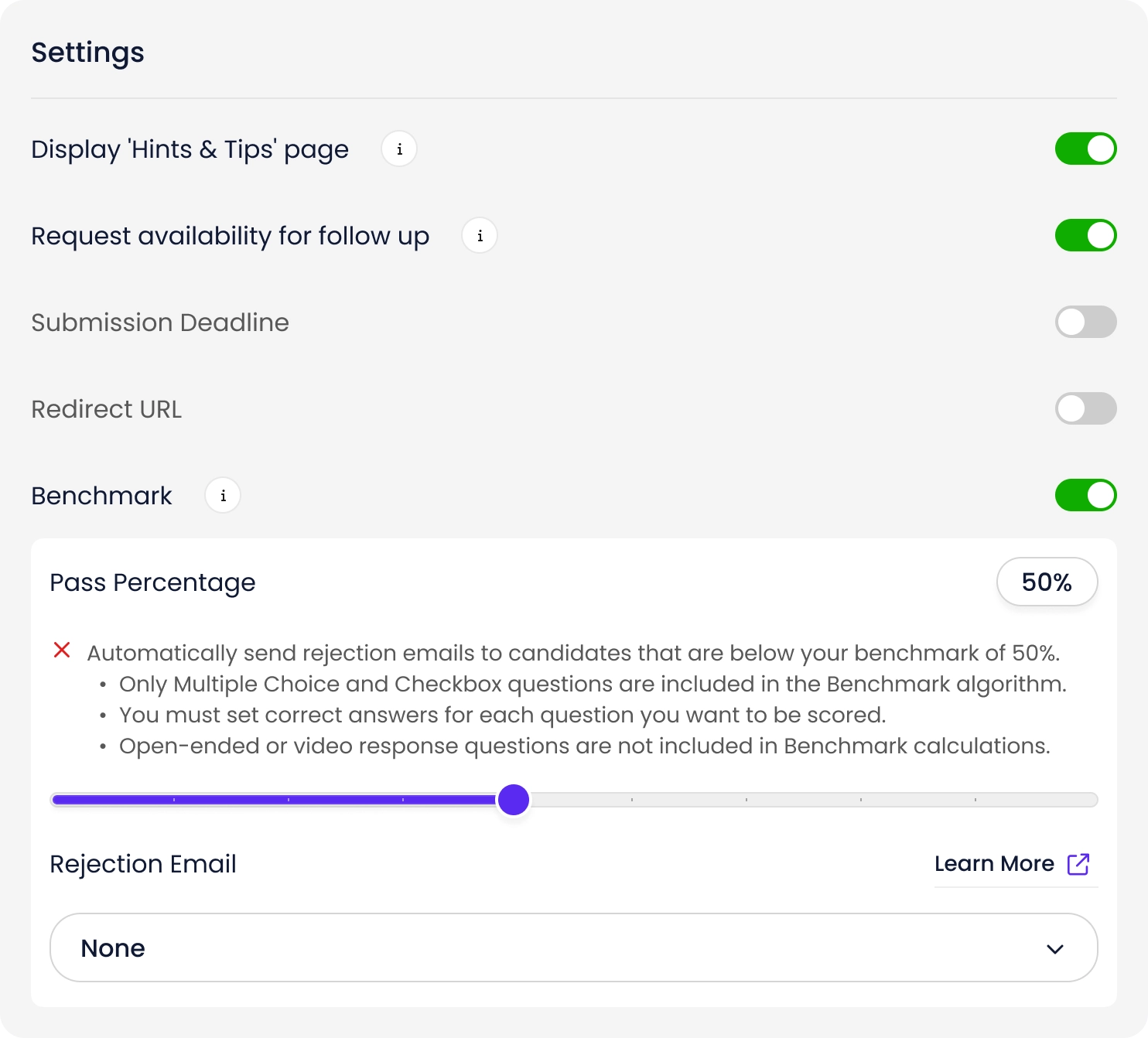
Candidates who don't meet them are filtered out automatically. Not by an algorithm guessing at their potential from a document. By their own direct answers to the questions that actually matter.
And it means the 200 candidates who make it through your first filter are there because they meet your requirements, not because they know how to optimise their CV.
See how every candidate actually thinks, communicates, and performs — before you commit a minute of interview time
Once you have a filtered pool, the next challenge is assessment. And most tools handle this stage with approaches that prove a candidate can perform an assessment, even when they are not a good fit for the job.
- Game-based cognitive assessments measure abstract traits like processing speed, pattern recognition, and risk tolerance through short tasks. You can’t confidently tell how they communicate with a hiring manager, explain their thinking under pressure, or represent themselves in a real work situation.
- Self-report behavioural questionnaires ask candidates to describe how they'd respond in a given situation. Those answers converge toward a predictable set of responses that tell you very little about the actual person behind them.
- Job simulation tells you how someone handles one specific task in a controlled scenario. It doesn't show you how they think out loud, how they present themselves, how they communicate under mild pressure
Willo's assessment stage is built around a different question: what would you actually learn about this candidate if you could watch them respond to real questions, in their own words, on their own time?
You build your interview using five question types: Video, audio-only, multiple choice, text, and file upload. Combine them to create an assessment that reflects the actual demands of the role.
- A customer-facing role might lead with a video question on handling a difficult conversation.
- A writing-heavy role might use a text response to evaluate communication quality.
- A technical role might use file upload to review work samples alongside video to assess how candidates explain their thinking.
Thinking Time gives candidates a set period to consider their answer before recording, which removes the advantage of scripted preparation and shows you how they actually reason under mild pressure.
And because every candidate answers the same questions in the same order under the same conditions, what you get back is a structured, comparable data set across your entire candidate pool, one your team can review independently, score consistently, and discuss with shared context.
Confirm the person behind the application is exactly who they say they are
In a market where AI can generate a compelling interview response, produce a polished written answer, and coach a candidate through every question type your assessment uses, verifying authenticity has become the gap that determines whether your shortlist is real or manufactured.
Most tools in this category don't address this problem at all. They assess what candidates produce and treat authenticity as the recruiter's problem to solve downstream, usually through a live interview that adds time, cost, and scheduling overhead back into a process you were trying to streamline.
Willo addresses it at the point of screening, through two capabilities no other tool in this list provides.
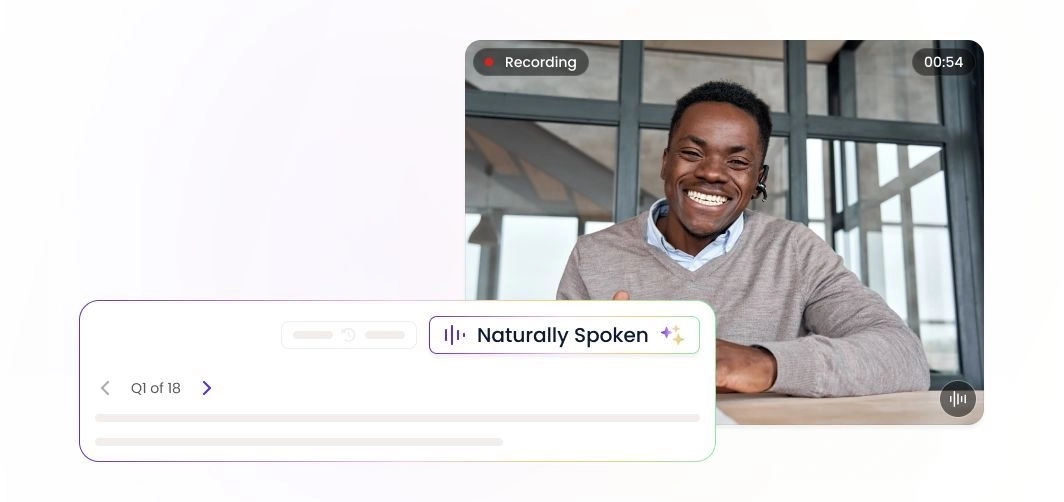
- Willo Proof: This tool analyzes every video response for signs of AI-generated delivery, script-reading behavior, and coached phrasing. Where flags are raised, it triggers automated ID verification through a passport and face-scan process that completes in minutes.
- Willo Verified runs credential checks the moment a candidate applies — background, right-to-work, references, social media, and email verification, all automated through third-party integrations. Verified attributes appear as green shields next to each candidate's name in your dashboard, so you can filter by verification status instantly.
With these features, you don’t only get the confidence that the candidate that makes the shortlist genuinely earned their place, you also save 50% more time. No need to manually cross-reference profiles against applications.
Score every candidate consistently and build a shortlist you can defend
The most common way tools address this is auto-scoring:
- The platform grades every response,
- Ranks candidates by score, and
- Surfaces the top performers.
You get a shortlist quickly.
What you don't get is visibility into how it was built, or any reliable way to explain to a hiring manager why the candidates who made it through were chosen over the ones who didn't.
Willo's scoring stage keeps the efficiency without removing your judgment from the outcome.
When a candidate completes their interview, Willo Intelligence automatically generates a full transcription of every response, an AI summary of their overall performance, and proficiency flagging that highlights relevant skills, knowledge areas, and communication style.
You get a structured, readable overview of every candidate in your pool — without spending 45 minutes per person to form that picture yourself.
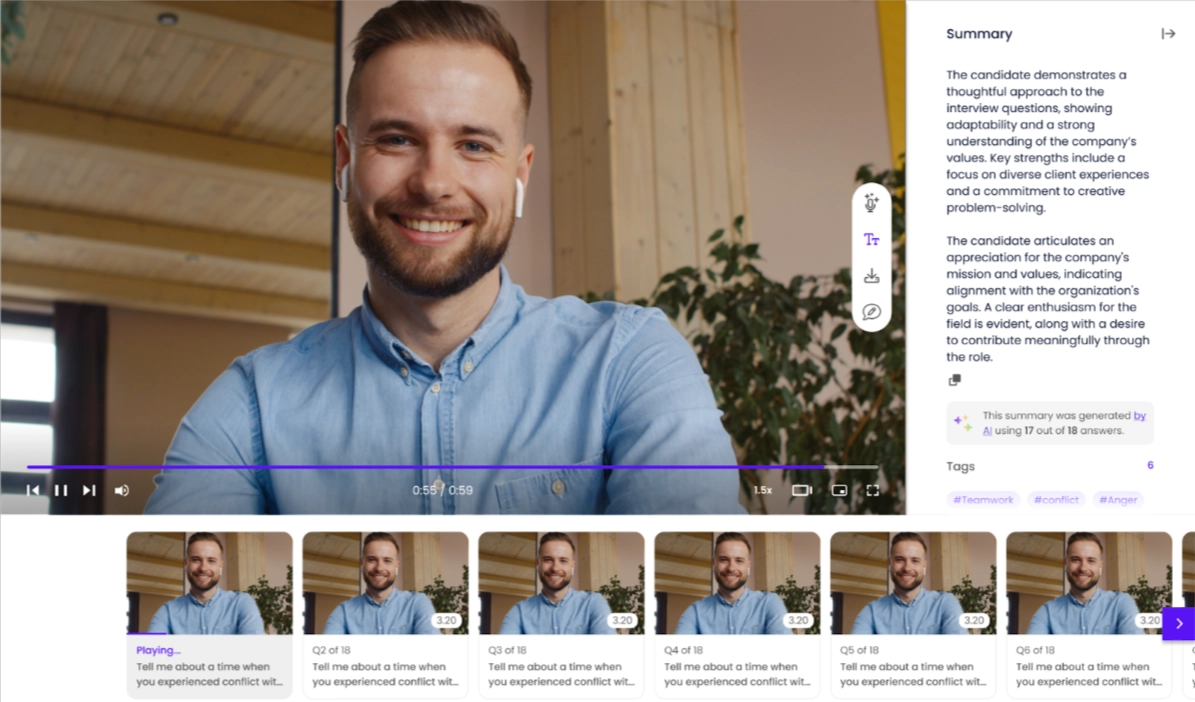
Your team then scores independently using customizable scorecards with criteria you define before review begins — communication quality, role-specific competencies, values alignment, or whatever dimensions matter most for this hire.
Blind scoring means no reviewer sees how others have rated until everyone has submitted, which removes the anchoring effect that skews group evaluation toward whoever spoke first.
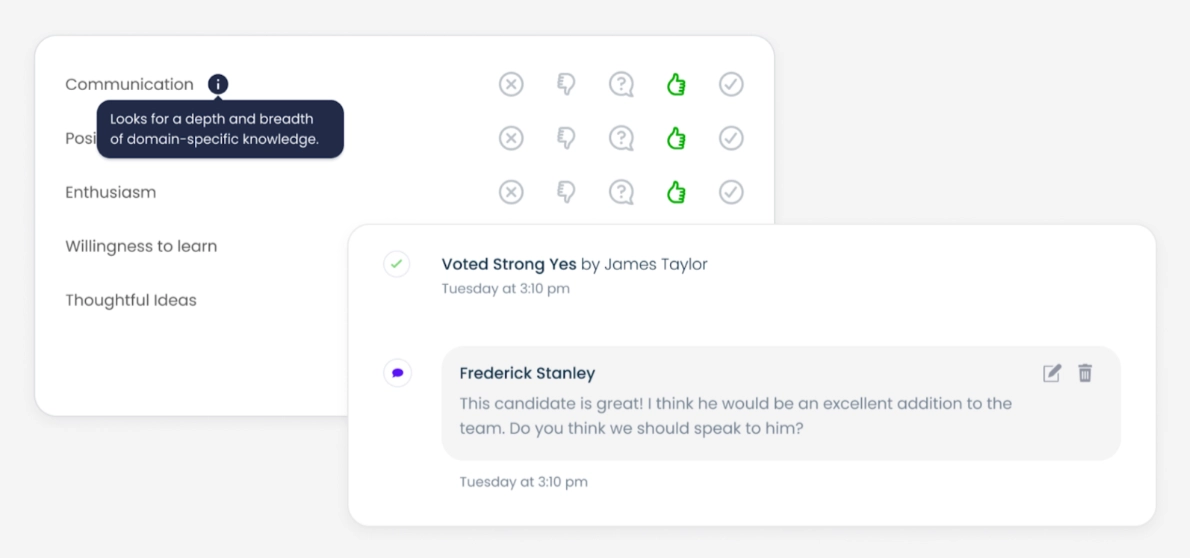
Additionally, timestamped comments let reviewers flag specific moments in a response for team discussion. Public share pages let you send candidate profiles to hiring managers who don't have a Willo account, without giving them access to the full platform.
That way, every score, every comment, every shortlisting decision is documented and attributable. When a hiring manager asks why you passed on someone, you have a clear, defensible answer.
Want to see how the full screening workflow works? Book a Willo demo
2. HireVue
Best for: Enterprise recruitment programs with dedicated TA teams that need AI-powered interview intelligence and a multi-modal assessment suite.
HireVue is an enterprise candidate assessment platform that combines video interviewing, AI-powered response analysis, game-based cognitive assessments, and conversational AI screening into a single system.
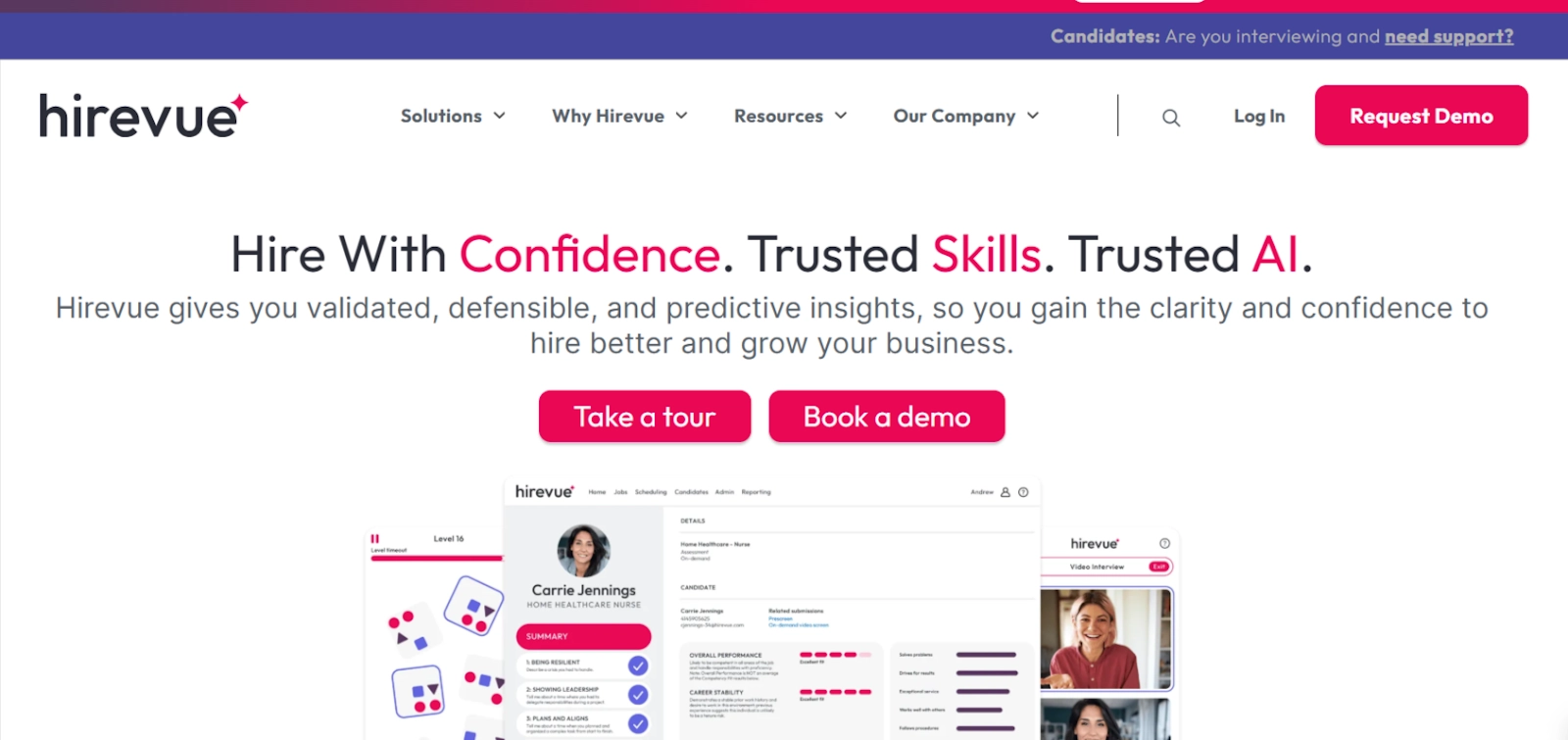
It's built for large organizations that need to consolidate multiple assessment modalities under one roof and run compliant hiring programs across multiple regions and business units simultaneously.
HireVue's core capabilities include:
- AI-powered video interview analysis that scores and ranks candidates before human review
- Psychologist-designed game-based assessments with published validation studies for legal defensibility
- Conversational AI screening for high-volume candidate intake
- 40+ language support for global enterprise programs
HireVue's approach is well-suited to enterprise organizations with dedicated TA teams, IT implementation resources, and the budget to match — pricing is custom and typically starts around $30,000/year.
For teams running on mid-market ATS platforms like Ashby, Lever, or BambooHR, integration compatibility is worth confirming before committing, as native connections are primarily built for enterprise HR stacks.
Similarly, teams who want human reviewers involved before a shortlist is formed will also want to understand how AI ranking shapes what reaches their desk.
Further reading: Best HireVue Alternatives Ranked | HireVue Candidate Experience Review | HireVue Review
3. Spark Hire
Spark Hire is a video-based candidate assessment platform built for small and mid-sized businesses that want to consolidate video interviewing, behavioral assessments, and applicant tracking into a single hiring stack without enterprise pricing or complexity.
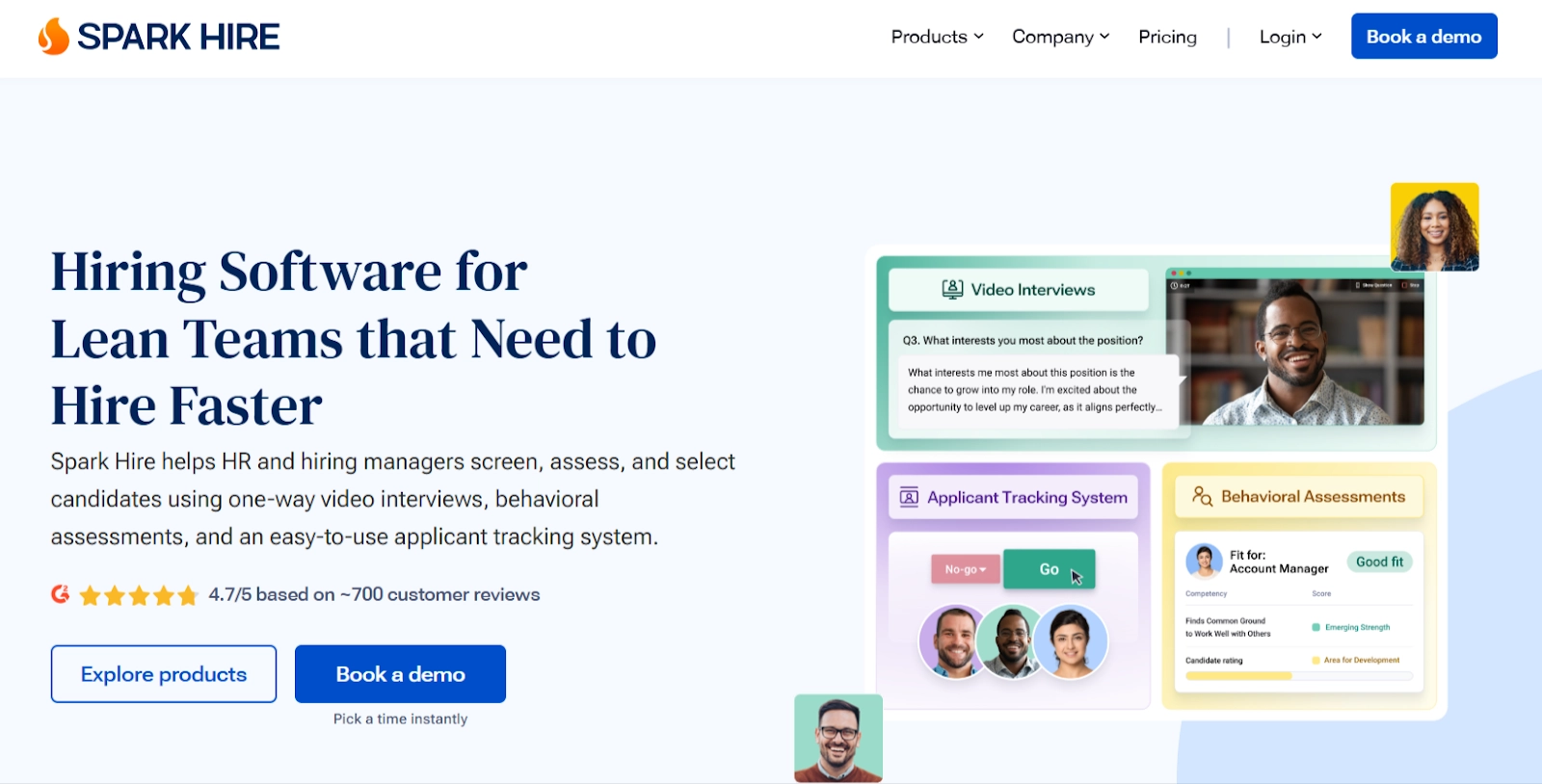
Spark Hire's core capabilities include:
- One-way async and live video interviews for flexible early and mid-stage screening
- Predictive behavioral assessments available on higher-tier plans
- Automated reference checks across 20+ languages
- 40+ native ATS integrations for mid-market hiring teams
Starting at $299/month, Spark Hire is positioned as a consolidation play for growing SMB teams — one platform handling what previously required two or three separate tools. That's a genuine advantage for teams dealing with vendor sprawl.
And for organizations whose primary need is high-volume async screening rather than a full hiring stack, the starting price point may be difficult to justify against more focused tools.
Further reading: Spark Hire Review | Spark Hire Alternatives
4. Hireflix
Hireflix is a one-way video interviewing platform built around a single, deliberate design principle: do one thing exceptionally well. Where most video screening tools bundle features across multiple assessment formats, Hireflix focuses exclusively on async video interviews — making it one of the fastest platforms to set up and one of the most consistently praised for candidate experience and ease of use.
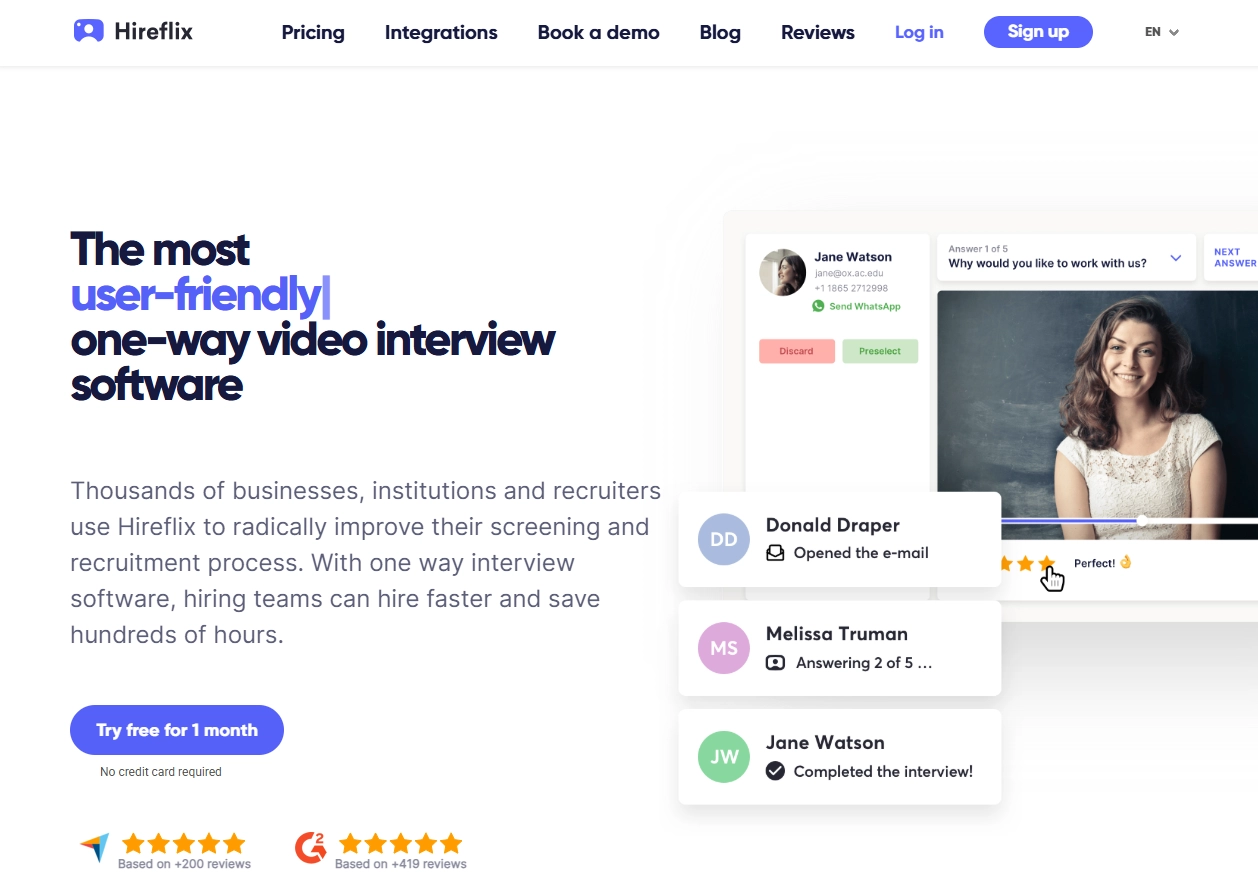
Hireflix's core capabilities include:
- One-way async video interviews with customizable thinking time, answer time, and retake settings
- Recruiter intro videos and branded candidate experience with custom domain support
- Automated interview invitations and reminders via email, SMS, and WhatsApp
- ATS integrations with Greenhouse, Lever, BambooHR, Ashby, Workable, and 50+ others via Zapier
Plans start at $75/month with all features included across every tier — no gating key functionality behind higher plans. That transparent, flat-rate structure makes Hireflix a strong fit for teams that want predictable costs and a tool that's live within minutes.
The tradeoff is intentional scope: Hireflix doesn't offer multi-format assessment, AI authenticity detection, candidate credentialing, or structured scoring tools. For teams whose primary need is frictionless async video at a low entry price, that's a reasonable trade. For teams who need to assess deeper than video alone, or verify that what they're seeing is genuine, a more comprehensive platform will be necessary.
Further reading: Hireflix Alternatives
5. TestGorilla
TestGorilla is a pre-employment skills testing platform built for teams that want quantifiable, test-based evidence of candidate ability before committing to an interview. Its hiring philosophy centers on supporting resume screening with objective assessment data covering technical skills, cognitive ability, personality traits, and soft skills from a single library of 400+ validated tests.
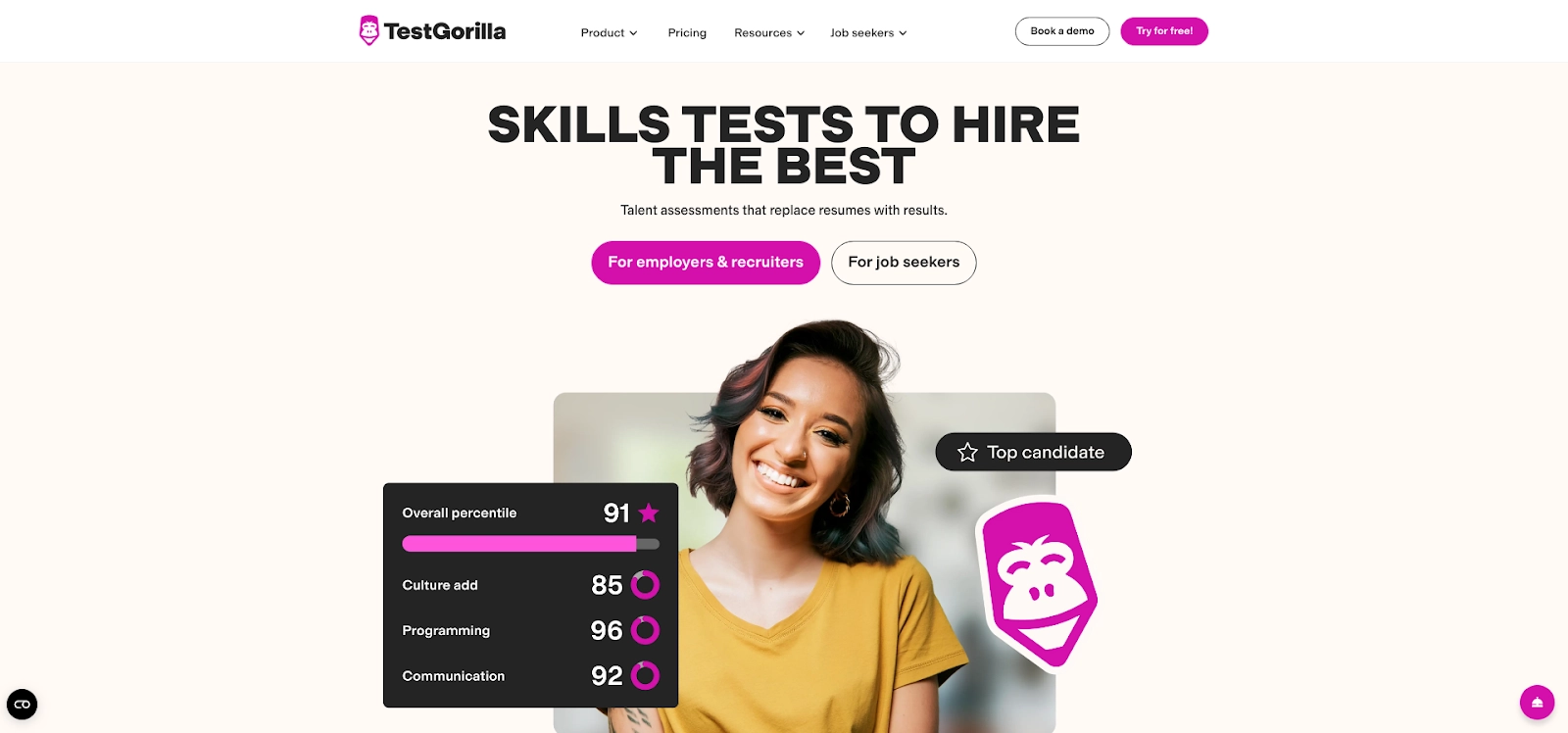
TestGorilla's core capabilities include:
- 400+ pre-built assessments spanning technical, cognitive, personality, and role-specific skills
- Custom question types including multiple choice, essay, file upload, and one-way video
- AI-assisted resume scoring and qualifying questions for early-stage filtering
- Anti-cheating features including screen monitoring and full-screen exit alerts
- Integrations with Greenhouse, SmartRecruiters, Lever, and Zapier
TestGorilla suits teams hiring across diverse role types who want a single platform covering both technical and soft skills assessment. Pricing starts at $135/month on annual plans scaling based on company headcount rather than hiring volume — which means costs increase as your team grows, regardless of how many roles you're actively filling.
Further reading: Testgorilla Alternatives | Testgorilla Pricing Concerns
6. HackerRank
HackerRank is a technical assessment platform built for engineering and data science hiring teams that need an objective, scalable way to evaluate coding ability before a single interview takes place. Its hiring philosophy is straightforward: replace resume-based guesswork with hands-on evidence of what candidates can actually build.
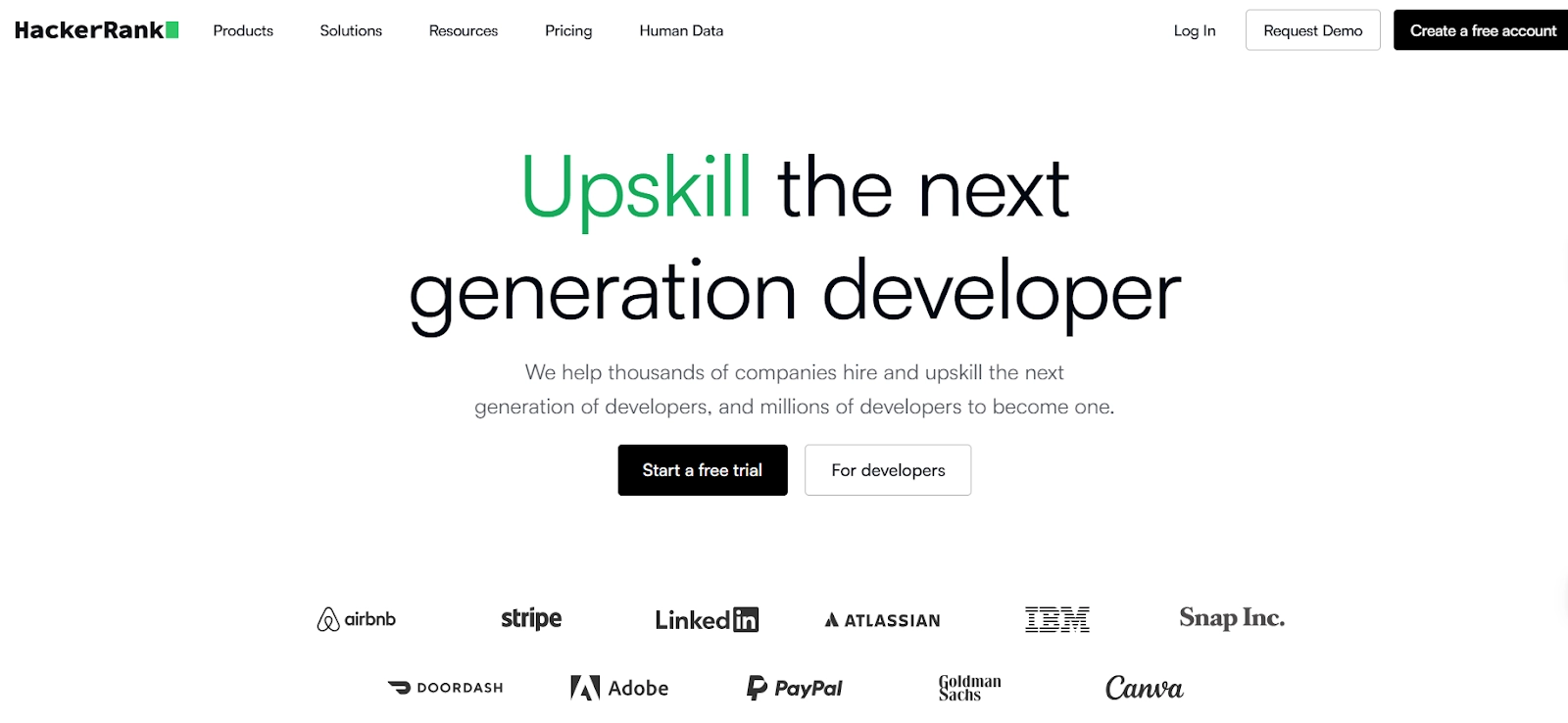
HackerRank's core capabilities include:
- Coding assessments across 55+ programming languages with a 4,000+ question library
- Live CodePair interviews for real-time pair programming sessions in later stages
- An AI Interviewer for automated technical screening at scale
- Role-specific assessment libraries for front-end, back-end, data science, and more
For engineering teams whose senior developers are regularly pulled into interviews with candidates who can't write working code, HackerRank solves a real and costly problem.
Starter plans begin at $199/month, with Pro plans around $449/month unlocking ATS integrations. HackerRank assesses technical skill only — pairing it with a communication-focused screening tool gives you a more complete picture of each candidate.
7. Xobin
Best for: AI-based candidate evaluation across tech and non-tech roles
Xobin helps recruiters screen, interview, and evaluate candidates with speed and accuracy. From software developers and designers to sales executives and customer support, Xobin ensures a seamless, bias-free hiring process. This makes it a perfect fit for modern hiring teams and enterprises seeking scalable, data-driven recruitment.
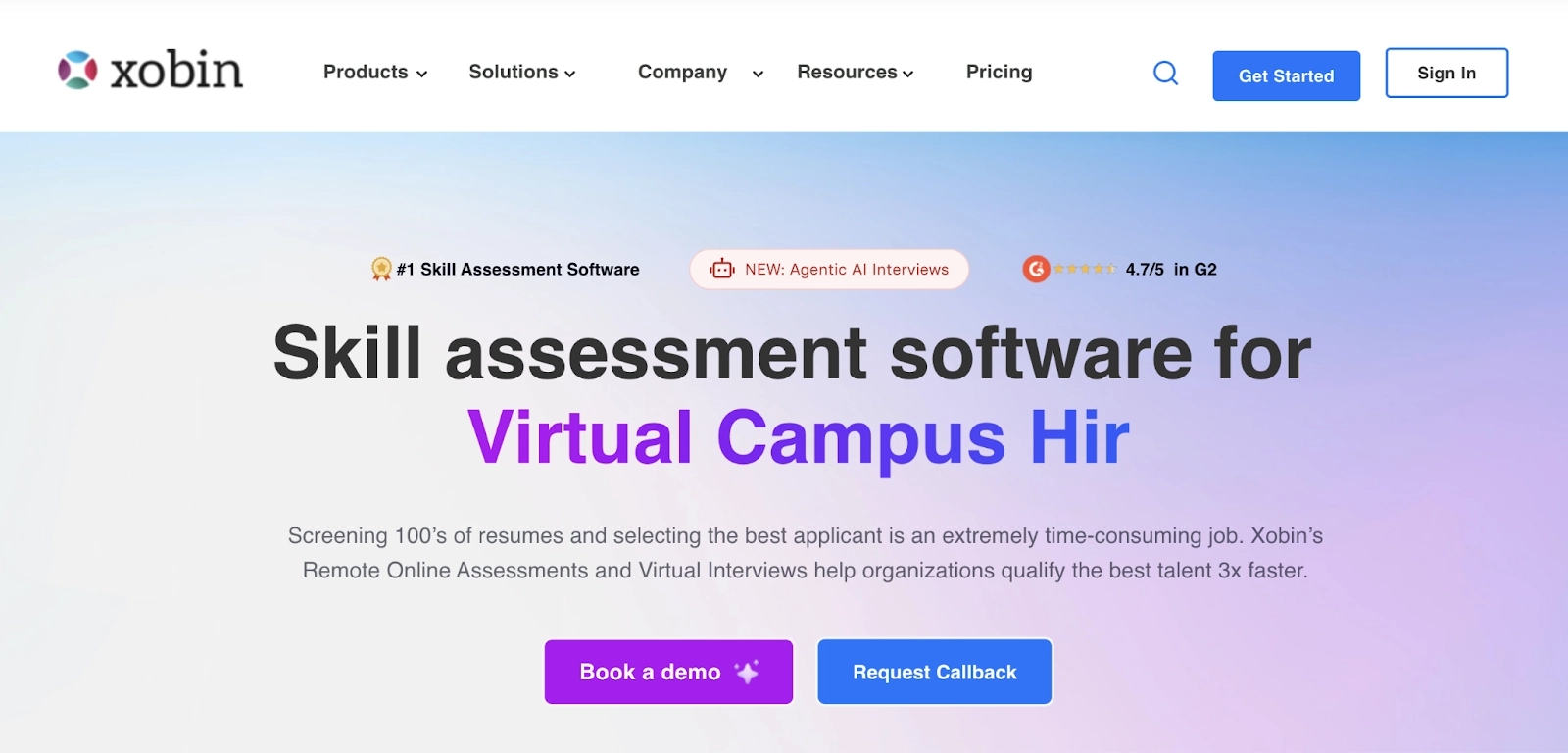
Xobin's core capabilities include:
- 3,400+ skills-based tests and 2,500+ role-based assessments covering technical and non-technical functions
- AI-powered video interviews with advanced proctoring and automated answer evaluation
- Game-based assessments and psychometric and culture-fit testing
- AI-analyzed communication across 15+ global languages
- White-labeled assessments and ATS and HR tool integrations
Xobin is a strong fit for enterprise hiring teams running high-volume recruitment across diverse role types, where standardized, bias-free evaluation at speed is the priority. It is not suitable for academic institutions or individual use, so teams outside an enterprise or agency context should factor that into their evaluation.
8. Criteria Corp
Best for: Organizations that need scientifically validated cognitive aptitude testing with published adverse impact studies and ATS compatibility across any hiring stack.
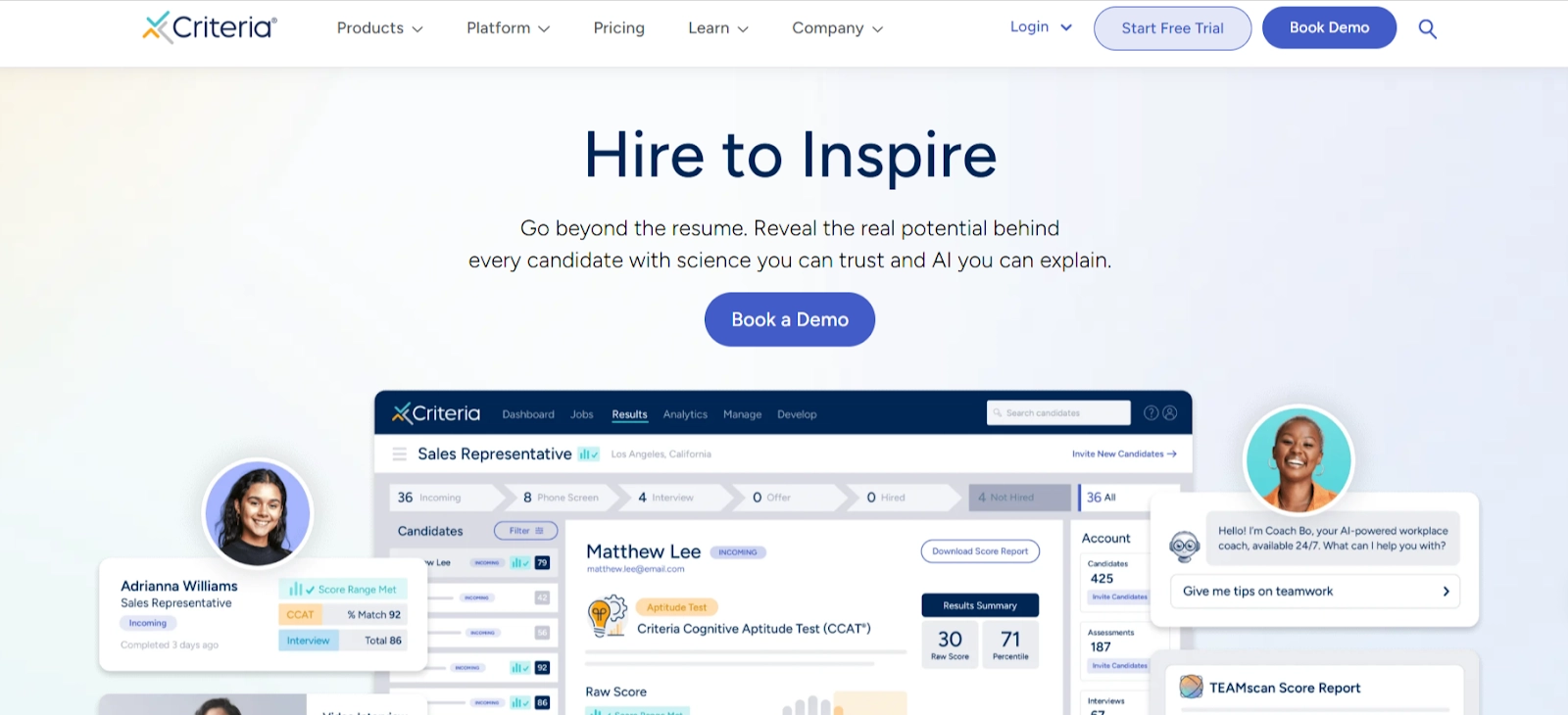
Criteria Corp is a pre-employment assessment platform that helps you make data-driven hiring decisions. It offers cognitive aptitude, personality, emotional intelligence, and skills-based tests to predict job performance and culture fit.
Criteria Corp's core capabilities include:
- 10 cognitive assessments including language-independent options for global programs
- Personality, emotional intelligence, and skills-based tests alongside cognitive measures
- Published adverse impact studies and APA and SIOP standards compliance
- 20+ named ATS integrations plus a universal browser extension for broader compatibility
Criteria is a strong fit for organizations running leadership pipelines, graduate programs, or any high-stakes hiring where cognitive screening methodology needs to survive a bias audit.
Pricing is available on request across three tiers. The setup and customization process can take time, and results typically require trained interpretation to apply meaningfully — teams without psychometric expertise internally may need additional support to get full value from the platform.
9. Pymetrics
Best for: Organizations running high-volume graduate or leadership hiring that need cognitive and behavioral assessment with documented bias reduction and strong DEI outcomes.
Pymetrics uses neuroscience-based games and AI to help you evaluate candidates’ cognitive, emotional, and social traits.
Its core premise is that non-verbal, reaction-time-based tasks can surface high-potential candidates from non-traditional backgrounds more equitably than verbal reasoning tests or resume screening.
So, instead of relying solely on traditional tests or resumes, it measures how people think and behave through short, game-like exercises to match them with roles where they’re likely to succeed.
Pymetrics' core capabilities include:
- 12 short game-based tasks measuring traits like attention, learning, and risk tolerance
- Custom job profile matching built from data on existing high performers
- 30-language support for global graduate and leadership programs
- Claimed 98% completion rate driven by the gamified, low-stakes format
Pymetrics works well for organizations running high-volume graduate or leadership hiring where identifying potential matters more than validating existing credentials, and where reducing adverse impact is a documented priority.
However, the game-like format may feel incongruous to candidates applying for senior roles, and the platform's scoring methodology, while validated, can be difficult to explain to hiring managers unfamiliar with neuroscience-based assessment.
10. Plum
Best for: Team-based roles where work style, collaboration preferences, and interpersonal traits directly affect performance, and where you want one reusable assessment across multiple role types and hiring stages.
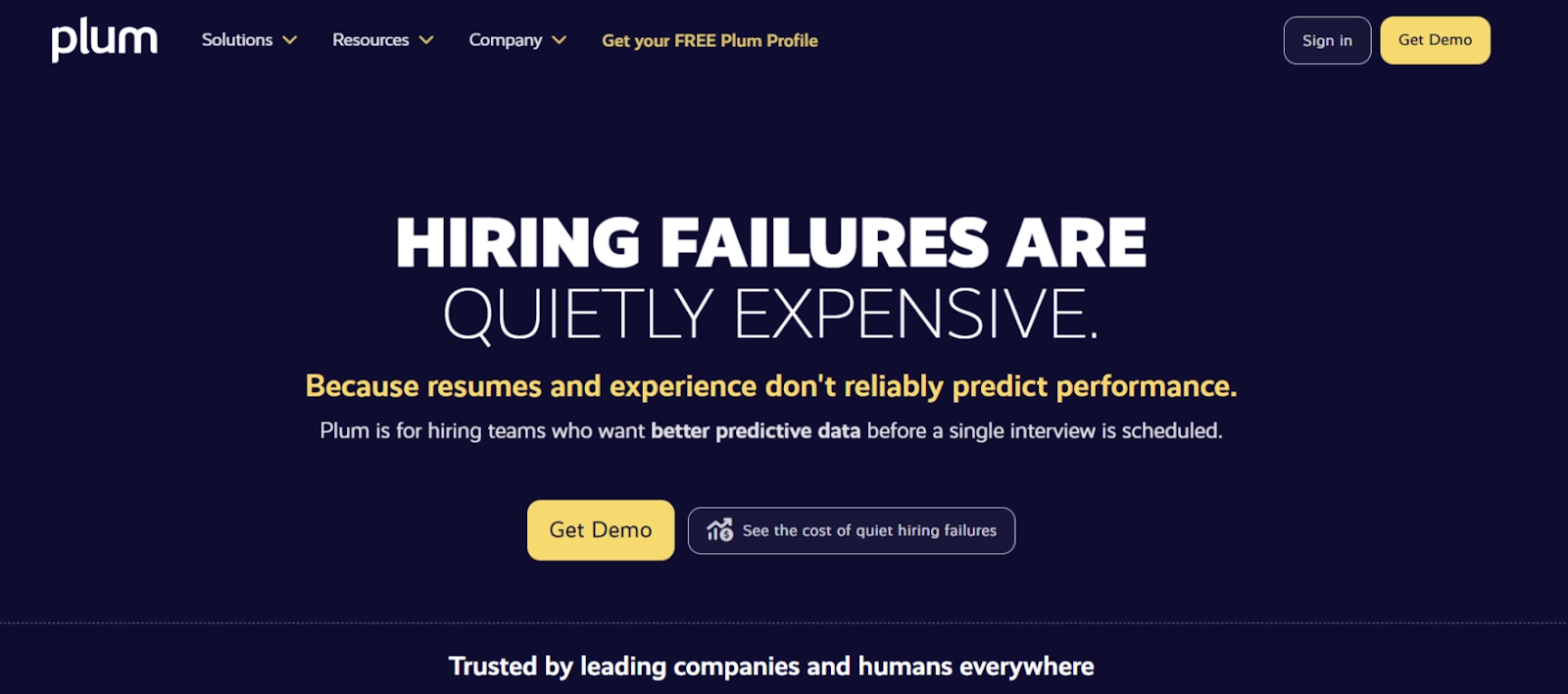
Plum is a psychometric assessment platform that measures personality, fluid intelligence, and social intelligence through a 25-minute forced-choice evaluation. Its hiring philosophy is built on matching people to roles where their natural traits are likely to translate into sustained performance — not just where their CV says they've worked before.
Plum's core capabilities include:
- Forced-choice methodology that resists social desirability faking common in self-report tests
- Automated Role Model tool built from 40,000+ real job profiles for benchmarking
- Auto-generated structured interview questions based on each candidate's assessment results
Plum works best as a supplementary layer for team-based roles where collaboration style and working preferences directly shape performance outcomes. It's most effective alongside skills or video assessment rather than as a standalone screen.
It is unsuitable for teams who are aware that overweighting personality data in hiring decisions carries documented bias risk, and the 25-minute assessment length may reduce completion rates in high-volume contexts. Pricing starts around $750/month based on third-party data.
11. Vervoe
Best for: Customer service, sales, and judgment-intensive roles where you need performance-ranked candidates before a single interview takes place.
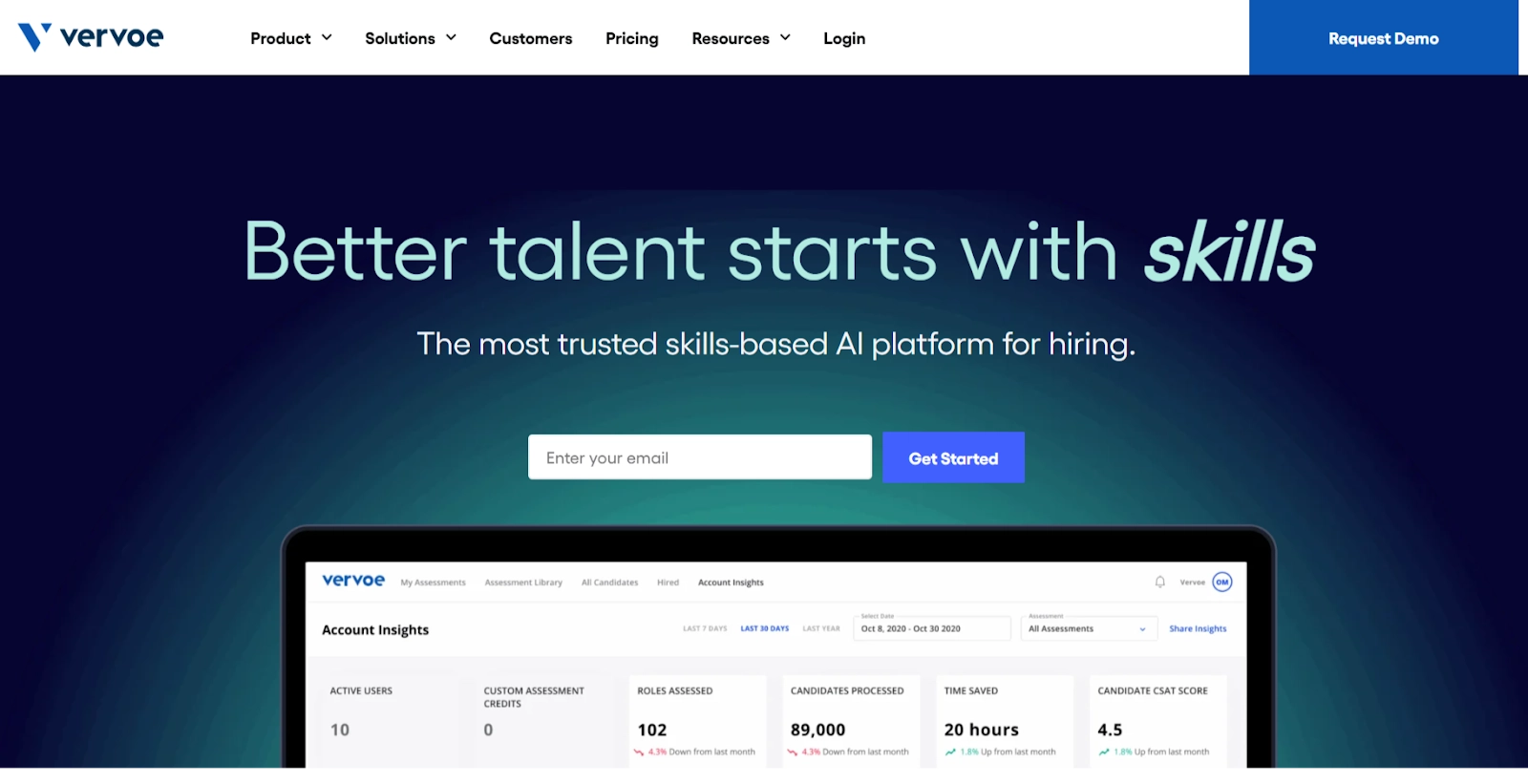
Vervoe is a job simulation platform that replaces early-stage interviews with role-specific performance tasks. Its hiring philosophy is direct: Vervoe believes the best predictor of how someone will do the job is watching them do the job.
Rather than asking candidates how they'd handle a situation, Vervoe shows you how they actually handle it. Vervoe's core capabilities include:
- 300+ expert-built assessment templates across customer service, sales, and operations roles
- 10+ question types including video, written responses, and coding challenges
- AI grading that ranks candidates by performance before human review
- Dynamic scenario generation designed to resist AI-assisted preparation
Vervoe is a strong fit for customer-facing, judgment-intensive roles where standard interviews give you no reliable read on how candidates perform under real conditions. A 7-day free trial is available, with enterprise pricing on request.
The AI grading accuracy sits at approximately 71-80% by the platform's own reporting, which means human review remains important for borderline decisions — teams should factor that into their workflow rather than treating ranked output as final.
12. Arctic Shores
Best for: Graduate programs, leadership pipelines, and volume hiring contexts where you need behavioral and cognitive insight that candidates cannot prepare for, game, or generate with AI.
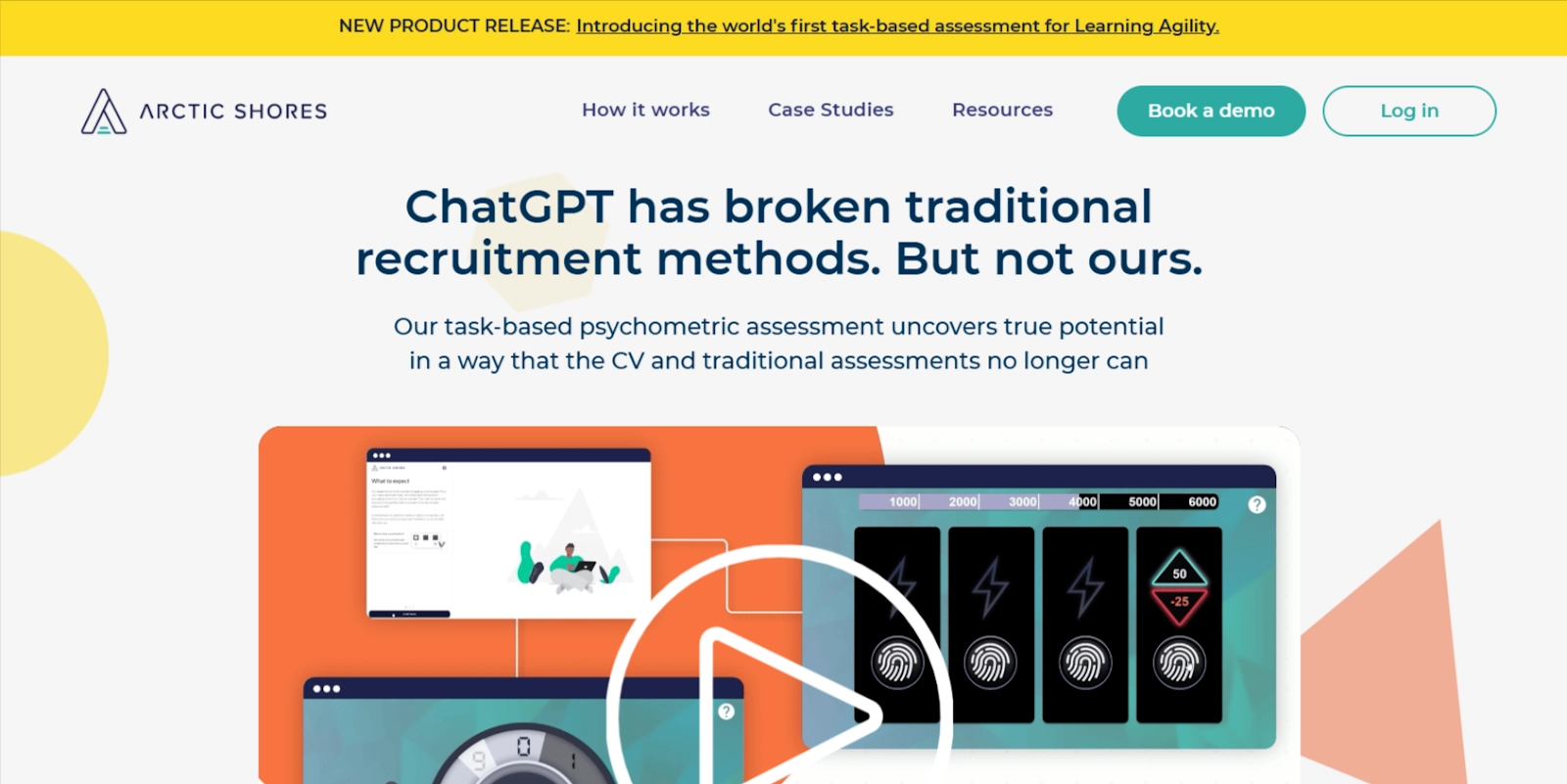
Arctic Shores is a gamified psychometric assessment platform developed in collaboration with the University of Oxford. It captures up to 12,000 behavioral data points per candidate through interactive neuroscience-based tasks, measuring 33 traits including cognitive ability, risk tolerance, and emotional regulation. Because there are no text inputs, the format is structurally resistant to AI-generated responses.
Arctic Shores' core capabilities include:
- Up to 10 gamified tasks with no questions to Google, memorize, or generate with AI
- Automated fit scoring from 0-100 with custom interview guides for hiring managers
- Native integration with Willo for combined behavioral and video screening workflows
- Validated against published psychometric standards developed with Oxford researchers
Arctic Shores is well suited to graduate programs, leadership pipelines, and volume hiring contexts where authenticity of response matters and traditional assessment formats are vulnerable to gaming. Pricing is available on request.
The platform's scoring methodology, while scientifically grounded, can appear opaque to candidates and hiring managers without psychometric training — and recruiters typically need onboarding time before they can apply results confidently.
How To Choose The Right Candidate Assessment Tool: Don't Start With Volume.
Now that you've seen the options, the next question is how to choose between them.
Most guides on this topic tell you to start by answering three questions: How many people are you hiring? What roles are you filling? What's your budget?
Those aren't bad questions. But they assume the core problem is one of scale and logistics — that if you just find a tool that handles your volume at the right price point, you'll hire better.
That assumption may have worked five years ago. It doesn't hold in 2026.
The teams struggling most with hiring today aren't struggling because they're bad at it. They're struggling because the environment has shifted faster than the tools designed to help them. Application volumes have surged. AI-generated resumes and responses have made traditional signals unreliable.
And most assessment tools on the market were built to solve a 2019 problem — how do we process more candidates faster — not the 2026 problem, which is: how do we know what we're seeing is real?
As a result, starting with volume as your primary filter doesn't answer that question. It just gets you to a bad shortlist faster.
What’s the right way to evaluate candidate assessment tools in 2026?
In 2026, before you evaluate any tool on this list against your volume, your budget, or your ATS, run it against these four criteria first.
1. Does it assess genuine capability or test-taking performance?
The best-performing candidates on most assessments aren't necessarily the best candidates for the role. They're the candidates who are best at taking that type of assessment. Keyword-optimised CVs, coached behavioural responses, and AI-assisted answers have all made it easier to perform well on conventional screening without the underlying capability to match.
Look for tools that assess candidates in formats that are difficult to prepare for and impossible to fully replicate with AI:
- Structured video responses with thinking time limits,
- Dynamic scenarios,
- Live coding environments with playback, or
- Behavioral tasks that capture decision-making in real time rather than self-reported descriptions of it.
Hiring tools that guarantee these criteria ensures your shortlist is a genuine reflection of your candidate pool or not curated set of responses optimised for your assessment format.
2. Does it verify that what you're seeing is genuine?
Assessment tells you how a candidate performs. It doesn't tell you whether that performance is authentic. In a hiring environment where AI can generate a compelling video response, produce a polished written answer, and coach a candidate through any question type your assessment uses, treating authenticity as someone else's problem is a meaningful risk.
According to the latest hiring research, 67.7% of talent leaders now rank behavioral interviewing with specific examples as their most reliable signal of genuine talent — precisely because it's harder to fabricate than static documents.
The tools that matter in 2026 are those that go further: detecting AI-generated delivery, validating credentials automatically, and confirming that the person submitting the assessment is who they claim to be.
3. Does it keep your judgment in the process?
78.7% of hiring professionals say final hiring decisions must remain human-led. Not one truly believes automation should handle all stages of the process. Yet the majority of AI-powered assessment tools are architected to do exactly that; score, rank, and surface candidates before a human has reviewed a single response.
The question to ask any vendor is a simple one: at what point does a human first see the candidate? If the answer is "after AI ranking," your shortlist has already been shaped by a model you didn't train, on criteria you can't fully interrogate, in ways you can't easily explain to a hiring manager.
Look for tools where AI summarises and informs, but where the evaluation and shortlisting decisions remain yours.
4. Does it reduce friction for candidates, not just for recruiters?
Drop-off rates during the assessment stage can reach 25-42% on platforms that require app downloads, complex logins, or lengthy assessments without clear context. Every friction point costs you candidates — and disproportionately costs you the candidates who have options and won't tolerate a clunky process.
A tool that saves your team time but drives away a third of your candidate pool before assessment even begins hasn't solved your problem. It's created a new one. Prioritise tools with browser-only access, mobile optimisation, 24/7 candidate support, and assessment lengths calibrated to the role — not to the vendor's feature set.
Screen Faster. Shortlist With Confidence. Only With Willo
Every tool in this guide will save your team time. But that’s just the baseline in 2026. The teams pulling ahead have stopped asking "how do we screen more?" and started asking "how do we hire faster with confidence?”
Willo is the answer. The only candidate assessment tool built to provide signal quality, human judgment, and verified authenticity rather than faster filtering. Structured async interviews that show you how candidates actually think. Automated verification that confirms who they really are. AI that informs every step while your team makes every call.
If that's the problem you're trying to solve, book a Willo demo and see how the full screening workflow runs for your hiring volume.