- Willo works best for screening large applicant pools against your own criteria, with seamless ATS handoff and AI scores your team can check before deciding.
- Consider HireVue and Spark Hire if you need broader hiring workflows including behavioral assessments.
- TestGorilla is the best alternative for standardized skills tests, while Hireflix fits straightforward one-way video interviews.
If you’re looking for alternatives to Willo, it’s most likely because you need live interviews, specialist assessments, or a platform that manages more of your hiring process. Or maybe you've read that Willo is mainly a video interviewing tool and aren't sure it can handle your screening needs.
Over the past 8 years of building Willo, I’ve sat on dozens of sales calls, talking with customers and often discussing Willo's competitors. The common thread is what they’ve read or heard about our platform beforehand; some of it is valid, but much is outdated or flat-out untrue.
Willo has changed considerably since we started with video interviews, and some information online just hasn't caught up. In this guide, we'll clear up those misconceptions and compare six alternatives, covering where they might be a better fit plus when Willo is still the best call.
Willo alternatives at a glance
Here's where the six main alternatives fit, with Willo included for reference.
What is Willo, how does it work, and who is it best suited to?
Willo is candidate screening software for high-volume hiring teams that want to build defensible shortlists: teams that don’t just need to manage high-volume hiring but also need the confidence to decide who should progress, why they should progress, and what evidence supports that decision.
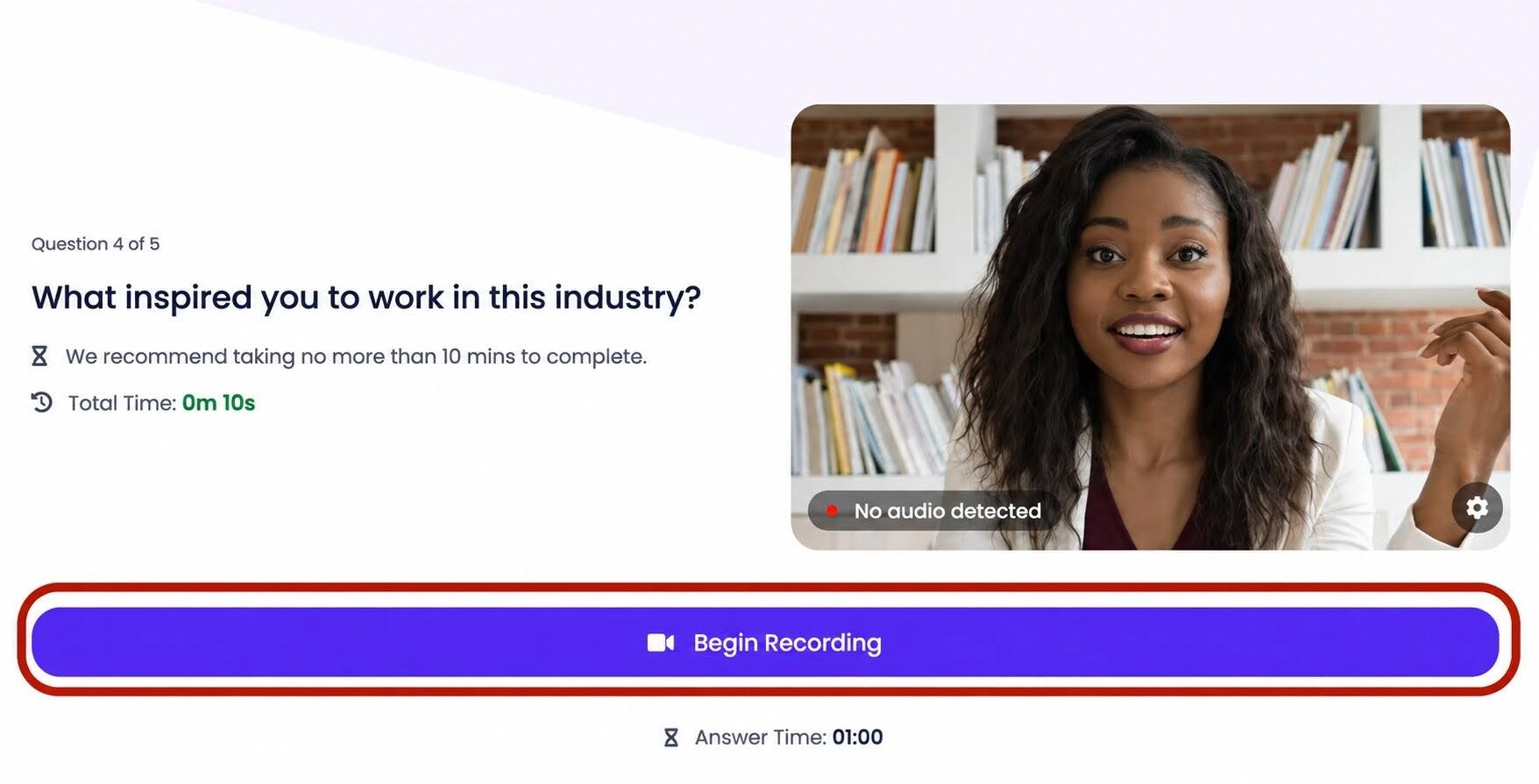
It’s built for the stage between application and live interview, when you have far more applicants than your team can meet and need a fair, repeatable way to decide who moves forward.
Here’s what that looks like in practice:
- Set the criteria that matter for the role: Upload the job description, your scoring framework, the must-haves and nice-to-haves, and your company’s values. Willo turns them into criteria you can review and edit so that you can assess candidates against your priorities, not generic scores.

- Build your assessment and collect responses in formats that suit the role: Create custom role-specific questions or start with one of 1,500 ready-made assessments. Every candidate answers the same questions in their own time, on any device, by video, audio, text, multiple choice, CV, or file upload, giving your team a consistent basis for review.

- Review the evidence with Insights: As responses come in, Willo Insights scores each one against your Blueprint and shows the evidence behind the score, including where a candidate clearly meets a criterion and where the evidence is thin. That way, your reviewers start with the candidates who best match your criteria. They can check every score against the original answer, instead of starting with a pile of unwatched recordings.
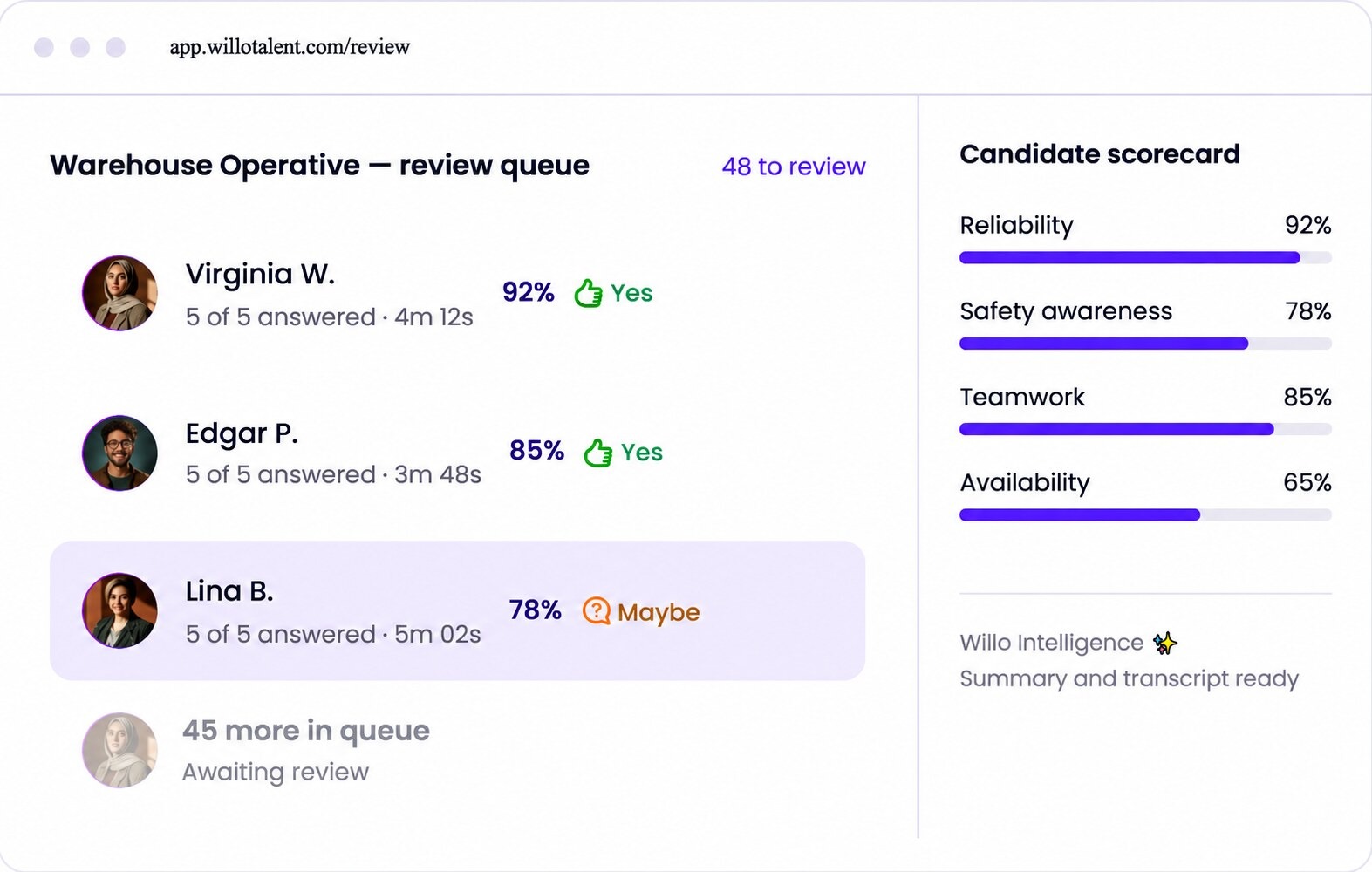
- Make the shortlist decision together: Hiring managers and recruiters rate responses using shared Scorecards, compare notes, and agree on who moves forward before anyone is invited to a live interview. The results flow back into your ATS, so the shortlist lands where your team already works.
Willo is best for you if your team:
- Receives more applicants than you can realistically interview, whether that’s a seasonal graduate intake or always-on hiring.
- Wants to assess candidates against their own criteria rather than a vendor’s predefined tests.
- Needs hiring managers across departments or locations to assess candidates in the same way.
- Already uses an ATS and wants a screening layer that connects to it.
If your priority is something else, such as live interview management, standardized skills testing, or proctored exams, one of the alternatives below may be a better fit.
See how Willo would handle your next role: start your free 14-day trial or book a demo.
3 things to know before comparing Willo alternatives (2026 update)
Some of what you’ll read about Willo on third-party sites describes an earlier version of the product. Before we compare the alternatives, here are the points people most often get wrong, and what Willo does today.
- Willo offers more than just video interviews
- Willo supports high-volume at enterprise scale– like HireVue
- Willo now supports CV screening
Willo offers more than video interviews
Willo started primarily as video interviewing software. Today, we’re candidate screening software focused on helping you review evidence and build stronger shortlists.
You can combine video, audio, text, multiple-choice questions, and file uploads in the same assessment. That means you can ask candidates to explain an answer, submit a work sample, or respond to a role-specific question without requiring everything to be recorded on camera.
You choose the format that best fits each question, so a sales candidate might pitch on video while an analyst uploads a work sample.
Madison Reed, for example, lets stylist candidates answer by audio or video. It doubled its candidate response rate and cut its time to fill from more than 30 days to 15 or fewer.
You can also use Willo as a screening layer alongside your ATS:
- Insights scores responses against your Blueprint and shows the evidence behind each score.
- RealTalk flags potentially scripted or AI-generated answers for closer review.
- Identity and right-to-work checks help you verify candidates.
- Transcripts and summaries help you find relevant evidence without watching every response in full.
So the useful question isn’t whether candidates can record a video. It’s whether your team can trust what it’s seeing and decide faster.
Willo supports high-volume and enterprise hiring.
Willo helps teams screen large applicant pools consistently across departments and connect screening to their existing hiring systems. Here’s how Willo handles each one.
- Handle high volumes without adding headcount. EDF UK’s nine-person recruiting team and its RPO partner use Willo to screen more than 17,000 applications and 400+ hires per season while spending half as much time on admin.
- Work consistently across teams: The City of Long Beach uses Willo across 23 departments, screening around 100 candidates per role. As part of its wider hiring improvements, the average timeline for unclassified roles fell from six to eight months to 90 business days.
- A fit with the systems you already use. Willo connects to 50+ native integrations, including Workday, SAP SuccessFactors, Oracle, iCIMS, and Greenhouse, plus an open API– and 5,000+ hiring tools through Zapier.
- Security and governance your IT team will ask about. Willo’s information security management system is certified to ISO 27001:2022; data is encrypted in transit and at rest, and the platform is GDPR compliant and aligned with WCAG 2.1 AA accessibility standards.
Smaller teams can use Willo too. Willo Lite costs $59 per live role per month with no contract and covers up to five live roles and five users at a time.
Willo now supports CV screening.
You can use Willo to screen CVs as part of your candidate screening process. Alongside assessment responses, CVs give your team another source of information to consider when deciding who should progress.
The difference is that Willo doesn’t treat resumes as the primary source of evidence. Willo assesses the CV against the same Blueprint as the candidate’s responses, so your team sees both side by side: what the candidate claims on paper, and how they explain their experience and approach in their own words.
Combined with identity checks and Real Talk detection, that gives you a fuller and more trustworthy picture of each applicant.
In-depth review of the six Willo alternatives for high-volume hiring
1. HireVue: Best for enterprise hiring and specialist assessments

HireVue is a strong Willo alternative for organizations that want a single enterprise suite for interviews, assessments, and candidate engagement. Where Willo focuses on the screening stage, HireVue combines video interviewing, assessments, and scheduling into a broader hiring platform. Its assessment options include specialist methods such as coding tests and job simulations.
HireVue may suit your team if you:
- Want live and on-demand interviews alongside assessments from one provider.
- Need specialist assessment methods, such as coding tests or job simulations.
- Are looking for a broader enterprise hiring suite.
Willo, on the other hand, may suit your team if you:
- Want a focused screening stage before live interviews.
- Already have an ATS and want screening to fit into your existing process.
- Need enterprise support while keeping the day-to-day screening workflow manageable.
For a closer comparison, read our HireVue vs. Willo comparison.
2. Spark Hire: Best for teams wanting a hiring platform with a built-in ATS

Spark Hire is a suitable Willo alternative for teams that want to manage more of the hiring process with one provider. It combines applicant tracking through Spark Hire Recruit, one-way and live video interviews, and predictive behavioral assessments, with automated reference checks also available.
These come as separate products or in bundles, so you can choose how much of the hiring process Spark Hire covers. Willo, by contrast, is purpose-built for screening.
Spark Hire may suit your team if you:
- Want applicant tracking, one-way and live video interviews, and behavioral assessments within one product ecosystem.
- Need an applicant tracking system to manage jobs, candidate pipelines, evaluations, and offers.
- Need automated reference checking as part of your hiring workflow.
Willo, on the other hand, may suit your team if you:
- Already have an ATS and want to add a dedicated candidate-screening layer.
- Need to assess large applicant pools consistently before deciding who reaches a live interview.
- Want candidates to provide evidence through video, audio, text, multiple-choice answers, resumes, and file uploads.
We've explored the differences in our Spark Hire vs. Willo comparison.
3. VidCruiter: Best for structured and custom interview management
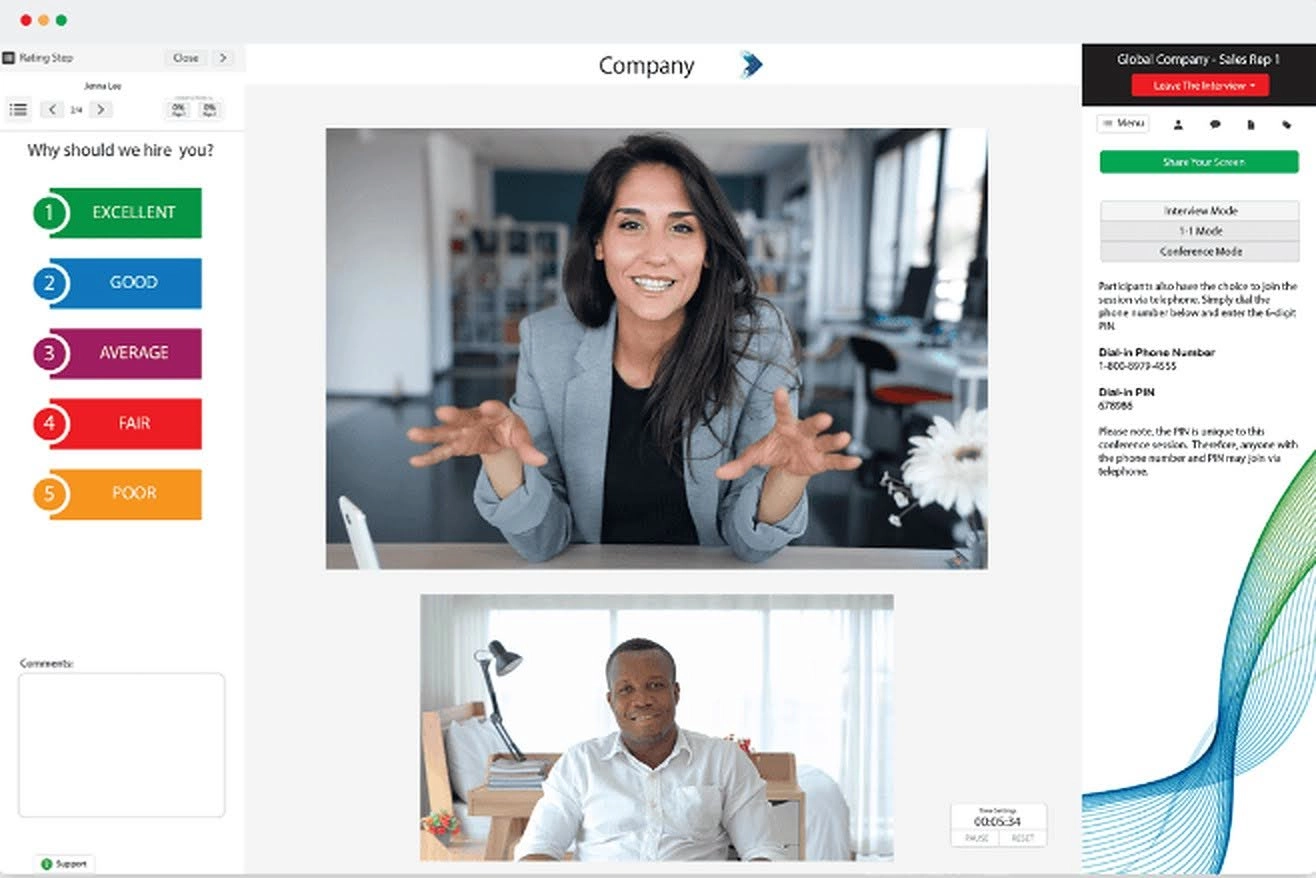
VidCruiter is a strong Willo alternative for organizations that need to manage interviews across several stages and formats. It supports pre-recorded, live, in-person, and hybrid interviews, with structured interview guides, standardized rating scales, and panel scoring. It also handles scheduling and reference checks and maintains documented interview records to support internal reviews and compliance requirements.
VidCruiter may suit your team if you:
- Run multi-stage interview processes involving many interviewers.
- Need the same structured approach for online and in-person interviews.
- Need detailed interview records for compliance or audit purposes.
Willo, on the other hand, may suit your team if you:
- Spend most of your time deciding who deserves an interview in the first place.
- Want a structured first stage where candidates can answer by video, audio, text, or file upload.
- Prefer to schedule live interviews in the calendar tools you already use.
Our VidCruiter vs. Willo comparison breaks down how the two platforms handle interviews and screening.
4. Jobma: Best for teams needing multiple interview formats and skills assessments

Jobma is a suitable Willo alternative for teams that want AI to play a bigger role in the interview itself. Alongside one-way, live, and panel video interviews, it offers an autonomous AI interviewer that asks follow-up questions based on each candidate’s answers. It also includes technical, cognitive, language, and game-based assessments, with AI and human proctoring.
Jobma may suit your team if you:
- Want an AI interviewer to run screening conversations and ask follow-up questions.
- Need live and panel interviews in the same platform as your screening.
- Want specialist assessments alongside interviews.
Willo, on the other hand, may suit your team if you:
- Want your team to set the questions upfront, so every candidate gets the same assessment.
- Prefer AI to support your team’s review rather than conduct the conversation.
- Want reviewers to rate responses independently and agree on a shortlist before a live interview.
Read our Jobma vs. Willo comparison to see how their interviewing approaches differ.
5. TestGorilla: Best for standardized skills assessments

TestGorilla is a strong Willo alternative for teams that want standardized skills tests at the center of screening. Its library of more than 350 tests covers technical skills, cognitive ability, personality, and job knowledge, and it adds AI interviews, coding challenges, job simulations, and anti-cheating controls. Because every candidate takes the same test, results are easy to compare across a large pool.
TestGorilla may suit your team if you:
- Need to measure specific, testable skills, such as coding or cognitive ability.
- Want to rank large applicant pools on standardized test results.
- Want to start on a free plan before committing.
Willo, on the other hand, may suit your team if you:
- Want questions built around your role, rather than standard tests you can’t edit.
- Want to hear how candidates explain their experience and approach in their own words.
- Want your team to review the evidence behind each score against your own criteria.
The two can also work together. Toyota Great Britain, for example, uses abstract reasoning tests to identify top performers, then uses Willo to assess depth, values fit, and potential.
You can explore the assessment and screening differences in our TestGorilla vs. Willo comparison.
6. Talview: Best for interviews, assessments, and remote proctoring

Talview is a suitable Willo alternative for organizations that need tightly controlled remote assessments. Alongside live and asynchronous video interviews, it offers coding, cognitive, behavioral, and language assessments, with AI-powered proctoring, identity verification, and secure browser controls that help detect impersonation and misconduct.
Talview may suit your team if you:
- Run high-stakes remote tests where proctoring is essential.
- Need secure browser controls that lock down the testing environment.
- Assess large, geographically dispersed applicant pools through exam-style tests.
Willo, on the other hand, may suit your team if you:
- Want confidence that candidates are genuine without asking them to install a secure browser.
- Want structured screening questions rather than exam-style tests.
- Prefer published pricing, including pay-per-role Willo Lite, to a minimum candidate commitment.
For a closer look at screening and remote testing, check our Talview vs. Willo comparison.
Other Willo alternatives to consider
Two more options are worth a look, particularly for smaller teams with specific screening needs.
Hireflix: Best for straightforward one-way video interviews

Hireflix is designed for teams that only need one-way video interviews. You can set questions, control response times and retakes, and let candidates record their answers on their own schedule. Plans include unlimited interviews and user seats, so you won't have to worry about those limits as hiring picks up. The main limitation is its focus on video. You'll need another tool if you want to assess candidates through other formats.
Truffle: Best for small businesses that want resume screening and interviews in one tool
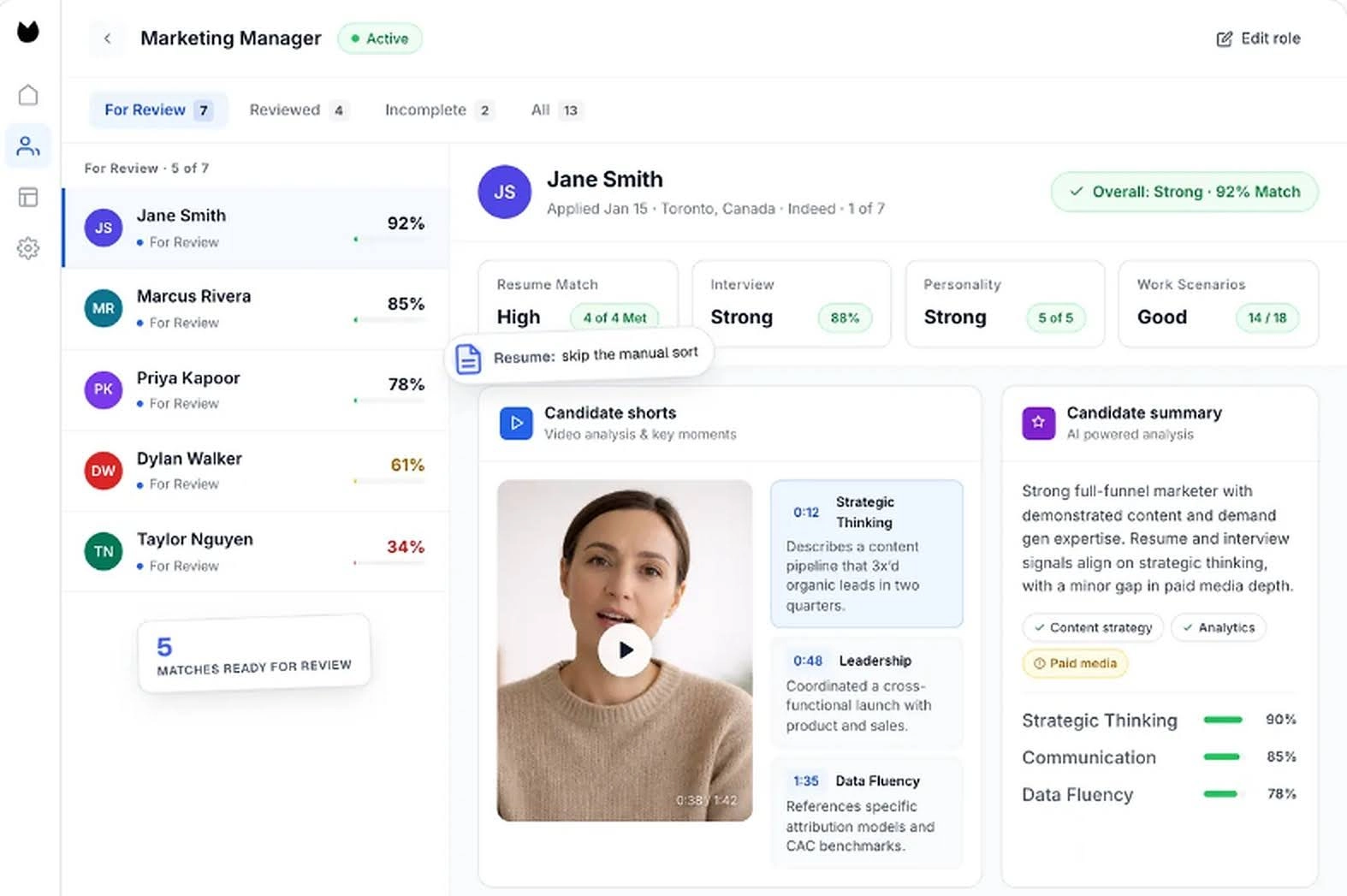
Truffle is aimed at small businesses that want more than resume reviews. It lets you put resume screening, recorded interviews, and assessments into a single workflow, then uses AI to score candidates against your requirements.
Pricing is credit-based, so costs depend on which screening methods you use and how many candidates you assess. If you’d rather build questions around your own role criteria and check the evidence behind each score, Willo takes that approach.
How to choose the right alternative for your hiring process
Start with the part of your hiring process you want to improve. Before comparing platforms, think about what your team needs the software to handle.
Consider your hiring volume.
Think about how many candidates you screen, how often you hire, and how many roles are open at once. Check whether the platform can handle seasonal spikes without additional costs or manual work. A smaller recruiting team handling thousands of applications may have very different needs from a large organization hiring steadily throughout the year.
Decide what evidence you need from candidates.
Are you testing technical ability, evaluating communication skills, or checking how candidates meet your job requirements? Specialist talent assessment tools may be better for standardized skills testing. For roles where you need to evaluate responses against your own criteria, look for a screening tool that gives reviewers access to the evidence behind each assessment.
Check which interview formats you'll use
Not every team needs live interviews, AI-led conversations, and recorded responses in one system. Think about which formats belong in your screening process and which are better handled later. A focused video tool may be enough for straightforward screening, while a broader suite can help when your workflow includes several interview formats.
See how your team will review candidates together.
Ask for a demonstration of what happens after candidates submit their responses. Can reviewers score independently, leave comments, revisit answers, and agree on a shortlist? Check how permissions work when hiring managers from different departments need access.
Look at how it works with your ATS.
Already using an ATS? Find out whether you can keep it. Ask which candidate records, invitations, scores, and status updates move between the systems. A claimed integration doesn't always mean every part of the workflow is connected.
Check what you'll pay as hiring changes.
Look at the limits behind the price. How many candidates, active roles, and reviewers are included? Will assessments, integrations, or additional users cost extra? Check what happens to your bill during a busy hiring period, particularly if the platform charges per candidate or assessment.
FAQs
Find the right fit for your screening needs.
Before choosing a platform, think about what happens after candidates complete their assessments. Does your team have enough information to decide who should progress? And can reviewers explain why they made that decision?
That's what we've built Willo to help with. Whether you're screening hundreds or thousands of applicants, you can give every candidate a consistent assessment and give your hiring team the evidence it needs to make confident shortlist decisions.
Start your free 14-day Willo trial and see how it works with your next hiring campaign.